Mineral Resources Development Company has appointed Howard Lole as a director of Gas Resources Gigira Limited, completing the Tuguba region’s required representation on the board responsible for PDL 1 interests in the PNG LNG Project.
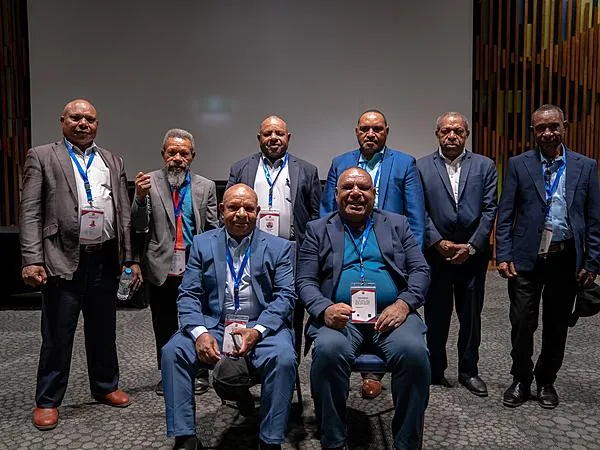
The Board of Mineral Resources Development Company (MRDC) announced on September 7, 2026, that Lole had been appointed director-elect representing the Tuguba region of Petroleum Development License 1 (PDL 1) on the board of Gas Resources Gigira Limited (GRGL).
GRGL is the corporate trustee responsible for managing the equity and royalty benefits associated with PDL 1 in the PNG LNG Project.
Lole’s appointment follows an election held on August 21 at the Port Moresby Hilton Hotel, where he and fellow candidate Eric Kambe finished tied. MRDC said the appointment was made after the prescribed electoral process and a comprehensive review by its board.
The MRDC Board determined that the applicable legal, governance and procedural requirements had been met before making the appointment in its capacity as shareholder.
Completing Tuguba representation
MRDC said the appointment was made pursuant to Section 176 of the Oil and Gas Act, the MRDC Authorization Act, the GRGL Constitution, the relevant Trust Deed and the GRGL Directors Election Rules.
Lole becomes the second director representing the Tuguba region on the GRGL Board, joining Libe Parindali, Thompson Mugubigo, Philip Iruka, Thomas Dara Ola and Larry Andagali, who represent landowner interests on the board.
His appointment brings more than 25 years of experience across the public and private sectors, including the financial, industrial and mining industries.
Lole currently serves as a director of Tolu Minerals Ltd and the TWL Group. He holds a degree in Mining Engineering from the PNG University of Technology and a master's degree in Engineering from the University of New South Wales, specializing in Mining Industry Management.
MRDC managing director Augustine Mano congratulated Lole on his election, highlighting his experience across business, oil and gas and mining.
“Mr. Lole comes to the board with extensive experience in business, the oil and gas, and mining sector,” Mano said.
“He is a well-respected leader in the industry who joins a board blessed with a wealth of experience which will add value to the governance and direction of the company going forward.”
Election process and outstanding benefits
Mano also thanked Kambe and the PDL 1 Tuguba Clan Chairmen for their participation in the electoral process.
He acknowledged the Independent Observers, Chief Magistrate, Electoral Commission and National Petroleum Authority for their involvement in the process, which MRDC said helped ensure the clan chairman and director elections were conducted fairly and transparently.
The appointment also comes as MRDC works toward distributing outstanding PDL 1 royalty and equity benefits to beneficiaries.
Mano reiterated MRDC’s commitment to having the outstanding benefits paid during 2026. The company will now begin work to establish the sub-clan bank accounts, which MRDC described as the final stage before royalty and equity benefits can be distributed to beneficiaries.
The completion of the Tuguba directorship requirement therefore marks both a governance milestone for GRGL and another step in the process toward distributing outstanding benefits from PDL 1.
Papua New Guinea’s Independent Consumer and Competition Commission (ICCC) has launched its Corporate Plan 2026–2030, setting out the regulator’s strategic priorities for strengthening consumer protection, competition enforcement and economic regulation over the next five years.
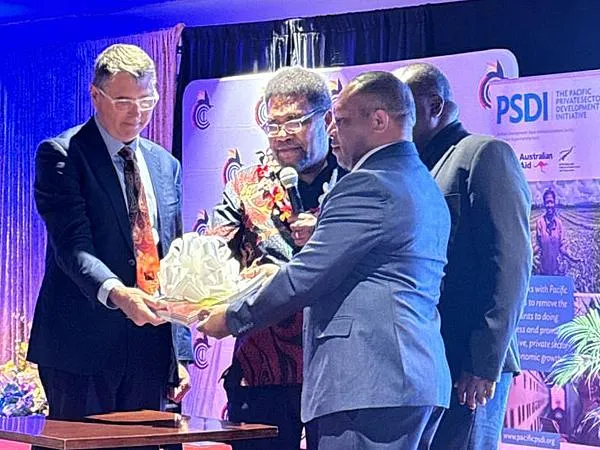
Minister for Rural and Economic Development Joseph Lelang and ICCC Commissioner and Chief Executive Officer Roy Nunts Daggy launched the plan at APEC Haus in Port Moresby on August 28, 2026.
Developed with support from the Pacific Private Sector Development Initiative (PSDI), the plan establishes the ICCC’s strategic direction around four goals that reflect its statutory responsibilities to protect consumers, promote competitive markets and regulate industries and prices where necessary.
The plan also sets an institutional objective for the ICCC to strengthen its performance and establish itself as an independent and expert economic regulator.
In the plan’s introduction, Daggy said the Corporate Plan sets out how the Commission will use “its independence, expertise, and integrity to deliver real results” for families, businesses and communities across Papua New Guinea.
Focus on women and disadvantaged consumers
The Corporate Plan places particular emphasis on improving outcomes for women consumers, women traders and disadvantaged groups.
The ICCC has committed to targeted outreach and investigator training, while also identifying opportunities within its regulatory functions to support greater participation by women in the formal economy.
The focus recognizes that effective consumer protection and competition regulation require the regulator to engage with different groups across the economy and ensure that information, enforcement and regulatory services are accessible to those who may face greater barriers to participating in formal markets.
Preparing for expanded competition and consumer powers
The five-year strategy also anticipates changes to the ICCC’s mandate under a new competition and consumer protection bill currently undergoing consultations with PSDI support.
The proposed legislation is expected to expand Papua New Guinea’s consumer protection framework through fair trading provisions covering misleading and deceptive conduct, as well as guarantees concerning the quality of consumer goods and services.
The Corporate Plan therefore commits the ICCC to preparing for the new law before it comes into force. This includes strengthening enforcement capability, developing guidance materials and expanding consumer and trader education.
The approach is intended to ensure the Commission is equipped to implement and enforce the expanded framework once the legislation is passed.
Strengthening the regulator
The Corporate Plan links the ICCC’s external regulatory responsibilities with efforts to strengthen its own institutional capability.
The Commission’s four strategic goals provide the framework for its work over the 2026–2030 period, covering its responsibilities for consumers, competition and regulated sectors while also addressing the organizational performance needed to carry out those functions effectively.
The emphasis on independence, expertise and integrity reflects the ICCC’s stated ambition to be recognized as an expert economic regulator capable of delivering practical outcomes for consumers, businesses and communities.
The launch was attended by ICCC Associate Commissioner, Non-Resident Marcus Bezzi, Associate Commissioner, Resident Jack Timi, and other officials.
The new Corporate Plan provides the ICCC with its strategic roadmap as Papua New Guinea prepares for potentially significant changes to its competition and consumer protection regime.
Ok Tedi Mining Limited has declared a K450 million interim dividend for the first half of 2026, while the company says its mining and processing operations remain uninterrupted despite prolonged dry weather affecting water levels on the Fly River.
Ok Tedi Mining Limited (OTML) has declared a K450 million interim dividend for the first half of 2026, with the payment distributed between the State and Western Province landowner interests according to their respective shareholdings.
Managing Director and Chief Executive Officer Kedi Ilimbit said K300 million would be paid to Kumul Minerals Holdings Limited on behalf of the State, representing its 60% shareholding, while K150 million would be paid to the Mineral Resources Development Company (MRDC), which manages the interests of Ok Tedi's landowners.
“The K450 million interim dividend benefits all Ok Tedi shareholders,” Ilimbit said. “While K300 million is payable to the State, K150 million is equally payable through MRDC on behalf of the people of Western Province.”
He said the full dividend distribution should be accurately reflected, noting that the payment demonstrates Ok Tedi's continuing contribution to the PNG economy and provides direct benefits to both the State and Western Province through their respective shareholdings.
Operations remain uninterrupted
The dividend announcement comes as Ok Tedi manages logistical challenges caused by prolonged dry weather in Western Province.
Ilimbit said water levels on the Fly River are lower than normal, but mining and processing operations remain uninterrupted.
The company has implemented contingency measures to maintain supplies of fuel, consumables, equipment and other critical operational requirements. It has also introduced alternative logistics arrangements to maintain continuity and minimise potential disruption to its operations.
Ok Tedi is continuing to monitor river conditions and adjust its logistics planning as required.
“While the dry weather is presenting logistical challenges, our teams have implemented contingency measures to ensure operational continuity,” Ilimbit said. “Mining and processing operations continue, and our focus remains on maintaining safe and reliable operations while delivering value to our shareholders, communities and the country.”
The company said it remains focused on maintaining safe, responsible and sustainable operations while managing the logistical impacts of the dry conditions.
Ok Tedi will continue to provide updates on operational matters as required and said it remains committed to transparent engagement with shareholders, stakeholders and communities.
State-owned copper and gold producer
Ok Tedi operates an open-pit copper, gold and silver mine in the Star Mountains of Western Province and is majority state-owned. The company has operated in the region for more than 40 years and exports copper concentrate to smelters and ore refineries in Japan, the Philippines, Indonesia, South Korea, India and Germany.
The company said its operations have contributed to development in Western Province through direct and indirect employment, royalties, compensation payments and business opportunities.
Ok Tedi is also expanding its footprint into Milne Bay Province through its acquisition of Gallipoli Exploration Limited, a wholly owned subsidiary of Australian mining company Kingston Resources Limited, for the Misima mine.
Papua New Guinea has cleared the way for 5G mobile services, with the National Information and Communications Technology Authority confirming that spectrum in the 2.6 GHz and 3.5 GHz bands is now available for licensing to qualified mobile operators.
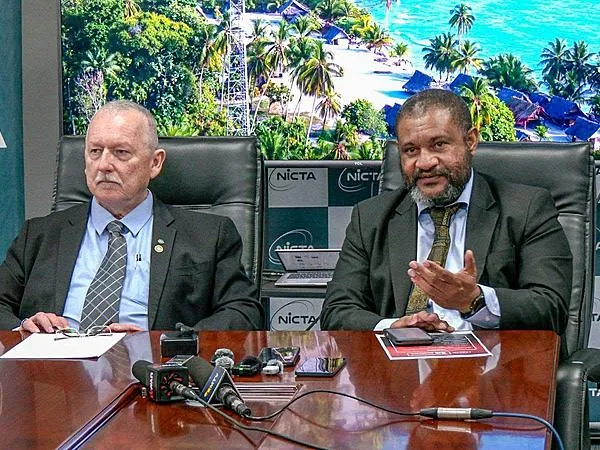
NICTA board chairman Brian Riches said the decision marked a milestone for the country’s digital economy and followed several years of legal, technical and regulatory work by the telecommunications regulator.
The regulator said it had completed the required process for the internationally harmonised 2.6 GHz and 3.5 GHz bands, which are classified as High Demand Spectrum. Making the bands available is intended to give operators the regulatory certainty needed to plan, invest in and deploy next-generation mobile networks and services.
The move puts Papua New Guinea among more than 150 countries that had launched or soft-launched 5G networks by July 2026, according to the Global Mobile Suppliers Association.
NICTA said the decision followed detailed spectrum planning and market assessments, industry consultation, reviews of international best practice and an assessment of future demand for mobile broadband services. The licensing framework is intended to support investment and innovation while safeguarding competition.
The allocation of both bands reflects NICTA’s commitment to technological neutrality, allowing operators to deploy advanced 4G and 5G services according to their business and customer requirements.
Larger contiguous spectrum assignments are expected to improve network efficiency, reduce deployment costs and increase capacity, while enabling faster speeds, lower latency, greater reliability and improved customer experiences.
Rollout obligations
Vodafone PNG has committed to providing 5G services across the National Capital District and at least one additional city within 18 months. Its rollout targets include reaching at least 20 per cent of Papua New Guinea’s population within 36 months and at least 30 per cent within 60 months.
NICTA has also negotiated public-interest obligations requiring each mobile operator acquiring High Demand Spectrum to extend 4G coverage to 20 new sites identified under the Universal Access and Service programme.
The requirements are intended to ensure that the benefits of the new spectrum extend beyond major urban centres and help reduce the country’s digital divide.
NICTA said the High Demand Spectrum is being licensed for a fair and reasonable fee, with revenue from the licences intended to support initiatives that extend digital connectivity to underserved and unserved communities.
The approach is designed to allow the commercial development of advanced mobile services in urban areas to help fund greater connectivity opportunities in rural and remote parts of Papua New Guinea.
The regulator will independently audit rollout commitments, coverage obligations and quality-of-service requirements. Operators that fail to meet their obligations could face enforcement measures and penalties.
Boost for digital economy
NICTA said improved connectivity would support the Government’s broader digital transformation agenda, including the digitisation of public services, e-government platforms, digital education, healthcare and private-sector innovation.
For businesses, improved connectivity is expected to increase productivity, support cloud computing and digital services, facilitate electronic commerce and strengthen links with regional and global markets. For consumers, it is expected to improve access to information, education, financial services, entertainment and government services.
The rollout of 5G is therefore expected to have an impact beyond mobile phone services, supporting the wider development of Papua New Guinea’s digital economy.
For investors, NICTA said the licensing framework also demonstrates the country’s commitment to modern digital infrastructure and a stable and predictable regulatory environment.
Next phase of spectrum reform
The licensing announcement marks the beginning of a new phase for NICTA, rather than the end of the regulatory process.
The authority will work with licensed operators to facilitate deployment, monitor compliance with licence conditions, oversee spectrum utilisation and network performance, and ensure rollout commitments are achieved within agreed timeframes.
NICTA will also continue with wider spectrum reforms, including making additional High Demand Spectrum bands available where appropriate, supporting satellite and non-terrestrial network services, expanding opportunities for licence-exempt and Wi-Fi services, and keeping PNG’s spectrum management framework aligned with international best practice and future technological developments.
Riches said the licensing decision marked an important stage in Papua New Guinea’s digital development.
“Today marks an important milestone in Papua New Guinea’s digital journey,” he said, adding that NICTA remained committed to affordable, reliable and inclusive connectivity for Papua New Guineans wherever they live.
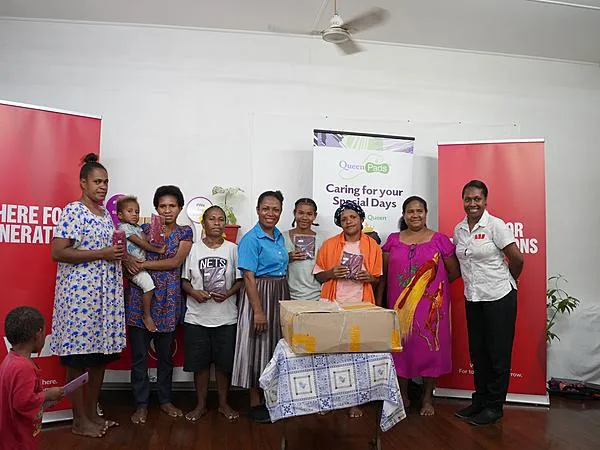
Port Moresby, 2 September 2026. Westpac PNG has partnered with 2025 Westpac Outstanding Women Awards (WOWA) Overall Winner Anne-Shirley Korave and her organization, Queenpads, to donate 80 reusable menstrual hygiene packs to Haus Ruth, a safe house in Port Moresby supporting survivors of gender-based violence and their children.
The donation was delivered as part of a community support session at Haus Ruth, including an education session led by Anne-Shirley with survivors and staff, the handover of Queenpads packs, and a practical financial literacy session delivered by Westpac PNG.
Haus Ruth, run by City Mission PNG, provides meals, accommodation and essential support for survivors of gender-based violence and their children. The donation recognizes that access to menstrual hygiene products is a practical need that can affect dignity, confidence, wellbeing and participation in daily life.
Westpac PNG chief executive Andrew Cairns said the initiative reflected the purpose of the WOW Awards by extending support beyond recognition and into practical community action.
“The WOW Awards are about backing women who are already making a difference in their communities,” Mr Cairns said. “Through this donation to Haus Ruth, we are proud to support Anne-Shirley and Queenpads in responding to a real community need. This initiative brings together practical support, education and financial literacy in a way that recognizes the dignity and wellbeing of women and girls.”
Anne-Shirley Korave, 2025 WOWA Overall Winner and founder of Queenpads, said improving access to menstrual hygiene products was an important part of supporting women and girls.
“When women and girls have access to the products and support they need, it helps protect dignity, build confidence and support wellbeing,” Ms Korave said. “We are grateful to partner with Westpac PNG to provide these packs to Haus Ruth and to spend time with survivors and staff through an education session that responds to a practical need.”
As part of the visit, Westpac PNG also delivered free, practical financial literacy training for Haus Ruth staff and survivors, supporting financial confidence and capability alongside health and wellbeing outcomes.
Through the WOW Awards and partnerships with women-led organizations such as Queenpads, Westpac PNG continues to champion women leaders and contribute to practical initiatives that create positive social impacts across Papua New Guinea.
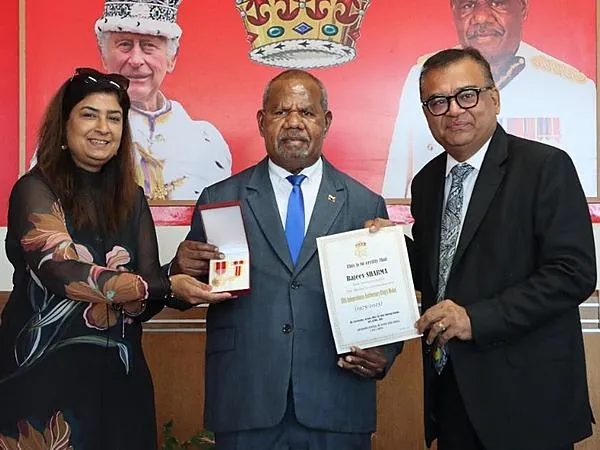
National Superannuation Fund (Nasfund) chief executive officer Rajeev Sharma has received the 50th Anniversary King’s Medal in recognition of his 25 years of service in finance, accounting and corporate leadership in Papua New Guinea.
Governor-General Grand Chief Sir Bob Dadae, representing King Charles III, presented the medal to Sharma at Government House in Port Moresby.
During the presentation ceremony, Sir Bob acknowledged Sharma’s contribution to Papua New Guinea and his continuing role in advancing retirement security and strengthening confidence in the country’s superannuation industry.
Sharma said he was honored to receive the national recognition and dedicated the award to his family and the staff of Nasfund.
“I want to say thank you to the people of Papua New Guinea for accepting us in PNG. I am very honoured and humbled to receive this award on behalf of my wife and children,” Sharma said.
“This award is not only for me but for all the Nasfund staff who work tirelessly with me. I really appreciate this.”
The commemorative medal was approved by King Charles III as part of Papua New Guinea’s 50th Independence Anniversary celebrations. It recognizes Papua New Guineans and others who have made significant contributions to the country’s development over the past five decades.
Nasfund leadership
Nasfund chairman Christopher Elphick congratulated Sharma, describing the presentation as a proud moment for the superannuation fund.
“It is a proud moment for Nasfund to see our CEO receive such a distinguished national honour through the Governor-General, His Excellency Grand Chief Sir Bob Dadae, on behalf of His Majesty King Charles III,” Elphick said.
Elphick said Sharma had strengthened Papua New Guinea’s superannuation sector while promoting sound governance and delivering long-term value for Nasfund members.
“Rajeev’s commitment to strengthening Papua New Guinea’s superannuation sector, promoting sound governance, and delivering long-term value for our members has made a lasting impact,” he said.
The recognition reflected Sharma’s professional achievements as well as his dedication to serving Papua New Guinea and the wider Pacific region, Elphick said.
He said Sharma’s leadership had helped position Nasfund as one of Papua New Guinea’s most respected and trusted financial institutions.
On behalf of the Nasfund board, management and staff, Elphick thanked Sharma for his leadership, dedication and service.
If you want, I can also make this more PNG Post-Courier-style, business-news style, or a sharper Reuters/MLex-style version.
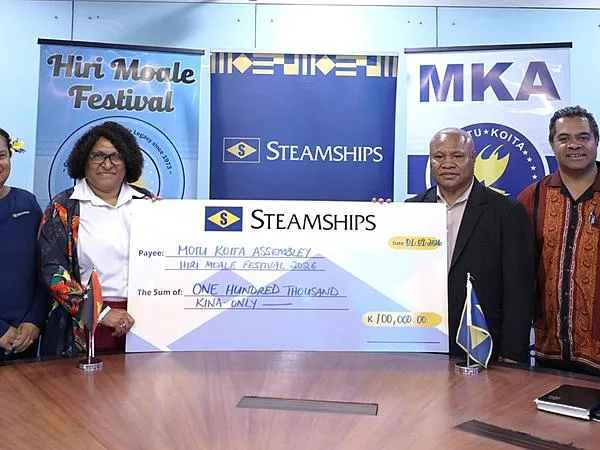
Steamships has committed PGK100,000 as a Gold sponsor of the 2026 Hiri Moale Festival, reinforcing the company’s support for the Motu Koita communities and the preservation of Papua New Guinea’s cultural heritage.
The sponsorship reflects Steamships’ long-standing relationship with the Motu Koita people, whose communities are closely connected to the company’s operations, employees, customers and investments across the National Capital District.
Steamships managing director Chris Daniells said the company’s history was closely linked to the Motu Koita people through the sea and the historic Hiri trading voyages.
“The story of the Motu Koita people and the story of Steamships are connected by the sea,” Daniells said.
He said the Hiri voyages established traditions of trade, trust and cooperation that continued to reflect values shaping Steamships during its 108-year history.
The sponsorship also recognises the historical relationship between Steamships and the Motu Koita people, including the early partnership between company founder Captain Algernon Fitch and Captain Pipi Gari of Elevala.
Gari became the first qualified Papuan ship captain in 1929. Steamships said generations of Motu Koita men and women had also contributed to the company over the years.
The sponsorship forms part of Steamships’ corporate social responsibility strategy, which focuses on strengthening relationships and creating long-term value in the communities where the company operates.
Chairman of the Motu Koita Assembly Russell Simon Wavik welcomed the contribution, saying it recognised the enduring partnership between the company and the community.
“We appreciate Steamships' Gold Sponsorship of the 2026 Hiri Moale Festival and acknowledge the enduring relationship between Steamships and the Motu Koita people,” Wavik said.
The Hiri Moale Festival is one of PNG’s major cultural events and celebrates the history of the Hiri trading voyages, which connected Motu and Gulf communities through traditional maritime trade.
Steamships said it looked forward to supporting the 2026 festival and joining the Motu Koita community in celebrating the cultural tradition.
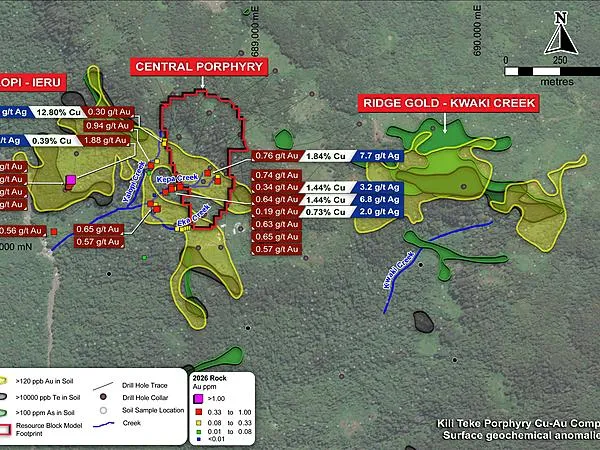
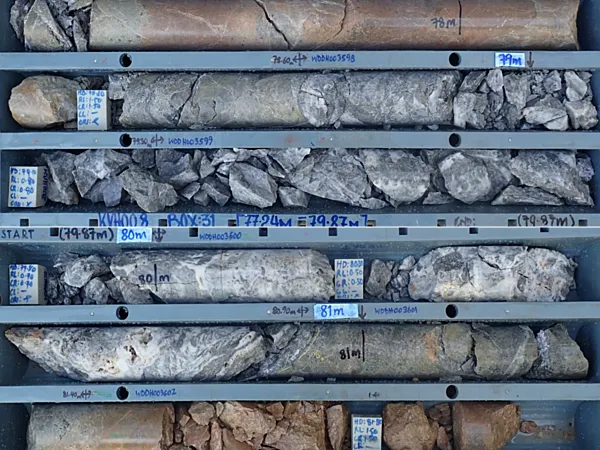
South Pacific Metals Corp has identified new copper-gold targets outside the existing mineral resource at its Kili Teke project in Hela province, Papua New Guinea, after surface sampling returned up to 12.8 percent copper, 0.30 grams of gold per tonne and 104 grams of silver per tonne.
The company said the results from its first-phase exploration programme strengthened evidence of mineralisation west and east of the Central Main Porphyry, which hosts a 237-million-tonne inferred resource. The resource contains 0.34 percent copper and 0.24g/t gold, equivalent to about 4.2 million ounces of gold equivalent.
The highest-grade surface result came from an outcrop sample collected from a massive sulphide unit along a north-south fault contact on the western margin of the Central Porphyry. The unit has been mapped for more than 200 metres and remains open.
South Pacific Metals said eight samples collected across part of a historic trench also confirmed mineralisation, averaging 0.36 percent copper and 0.72g/t gold.
The company is focusing its exploration on two areas outside the current resource: the Ieru-Yalopi zone west of the Central Main Porphyry and the Ridge Gold-Kwaki Creek area to the east.
At Ieru-Yalopi, the company is investigating a large gold-in-soil anomaly, the historic Ieru trench and the newly mapped massive sulphide unit. The historic trench returned 132 metres at 0.55 percent copper and 0.6g/t gold, including 27 metres at 0.97 percent copper and 1.25g/t gold.
At Ridge Gold, historic soil sampling returned gold values of up to 9,390 parts per billion, or 9.39g/t, within a strong gold-in-soil anomaly. The company said elevated tellurium could indicate an alkalic, Porgera-style target.
A 205-sample soil grid has been completed at Kwaki Creek, while mapping has identified additional altered and mineralised outcrops, including monzonite. The company said the target area is larger than previously understood.
South Pacific Metals exploration manager Octavio Garcia said the western and eastern targets were developing differently but were both providing useful information for exploration.
“On the western side we have strong outcrop exposure in the creek beds, including sulphide mineralisation we can trace along strike for a couple of hundred metres,” Garcia said.
He said Ridge Gold would be defined more by soil geochemistry than surface exposure, with the company now working to develop a properly ranked, structurally informed drill-target inventory.
South Pacific Metals is also assessing mineralisation at depth beneath the existing Central Main Porphyry resource.
Historical drilling by former operator Harmony Gold covered about 37,500 metres, with the existing resource defined within the upper portion of the porphyry centre. The company said several long and high-grade historical intersections extend below the current resource model, with some holes ending in mineralisation.
One historical hole, KTDD022, returned 187 metres at 1.10 percent copper equivalent, including 0.62 percent copper and 0.44g/t gold, from 501 metres.
Another hole, KTD025, intersected a high-grade skarn zone running 8 metres at 13.31 percent copper and 11.75g/t gold from 920 metres.
The company said these historical results point to potential mineralisation beyond the boundaries of the current resource model and will form part of its deeper targeting work.
South Pacific Metals has a further 205 soil samples and 60 rock samples awaiting assay. It is also undertaking geochemical analysis, structural work, mapping and interpretation, alongside planned LiDAR and airborne magnetic surveys to support drill planning.
The company expects to define drill-ready targets in the two priority areas by the end of October 2026, ahead of a planned maiden diamond drilling programme.
South Pacific Metals chief executive Timo Jauristo said the company's first exploration programme in almost a decade was providing evidence that Kili Teke could extend beyond the historically drilled Central Porphyry.
The company said the current programme represents the first systematic exploration at Kili Teke in about 10 years.
Great Pacific Gold Corp has confirmed broad, shallow gold mineralisation at the Kavasuki target in Papua New Guinea's East New Britain province, identifying a priority near-surface exploration window across its Wild Dog Project.
The company said its maiden diamond drilling programme at Kavasuki returned multiple broad gold intersections, including 58.90 metres grading 2.43 grams of gold per tonne (g/t) in hole KVH-01. The programme comprised 12 diamond holes totalling 1,844.8 metres and was designed to confirm historical mineralisation, test the continuity of the Kavasuki vein system and investigate historical geophysical anomalies.
Other significant results included 18.10 metres at 2.08g/t gold in KVH-01, 38.40 metres at 2.07g/t in KVH-03 and 59.90 metres at 1.38g/t in KVH-04. Higher-grade intervals included 1.20 metres at 17.93g/t and 2.20 metres at 15.78g/t.
The company said the strongest gold mineralisation identified to date is concentrated from surface to about 70 metres vertical depth, while the principal Kavasuki vein structure continues below the mineralised horizon.
Great Pacific Gold said drilling had refined its understanding of the Kavasuki system and established an elevation-controlled window for prospective mineralisation.
The Kavasuki target is a structurally controlled epithermal quartz-vein system within the 15-kilometre Wild Dog structural corridor. Drilling confirmed the historically reported mineralised intervals and demonstrated continuity of the main vein structure at depth. Better grades, generally between 1g/t and 2.5g/t gold, were concentrated within the shallow window, with narrow higher-grade zones reaching about 18g/t.
Great Pacific Gold said the deeper holes tested levels below the more favourable mineralised window and returned low concentrations of gold and associated pathfinder elements.
The company also revised its interpretation of historical three-dimensional induced polarisation, or 3DIP, data. It now believes the principal chargeability response at Kavasuki is associated with disseminated pyrite in an interbedded volcanic-siltstone sequence rather than directly with gold mineralisation.
The reinterpretation is expected to provide a new filter for ranking geophysical targets elsewhere along the Wild Dog corridor.
Great Pacific Gold chief operating officer and vice-president exploration Callum Spink said the maiden Kavasuki programme had achieved its core technical objectives.
“Our maiden programme at Kavasuki delivered broad zones of shallow gold mineralisation, including 58.9 metres at 2.43 g/t gold, and achieved its core technical objectives by confirming historical mineralisation, demonstrating continuity of the vein system at depth and resolving the principal source of the historical chargeability response,” Spink said.
He said the results provided the company with a clearer understanding of where higher grades occur and how to target the system, which would also help rank targets across the broader Wild Dog corridor.
Great Pacific Gold plans to undertake further surface work at Kavasuki, including priority trenching south of the drilled area where higher elevation could preserve the prospective mineralisation window.
The company will also conduct trenching and detailed mapping north towards Kavasuki Creek, including follow-up work on a known 3-4-metre-wide vein about 600 metres north-north-east of the drilled area that returned 4.4g/t gold. A future drill test is also planned for the ridge between Sinivit and Kavasuki, combining the revised 3DIP interpretation with the newly defined elevation window.
With Kavasuki drilling complete, Great Pacific Gold said its two diamond drill rigs had moved to Magiabe and Mengmut, ahead of work on the Morgan and EK targets.
The company also disclosed corrections to previously reported Kavasuki results following final database validation. The revised results supersede earlier releases, although Great Pacific Gold said no change was material to its interpretation of the results.
Great Pacific Gold cautioned that the reported drill intercepts represent core lengths and that true widths are not yet known. It also said some final multi-element assay results remain pending and that geological interpretations may be revised as additional data become available.
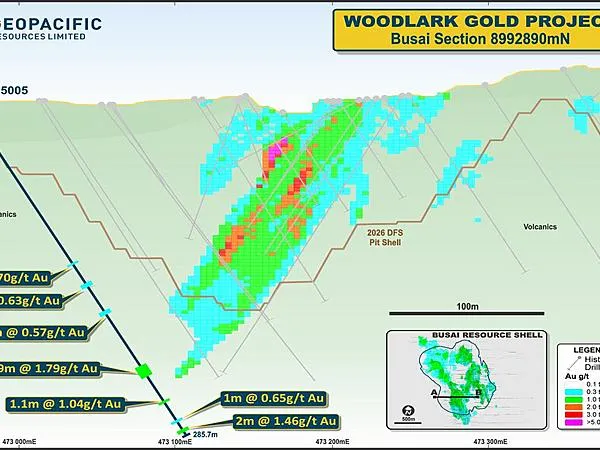
Geopacific Resources Ltd has reported a series of significant high-grade gold intersections from its latest drilling programme at the 1.98-million-ounce Woodlark Gold Project in Papua New Guinea, highlighting potential for resource growth and an extension of mine life.
The Australian-listed company said results from 29 reverse-circulation and diamond drill holes confirmed mineralisation across several near-mine and regional targets, including Wayai Creek, Little MacKenzie, Woodlark King, Busai Deeps and Great Northern. The drilling was completed in May, with assays now received for all completed holes.
Among the strongest results was a 1.4-metre intersection grading 29.40 grams of gold per tonne from 257 metres at Busai Deeps. The same hole included a 0.4-metre interval grading 76.30g/t gold.
At Little MacKenzie, drilling returned 2.3 metres at 16.40g/t gold from 114.7 metres, while Great Northern produced 2.7 metres at 9.34g/t from 110 metres. Woodlark King NW also returned a broad 36-metre intersection at 1.48g/t from 60 metres.
Geopacific said the drilling was designed to test potential extensions to existing resources, evaluate emerging discoveries and improve geological understanding needed for future mine planning and development.
At Wayai Creek, drilling tested the southern extension of the main lode and increased drill density for future resource updates. Results included 9 metres at 4.20g/t gold from 141 metres, 11 metres at 2.38g/t from 44 metres and a higher-grade 2-metre interval at 13.40g/t from 59 metres.
The company said the results outlined a coherent zone of shallow, structurally controlled mineralisation, with several significant intersections occurring from surface to about 50 metres. It said this could support near-surface resource growth and improve confidence in the geological model.
At Little MacKenzie, drilling also returned broad mineralised intervals, including 7.2 metres at 3.30g/t gold from 97.8 metres, alongside higher-grade zones. Geopacific said the results supported its revised geological model and indicated that mineralised lodes remained continuous along strike and at depth.
The Woodlark King NW result of 36 metres at 1.48g/t was described as a broad and continuous mineralised zone, providing greater confidence in the geometry and grade distribution of the mineralised domain ahead of future resource updates.
The exploration results come after Geopacific completed a definitive feasibility study for Woodlark, which the company said confirmed the project as a technically robust development opportunity.
The study forecasts annual production of more than 100,000 ounces of gold at all-in sustaining costs below A$2,000 an ounce. It reported a post-tax net present value, discounted at 8 percent, of A$1.3 billion, a post-tax internal rate of return of 50.6 percent and an 18-month payback period.
Geopacific's current Woodlark mineral resource stands at 70.1 million tonnes grading 0.88g/t gold for 1.98 million ounces of contained gold. Its ore reserve totals 34.3 million tonnes at 1.09g/t for about 1.2 million ounces.
Geopacific managing director Hamish Bohannan said the latest drilling had strengthened the company's geological understanding of Woodlark and reinforced the scale of the project.
“The latest results from drilling across Woodlark continue to strengthen our geological understanding of the Project, reinforce the scale of the opportunity ahead of us and provide potential upside to the DFS,” Bohannan said.
He said the company was continuing to develop a pipeline of near-mine and regional exploration programmes, including testing extensions to known mineralisation beneath shallow cover in areas that had seen limited exploration.
Geopacific said it would now undertake detailed geological interpretation and review its geological models, while continuing surface geochemical sampling across selected targets. The company is also assessing the potential use of additional geophysical surveys to guide the next phase of exploration.
Westpac PNG has signed the PNG Empower Finance Code, becoming a founding signatory to the voluntary, principles-based code aimed at strengthening the financial sector’s prevention of and response to financial abuse.
Signed at a ceremony in Port Moresby, the code reflects a shared commitment among participating financial institutions to improve financial capability, promote safer financial services, support consumer protection and strengthen coordinated responses across Papua New Guinea’s financial sector.
The Empower Finance Code was developed through the Bank of Papua New Guinea’s Empower Finance Kibung, a community of practice that brings together banks and financial institutions to build a shared understanding of financial abuse, distinguish it from fraud and scams, and support practical action to reduce the misuse of financial products and services.
Westpac PNG Chief Executive Andrew Cairns said signing the code marked an important step in the bank’s ongoing commitment to helping customers and communities bank safely and confidently.
“Financial abuse can limit a person’s independence and cause significant harm within families and communities. As a bank, we have an important role to play in recognising how financial products and services can be misused, strengthening safeguards, and supporting our customers with genuine care and practical help,” Cairns said.
“By becoming a founding signatory to the PNG Empower Finance Code, Westpac PNG is reinforcing our commitment to financial inclusion and consumer protection. We look forward to continuing to work with the Bank of Papua New Guinea and industry peers to share learnings and contribute to safer banking experiences for our customers.”
The code sets out four commitments for signatories, intended to support ongoing improvements in awareness, staff capability, customer support, internal policy development and sector-wide cooperation.
Westpac PNG said its signing of the code aligns with its broader focus on helping create a more inclusive and financially confident Papua New Guinea, where customers can access banking services and support that are safe, fair and responsive to their needs.
Another year, another exciting opportunity to welcome a new group of young learners to the Hastings Deering Port Moresby Business Centre.
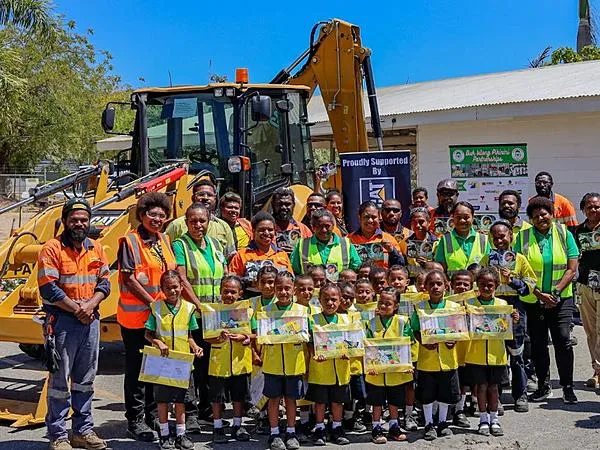
As part of Book Week 2026, children from Buk Bilong Pikinini visited our Port Moresby facilities for an educational and engaging tour, giving them a firsthand look at what we do.
The children enjoyed an exciting tour of the Business Centre, starting with our Sales Team, where they saw a brand-new CAT 426 Backhoe Loader. They then visited our Learning Centre, where they learned about machine electrical systems and watched a demonstration.
The tour continued to the Hose Pressing Container, Parts Warehouse and Service Workshop. The children explored the tool store, watched our technicians at work and even had a hands-on experience with a forklift.
It was a wonderful opportunity to inspire the next generation and spark curiosity about careers in engineering, technology and the trades.
The visit concluded with lunch and gifts provided by the HD POM team, leaving the children with smiles and lasting memories of their experience.
A big thank you to everyone involved in organising and supporting this successful event. Your commitment helped make the Buk Bilong Pikinini Visit 2026 a rewarding and inspiring day for everyone.
“Investing in young minds today helps build the future of our nation tomorrow.”
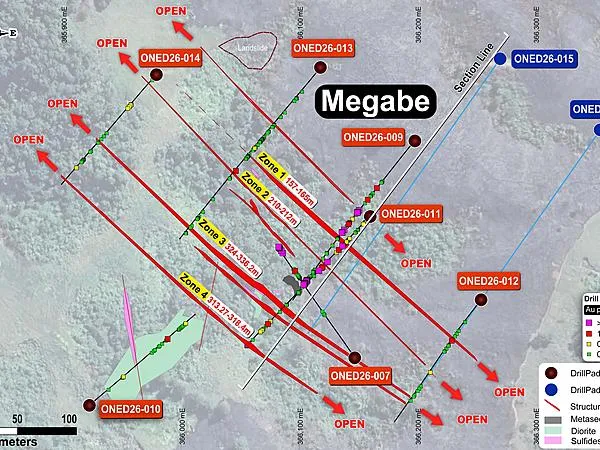
South Pacific Metals Corp has extended the confirmed mineralised strike length of its Megabe prospect in Papua New Guinea to more than 300 metres, with drilling indicating that the structures remain open along strike and at depth.
The Vancouver-based explorer said all five holes drilled at its 100%-owned Osena Project, immediately southwest of K92 Mining’s Kainantu gold-copper mine, intersected mineralised structures. Four step-out holes on the Megabe trend confirmed continuity from the northwest to the southeast, while a fifth hole identified mineralisation beyond the Megabe corridor.
The latest results include 5.1 metres at 1.79 grams per tonne gold equivalent (AuEq), including three metres at 2.66 g/t AuEq, in hole ONED26-011. The intercept was identified as a potential fourth mineralised zone and was located beyond the window predicted by the company’s geological interpretation.
South Pacific Metals said the drilling has helped establish the geometry of the Megabe structures and provides a basis for targeting higher-grade mineralisation at depth.
High-grade targets
The company said four holes were designed to define the geometry and strike continuity of the northwest-trending Megabe structures, with each intersecting the targeted structures.
The mineralised trend now extends for more than 300 metres, while drilling limits rather than the structures themselves define the current boundaries of the system, South Pacific Metals said.
The step-out drilling intercepted the upper part of the system, above the interpreted productive high-grade zone and within a leached horizon that the company believes extends at least 100 metres below surface.
Follow-up drilling is now being directed towards the deeper portion of the system. The company plans to drill below and down-plunge to the southeast of discovery hole ONED26-009, which previously returned five metres at 12.84 g/t AuEq, including two metres at 28.06 g/t AuEq, and 12.2 metres at 6.24 g/t AuEq, including two metres at 16.65 g/t AuEq.
Chief executive Timo Jauristo said the latest drilling suggested the high-grade zones encountered in ONED26-009 may represent only the upper margins of the main system.
“We think the high-grade zones in hole ONED26-009 have only clipped the upper edges of the main system,” Jauristo said, adding that the company would drill deeper holes to test continuity of high-grade mineralisation.
Hole ONED26-010, drilled into a separate group of structures southwest of Megabe, returned 18 metres at 0.25 g/t AuEq, confirming that mineralised structures extend beyond the main Megabe corridor.
Broader Ontenu potential
The Megabe prospect forms part of the broader five-kilometre Ontenu prospective area, where the company has identified at least eight northwest-trending mineralised structures.
Only small portions of three structures — Jorkol, Onki and Megabe — have so far been drill-tested, leaving most of the identified targets undrilled.
Exploration manager Octavio Garcia said the step-out programme had confirmed several geological parameters, including the continuity and geometry of the mineralised structures.
He said geochemical results indicated potential for continuity beyond 300 metres of strike, while the company had also identified subparallel mineralised structures and local leaching similar to that observed at K92’s Kora vein.
The company believes the results provide evidence of an intermediate-sulphidation epithermal system comparable with neighbouring deposits, although further drilling will be required to establish its full extent.
Drilling has continued at Ontenu Central, where two of four planned holes have been completed and two are nearing completion. The programme is testing newly mapped northwest-southeast mineralised trends while drilling advances at Megabe.
South Pacific Metals said the next two Megabe holes would target higher-grade mineralisation below the current drilling and down-plunge to the southeast of ONED26-009.
The company said Megabe remains the most advanced of the eight identified structures at Ontenu, with further geological mapping and drilling planned across the broader prospective area.
Prime Minister James Marape has outlined a long-term plan to revive PNG Power Ltd through structural reforms, provincial partnerships and partial privatisation, describing the state-owned electricity utility as being in a “terminal” financial and operational condition.
Responding in Parliament to a question from West New Britain Governor Sasindran Muthuvel, Marape said the Government had been pursuing reforms since 2023 to make PNG Power financially sustainable, improve efficiency and expand reliable electricity access nationwide.
He said the utility’s problems reflected decades of inadequate maintenance, ageing infrastructure, rising operating costs and poor revenue collection.
“PNG Power is a very sick state-owned enterprise,” Marape said. “If I were to make an example of cancer, it is in a terminal stage. It is no longer stage one, stage two or stage three. It is in stage four.”
Marape said independent reviews, including work by Deloitte, had confirmed the severity of PNG Power’s financial and operational problems.
He said routine maintenance had failed to keep pace with ageing assets built from the 1970s onwards, affecting generation, transmission, distribution and billing systems.
“In one major centre on the Highlands grid, around 80 per cent of customers do not pay for electricity. No utility can remain financially healthy under those circumstances,” he said.
Structural reform
Marape said successive governments had also kept electricity tariffs largely unchanged for years to shield consumers, despite rising costs associated with supplying power.
“There has never really been a tariff increase over many years because we wanted to help our people,” he said.
“Only recently have we allowed a modest increase, but PNG Power continues to struggle under enormous debts and liabilities.”
Despite the utility’s financial position, the Government had invested almost K1.5 billion in critical electricity infrastructure, Marape said.
The investment included the 132-kilovolt transmission line linking Edevu to Port Moresby, which has enabled an additional 54 megawatts of power to be supplied to the National Capital District.
“Our Government has continued investing in infrastructure, but the company now requires decisive structural reform to remove the parts of the business that are no longer sustainable while strengthening those that remain viable,” he said.
A key element of the reform programme would be the gradual transfer of loss-making “C centres” to capable provincial governments and other qualified operators under regulated arrangements, Marape said.
He stressed that the proposed changes should not be viewed simply as an asset sale, but as an effort to preserve electricity services, protect consumers and limit pressure for further tariff increases.
“We are looking at provinces that have the capacity to operate their own power companies under licence through the National Energy Authority, which our Government established as part of these reforms,” he said.
“We are already examining proposals involving East and West Sepik, where PNG Power could partner with provincial governments or other qualified operators.”
Provincial participation
Marape cited the operation of the Ok Tedi power subsidiary as an example of how provincial and resource-sector partnerships could support improved electricity services.
He said provinces with viable energy resources could also establish their own electricity businesses, either independently or in partnership with PNG Power.
“There is nothing wrong with provincial governments owning or partnering in power companies while PNG Power continues as a strategic partner,” he said.
Under the proposed model, more generation and distribution responsibilities could be managed at the provincial level, while PNG Power focuses on the major national grids serving Port Moresby, Lae and the Highlands, he said.
Marape said further details of the policy would be released before the Mining, Petroleum and Energy Conference later this year.
The Government's objective was to create a financially sustainable electricity sector capable of delivering reliable and affordable power while allowing provinces to participate directly in energy development, he said.
Papua New Guinea’s maritime future will depend not only on vessels and infrastructure, but also on the strength of the businesses that support the industry from within. Local capability — spanning technical service, equipment support and operational coordination — will be critical in building a more resilient and efficient maritime economy. This is where JJ Ship Equip Agencies Ltd (JJSEA) is positioning itself as a key local partner.
For JJSEA, local capability is fundamentally practical. “We see local capability as the ability to solve real maritime problems inside Papua New Guinea with local knowledge, local people, local responsiveness and stronger in-country support systems,” the company says. This goes beyond market presence to reducing reliance on slow external processes and strengthening domestic support systems. In practice, it includes dependable supplier access, effective coordination, technical understanding and consistent follow-through. For the wider industry, stronger local capability means greater continuity, less downtime and improved operational resilience.
This perspective has shaped the company’s evolution. JJSEA has moved from a straightforward marine supplier into a more integrated support provider, reflecting what the PNG market requires. “Operators do not only need items delivered; they need help with urgency, technical fit, sourcing complexity, compliance expectations and operational coordination,” the company explains. As a result, JJSEA has invested in supplier relationships, practical knowledge and service capability, positioning itself as a problem-solving partner rather than a transactional vendor.
Shipping companies in Papua New Guinea operate in a demanding environment defined by distance, remote routes, unpredictable weather, infrastructure constraints and procurement lead times. These challenges are compounded by reliance on foreign sourcing and rising compliance expectations. JJSEA addresses this by providing a responsive local point of contact. “We give clients a practical local point of contact that can help source equipment, coordinate support, advise on urgency, manage follow-up and keep communication moving when time matters,” the company says. In this context, reducing operational friction is a core part of the value it delivers.
A defining feature of JJSEA’s approach is its focus on coordination. Rather than treating supply as a standalone transaction, the company engages with the broader operational context — including vessel schedules, locations and technical requirements. “In many cases we act as a coordination point — aligning suppliers, technical parties, logistics and delivery timing so the operator can resolve the issue with less disruption,” it notes. This also extends to forward planning, particularly around inspections, maintenance and known operational bottlenecks. In PNG, where procurement alone rarely solves operational challenges, coordination and follow-through are essential.
As the maritime sector modernises, expectations are rising. Operators are placing greater emphasis on product quality, documentation, traceability and technical reliability, alongside more professional service standards. JJSEA observes “stronger demand for product quality, better documentation, more reliable technical support, greater traceability, and more professional operational follow-up.” In response, it is strengthening supplier discipline, improving documentation standards and expanding its ability to support more technically complex requirements. The company views this shift as positive, noting that modernisation will depend not only on vessels, but also on the quality of the support ecosystem around them.
Since its establishment in 2015, JJSEA has expanded its presence across Lae, Port Moresby, Rabaul, Madang, Kimbe and Buka, while building relationships with a wide range of operators, including Consort Express, Pacific Towing, Steamships, Swire, P&O Maritime and Lutheran Shipping. While it does not disclose financial metrics, its growth is reflected in increased market reach, repeat business and rising demand for dependable local support.
Partnerships are central to strengthening this capability. JJSEA operates within a broader ecosystem involving vessel operators, regulators, ports, classification societies, technical providers and international suppliers. “No single business can do that alone,” the company says, emphasising the need for collaboration. It works with stakeholders including the National Maritime Safety Authority and technical partners to support both client outcomes and broader industry development.
Looking ahead, JJSEA’s priorities over the next three to five years focus on strengthening service depth and reliability. These include expanding technical capability, improving inventory planning, investing in people and systems, and enhancing collaboration with credible partners. The aim is to build “a more capable local maritime support platform” that can serve commercial operators and coastal shipping more effectively across Papua New Guinea.
As the sector evolves, the importance of capable local businesses will continue to grow. JJSEA’s trajectory reflects a broader shift towards stronger domestic solutions, higher standards and more resilient support systems. By combining local knowledge with practical service delivery, the company is contributing to a more dependable and self-sustaining maritime sector — one that supports both economic activity and national connectivity.
The reopening of the Apo Street Market along Somare Circuit, Waigani Road, has formalised a new operating framework for 75 informal vendors and positioned the marketplace as a model for small and informal businesses in Port Moresby, Papua New Guinea.
National Capital District Governor Powes Parkop officiated at the reopening and recognised the Apo Market Fresh Produce Association as operating under NCDC approval on August 14 this year.
Governor Parkop said the market had demonstrated that informal markets could operate successfully when supported by proper management, waste disposal and community cooperation.
“This market has earned the right to operate temporarily under NCDC approval. It has set the standard for all other street markets in Port Moresby, showing that with proper management, waste disposal, and community cooperation, informal markets can thrive and contribute positively to our city’s image,” he said.
The market’s continued operation will be subject to conditions, including maintaining cleanliness, proper waste management and payment of small daily fees to support water and waste services.
The 75 vendors have also been provided with street market kits comprising tents, tables and chairs through the Apo Market Fresh Produce Association.
From a local economic perspective, the reopening provides vendors with an organised marketplace to sell fresh produce and other locally prepared products, including roasted kaukau, cassava, taro, sweet corn, peanuts and kulau.
Governor Parkop said the initiative would benefit both vendors and residents while enhancing the reputation of Port Moresby.
The reopening was attended by Deputy City Manager Edith Laufa, Amazing Port Moresby Director Fazilah Bazari, Lady Emeline Tufi Dadae, NCDC and Amazing Port Moresby staff, vendors and community members.
Lady Dadae, who was the Guest of Honour, acknowledged the efforts of the vendors and those who supported the reopening.
The recognition of Apo Market establishes it as an example of how informal marketplaces can be organised to support local livelihoods while meeting city management requirements.
The National Superannuation Fund (Nasfund) has signed the PNG Empower Finance Code alongside the Bank of Papua New Guinea (BPNG) and 14 other financial-sector institutions, establishing a unified industry approach to combating financial abuse, coercion and product misuse in Papua New Guinea.
The code was signed at the Crown Hotel in Port Moresby, marking a coordinated effort by the financial sector to address domestic and family-related financial abuse as a systemic financial risk.
The framework is described as the first central bank-led initiative globally in which a regulator and commercial financial institutions have co-designed a voluntary industry code to address financial abuse.
For workers across Papua New Guinea, superannuation balances can represent their largest accumulated financial asset, making members particularly vulnerable when life events, unemployment claims or retirement payouts occur.
Speaking at the signing ceremony, Nasfund Chief Executive Officer Rajeev Sharma warned that rapid digital transformation, while improving convenience and access, has also created new vulnerabilities that the financial sector must address.
“Years ago, transactions required personal visits to branches and physical signatures, which naturally made impersonation difficult. Today, member interactions take place across mobile channels, emails and self-service portals. While this delivers speed, it also creates faceless interactions,” Sharma said.
He said digital channels can create opportunities for unauthorised parties to pressure vulnerable contributors, intercept one-time passwords or redirect payout accounts.
“Modernisation cannot come at the cost of personal safety,” he said.
Sharma also highlighted the risk of financial abuse within families, noting that cultural expectations around supporting relatives can sometimes blur the line between family assistance and coercion.
“In Papua New Guinea, looking after family is second nature, but there is a clear boundary between cultural care under the wantok system and being coerced out of your life savings,” he said.
He added that some members may experience persistent financial pressure without recognising it as financial abuse.
Sharma said Nasfund’s fiduciary responsibility extends beyond managing members’ savings and delivering investment returns to ensuring members retain control over their funds.
“Our fiduciary duty goes far beyond posting annual interest; it extends to ensuring that our members genuinely retain control over their own money,” he said.
He said the financial sector’s decision to work collectively under the leadership of BPNG Governor Elizabeth Genia would help close gaps that allow coerced funds to move between institutions undetected.
“No single institution can stamp out financial exploitation in isolation,” Sharma said.
The signing positions Nasfund alongside BPNG and other financial-sector participants in developing a coordinated response to financial abuse, while recognising the growing risks associated with digital financial services.
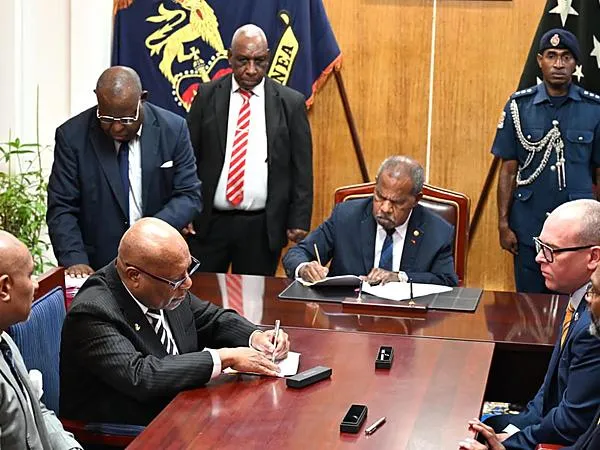
The long-awaited Community Development Agreement (CDA) for the Simberi Mining Project has finally been signed, marking a significant milestone for the Simberi and wider Tabar Island communities after three decades of negotiations and delays.
The agreement was signed on Aug. 28, 2026, at the New Ireland Provincial Government Assembly in Kavieng, bringing together the State, New Ireland Provincial Government (NIPG), Sentral Niu Ailan Local Level Government (SNALLG), Simberi Mining Area Association (SMAA) and Simberi Gold Company Pty Ltd (SGC).
The signing marks the latest step in a process that began with the first CDA in 1996.
Mining Minister Solen Loifa signed on behalf of the State, while New Ireland Governor Byron Chan signed for the New Ireland Provincial Government.
SNALLG President Terence Kamari signed for the local-level government, while SMAA Chairman Pius Vaket Maris signed on behalf of the Simberi mining area landowner association.
Simberi Gold Company Country Manager Randy McMahon represented SGC at the ceremony. However, the company did not sign the agreement because of an administrative hold-up and has indicated it will do so at a later date.
The CDA has undergone an extended process of review, consultation and statutory consideration since the original agreement was signed in 1996.
The agreement was reviewed in 2012 and finalised in 2013. Between 2014 and 2016, statutory approvals were sought for fiscal and legal clearance, alongside the preparation of the Business Development Plan and Training and Employment Plan.
In 2017, the National Executive Council approved implementation of the agreement through NEC Policy Decision No. 95/2017.
Implementation was subsequently delayed after the New Ireland Provincial Government sought increased benefits under arrangements including the Special Support Grant (SSG), Infrastructure Development Grant (IDG) and Tax Credit Scheme (TCS).
Further delays were caused by internal disputes within the Simberi Mining Area Association, the COVID-19 pandemic and a court case over SMAA leadership in 2023.
The signing on Aug. 28 now allows the parties to move towards implementing their commitments under the CDA, with the agreement expected to provide a framework for community development and the distribution of benefits from the mining project.
Benefits and long-term development
Loifa congratulated all parties for reaching the agreement and commended them for their patience, understanding and cooperation throughout the prolonged process.
He also urged Simberi landowners and communities to take a long-term view of the benefits generated by mining.
The minister said the gold resources on the islands are finite and will eventually be exhausted, making it essential to invest current mining benefits in sustainable projects and businesses.
Such investments, he said, would help ensure future generations continue to benefit from the resources after mining operations end.
Mineral Resources Authority Acting Managing Director Harry Kore reaffirmed the authority’s commitment to facilitating implementation of the CDA.
Kore said the MRA would continue working closely with all stakeholders, particularly landowners, to ensure benefits are delivered in accordance with the agreement.
For the New Ireland Provincial Government, the signing also marks a significant achievement for landowners who, according to Governor Chan, had missed out on benefits for about 10 years while the agreement remained unresolved.
Chan congratulated all parties and particularly acknowledged Simberi landowners for their patience throughout the lengthy process.
Landowners welcome historic agreement
For SMAA Chairman Pius Vaket Maris, the signing represents more than the conclusion of a lengthy administrative process. He described it as a historic achievement and the beginning of a new chapter for the people of Simberi Island and the wider Tabar community.
“Today is a proud day for the people of Simberi Island and the wider Tabar community. We are not simply signing a Community Development Agreement — we are signing a new chapter in the history of our people,” Maris said.
He said the wealth generated from Simberi’s mineral resources must translate into lasting improvements in the lives of the people living in the mining area.
As chairman of the association, Maris said he carries the hopes and aspirations of thousands of people across Simberi and the wider Tabar Island group, including previous generations and the children who will inherit the islands after mining has ceased.
He acknowledged that the community’s relationship with large-scale mining has brought both opportunities and challenges.
While development is welcome, Maris stressed that land cannot be viewed solely as an economic resource.
“Land is identity, history, culture, livelihood and the foundation of the future,” he said.
He said the responsibility of the current generation is to safeguard the land for those who come after them.
“Our ancestors did not inherit land to sell it away; they held it in trust for future generations. Likewise, we hold it in trust today for those who will come after us. That is why this agreement is so important,” Maris said.
He acknowledged that reaching the agreement required extensive discussions, consultations and negotiations, including difficult conversations among stakeholders.
However, he said the parties were ultimately able to reach agreement through mutual respect and a shared commitment to progress.
With the CDA now signed, the focus shifts from negotiation to implementation.
For the Simberi and Tabar communities, the agreement is expected to provide a structured pathway for community development and stakeholder benefits while strengthening the relationship between the mining operation, government and landowners.
The signing also renews the focus on converting finite mineral wealth into sustainable economic opportunities that continue supporting communities beyond the life of the Simberi mining operation.
The revised Community Development Agreement (CDA) for the Hidden Valley Mining Project has been formally signed, paving the way for participating landowners and communities in Morobe Province to access benefits from the gold operation.
Mining Minister Solen Loifa signed the revised CDA on behalf of the State yesterday in Lae. The signing was witnessed by Morobe Governor Rainbo Paita, Bulolo MP Sam Basil Junior, Wau Waria MP Marsh Narawec, Acting Managing Director of the Mineral Resources Authority Harry Kore, representatives of Harmony Gold, the State team, project landowners and affected communities.
The revised agreement brings together the State, mine operator, landowners, and local- and provincial-level governments under a framework designed to distribute development benefits associated with the Hidden Valley operation.
The parties to the CDA are Nakuwi Association Inc., Bulolo Urban Local Level Government, Wau Urban Local Level Government, Watut Rural Local Level Government, Wau Rural Local Level Government, Morobe Provincial Government, the Independent State of Papua New Guinea and Morobe Consolidated Goldfields Limited, the company operating the Hidden Valley Mine under Harmony Gold.
At the Aug. 11 signing, three parties — the State, Nakuwi Association Inc. and Morobe Consolidated Goldfields Limited — formally executed the revised agreement.
The remaining five parties are expected to sign after agreement is reached on the redistribution of benefits at the provincial level.
A Provincial Executive Council (PEC) meeting is scheduled to consider the benefit-sharing arrangements, which will determine the distribution of benefits among the relevant local-level governments and the Morobe Provincial Government.
Minister Loifa said the signing represents an important step towards enabling the parties to the CDA to access the benefits provided under the agreement.
He acknowledged the efforts of the Marape-Rosso government, landowners, affected communities and the late former Morobe Governor Luther Wenge, who was described as instrumental in progressing the CDA.
The minister also recognised the support of current Governor Rainbo Paita and the Morobe Provincial Government in bringing the revised agreement to the signing stage.
The CDA is expected to provide a framework through which benefits associated with the Hidden Valley Mine can reach the communities and institutions covered by the agreement.
Loifa urged landowners and communities to use the benefits responsibly and invest them in initiatives that can improve living standards and support sustainable development.
The minister stressed that all parties must take ownership of the CDA and honour their respective commitments under the agreement.
For the Hidden Valley project, the revised CDA provides an important mechanism for strengthening the link between mining activity and local economic and community development, particularly in areas directly affected by the operation.
The agreement also places responsibility on participating parties to ensure that benefits are managed effectively and translated into sustainable outcomes for communities beyond the life of individual mining activities.
Eleven Papua New Guinean small and medium-sized enterprises (SMEs) have each received about K22,000 in seed funding to develop innovative, climate-resilient business solutions, providing a boost to the country’s emerging green economy.
The funding was awarded under the PNG Greenpreneurs initiative, supported by the Australian government through the PNG Climate Finance Initiative for Resilience and Sustainable Transition (Climate FIRST) program.
The initiative is designed to help local entrepreneurs turn climate-focused ideas into viable businesses while building their capacity to attract investment, create economic opportunities and strengthen PNG’s climate resilience.
Before receiving the funding, participants completed an intensive capacity-building program covering business development, coaching, mentorship, business planning, pitch preparation and investor readiness.
The Australian High Commission said the program demonstrated the potential of Papua New Guinean entrepreneurs to use innovation and business development to address climate challenges while creating new economic opportunities for communities.
The seed funding is particularly significant for SMEs, which often face challenges accessing the early-stage capital needed to develop products, test business models and expand operations.
Through Climate FIRST, Australia is partnering with the PNG government to strengthen local SMEs’ capacity to build resilience to climate change, reduce emissions and unlock sustainable, low-carbon investment opportunities.
The program also seeks to strengthen the broader SME ecosystem by equipping entrepreneurs with the skills and knowledge needed to develop commercially sustainable businesses and become more investment-ready.
The funding awards were announced during the PNG Greenpreneurs Graduation, which celebrated 175 Greenpreneurs from seven provinces who completed the climate entrepreneurship development program.
The graduation highlighted the growing role of entrepreneurship and private-sector innovation in supporting PNG’s economic development, particularly in emerging areas such as climate adaptation, sustainable production and low-carbon business.
For the participating SMEs, the seed funding provides an opportunity to move from business concepts and early-stage ideas toward implementation and commercialisation.
The Australian High Commission said the program reaffirmed Australia’s commitment to supporting inclusive and sustainable economic growth in PNG while strengthening the ability of local businesses and communities to respond to climate change.
As PNG continues to explore opportunities for sustainable economic growth, initiatives such as Greenpreneurs are creating pathways for local SMEs to participate in the emerging green economy and potentially attract further investment into climate-focused businesses.
Bank of Papua New Guinea (BPNG) Governor Elizabeth Genia has outlined a broad financial-sector reform agenda aimed at strengthening monetary and financial stability, expanding financial inclusion and creating a more competitive and modern financial system to support investment and sustainable economic growth. Speaking at the Business Advantage PNG Investment Conference in Brisbane on 10 August 2026, Genia said stability must remain the foundation of Papua New Guinea’s economic development, as businesses, households and investors require confidence and predictability to make long-term decisions. Her address, titled “Driving Financial Sector Reform, Inclusion and Stability”, highlighted reforms across monetary policy, banking regulation, payments infrastructure, foreign exchange, financial inclusion, green finance and prudential supervision. Genia said the Bank’s statutory mandate under the Central Banking Act places price stability as its primary objective, followed by financial stability and the promotion of sustainable medium-term economic growth, particularly in the non-mineral and non-petroleum sectors. “A stable financial system allows savings to be channelled towards productive investment and supports the flow of credit through the economy, giving households and businesses greater certainty when planning for the future,” she said. On price stability, Genia said headline inflation is forecast at around 4 per cent in 2026, with underlying inflation measures expected to remain at or just below that level through 2027 and 2028. She said the convergence of headline and underlying inflation measures provides greater confidence in the medium-term inflation outlook, although the Bank remains alert to external and domestic risks. The re-emergence of the El Niño weather pattern is already affecting mining operations and domestic food production, she said, making weather-related pressures an area of close monitoring for the central bank. Genia also highlighted the impact of exchange-rate movements on inflation, noting that in recent years the exchange rate has played a stronger role than the Kina Facility Rate (KFR) as the nominal anchor for inflation. The Bank’s longer-term objective is for the KFR to become a more effective monetary-policy instrument. A key part of the reform agenda is restoring greater flexibility and convertibility in the foreign-exchange market. Genia said the Kina is now approximately 20 per cent lower against major currencies than it was in January 2023, describing the depreciation as measured and gradual, with minimal impact on inflation and broader macroeconomic stability. “As the exchange rate adjusted lower and inflows strengthened, the backlog of outstanding FX orders fell significantly,” she said. According to Genia, the reduction in the foreign-exchange backlog is one of the clearest indications that the market is moving closer to equilibrium. While PNG has not yet achieved full Kina convertibility, she said the country is moving in the right direction. The adjustment in the exchange rate also creates conditions for monetary policy to play a greater role in anchoring inflation. “If we now have more of the exchange-rate adjustment behind us than ahead of us, it creates the conditions for the nominal anchor for inflation to begin passing back from the exchange rate to the Kina Facility Rate,” Genia said. Bank of PNG targets stronger monetary-policy transmission Genia identified weak monetary-policy transmission as one of the major challenges facing the financial system. Changes in the KFR have not historically translated into corresponding movements in commercial lending and deposit rates, limiting the effectiveness of monetary policy in influencing economic activity. She said strengthening transmission through the KFR is therefore a critical next stage of reform. The Governor also pointed to limited competition in PNG’s banking market as another challenge. The recent entry of National Banking Corporation (NBC), TISA Bank and CreditBank is expected to increase competition for deposits and lending, although Genia cautioned that the new institutions will need time to build their businesses sustainably. Genia said BPNG is strengthening the regulatory and institutional foundations of the financial sector. Recent amendments to the Central Banking Act have strengthened the Bank’s governance while preserving its independence. Further reviews are also being undertaken of the Banks and Financial Institutions Act, the foreign-exchange regulatory framework and the National Payments System Act. The Bank is also strengthening prudential supervision and system-wide stress testing to identify risks not only within individual financial institutions but across the financial system. Operational resilience is another priority, including stronger risk management, information technology, cybersecurity and payments infrastructure. Genia said critical financial services must remain available during disruptions and that the infrastructure supporting transactions across the economy must be secure and resilient. BPNG has also introduced an Emergency Liquidity Assistance Policy, approved by its Board earlier this year, which allows the Bank to provide temporary liquidity support to an otherwise solvent and viable commercial bank experiencing severe short-term liquidity pressures. She said the policy forms part of broader contingency arrangements designed to protect confidence and financial stability. Financial inclusion expands Financial inclusion remains another major pillar of the Bank’s agenda under the National Financial Inclusion Strategy 2023–2027 and through the Centre for Excellence in Financial Inclusion (CEFI). The strategy focuses on expanding access to financial services, particularly through mobile and digital banking, with a strong focus on women and rural communities. Genia said more than 250,000 Papua New Guineans have received financial literacy training through CEFI programmes, including approximately 120,000 women. She said financial inclusion is ultimately about bringing more people into the formal financial system and enabling them to participate more fully in economic activity. PNG is also preparing to host the Alliance for Financial Inclusion (AFI) Global Policy Forum in Port Moresby, bringing together central bank governors, policymakers and financial-sector thought leaders from around the world. The forum will be held under the theme “Building Resilient Economies for an Inclusive Future”. Genia said hosting the international forum provides PNG with an opportunity to showcase its progress, strengthen regional cooperation and draw greater international attention to financial inclusion opportunities and challenges in the Pacific. Green finance emerges as new investment pathway Climate resilience and sustainable use of natural resources are also becoming increasingly important components of PNG’s financial-sector development. Genia said BPNG’s Inclusive Green Finance agenda is intended to help mobilise private and public capital towards investments that deliver environmental and economic benefits. A Green Finance Summit held in Port Moresby in May brought together government, development partners and the private sector to focus on moving green finance policy towards implementation. Four key components are being developed: the Inclusive Green Finance Taxonomy, Green Finance Academy, Environmental Risk Guidelines and Green Finance Facilities. The taxonomy is intended to provide clarity on what qualifies as green or sustainable investment, while the Green Finance Academy will build technical capacity within the sector. The Environmental Risk Guidelines will support better classification and reporting of green lending and help financial institutions incorporate environmental and climate risks into their risk-management systems. Green Finance Facilities, meanwhile, are intended to mobilise capital for commercially viable investments that support climate resilience. East Sepik project demonstrates economic value of conservation Genia highlighted the April Salumei Rainforest Community Conservation Project in East Sepik as an example of green finance being applied in practice. The project covers more than 600,000 hectares of rainforest that had originally been identified for commercial logging. Traditional landowners instead chose to preserve the forest and generate economic value through the carbon stored in the rainforest. Verified carbon credits generated through the project can be sold to entities seeking to offset emissions, with proceeds used to support community development initiatives, including schools, sustainable agriculture and employment. Under a new five-year development plan, further investment is expected in health and education. Genia said the project demonstrates how environmental assets can be protected while creating economic value and directing benefits back to the communities that own and protect those resources. AML/CFT reforms and FATF grey-list response The Governor also linked financial-sector reform to Papua New Guinea’s international financial-system obligations. PNG is currently responding to its placement on the Financial Action Task Force (FATF) grey list, with a review of the Anti-Money Laundering and Counter-Terrorist Financing (AML/CFT) Act forming part of the national reform programme. Genia said the focus is on implementing the agreed action plan, strengthening the effectiveness of PNG’s AML/CFT framework and demonstrating progress. For BPNG, she said the reforms are directly connected to maintaining the integrity of the domestic financial system and confidence in PNG’s links with the international financial system. BPNG is also pursuing reforms to the national payments system as financial technology and payment platforms continue to evolve. Genia said domestic and international payment systems must remain interoperable, secure and capable of accommodating new technologies. For PNG’s domestic market, she said financial institutions must be able to transact effectively with one another and the country’s national payments infrastructure must keep pace with developments in the wider payments ecosystem. Genia stressed that financial-sector reform would not produce results overnight. “Financial sector reform is not one single switch. It involves a series of measures that take time to take effect and, above all, require stability if they are to deliver meaningful results,” she said. For investors and businesses, the reform agenda points to a financial system intended to provide greater stability, stronger competition, improved access to finance and more effective monetary-policy transmission, while creating new opportunities in digital banking, green investment and the broader non-resource economy.
Bank of Papua New Guinea (BPNG) Governor Elizabeth Genia has outlined a broad financial-sector reform agenda aimed at strengthening monetary and financial stability, expanding financial inclusion and creating a more competitive and modern financial system to support investment and sustainable economic growth.
Speaking at the Business Advantage PNG Investment Conference in Brisbane on 10 August 2026, Genia said stability must remain the foundation of Papua New Guinea’s economic development, as businesses, households and investors require confidence and predictability to make long-term decisions.
Her address, titled “Driving Financial Sector Reform, Inclusion and Stability”, highlighted reforms across monetary policy, banking regulation, payments infrastructure, foreign exchange, financial inclusion, green finance and prudential supervision.
Genia said the Bank’s statutory mandate under the Central Banking Act places price stability as its primary objective, followed by financial stability and the promotion of sustainable medium-term economic growth, particularly in the non-mineral and non-petroleum sectors.
“A stable financial system allows savings to be channelled towards productive investment and supports the flow of credit through the economy, giving households and businesses greater certainty when planning for the future,” she said.
On price stability, Genia said headline inflation is forecast at around 4 per cent in 2026, with underlying inflation measures expected to remain at or just below that level through 2027 and 2028.
She said the convergence of headline and underlying inflation measures provides greater confidence in the medium-term inflation outlook, although the Bank remains alert to external and domestic risks.
The re-emergence of the El Niño weather pattern is already affecting mining operations and domestic food production, she said, making weather-related pressures an area of close monitoring for the central bank.
Genia also highlighted the impact of exchange-rate movements on inflation, noting that in recent years the exchange rate has played a stronger role than the Kina Facility Rate (KFR) as the nominal anchor for inflation.
The Bank’s longer-term objective is for the KFR to become a more effective monetary-policy instrument.
A key part of the reform agenda is restoring greater flexibility and convertibility in the foreign-exchange market.
Genia said the Kina is now approximately 20 per cent lower against major currencies than it was in January 2023, describing the depreciation as measured and gradual, with minimal impact on inflation and broader macroeconomic stability.
“As the exchange rate adjusted lower and inflows strengthened, the backlog of outstanding FX orders fell significantly,” she said.
According to Genia, the reduction in the foreign-exchange backlog is one of the clearest indications that the market is moving closer to equilibrium.
While PNG has not yet achieved full Kina convertibility, she said the country is moving in the right direction.
The adjustment in the exchange rate also creates conditions for monetary policy to play a greater role in anchoring inflation.
“If we now have more of the exchange-rate adjustment behind us than ahead of us, it creates the conditions for the nominal anchor for inflation to begin passing back from the exchange rate to the Kina Facility Rate,” Genia said.
Genia identified weak monetary-policy transmission as one of the major challenges facing the financial system.
Changes in the KFR have not historically translated into corresponding movements in commercial lending and deposit rates, limiting the effectiveness of monetary policy in influencing economic activity.
She said strengthening transmission through the KFR is therefore a critical next stage of reform.
The Governor also pointed to limited competition in PNG’s banking market as another challenge.
The recent entry of National Banking Corporation (NBC), TISA Bank and CreditBank is expected to increase competition for deposits and lending, although Genia cautioned that the new institutions will need time to build their businesses sustainably.
Genia said BPNG is strengthening the regulatory and institutional foundations of the financial sector.
Recent amendments to the Central Banking Act have strengthened the Bank’s governance while preserving its independence. Further reviews are also being undertaken of the Banks and Financial Institutions Act, the foreign-exchange regulatory framework and the National Payments System Act.
The Bank is also strengthening prudential supervision and system-wide stress testing to identify risks not only within individual financial institutions but across the financial system.
Operational resilience is another priority, including stronger risk management, information technology, cybersecurity and payments infrastructure.
Genia said critical financial services must remain available during disruptions and that the infrastructure supporting transactions across the economy must be secure and resilient.
BPNG has also introduced an Emergency Liquidity Assistance Policy, approved by its Board earlier this year, which allows the Bank to provide temporary liquidity support to an otherwise solvent and viable commercial bank experiencing severe short-term liquidity pressures.
She said the policy forms part of broader contingency arrangements designed to protect confidence and financial stability.
Financial inclusion remains another major pillar of the Bank’s agenda under the National Financial Inclusion Strategy 2023–2027 and through the Centre for Excellence in Financial Inclusion (CEFI).
The strategy focuses on expanding access to financial services, particularly through mobile and digital banking, with a strong focus on women and rural communities.
Genia said more than 250,000 Papua New Guineans have received financial literacy training through CEFI programmes, including approximately 120,000 women.
She said financial inclusion is ultimately about bringing more people into the formal financial system and enabling them to participate more fully in economic activity.
PNG is also preparing to host the Alliance for Financial Inclusion (AFI) Global Policy Forum in Port Moresby, bringing together central bank governors, policymakers and financial-sector thought leaders from around the world.
The forum will be held under the theme “Building Resilient Economies for an Inclusive Future”.
Genia said hosting the international forum provides PNG with an opportunity to showcase its progress, strengthen regional cooperation and draw greater international attention to financial inclusion opportunities and challenges in the Pacific.
Climate resilience and sustainable use of natural resources are also becoming increasingly important components of PNG’s financial-sector development.
Genia said BPNG’s Inclusive Green Finance agenda is intended to help mobilise private and public capital towards investments that deliver environmental and economic benefits.
A Green Finance Summit held in Port Moresby in May brought together government, development partners and the private sector to focus on moving green finance policy towards implementation.
Four key components are being developed: the Inclusive Green Finance Taxonomy, Green Finance Academy, Environmental Risk Guidelines and Green Finance Facilities.
The taxonomy is intended to provide clarity on what qualifies as green or sustainable investment, while the Green Finance Academy will build technical capacity within the sector.
The Environmental Risk Guidelines will support better classification and reporting of green lending and help financial institutions incorporate environmental and climate risks into their risk-management systems.
Green Finance Facilities, meanwhile, are intended to mobilise capital for commercially viable investments that support climate resilience.
Genia highlighted the April Salumei Rainforest Community Conservation Project in East Sepik as an example of green finance being applied in practice.
The project covers more than 600,000 hectares of rainforest that had originally been identified for commercial logging.
Traditional landowners instead chose to preserve the forest and generate economic value through the carbon stored in the rainforest.
Verified carbon credits generated through the project can be sold to entities seeking to offset emissions, with proceeds used to support community development initiatives, including schools, sustainable agriculture and employment.
Under a new five-year development plan, further investment is expected in health and education.
Genia said the project demonstrates how environmental assets can be protected while creating economic value and directing benefits back to the communities that own and protect those resources.
The Governor also linked financial-sector reform to Papua New Guinea’s international financial-system obligations.
PNG is currently responding to its placement on the Financial Action Task Force (FATF) grey list, with a review of the Anti-Money Laundering and Counter-Terrorist Financing (AML/CFT) Act forming part of the national reform programme.
Genia said the focus is on implementing the agreed action plan, strengthening the effectiveness of PNG’s AML/CFT framework and demonstrating progress.
For BPNG, she said the reforms are directly connected to maintaining the integrity of the domestic financial system and confidence in PNG’s links with the international financial system.
BPNG is also pursuing reforms to the national payments system as financial technology and payment platforms continue to evolve.
Genia said domestic and international payment systems must remain interoperable, secure and capable of accommodating new technologies.
For PNG’s domestic market, she said financial institutions must be able to transact effectively with one another and the country’s national payments infrastructure must keep pace with developments in the wider payments ecosystem.
Genia stressed that financial-sector reform would not produce results overnight.
“Financial sector reform is not one single switch. It involves a series of measures that take time to take effect and, above all, require stability if they are to deliver meaningful results,” she said.
For investors and businesses, the reform agenda points to a financial system intended to provide greater stability, stronger competition, improved access to finance and more effective monetary-policy transmission, while creating new opportunities in digital banking, green investment and the broader non-resource economy.
The return of the Malagan Festival to Kavieng after more than 30 years is creating a platform for local businesses, producers and communities to showcase products while strengthening New Ireland’s cultural tourism potential.
The three-day provincial festival, held under the theme “Stronim Pasin Tumbuna! Strongim Pasin Niu Aila”, brings together communities from across New Ireland for traditional rituals, dances, music, arts and crafts, food, cultural exhibitions and an agricultural show.
The festival opened with a colourful Kinavai ceremony at the Kavieng beachfront, where communities and visitors welcomed New Ireland Governor Byron Chan before activities moved to the Kopkop Showground.
Governor Chan said the revival of the festival was significant, as the Malagan Festival had previously been one of New Ireland’s major cultural events before disappearing for more than three decades.
“The festival provides an important opportunity for New Ireland communities to come together and celebrate the customs, traditions and traditional knowledge systems that have shaped the province’s identity,” Chan said.
From a business perspective, the festival is providing local entrepreneurs and community groups with an opportunity to sell and promote traditional arts and crafts, cultural products, local food and other locally produced goods.
Business houses are also participating through exhibitions, while cultural groups and choirs are contributing to the three-day programme, attracting visitors from within and outside the province.
The revival comes as New Ireland continues to position its unique cultural heritage as an asset for tourism and local economic activity. Increased visitor participation in cultural events can create opportunities for accommodation providers, transport operators, food vendors, handicraft producers and other small businesses.
The festival also incorporates an agricultural show, providing producers with an avenue to display local agricultural products and potentially connect with markets and customers.
A major announcement during the festival was the decision to establish a monument honouring the late Grand Chief Sir Julius Chan, founding father of New Ireland and former Prime Minister of Papua New Guinea.
Chan said the statue would be erected within the Provincial Assembly precinct as a permanent tribute to Sir Julius Chan’s contribution to New Ireland and the nation.
“The statue will be erected at the Provincial Assembly precinct as a permanent tribute to his contribution to the province and the nation,” he said.
The Malagan Festival continues through Saturday, with further cultural presentations and community activities planned.
Meanwhile, the official launch of the Sir Julius Chan Foundation is scheduled for Saturday at the Chan family residence at Huris in Namatanai District.
The festival’s return marks not only a cultural revival for New Ireland but also an opportunity to strengthen community-based enterprise and develop cultural tourism as part of the province’s broader economic potential.
Papua New Guinea’s agriculture sector is being positioned at the centre of trade, investment and business development discussions, with government agencies and industry organisations coming together for the PNG Agriculture and Trade Festival 2026 in Goroka.
The festival, being held at the Goroka Showground from 28 to 30 August, is bringing together farmers, processors, government agencies, businesses and industry stakeholders as part of celebrations marking 70 years of the Highlands Farmers and Settlers Association (HFSA).
The event combines the Goroka Show, coffee and agriculture activities with business and trade opportunities, providing a platform for stakeholders to promote locally produced commodities while discussing the policy and infrastructure needed to expand market access.
The Department of International Trade and Investment is among the government agencies supporting the festival, with its sponsorship complementing its participation in important consultations on trade and business being held alongside the event.
The National Institute of Standards and Industrial Technology (NISIT) is conducting consultations on standards and quality requirements for the agriculture sector, while the National Trade Office is holding consultations on the Economic Partnership Agreement and trade opportunities with the United Arab Emirates (UAE) on 28 August.
The Investment Promotion Authority (IPA) and the Small and Medium Enterprise Corporation (SMEC) are also undertaking surveys focused on businesses and small and medium enterprises (SMEs).
The government’s involvement reflects a broader push to connect agricultural production with standards, investment, trade agreements and private-sector development.
Spice Board supports festival
The PNG Spice Board has also backed the event with a K15,000 sponsorship, strengthening the participation of the spice industry and supporting efforts to connect farmers and processors with potential markets.
The Farmers and Settlers Association commended the Board and its management for supporting the Agriculture and Trade Festival and for establishing an exhibition at the event.
The Spice Board has brought spice processors and farmers to its stalls, giving participants an opportunity to showcase products and engage with industry stakeholders.
PNG Spice Board board member Sakarias Iko and Programme Director Baksy Poka represented the organisation and presented the K15,000 contribution to Festival Committee representative Kawage Teka.
Farmers and Settlers Association representative Jemmima Colbran thanked the Spice Board for its financial support, participation and assistance to spice exhibitors.
She also acknowledged the support of the PNG Biosecurity Authority and the Fresh Produce Development Agency, as well as the Kokonas Indastri Koporesen (KIK) and the Department of Agriculture and Livestock Highlands Regional Office for their roles in organising and facilitating the event.
Colbran said the cooperation demonstrates the importance of long-term partnerships in strengthening PNG’s agricultural sector and supporting the economy.
The partnership was highlighted as part of a relationship spanning 70 years, with stakeholders using the milestone to reinforce the need for continued cooperation between government, industry and farmers.
Nadzab international gateway proposed
The discussions around agriculture and trade have also renewed calls for improved transport connectivity, particularly for the country’s major commercial and agricultural centres outside Port Moresby.
Stakeholders have called on the Government to consider opening Nadzab Airport in Morobe Province to direct international flights, including potential services connecting Lae with international destinations and markets.
The proposal is aimed at improving the movement of people, goods and trade while reducing reliance on Jacksons International Airport in Port Moresby, which stakeholders say is already experiencing congestion.
Lae is strategically positioned as a major industrial and commercial centre and serves as a gateway to the Highlands and Momase regions, including some of PNG’s most important agricultural production areas.
Direct international connectivity through Nadzab could therefore provide economic benefits beyond passenger travel by improving access for exporters, investors, businesses and international buyers.
For agricultural producers, faster and more efficient transport links are particularly important for commodities that require reliable supply chains, quality control and access to overseas markets.
The push for Nadzab also aligns with the broader objectives of the Agriculture and Trade Festival, which is seeking to connect farmers and producers with processing, investment and trade opportunities.
Standards and quality critical to exports
The NISIT consultation on standards and quality is another important component of the festival’s business and economic focus.
As PNG seeks to increase agricultural exports and participate more strongly in international markets, producers and processors must meet the standards and quality requirements of overseas buyers.
Strengthening awareness of standards at the farmer and business level can help improve product quality, reduce barriers to trade and create greater opportunities for value-added agricultural products.
Similarly, the National Trade Office’s consultation on trade with the UAE provides an opportunity for PNG businesses to understand potential market access and the opportunities available through closer trade relationships.
The involvement of IPA and SMEC further broadens the festival’s economic focus by gathering information on businesses and SMEs and identifying the challenges facing smaller enterprises.
The festival demonstrates the interconnected nature of PNG’s economic development priorities.
Agriculture provides the production base, but farmers require infrastructure, finance, standards, processing capacity, market access and reliable transport to turn production into sustainable commercial businesses.
Government agencies, industry organisations and private businesses therefore have an important role to play in creating an environment where farmers can move into higher-value production and connect with domestic and international markets.
The presence of the Department of International Trade and Investment, NISIT, National Trade Office, IPA, SMEC, PNG Spice Board, Biosecurity Authority, FPDA, KIK and DAL at the event provides a direct link between agricultural production and the broader business and trade agenda.
The PNG Agriculture and Trade Festival 2026 will continue at the Goroka Showground on 28, 29 and 30 August, bringing together agriculture, coffee, business, trade and cultural activities as stakeholders look to strengthen the sector’s contribution to PNG’s economy.
With the country seeking to diversify its economy and increase non-resource exports, stakeholders say stronger partnerships, infrastructure and market connections will be essential to ensuring PNG’s farmers and businesses can compete both domestically and internationally.
Papua New Guinea has signed a revised Papua LNG Project Agreement aimed at strengthening the project’s commercial viability while protecting the State’s long-term fiscal interests, with a firm deadline now set for a Final Investment Decision (FID) by 15 December 2026.
Petroleum Minister Jimmy Maladina said the revised agreement follows detailed negotiations between the Government and Papua LNG project participants and provides a targeted fiscal support mechanism designed to address weaker market conditions without permanently reducing the State’s overall fiscal take.
“This is a balanced transaction, not a giveaway,” Maladina said. “The arrangement recognises the commercial realities facing a project of this scale while ensuring Papua New Guinea retains appropriate protection and participates in the upside when market conditions are stronger.”
The fiscal mechanism is temporary, reciprocal and capped, with safeguards intended to protect government revenues over the longer term. Royalty and development levy payments to landowners, provincial governments and local-level governments will remain protected under the revised arrangements.
A key component of the negotiated package is an option for a State nominee to acquire an additional 2.5 per cent interest in Papua LNG, on top of the State’s existing entitlement under Section 165 of the Oil and Gas Act.
The associated PNG LNG arrangements will also provide an improved wellhead-value basis for calculating royalty and development levy payments, potentially strengthening the revenue base for government and project-area stakeholders.
The package further includes cheaper gas for domestic electricity generation and free gas to generate up to one megawatt of discounted electricity for landowner communities in and around Caution Bay.
The Government views Papua LNG as a major investment capable of generating construction and operational employment, contracts for local businesses, infrastructure development and substantial future government revenue.
For Papua New Guinea’s private sector, a move into development would create opportunities across construction, logistics, transport, accommodation, catering, engineering, security and other supporting services.
Maladina said the Government’s objective during negotiations was to establish a commercially viable pathway to development while maintaining safeguards for the State.
“Papua LNG represents a major investment in Papua New Guinea. It has the potential to generate employment, business opportunities, infrastructure investment and substantial future government revenue,” he said.
FID deadline
The revised arrangements are conditional on Papua LNG achieving an affirmative FID by 15 December 2026.
Maladina described the date as a “drop-dead deadline”, signalling that the negotiated fiscal arrangements are intended to secure a firm investment commitment rather than provide an open-ended concession.
“The State has provided this negotiated pathway for one clear purpose: to secure a firm investment commitment and move Papua LNG into development,” he said.
The signing now shifts attention to the project participants and the remaining work required to reach FID. If achieved, the decision would mark a significant step towards construction and development of another major gas investment in PNG, with potential flow-on impacts for government revenues, employment, local contracting and infrastructure spending.
For the Government, the immediate priority is therefore to convert the revised agreement into a firm investment decision by the December deadline while ensuring the State and affected communities retain an appropriate share of the project’s long-term economic benefits.
Follow on LinkedIn:
PNG Business News
Be the "First" to get our exclusive Digital Magazine & Weekly Newsletter.