South Pacific Metals Corp has extended the confirmed mineralised strike length of its Megabe prospect in Papua New Guinea to more than 300 metres, with drilling indicating that the structures remain open along strike and at depth.
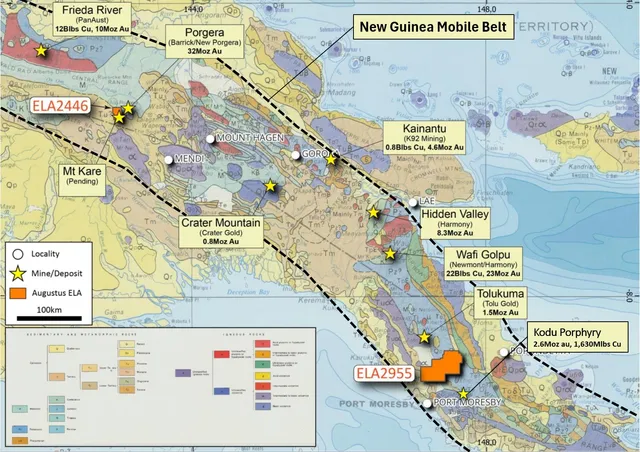
The Vancouver-based explorer said all five holes drilled at its 100%-owned Osena Project, immediately southwest of K92 Mining’s Kainantu gold-copper mine, intersected mineralised structures. Four step-out holes on the Megabe trend confirmed continuity from the northwest to the southeast, while a fifth hole identified mineralisation beyond the Megabe corridor.
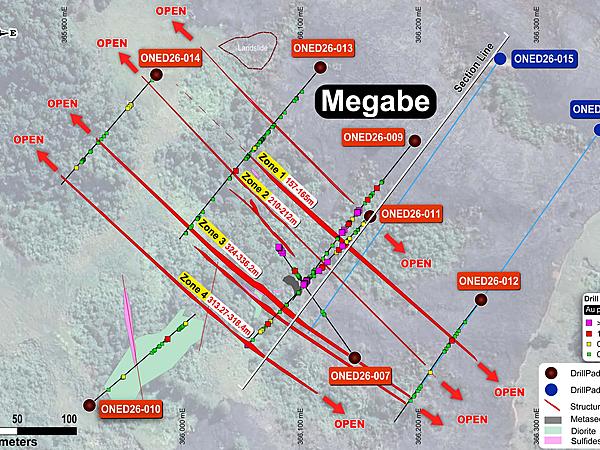
The latest results include 5.1 metres at 1.79 grams per tonne gold equivalent (AuEq), including three metres at 2.66 g/t AuEq, in hole ONED26-011. The intercept was identified as a potential fourth mineralised zone and was located beyond the window predicted by the company’s geological interpretation.
South Pacific Metals said the drilling has helped establish the geometry of the Megabe structures and provides a basis for targeting higher-grade mineralisation at depth.
High-grade targets
The company said four holes were designed to define the geometry and strike continuity of the northwest-trending Megabe structures, with each intersecting the targeted structures.
The mineralised trend now extends for more than 300 metres, while drilling limits rather than the structures themselves define the current boundaries of the system, South Pacific Metals said.
The step-out drilling intercepted the upper part of the system, above the interpreted productive high-grade zone and within a leached horizon that the company believes extends at least 100 metres below surface.
Follow-up drilling is now being directed towards the deeper portion of the system. The company plans to drill below and down-plunge to the southeast of discovery hole ONED26-009, which previously returned five metres at 12.84 g/t AuEq, including two metres at 28.06 g/t AuEq, and 12.2 metres at 6.24 g/t AuEq, including two metres at 16.65 g/t AuEq.
Chief executive Timo Jauristo said the latest drilling suggested the high-grade zones encountered in ONED26-009 may represent only the upper margins of the main system.
“We think the high-grade zones in hole ONED26-009 have only clipped the upper edges of the main system,” Jauristo said, adding that the company would drill deeper holes to test continuity of high-grade mineralisation.
Hole ONED26-010, drilled into a separate group of structures southwest of Megabe, returned 18 metres at 0.25 g/t AuEq, confirming that mineralised structures extend beyond the main Megabe corridor.
Broader Ontenu potential
The Megabe prospect forms part of the broader five-kilometre Ontenu prospective area, where the company has identified at least eight northwest-trending mineralised structures.
Only small portions of three structures — Jorkol, Onki and Megabe — have so far been drill-tested, leaving most of the identified targets undrilled.
Exploration manager Octavio Garcia said the step-out programme had confirmed several geological parameters, including the continuity and geometry of the mineralised structures.
He said geochemical results indicated potential for continuity beyond 300 metres of strike, while the company had also identified subparallel mineralised structures and local leaching similar to that observed at K92’s Kora vein.
The company believes the results provide evidence of an intermediate-sulphidation epithermal system comparable with neighbouring deposits, although further drilling will be required to establish its full extent.
Drilling has continued at Ontenu Central, where two of four planned holes have been completed and two are nearing completion. The programme is testing newly mapped northwest-southeast mineralised trends while drilling advances at Megabe.
South Pacific Metals said the next two Megabe holes would target higher-grade mineralisation below the current drilling and down-plunge to the southeast of ONED26-009.
The company said Megabe remains the most advanced of the eight identified structures at Ontenu, with further geological mapping and drilling planned across the broader prospective area.