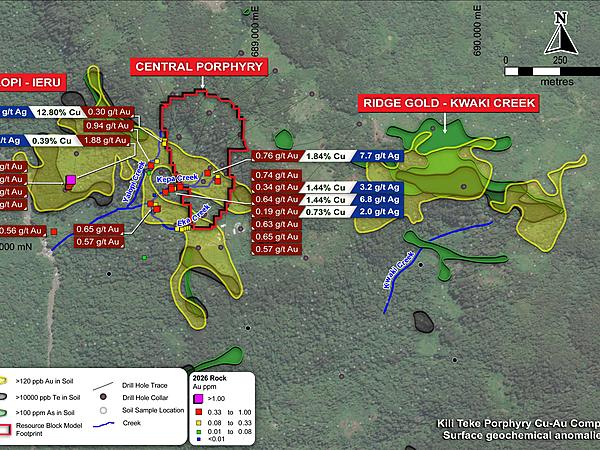
South Pacific Metals Corp has identified new copper-gold targets outside the existing mineral resource at its Kili Teke project in Hela province, Papua New Guinea, after surface sampling returned up to 12.8 percent copper, 0.30 grams of gold per tonne and 104 grams of silver per tonne.
The company said the results from its first-phase exploration programme strengthened evidence of mineralisation west and east of the Central Main Porphyry, which hosts a 237-million-tonne inferred resource. The resource contains 0.34 percent copper and 0.24g/t gold, equivalent to about 4.2 million ounces of gold equivalent.
The highest-grade surface result came from an outcrop sample collected from a massive sulphide unit along a north-south fault contact on the western margin of the Central Porphyry. The unit has been mapped for more than 200 metres and remains open.
South Pacific Metals said eight samples collected across part of a historic trench also confirmed mineralisation, averaging 0.36 percent copper and 0.72g/t gold.
The company is focusing its exploration on two areas outside the current resource: the Ieru-Yalopi zone west of the Central Main Porphyry and the Ridge Gold-Kwaki Creek area to the east.
At Ieru-Yalopi, the company is investigating a large gold-in-soil anomaly, the historic Ieru trench and the newly mapped massive sulphide unit. The historic trench returned 132 metres at 0.55 percent copper and 0.6g/t gold, including 27 metres at 0.97 percent copper and 1.25g/t gold.
At Ridge Gold, historic soil sampling returned gold values of up to 9,390 parts per billion, or 9.39g/t, within a strong gold-in-soil anomaly. The company said elevated tellurium could indicate an alkalic, Porgera-style target.
A 205-sample soil grid has been completed at Kwaki Creek, while mapping has identified additional altered and mineralised outcrops, including monzonite. The company said the target area is larger than previously understood.
South Pacific Metals exploration manager Octavio Garcia said the western and eastern targets were developing differently but were both providing useful information for exploration.
“On the western side we have strong outcrop exposure in the creek beds, including sulphide mineralisation we can trace along strike for a couple of hundred metres,” Garcia said.
He said Ridge Gold would be defined more by soil geochemistry than surface exposure, with the company now working to develop a properly ranked, structurally informed drill-target inventory.
South Pacific Metals is also assessing mineralisation at depth beneath the existing Central Main Porphyry resource.
Historical drilling by former operator Harmony Gold covered about 37,500 metres, with the existing resource defined within the upper portion of the porphyry centre. The company said several long and high-grade historical intersections extend below the current resource model, with some holes ending in mineralisation.
One historical hole, KTDD022, returned 187 metres at 1.10 percent copper equivalent, including 0.62 percent copper and 0.44g/t gold, from 501 metres.
Another hole, KTD025, intersected a high-grade skarn zone running 8 metres at 13.31 percent copper and 11.75g/t gold from 920 metres.
The company said these historical results point to potential mineralisation beyond the boundaries of the current resource model and will form part of its deeper targeting work.
South Pacific Metals has a further 205 soil samples and 60 rock samples awaiting assay. It is also undertaking geochemical analysis, structural work, mapping and interpretation, alongside planned LiDAR and airborne magnetic surveys to support drill planning.
The company expects to define drill-ready targets in the two priority areas by the end of October 2026, ahead of a planned maiden diamond drilling programme.
South Pacific Metals chief executive Timo Jauristo said the company's first exploration programme in almost a decade was providing evidence that Kili Teke could extend beyond the historically drilled Central Porphyry.
The company said the current programme represents the first systematic exploration at Kili Teke in about 10 years.