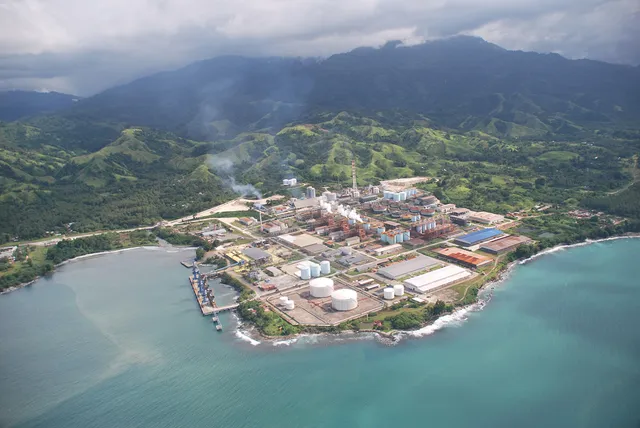
Geopacific Resources Ltd has reported a series of significant high-grade gold intersections from its latest drilling programme at the 1.98-million-ounce Woodlark Gold Project in Papua New Guinea, highlighting potential for resource growth and an extension of mine life.
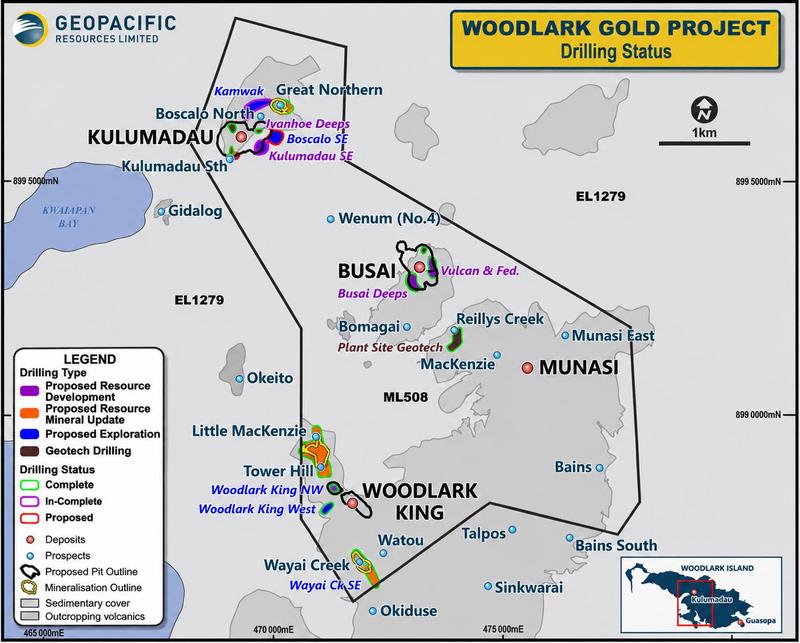
The Australian-listed company said results from 29 reverse-circulation and diamond drill holes confirmed mineralisation across several near-mine and regional targets, including Wayai Creek, Little MacKenzie, Woodlark King, Busai Deeps and Great Northern. The drilling was completed in May, with assays now received for all completed holes.
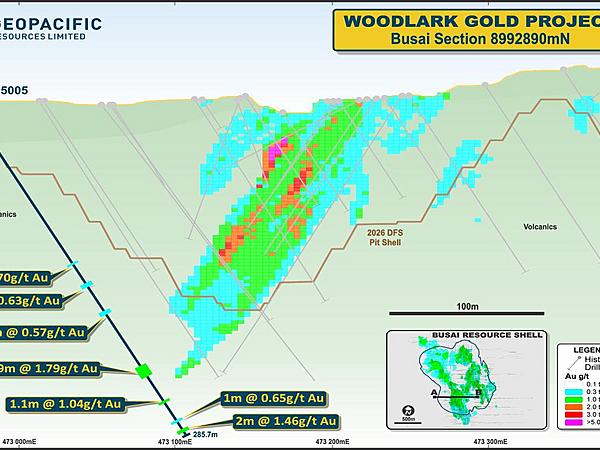
Among the strongest results was a 1.4-metre intersection grading 29.40 grams of gold per tonne from 257 metres at Busai Deeps. The same hole included a 0.4-metre interval grading 76.30g/t gold.
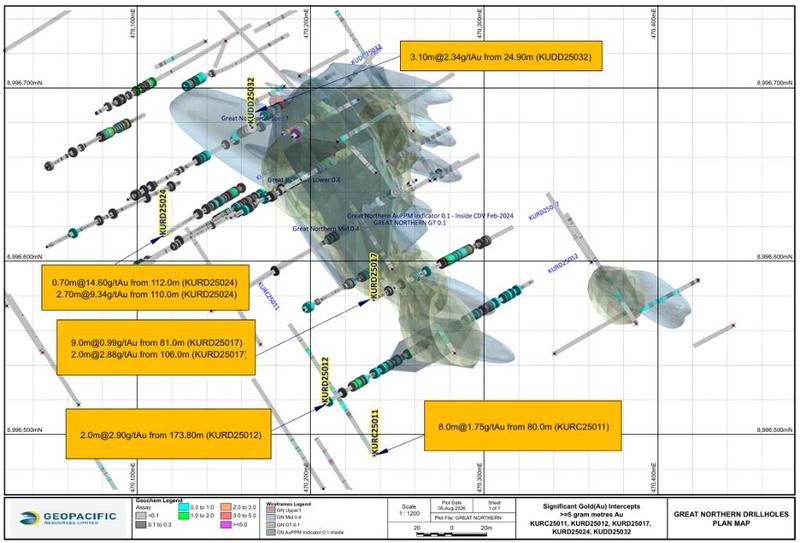
At Little MacKenzie, drilling returned 2.3 metres at 16.40g/t gold from 114.7 metres, while Great Northern produced 2.7 metres at 9.34g/t from 110 metres. Woodlark King NW also returned a broad 36-metre intersection at 1.48g/t from 60 metres.
Geopacific said the drilling was designed to test potential extensions to existing resources, evaluate emerging discoveries and improve geological understanding needed for future mine planning and development.
At Wayai Creek, drilling tested the southern extension of the main lode and increased drill density for future resource updates. Results included 9 metres at 4.20g/t gold from 141 metres, 11 metres at 2.38g/t from 44 metres and a higher-grade 2-metre interval at 13.40g/t from 59 metres.
The company said the results outlined a coherent zone of shallow, structurally controlled mineralisation, with several significant intersections occurring from surface to about 50 metres. It said this could support near-surface resource growth and improve confidence in the geological model.
At Little MacKenzie, drilling also returned broad mineralised intervals, including 7.2 metres at 3.30g/t gold from 97.8 metres, alongside higher-grade zones. Geopacific said the results supported its revised geological model and indicated that mineralised lodes remained continuous along strike and at depth.
The Woodlark King NW result of 36 metres at 1.48g/t was described as a broad and continuous mineralised zone, providing greater confidence in the geometry and grade distribution of the mineralised domain ahead of future resource updates.
The exploration results come after Geopacific completed a definitive feasibility study for Woodlark, which the company said confirmed the project as a technically robust development opportunity.
The study forecasts annual production of more than 100,000 ounces of gold at all-in sustaining costs below A$2,000 an ounce. It reported a post-tax net present value, discounted at 8 percent, of A$1.3 billion, a post-tax internal rate of return of 50.6 percent and an 18-month payback period.
Geopacific's current Woodlark mineral resource stands at 70.1 million tonnes grading 0.88g/t gold for 1.98 million ounces of contained gold. Its ore reserve totals 34.3 million tonnes at 1.09g/t for about 1.2 million ounces.
Geopacific managing director Hamish Bohannan said the latest drilling had strengthened the company's geological understanding of Woodlark and reinforced the scale of the project.
“The latest results from drilling across Woodlark continue to strengthen our geological understanding of the Project, reinforce the scale of the opportunity ahead of us and provide potential upside to the DFS,” Bohannan said.
He said the company was continuing to develop a pipeline of near-mine and regional exploration programmes, including testing extensions to known mineralisation beneath shallow cover in areas that had seen limited exploration.
Geopacific said it would now undertake detailed geological interpretation and review its geological models, while continuing surface geochemical sampling across selected targets. The company is also assessing the potential use of additional geophysical surveys to guide the next phase of exploration.