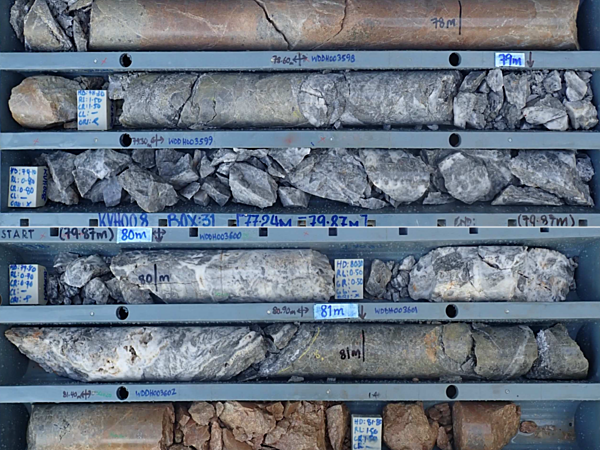
Great Pacific Gold Corp has confirmed broad, shallow gold mineralisation at the Kavasuki target in Papua New Guinea's East New Britain province, identifying a priority near-surface exploration window across its Wild Dog Project.
The company said its maiden diamond drilling programme at Kavasuki returned multiple broad gold intersections, including 58.90 metres grading 2.43 grams of gold per tonne (g/t) in hole KVH-01. The programme comprised 12 diamond holes totalling 1,844.8 metres and was designed to confirm historical mineralisation, test the continuity of the Kavasuki vein system and investigate historical geophysical anomalies.
Other significant results included 18.10 metres at 2.08g/t gold in KVH-01, 38.40 metres at 2.07g/t in KVH-03 and 59.90 metres at 1.38g/t in KVH-04. Higher-grade intervals included 1.20 metres at 17.93g/t and 2.20 metres at 15.78g/t.
The company said the strongest gold mineralisation identified to date is concentrated from surface to about 70 metres vertical depth, while the principal Kavasuki vein structure continues below the mineralised horizon.
Great Pacific Gold said drilling had refined its understanding of the Kavasuki system and established an elevation-controlled window for prospective mineralisation.
The Kavasuki target is a structurally controlled epithermal quartz-vein system within the 15-kilometre Wild Dog structural corridor. Drilling confirmed the historically reported mineralised intervals and demonstrated continuity of the main vein structure at depth. Better grades, generally between 1g/t and 2.5g/t gold, were concentrated within the shallow window, with narrow higher-grade zones reaching about 18g/t.
Great Pacific Gold said the deeper holes tested levels below the more favourable mineralised window and returned low concentrations of gold and associated pathfinder elements.
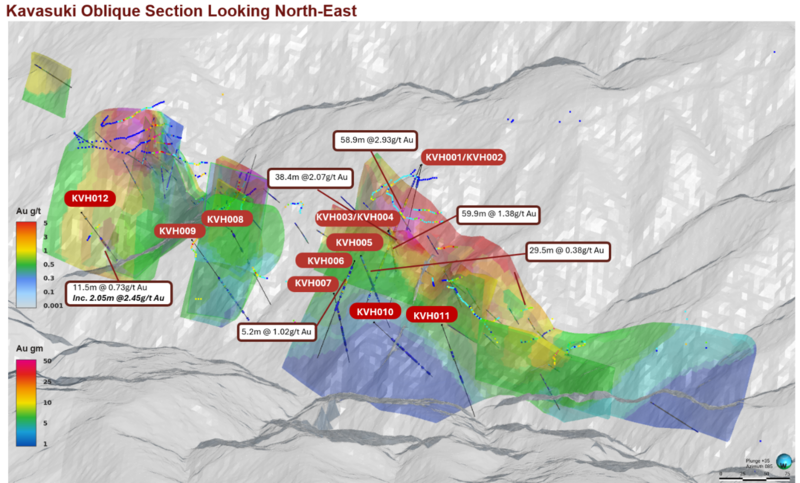
The company also revised its interpretation of historical three-dimensional induced polarisation, or 3DIP, data. It now believes the principal chargeability response at Kavasuki is associated with disseminated pyrite in an interbedded volcanic-siltstone sequence rather than directly with gold mineralisation.
The reinterpretation is expected to provide a new filter for ranking geophysical targets elsewhere along the Wild Dog corridor.
Great Pacific Gold chief operating officer and vice-president exploration Callum Spink said the maiden Kavasuki programme had achieved its core technical objectives.
“Our maiden programme at Kavasuki delivered broad zones of shallow gold mineralisation, including 58.9 metres at 2.43 g/t gold, and achieved its core technical objectives by confirming historical mineralisation, demonstrating continuity of the vein system at depth and resolving the principal source of the historical chargeability response,” Spink said.
He said the results provided the company with a clearer understanding of where higher grades occur and how to target the system, which would also help rank targets across the broader Wild Dog corridor.
Great Pacific Gold plans to undertake further surface work at Kavasuki, including priority trenching south of the drilled area where higher elevation could preserve the prospective mineralisation window.
The company will also conduct trenching and detailed mapping north towards Kavasuki Creek, including follow-up work on a known 3-4-metre-wide vein about 600 metres north-north-east of the drilled area that returned 4.4g/t gold. A future drill test is also planned for the ridge between Sinivit and Kavasuki, combining the revised 3DIP interpretation with the newly defined elevation window.
With Kavasuki drilling complete, Great Pacific Gold said its two diamond drill rigs had moved to Magiabe and Mengmut, ahead of work on the Morgan and EK targets.
The company also disclosed corrections to previously reported Kavasuki results following final database validation. The revised results supersede earlier releases, although Great Pacific Gold said no change was material to its interpretation of the results.
Great Pacific Gold cautioned that the reported drill intercepts represent core lengths and that true widths are not yet known. It also said some final multi-element assay results remain pending and that geological interpretations may be revised as additional data become available.