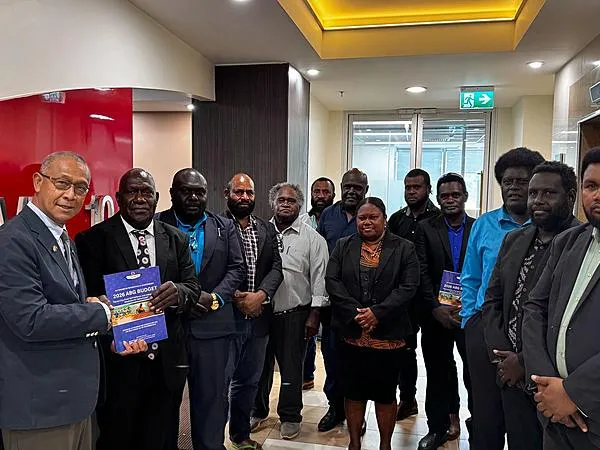
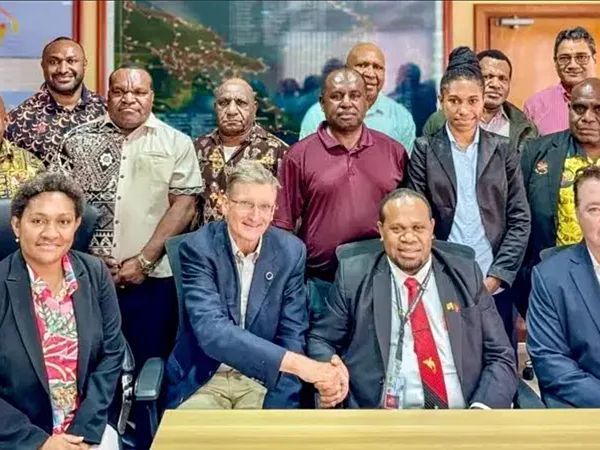
The Autonomous Bougainville Government (ABG) on 4 February presented its 2026 Budget Framework to the national minister for treasury, Ian Ling-Stuckey, in Port Moresby.
The budget totals K844.09 million and emphasises fiscal discipline and Bougainville’s readiness for independence.
ABG Minister for Treasury and Finance Albert Punghau presented the framework, outlining three priorities: protecting frontline services, supporting independence readiness and strengthening Bougainville’s own revenue base.
The Bougainville House of Representatives unanimously passed the budget in December 2025 under the theme “Advancing Fiscal Self-Reliance and Independence Readiness for Nationhood.”
The total appropriation includes K240.98 million, or 28.55 per cent, for recurrent expenditure to support essential services, and K603.11 million, or 71.45 per cent, for development projects, including infrastructure and economic investment.
Funding sources comprise national government grants of K520.36 million, ABG internal revenue of K46.75 million and reappropriated funds totalling K276.98 million.
“This balanced appropriation reflects our commitment to disciplined financial management and transparent resource utilisation,” Punghau said.
A key feature of the 2026 budget is the Constituency Independence-Readiness Programme, which allocates K1 million per constituency to support local economic activities and community-driven projects. The programme operates under Bougainville Executive Council-endorsed guidelines, with verified outputs and transparent controls.
The K150 million Restoration and Development Grant prioritises infrastructure rehabilitation, with 32 per cent directed to projects that improve access, connectivity and service delivery.
More than 54 per cent of recurrent grants are allocated to health and education, reinforcing the ABG’s focus on human capital development.
Punghau reaffirmed the ABG’s commitment to accountability, confirming that outstanding audits from 2017 to 2023 will be addressed and that reporting standards will be maintained.
“The ABG will measure 2026 performance through tangible outputs, including completed and commissioned projects, improved service delivery, restored infrastructure functionality and visible progress toward economic productivity and institutional readiness,” he said.
The ABG continues its practice of early budget submission and remains among the first regional governments to present its budget to the National Treasury each year.
Punghau requested formal endorsement of the framework to allow the early release of first-quarter grants, ensuring continuity of services and smooth implementation in 2026.
The Bank of Papua New Guinea (BPNG) has officially launched a new K100 banknote into circulation, honouring the legacy of one of the nation’s most influential leaders, the Late Sir Julius Chan, marking one year since his passing.
Speaking at the national launch 27 on January at the Stanley Hotel in Port Moresby, BPNG Governor Elizabeth Genia said the new K100 note represents both a tribute to Sir Julius’s enduring contribution to Papua New Guinea and a reaffirmation of the country’s economic sovereignty and identity.
The launch follows a request made by Prime Minister James Marape last year for the central bank to design a new K100 banknote to honour Sir Julius Chan’s legacy. The note is now formally issued as legal tender and began circulation on January 28 through commercial banking partners across the country.
“This is an important national moment,” Governor Genia said, describing the K100 as a banknote that “moves through every part of our economy,” carrying trust, value and a story about who Papua New Guineans are as a people.
New K100 Note Design
Produced in partnership with long-standing printing partner Note Printing Australia (NPA), the new K100 banknote features a portrait of Sir Julius Chan alongside carefully selected cultural and historical symbols reflecting his leadership and Papua New Guinea’s heritage as a trading nation.
The front of the K100 banknote retains the iconic image of Parliament House, representing the nation’s sovereignty and identity. The National Crest of Papua New Guinea – a bird of paradise sitting on a Kundu drum and spear – also remains.
The new design is legal tender from today and represents a permanent transition to a new standard design for the K100 note.
Governor Genia acknowledged NPA Chief Executive Officer Malcolm McDowell and his team for understanding the national significance of the project and delivering a banknote that reflects the values that defined Sir Julius’s public life — care, discipline and respect.
The design incorporates the Toea armband from the Trobriand Islands, symbolising long-standing traditions of commerce and exchange that predate modern currency. Imagery of the New Ireland shark caller and a traditional canoe represent courage, skill and leadership, while the lakatoi sailing in the distance reflects historic trade routes and Papua New Guinea’s outward-looking future.
“These are not simply decorative elements,” Governor Genia said. “They carry meaning — meaning rooted in our history, culture and identity.”
Sir Julius Chan’s Foundational Role in BPNG
Governor Genia highlighted Sir Julius Chan’s pivotal role in establishing the Bank of Papua New Guinea itself. In 1973, as the country’s first Minister for Internal Finance, Sir Julius personally led negotiations to ensure Papua New Guinea would have not just a bank, but an independent central bank — professional, credible and uniquely Papua New Guinean.
She said Sir Julius understood that true independence included the ability to define national value, a principle reflected in his decision to name the country’s currency the Kina and the Toea, anchoring money in local culture, language and place.
“For the Bank of Papua New Guinea, Sir Julius Chan is not only a national leader,” Governor Genia said. “He is foundational to our institution.”
Governor Genia emphasised that a currency’s strength lies in the trust placed in it and its reach across the country. She said BPNG’s responsibility is to protect that trust through financial stability, sound policy and implementation of the National Financial Inclusion Strategy.
Through these efforts, the Bank works to ensure the value represented by the K100 note is accessible to all Papua New Guineans, including women, young people and communities in the most remote parts of the country.
The Governor also noted that the new banknote includes inclusive technology, with embedded features designed to assist people with vision impairment to use the currency independently and with dignity.
Circulation and Legal Tender Status
From January 28, the new K100 note was released into circulation through commercial banks, and all newly issued K100 notes will carry the updated design. Existing K100 banknotes will continue to circulate alongside the new version.
“As is standard practice, both designs remain legal tender,” Governor Genia said. “Both are worth exactly one hundred Kina. There is no loss of value — only an addition to our national story.”
She invited Papua New Guineans to reflect on the legacy of Sir Julius Chan when holding the new note — a leader of discipline, trade and vision, who believed Papua New Guinea could stand confidently among nations.
The Port Moresby Chamber of Commerce and Industry (POMCCI) has highlighted the critical role of industry-led reform in strengthening technical and vocational education and training (TVET) outcomes, as businesses across Papua New Guinea continue to grapple with skills shortages and rising workforce costs.
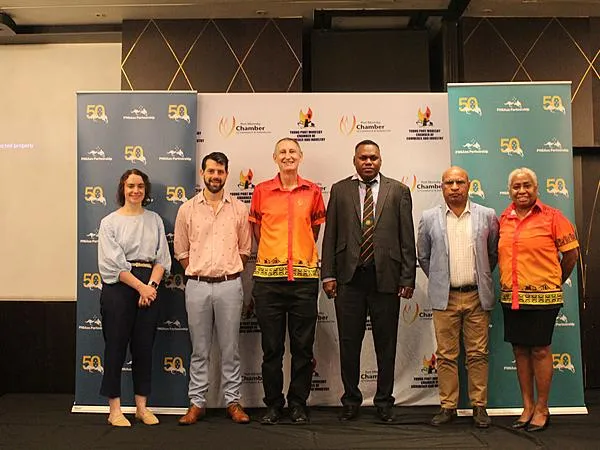
POMCCI and its members convened on 28 January for a Business Breakfast presentation on Higher Education and TVET reform, bringing together policymakers, development partners and the private sector to discuss how stronger collaboration can better align skills training with current and future workforce demand.
The presentation centred on a shared challenge facing employers across all sectors: the growing gap between training outcomes and job-ready skills. Speakers stressed that addressing this challenge cannot rest solely with government, but requires active and sustained engagement from industry to ensure training systems respond to real business needs.
Presentations at the breakfast highlighted several structural challenges within the TVET sector, including fragmented coordination, outdated curricula and limited alignment with real-world industry requirements. These issues have contributed to persistent skills shortages, increased reliance on imported labour, and higher recruitment and training costs for employers.
Current reform efforts aim to reposition technical and vocational education as a demand-driven system, where training programs are designed around the practical needs of employers and priority growth sectors such as construction, agriculture, hospitality and services.
For the private sector, the message was clear: stronger industry involvement in TVET leads to better-skilled graduates, improved productivity, and reduced recruitment and training costs, while also supporting long-term business sustainability.
A More Coordinated and Industry-Led Approach
Speakers outlined how ongoing reforms are strengthening national oversight, improving training quality and creating clearer pathways from training into employment. Central to this approach is a stronger role for industry in shaping skills priorities, contributing to curriculum development and supporting workplace-based learning opportunities.
Private sector engagement was highlighted as critical in identifying current and future skills needs, supporting work placements and apprenticeships, providing feedback on training relevance and graduate readiness, and partnering with institutions to strengthen overall training quality and outcomes.
This coordinated approach aims to ensure graduates enter the workforce with practical, consistent and job-ready skills, rather than qualifications alone — a shift seen as essential to improving productivity and competitiveness across PNG’s economy.
Opportunities for Business Collaboration
The session also outlined practical ways businesses can engage directly with the TVET system. These include participation in industry skills groups, partnerships with training institutions, and supporting structured pathways into employment for young people.
By working more closely with training providers and policy agencies, employers can play a direct role in shaping a workforce that meets operational needs, while also contributing to broader national development goals and long-term economic growth.
POMCCI extended its sincere appreciation to the speakers who contributed to the discussion.
Lonnie Baki, acting Secretary of the Department of Higher Education, Research, Science and Technology (DHERST), outlined the national reform agenda and emphasised the importance of aligning education systems with workforce demand.
Dr George Bopi-Kerepa, Project Manager for the Improved TVET for Employment (iTVET4E) Project, highlighted how industry partnerships can strengthen training relevance, access and employment outcomes.
Closing remarks were delivered by Jonathan Glenn, Inception Team Leader for the PNG–Australia Strongim Wok Long TVET (SWLT) Program, reinforcing the importance of collaboration between government, industry and development partners.
Through forums such as its Business Breakfasts, POMCCI continues to provide a platform for the private sector to engage meaningfully with policymakers and development partners on issues that directly affect business performance and economic growth.
POMCCI reaffirmed its commitment to fostering a vibrant, competitive and skills-ready business environment that supports sustainable growth for Papua New Guinea.
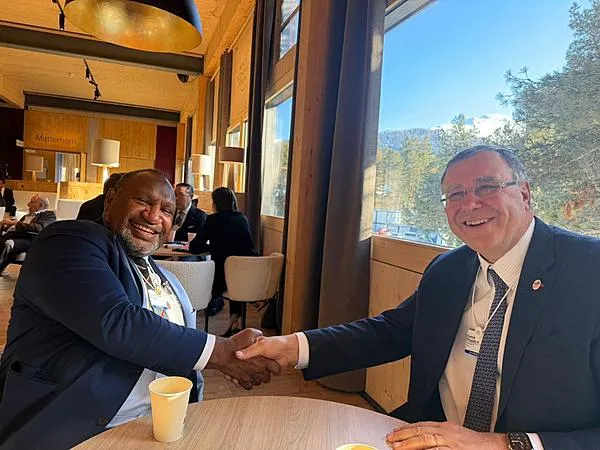
Prime Minister James Marape has confirmed that Papua New Guinea’s flagship resource projects, Papua LNG and Wafi-Golpu, remain top priorities for international investors following high-level engagements at the World Economic Forum in Davos, Switzerland.
Speaking to the media after returning to Port Moresby, Marape said discussions with key project partners reaffirmed strong commitment to advancing both developments in 2026.
“I made it absolutely clear – Papua LNG and Wafi-Golpu must move forward. There will be no warehousing of licences,” he said.
Marape confirmed meetings with senior executives from TotalEnergies and joint venture partners involved in Papua LNG, who assured the government that the project remains their leading priority.
“Papua LNG remains 100 per cent a focus project. Our task now is to cross the remaining dots while preserving the project’s value and return for both investors and the people of Papua New Guinea,” he said.
He said a state negotiating team is currently engaged in technical discussions overseas, with further engagement planned with international partners once alignment is reached.
The prime minister said the government expects a definitive announcement on Papua LNG later this year, ideally before Papua New Guinea’s Independence Day on 16 September.
“This is a project worth between US$13 billion and US$14 billion. It will be transformational for our economy,” he said.
On the Wafi-Golpu copper-gold project, Marape confirmed meetings with Harmony Gold executives, who provided assurances that the project also remains a priority.
A cabinet-appointed state peer review team has been established to address outstanding technical matters, after which the government will take a final position.
“I want the country to know: once we issue approvals, these projects must move straight to development. That commitment has been agreed,” Marape said.
He said both projects are central to unlocking billions of kina in economic activity, employment and downstream opportunities.
“These projects are not just about mining and gas – they are about building our economy towards a K200 billion future,” he said.
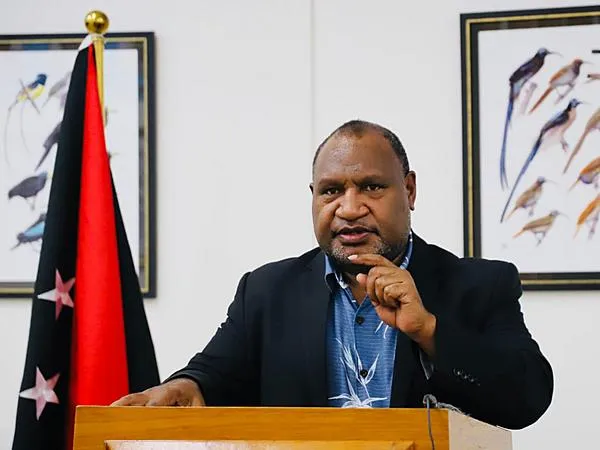
Prime Minister James Marape says Papua New Guinea is preparing to introduce artificial intelligence into government systems as part of a push to improve efficiency, transparency and fairness across public administration.
Speaking after returning from the World Economic Forum in Davos, Switzerland, Marape said discussions with global technology firms highlighted the potential for AI to reduce human bias and inefficiencies in government decision-making.
“We want non-emotional systems that select the best outcomes for the country,” he said.
Marape said AI could be applied to key areas including land administration, company registration, and licensing processes in mining, forestry and fisheries, as well as public service recruitment and government procurement.
“Our intention is to cut out nepotism, delays and corruption by using technology that applies merit-based principles,” he said.
The prime minister confirmed that several technology solutions encountered in Davos would be assessed through an open tender process, alongside proposals already being explored with international partners.
He said the adoption of AI would support national development goals and improve service delivery, while stressing that the technology was not intended to replace public servants.
“This is not about replacing people. It is about improving systems so public servants can focus on delivery,” Marape said.
He also pointed to growing global interest in digital infrastructure, data centres and clean energy as an opportunity for Papua New Guinea, noting that some international companies are exploring clean-energy-powered data centres.
“This is a new growth space for Papua New Guinea,” he said, adding that the integration of technology and renewable energy could form part of the country’s broader economic and development strategy.
The Department of Works and Highways (DWOH) has taken a major step towards modernising Papua New Guinea’s transport infrastructure with the launch of a consultancy to develop the country’s first legal and institutional framework for a railway network.
A pre-start meeting for the consultancy contract was held on 5 December, marking the commencement of planning for the proposed railway system. International law firm Leahy Lewin Lowing Sullivan (LLLS) has been awarded the contract to draft the legal framework that will underpin railway development in PNG.
The initiative is being led by the Railway Development Program Office within DWOH, which is tasked with delivering the project through a phased implementation approach, with clearly defined milestones and deliverables.
Laying the Legal and Institutional Foundations
The structured approach is expected to provide certainty for stakeholders while establishing the legal and institutional foundations required for PNG’s first railway transport network. Secretary for Works and Highways Gibson Holemba highlighted the importance of the consultancy in ensuring the long-term success and sustainability of the project.
“This initiative is about positioning government, technical experts, and legal partners to work together in delivering a complex, nation-building project,” Secretary Holemba said.
He explained that the initial phase of the railway network is planned along the Markham stretch of the Highlands Highway in Morobe Province, connecting the main port in Lae to Watarais.
“This railway is expected to significantly reduce heavy traffic volumes on the Highlands Highway and ease pressure on road infrastructure linking the Highlands Region,” he said. “Once operational, it will play a critical role in supporting key economic sectors, particularly mining and agriculture.”
Secretary Holemba also noted that the consultancy goes beyond drafting legislation. It represents a strategic effort to create an enabling environment for investment, coordination, and long-term infrastructure planning.
Opportunities for Business and Economic Growth
For the business community, the railway development signals new opportunities across construction, logistics, resource transport, and regional economic growth as PNG moves toward a more diversified transport system.
Representing LLLS, Managing Partner Michael Sullivan emphasised the strategic importance of expanding PNG’s land transport options. While rail transport is not entirely new to the country—having been used during the pre-independence era—modern challenges, particularly land compensation and security concerns, require updated legal solutions.
“These factors make it critical to have a clear and comprehensive legal framework in place before construction begins,” Sullivan said. He added that the consultancy will focus on addressing these challenges in a practical and commercially viable manner.
The launch of the consultancy marks a critical milestone in PNG’s journey toward a modern rail network and a more integrated, efficient transport system.
The establishment of the Gobo Girls School of Excellence in Jimi District, Jiwaka Province, Papua New Guinea, is emerging not only as a landmark education project but also as a catalyst for local business growth, employment creation, and rural economic participation.
“From the beginning, the school was designed to benefit the local economy, not just the education sector,” said Minister Wake Goi.
Following a recent board meeting, the first all-girls school of its kind in Jiwaka announced its operational readiness. Backed by more than K5 million in combined government, donor, and private sector contributions, the project reflects a growing model in PNG where education infrastructure also delivers tangible economic benefits to surrounding communities.
Education Investment with Economic Spillover
The School of Excellence, headed by the member for Jimi District and Minister for Aviation, Minister Wake Goi, is designed to deliver specialised science education to young women, with an initial intake of approximately 150 students drawn exclusively from the province. While the academic vision is ambitious, the economic footprint of the school is already being felt at the local level.
According to information obtained through an exclusive interview with PNG Business News, the school’s development has intentionally prioritised local participation across construction, supply chains, and ongoing operations, creating opportunities for small and medium enterprises (SMEs) and village-based producers.
“Education infrastructure like this creates ripple effects across the local economy, from farming to services to employment,” Minister Goi said.
Local SMEs and Village Producers Integrated into Supply Chain
One of the most immediate business impacts will come through food supply arrangements. All fresh produce and food supplies for students and teachers will be sourced from surrounding villages, ensuring a steady market for local farmers.
“All food for students and teachers will be sourced from nearby villages, creating a guaranteed market for local farmers and small producers,” Minister Goi said. “This school will provide long-term demand for local produce, which is a major opportunity for village-based SMEs and farmer groups.”
This arrangement effectively embeds subsistence and small-scale agricultural producers into a formal institutional supply chain, providing predictable demand and income. For rural SMEs and farmer groups, the school represents a long-term buyer that can support business planning, crop diversification, and cash-flow stability.
While private sector support has been confirmed, the identities of business contributors have not been disclosed due to sensitivities around political perceptions.
“There has been support from the business community, but the focus has always been on community benefit rather than publicity,” he said. “The priority is ensuring the school operates successfully without creating political misunderstandings around funding,” he added.
Construction and Employment Opportunities for Local Workers
The development phase of the school has already generated employment for more than 500 local tradespeople and caretakers, particularly in the construction of classrooms and teachers’ housing. Community members have been engaged in building works, ensuring that project funds circulate within the local economy rather than being externalised.
In addition to construction jobs, the school will provide ongoing employment opportunities for local residents as security personnel and support staff, further reinforcing the project’s role as a long-term employer in the district.
“Local people have been engaged to build the school and teachers’ houses, ensuring project funds stay within the community. Beyond construction, the school will continue to employ local residents in support and security roles,” Minister Goi said.
“This is not a one-off project — it creates ongoing jobs and income for families in the area,” he added.
Growing Institutional Presence in Jiwaka Province
The opening of the Gobo Girls School of Excellence will increase the number of secondary and high schools in Jiwaka Province from 25 to 26, strengthening the province’s education infrastructure.
The Teaching Service Commission has approved 20 teaching positions under the Secondary Salary Structure, focused on recruiting high-quality science specialists. The appointment process is underway, with oversight from provincial education authorities. Requests are also being made to expand leadership positions within the school, including additional Heads of Department, to ensure strong governance from the outset.
Minister Goi has committed to providing essential start-up resources, including desks and chairs, a tipper truck, food supplies, and stationery. Accommodation for teachers is already in place, with a 13-room headmaster’s residence completed and serving as interim housing until additional teachers’ houses are built.
Tuition Fee-Free (TFF) funding is yet to be confirmed, but the Minister has pledged personal financial support to ensure the school commences operations without delay.
“The school will become a permanent institution in the province, supporting livelihoods long after construction is completed,” Minister Goi emphasised.
Headmaster Johnmar Cudal confirmed that the school will commence operations this year, with a strong focus on academic performance and accountability to parents, reinforcing confidence in the institution’s long-term sustainability.
Papua New Guinea’s newly appointed Minister for the Department of Works and Highways, Peter Tsiamalili Jr, has called for integrity, accountability and uncompromising quality in the delivery of national infrastructure, as he formally assumed office following the passing of former Minister Hon. Solan Mirisim, MP.
Minister Tsiamalili was officially welcomed by the Secretary for Works and Highways, Mr Gibson Holemba, and departmental staff during a ceremony at the Works Headquarters in Port Moresby on January 26 this year. His appointment follows the death of Hon. Mirisim, who passed away in December 2025 after a brief illness.
In his inaugural address, Minister Tsiamalili emphasised that the future of PNG’s infrastructure development depended not only on roads and bridges, but on strong people, systems and values that protect state assets and deliver long-term national benefit.
“Today is more than a welcome ceremony. It is a moment of alignment,” the Minister said.
He described infrastructure as the “lifelines of our people” and a decisive factor in access to healthcare, education, markets and opportunity. The Minister further stressed that while political leadership provides direction, public servants deliver the nation, calling on officers across the department to recommit themselves to service, discipline and results.
Minister Tsiamalili made it clear that public frustration with unfinished or poor-quality infrastructure projects must be addressed.
“The people are tired of promises without progress,” he said. “They are tired of roads completed on paper but broken on the ground.”
He outlined a clear shift in departmental culture, anchored on integrity, discipline, accountability, performance and pride in workmanship, and reaffirmed the Government’s infrastructure vision under the Connect PNG agenda.
“Our theme is simple but powerful: Connect PNG Now to Build Our Future,” he said, noting that national connectivity is fundamental to economic growth, service delivery and social unity.
To achieve this, the Minister called for stronger internal alignment across planning, funding, procurement, supervision, reporting and leadership, with a renewed focus on transparency and quality.
“I want every project we touch to carry one signature: quality,” he said, rejecting shortcuts, weak standards and certification without proper delivery.
He announced plans to strengthen project controls, contract discipline, audit and compliance mechanisms, and on-site supervision, stressing that every wasted kina represents a missed development opportunity.
Message to the Department
Addressing staff directly, Minister Tsiamalili reminded officers of the broader national impact of their work.
“When you put on your yellow uniform, you are not just coming to work—you are building a nation,” he said, adding that enforcing standards and standing up for integrity protects lives, public investment and the department’s honour.
The address concluded with a dedication of the department’s work to God, with prayers for wisdom, fairness, unity and protection for workers on the ground.
“We are not here to manage decline. We are here to deliver progress,” the Minister said.
Transition Marked by National Loss
The appointment of Minister Tsiamalili follows the untimely passing of Hon. Solan Mirisim, the Member for Telefomin and former Minister for Works and Highways, who died on 2 December 2025 at the age of 47 after being rushed to Port Moresby General Hospital.
Mr Mirisim was a three-term Member of Parliament, first elected in 2012 and re-elected in 2017 and 2022. Over his political career, he held several key portfolios, including Forestry, Defence, and most recently Works and Highways under the Marape–Rosso Government.
Works Secretary Gibson Holemba described his passing as a profound loss to the department and the nation, adding that Mr Mirisim was widely respected as a nationalistic leader committed to connecting rural communities to markets and essential services.
Champion of Rural Connectivity
Hon. Mirisim is best remembered as a driving force behind the Connect PNG Program, which advanced road and bridge infrastructure into some of the country’s most remote and landlocked regions.
Under his leadership from 2022 to 2025, the program delivered major highway developments and missing-link projects, including the Telefomin–Tabubil Highway, the extension of the Magi Highway from Port Moresby to Alotau, and progress on the Trans-National Highway linking Morobe, Gulf and Port Moresby.
He also oversaw landmark initiatives such as the construction of the country’s longest footbridge at Papa–Lealea, forestry reforms promoting downstream processing and sustainability, and the push to increase the Infrastructure Tax Credit Scheme threshold from 2 per cent to 3 per cent.
Born and raised in Telefomin, Mr Mirisim was a businessman and community advocate before entering politics. He held a Certificate in Business Management from Lae Business College and remained deeply connected to the needs of rural Papua New Guinea throughout his career.
Late Minister’s Final Return Home
On 17 December 2025, the body of the late Minister arrived in Telefomin, where it was received by family members, community leaders, and a high-level delegation of national and regional leaders, marking a solemn moment of national reflection.
Leaders from the Greater Sepik region, senior government officials, and representatives from Ok Tedi Mining Limited paid tribute to his humility, leadership and enduring contribution to national development. Madang Governor Hon. Ramsey Pariwa described the Connect PNG Program as a lifeline for rural communities, while OTML Managing Director Mr Kedi Ilimbit emphasised the importance of honouring leaders who leave a lasting legacy.
Carrying the Legacy Forward
As the Department of Works and Highways enters a new chapter under Minister Peter Tsiamalili Jr, the transition marks both a renewed commitment to reform and a continuation of the infrastructure vision championed by the late Hon. Solan Mirisim.
While the nation mourns the loss of a dedicated leader, the Government has signalled its intent to build on his legacy—strengthening systems, delivering quality infrastructure and ensuring that connectivity remains central to Papua New Guinea’s economic and social future.
The Securities Commission of Papua New Guinea (SCPNG) will embark on major capital market reforms this year in collaboration with the Papua New Guinea National Stock Exchange (PNGX) and other stakeholders.
The announcement was made by the Minister for International Trade and Investment, Richard Maru, during the official launch of the Licensing Module of the Centurion Enterprise System for SCPNG in Port Moresby.
“The launch today marks a significant milestone in the digital transformation of PNG’s capital market regulatory framework. This is a major advancement in SCPNG’s digital transformation agenda, providing an efficient, secure and automated platform for licensing and onboarding of capital market participants,” said Minister Maru.
The Licensing Module is expected to streamline licensing processes, enhance the integrity, security and reliability of regulatory records, improve turnaround times and operational efficiency, strengthen investor confidence and market transparency and align PNG’s capital market regulation with international best practice.
Under the new system, licence applicants will be required to be registered with the Financial Analysis and Supervision Unit (FASU), reinforcing regulatory coordination and establishing direct linkages among peer regulators within PNG’s Anti-Money Laundering and Counter-Terrorism Financing (AML/CTF) framework.
“This system reflects the Government’s commitment to modernising public institutions and creating a regulatory environment that is efficient, investor-friendly and internationally credible. The Licensing Module positions the Securities Commission as a modern, digitally enabled regulator, reinforcing trust, accountability and operational excellence across the capital market. The system will strengthen market entry compliance, including enhanced fit and proper assessments of licence applicants. It also strengthens PNG’s ability to safeguard financial integrity, uphold international standards and protect investors,” said Minister Maru.
“A well-regulated capital market is essential for attracting investment, promoting economic diversification and supporting PNG’s long-term development aspirations under Vision 2050 and the Medium-Term Development Plan IV (2023–2027),” he added.
Beyond the enterprise system rollout, SCPNG, in partnership with PNGX and other stakeholders, will pursue broader reforms, including streamlining regulation, introducing tax incentives for listed companies and investors, enhancing the trading platform, expanding investor education and introducing new financial instruments such as green bonds.
Minister Maru said PNG’s capital market remains a frontier market facing significant structural challenges.
“The PNG capital market, primarily represented by the PNGX, remains a frontier market characterized by high concentration and limited liquidity. The market continues to face the structural challenges like limited market dept and liquidity, outdate tax regime and regulatory hurdles that hinder investments and discourage listings at the exchange. The number of listed entities has remained relatively static over the last few years. As of January 2026, there are only 12 listed companies on the PNGX- 8 Local Domestic Entities and 4 Foreign (Dual-Listed) Entities. The market is heavily "top-heavy," meaning a few massive companies (like Santos and BSP) account for the vast majority of its value. The Total Market Capitalization is approximately K135 billion to K140 billion. The liquidity remains extremely low and in terms of volume, it is common for only 4 to 5 securities to see any trading activity in a given week with a turnover ratio of often less than 1percent of total market cap annually. Most shares are held by large institutional investors Nambawan Super who "buy and hold," leaving very little "free float" for daily trading.”
He said the capital market nevertheless holds significant potential to drive economic growth and development, outlining a suite of reforms aimed at transforming PNGX from a dormant exchange into a catalyst for growth.
Supply-Side Policies (Increasing Listings)
Partial privatisation of state-owned enterprises through the listing of minority stakes to provide blue-chip domestic investment options.
Listing incentives, including tax breaks or reduced corporate tax rates, to offset compliance and transparency costs.
Establishment of an SME or “junior” board with lower entry requirements for growing local businesses.
Demand-Side and Liquidity Policies
Relaxation of foreign exchange restrictions to encourage foreign investor participation.
Incentives for retail participation, including micro-investing platforms and mobile applications.
Development of a secondary market, including a corporate debt and bond market, alongside equities.
Structural and Technical Reforms
Automated trading and settlement, transitioning to a fully digital, T+2 settlement system.
Mandatory local listing requirements for major foreign resource projects to ensure national participation in the financial sector.
Additional measures under consideration include taxation reforms or government intervention to reduce or exempt taxes for initial public offerings, private capital raisings and listings, compulsory listing requirements for companies doing business in PNG and enhanced regulatory powers to improve product clarity and oversight.
“By reforming our capital market and tax regime, we can attract investment, boost local businesses and drive PNG’s economic growth. We will establish a robust SCPNG Board to drive these reforms forward. This new Board will focus on policy development of the capital market to enable better transparency, accountability and effectiveness in the overall function of the Securities Commission. This will be a pivotal step towards strengthening our financial sector,” said Minister Maru.
He also announced that the inaugural Capital Market Summit will be held in May, featuring global experts who will share insights on reforming and expanding PNG’s capital market.
“In Fiji, the corporate tax rate for companies listed on the South Pacific Stock Exchange (SPX) is generally lower than the standard corporate rate to encourage public listing and investment. As of the current 2025–2026 fiscal cycle, the rate for listed companies was 15 percent and 25 per cent for the standard companies (unlisted). Beyond the lower income tax rate, companies listed on the SPX enjoy several other tax benefits including Tax-Free Dividends, Capital Gains Exemption, Listing Expense Deductions and Trading Gains. We want to embark on such reform to attract more companies to list on the PNGX,” said Minister Maru.
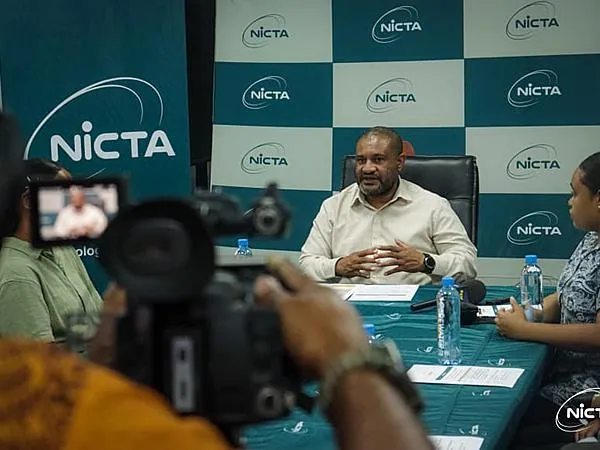
Since 2016, the National ICT Authority (NICTA) has supported more than 40 women to study Information and Communications Technology (ICT) and Science, Technology, Engineering and Mathematics (STEM)-related courses in-country.
The NICTA Girls in ICT Tertiary Scholarship Programme has been a cornerstone of development, contributing to government policies and national development goals.
This initiative, which began as NICTA’s commitment to a global campaign to bridge the gender gap in ICT participation, has since been domesticated and is well aligned with national goals and priorities in education and human capital development, providing opportunities for Papua New Guineans.
NICTA Acting Chief Executive Officer Polume Lume, when addressing the media at a press conference today, stressed the importance of the programme and how it aligns with government policy directives.
“This initiative directly addresses key national policies and agendas, including the National Gender Equity and Social Inclusion (GESI) Policy, the PNG Digital Transformation Policy and the National ICT Roadmap, which underline the need to address the unique challenges and opportunities faced by women and girls in the ICT and digital ecosystems.
“The Girls in ICT Tertiary Scholarship strongly underpins the Government’s education policy by ensuring that girls have equal access to quality education, safe learning environments and opportunities to complete their schooling, aligning with PNG’s Vision 2050 and national development goals.
“It aims to empower graduates to contribute to the implementation of current ICT policies focused on cyber and digital transformation, including the Digital Transformation Policy (2020), the Digital Government Act (2022) and the Cybersecurity Policy (2021).
“These frameworks seek to modernise government services, strengthen cybersecurity and build digital skills—areas where new graduates, such as Girls in ICT scholarship recipients, can actively contribute through innovation, technical expertise and community engagement,” Mr Lume said.
NICTA remains committed to creating an enabling environment where girls and women have equal access to ICT education, training and career opportunities.
The scholarship demonstrates NICTA’s shared commitment to inclusivity, encouraging socio-economic growth.
Applications for this year’s scholarship close at the end of February 2026.
Papua New Guinea has taken a decisive step toward reshaping its land governance framework, placing customary land reform at the centre of the country’s human rights, economic development and sustainability agenda.
Chairperson of the Special Parliamentary Committee on Customary Land and Land Reforms, Keith Iduhu, underscored the urgency of protecting customary land systems while unlocking their potential to drive inclusive economic growth.
Iduhu was speaking at the High-Level Seminar on Customary Land and Human Rights held at APEC Haus in Port Moresby on Jan. 22. The seminar, organised in partnership with the United Nations in Papua New Guinea, brought together senior government leaders, development partners, civil society organisations and customary landowners.
The discussions focused on how international human rights standards can guide land governance reform in a country where approximately 97 per cent of land remains under customary ownership.
Despite marking 50 years of independence, Iduhu said colonial-era land laws and administrative systems continue to shape land governance in ways that disadvantage Indigenous landowners.
“Indigenous Peoples in Papua New Guinea are the custodians of our land, sustaining one of the world’s richest reservoirs of biodiversity, primary forest cover and cultural heritage,” he said. “Yet our country continues to experience land-related disputes and violence traceable to historic dispossession and alienation.”
Nationwide consultations conducted by the parliamentary committee revealed persistent challenges, including land grabbing, fraudulent transactions, forced evictions, informal settlements, internal displacement and growing climate-related pressures. The consultations also highlighted serious gaps in legal protection, enforcement and access to justice, particularly for vulnerable groups.
According to Iduhu, Papua New Guinea is at a critical development crossroads, with land reform emerging as a foundational issue for long-term economic and social stability.
“The way forward is clear, we must end land-related violence and corruption, safeguard the rights of Indigenous landowners to determine their own development priorities, ensure free, prior and informed consent, and recognise restitution as the primary remedy for historic land loss,” he said.
He confirmed that Parliament made significant progress in 2025 through amendments to the Lands Act and the introduction of new laws aimed at strengthening land governance. Building on these reforms, a Customary Land Reform Bill proposed by the committee is now being prepared for tabling in Parliament.
Customary Land Reform Bill in focus
The proposed legislation seeks to reform the legal framework governing the recognition, registration, governance and use of customary land, while harmonising customary practices with constitutional principles.
Key elements of the reform include strengthening land group incorporation mechanisms, establishing clearer dispute resolution processes, improving oversight and accountability, and ensuring decisions affecting customary land are grounded in free, prior and informed consent obtained through good-faith processes.
Iduhu said the reforms would position Papua New Guinea at the forefront of sustainable development by aligning national laws with international human rights standards.
Human rights and economic development
As a state party to the International Covenant on Economic, Social and Cultural Rights, Papua New Guinea has a legal obligation to progressively realise rights such as adequate housing, where secure land tenure is a critical component.
United Nations representatives at the seminar reaffirmed that secure and equitable access to land is essential to eradicating poverty, guaranteeing an adequate standard of living and protecting the right to a clean, healthy and sustainable environment.
“Land is far more than an economic commodity,” Iduhu said. “It is the basis for social, cultural and religious practices, and central to identity and community life.”
He also highlighted the disproportionate impact of poor land governance on women, stressing their right to own, use and control land and property on an equal basis with men.
Indigenous rights and UNDRIP
The seminar reaffirmed Papua New Guinea’s obligations under the United Nations Declaration on the Rights of Indigenous Peoples, which recognises Indigenous Peoples’ collective rights to lands, territories and resources traditionally owned or occupied.
UNDRIP explicitly prohibits forced removals from ancestral land and requires free, prior and informed consent, fair compensation and, where possible, the option of return. These protections are reinforced by International Labour Organization Convention 169.
The declaration also affirms Indigenous Peoples’ right to self-determination, allowing them to freely pursue their economic, social and cultural development.
Government reform agenda
Deputy Prime Minister and Minister for Lands, Physical Planning and Urbanisation John Rosso delivered the keynote address, describing the seminar as timely as the government advances major land reforms.
Rosso urged that land reform must move beyond theory and deliver tangible social and economic benefits to traditional landowners.
“With nearly 90 per cent of our land under customary ownership, this is a unique national resource,” he said, warning landowners against selling land for minimal short-term gains.
Instead, he encouraged communities to work with the Department of Lands to transform customary land into bankable assets that support long-term prosperity.
“The Land Partnership Program provides a structured and voluntary pathway for customary landowners to partner with the State and responsible investors to develop their land,” he said. “Under this program, land titles go to customary owners, income is managed sustainably, and long-term benefits for families, clans and future generations are prioritized.”
Rosso outlined reforms underway to modernise land administration and support housing development, including digitisation of land systems, partnerships with developers to reduce construction costs, the First Home Buyer’s Grant, consideration of tax reforms including GST exemptions for housing, implementation of strata title laws and amendments to technical legislation administered by the Department of Lands and Physical Planning.
“These reforms are aimed at ensuring every Papua New Guinean has access to affordable housing and secure land titles that support home ownership, access to finance and economic inclusion,” Rosso said.
Both leaders agreed the national conversation is shifting from simply owning land to empowering landowners, ensuring customary land is protected by law while responsibly unlocked for development that benefits communities rather than a select few.
Iduhu acknowledged that while progress has been made, secure tenure remains elusive for many Papua New Guineans. He cited the findings of the 2005 and 2019 National Land Summits as a clear roadmap that must now be fully implemented.
“By grounding land reform in internationally recognised rights and human rights law, Papua New Guinea can pursue development that is sustainable, inclusive and respectful of future generations,” he said.
The two-day seminar is expected to produce concrete recommendations to guide Parliament, government agencies and development partners toward a more just, peaceful and sustainable land governance system for Papua New Guinea.
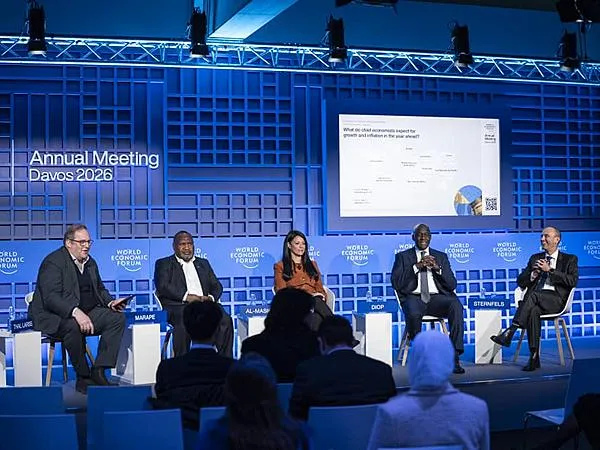
Papua New Guinea Prime Minister James Marape promoted the country as an investment destination of choice among global emerging markets during the 2026 World Economic Forum in Davos.
Speaking on a panel titled “Where are we with emerging markets?” at a WEF side meeting, Marape said Papua New Guinea’s economy has continued to grow despite heightened geopolitical tensions in the Pacific region.
He thanked the World Economic Forum for including Papua New Guinea in discussions on emerging markets and said the country’s geographic and political positioning underpins its appeal to investors.
“Papua New Guinea is placed in the middle of East and West, with our cultural affinity to the East and our democratic style of government with the West,” Marape said.
The prime minister said his government has pursued a foreign policy of “friends to all and enemies to none,” seeking to strike a careful balance in international relations while strengthening the country’s standing as an emerging economy in the post-COVID period.
As a result, he said, Papua New Guinea has recorded economic growth of more than 4 percent consistently over the past five years, while keeping inflation below the 50-year running average.
Marape said the government is working to diversify the economy away from its traditional reliance on mining and petroleum, with a greater emphasis on developing the non-resource sectors.
He told delegates that Papua New Guinea currently hosts two of the world’s largest oil and gas developers, TotalEnergies and ExxonMobil. ExxonMobil has operated the country’s flagship liquefied natural gas project since 2008, with first exports in 2014.
“Seventy percent of the US$22 billion project was bank financed, and that debt has recently been retired six months earlier than scheduled,” Marape said.
He said emerging markets are increasingly where new capital is concentrated, noting that capital “knows no boundaries” and will shift when markets become constrained or economic focus narrows.
Marape concluded by encouraging greater investment in emerging markets in South-East Asia and the Pacific, highlighting Papua New Guinea’s strategic location within the region.
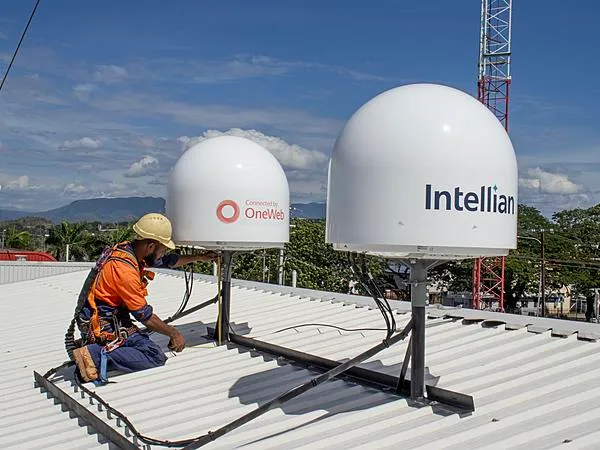
Technology and communications specialist TE (PNG) Limited has achieved a national first, receiving Papua New Guinea’s inaugural approval from the National Information and Communications Technology Authority (NICTA) to trial a fixed land OneWeb Low Earth Orbit (LEO) satellite service in Port Moresby. Live testing has now commenced, marking a significant milestone in the evolution of enterprise-grade connectivity across the country.
The approval enables TE PNG to conduct the first fully compliant, in-country OneWeb trial, positioning the company at the forefront of next-generation satellite communications in PNG. The trial is being delivered in partnership with Sat.One, with whom TE PNG has been working since 2022 to introduce OneWeb capabilities to the local market.
Built for Enterprise, Not “Best Effort”
OneWeb operates a global low-Earth-orbit satellite constellation engineered specifically for enterprise and government applications. Unlike consumer-focused LEO services, OneWeb delivers a managed, commercial-grade platform with defined performance profiles, traffic management, and the ability to design resilient, end-to-end enterprise architectures.
Compared to traditional geostationary (GEO) satellite services, OneWeb offers dramatically lower latency and higher responsiveness. More importantly for mission-critical operations, it provides predictability, control, and long-term supportability—attributes essential for sectors such as mining, maritime, aviation, utilities, government, and critical infrastructure, where connectivity reliability is non-negotiable.
Expanding Connectivity Options Across PNG
With NICTA approval now in place, TE PNG is able to design, deploy, and support a broad range of OneWeb solutions nationwide, including:
Fixed land OneWeb services for offices, sites, and facilities across Papua New Guinea
Mobile land solutions for vehicles and remote operations
Maritime OneWeb services for vessels operating within PNG waters
All services will be installed, monitored, and maintained locally by TE PNG as a licensed PNG provider, ensuring compliance, technical accountability, and on-the-ground support.
Industry Collaboration Years in the Making
TE PNG Managing Director Robbie Huxley described the milestone as the culmination of several years of groundwork and collaboration.
“I’ve been working with Sat.One to bring OneWeb services to Papua New Guinea since 2022. It’s incredibly rewarding to now be conducting the first fully fledged, fully approved OneWeb test in-country with the OneWeb team,” Huxley said.
He acknowledged the early foundations laid through previous satellite deployments, including the country’s first use of Kymeta flat-panel antennas for maritime and land-mobile applications using GEO connectivity.
“Daniel Fairbairn and I first met in 2022 to discuss what this could become. That early work laid much of the foundation for what we are doing today,” he said.
More Tools for Better Solutions
Huxley emphasised that OneWeb is not positioned as a replacement for existing services, but as another critical tool in a rapidly diversifying connectivity landscape.
“No single service is a one-size-fits-all answer. OneWeb, like Starlink, Amazon LEO, Intelsat, Digicel, Vodafone, and countless other technologies, simply gives us more options. More options mean we can design the right solution for each customer, rather than forcing every problem into the same box.”
A Step Forward for PNG’s Digital Resilience
The OneWeb trial represents a major step forward for resilient, high-performance connectivity in Papua New Guinea, particularly for organisations operating in remote, mobile, or high-risk environments.
“This is just the beginning,” Huxley said. “The satellite and connectivity landscape is changing rapidly, and we are proud to be part of that change—bringing new technologies and capabilities to PNG so our customers can operate, grow, and connect with confidence.”
As testing progresses in Port Moresby, the trial is expected to inform broader enterprise deployments, reinforcing PNG’s readiness to adopt advanced satellite technologies that support economic growth, national infrastructure, and digital transformation.
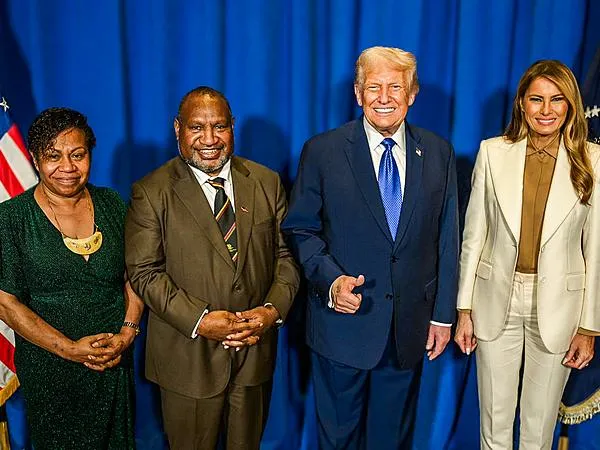
The U.S. Embassy in Port Moresby announced that Prime Minister James Marape met with U.S. President Donald J. Trump during the United Nations General Assembly (UNGA) in New York. The historic exchange underscores the strong partnership and close friendship between Papua New Guinea (PNG) and the United States.
The meeting follows a landmark visit to Port Moresby by Deputy Secretary of State Christopher Landau and head of U.S. Indo-Pacific Command Admiral Paparo to celebrate 50 years of PNG’s independence and of diplomatic relations with the United States.
Under the first Trump Administration, the United States reprioritised the Pacific Islands region in its foreign policy, advancing shared strategic objectives through economic growth, infrastructure development, connectivity, and security cooperation. The second Trump Administration has renewed its commitment to a free and open Pacific Islands region.
In July 2025, Prime Minister Marape visited Washington, D.C., meeting Vice President JD Vance, Deputy Secretary Landau, and senior defence leaders, including Admiral Christopher Grady. These meetings reaffirmed PNG’s importance to the United States and laid the groundwork for the U.S.-PNG Framework for Strategic Cooperation, signed in Port Moresby during the 50th anniversary celebrations. Following his meeting with President Trump, Prime Minister Marape has now engaged with the full spectrum of U.S. leadership, highlighting PNG’s central role in promoting a free, open, and secure Indo-Pacific.
During the September celebrations in Port Moresby, Deputy Secretary Landau hosted a U.S.-Pacific Islands Forum Roundtable, announcing a reinvigoration of partnerships and realignment of mutual priorities to deliver concrete benefits for both Americans and Pacific Islanders.
The Framework for Strategic Cooperation sets priorities for the next 50 years of U.S.-PNG relations, covering defence, maritime security, law enforcement, critical minerals, infrastructure, economic and commercial development, and the digital economy.
Security and Law Enforcement Cooperation
On 22 May 2023, the United States and PNG signed the Shiprider Agreement to counter maritime threats such as illegal fishing, drug trafficking, migrant smuggling, and illicit arms transport. Joint patrols under the agreement strengthen maritime governance in the Pacific and deter illegal activity in PNG’s Exclusive Economic Zone (EEZ). In 2024, U.S. Coast Guard cutters conducted two patrols with PNG authorities, carrying out 14 boardings to safeguard PNG’s maritime resources.
The United States is also investing $11 million in foreign military financing to enhance PNG’s humanitarian assistance, disaster relief, maritime security, domain awareness, and defence force professionalisation. PNG’s participation in the 2025 multilateral Exercise Talisman Sabre, including hosting a component outside Australia for the first time, demonstrates the PNG Defence Force’s growing regional role.
The U.S. Department of State’s Bureau of International Narcotics and Law Enforcement Affairs (INL) will provide a resident advisor from the Department of Homeland Security’s Federal Law Enforcement Training Centers (FLETC) to support police recruitment, training, and retention, aligning with Prime Minister Marape’s law-and-order agenda.
Economic Cooperation and Investment
The Framework also emphasises economic, commercial, and digital collaboration. U.S. businesses are major investors in PNG, including ExxonMobil, Newmont, Coca-Cola, Hilton, and Marriott. The 2022 launch of the American Chamber of Commerce Coral Sea provides an advocacy and networking platform for American companies in the region.
The American DGCI Corporation recently broke ground on a $498 million U.S.-funded fuel storage facility near Port Moresby Harbour. Implemented under the 2023 U.S.-PNG Defence Cooperation Agreement, the facility will create jobs, enhance energy security, and diversify the fuel market with a capacity of over 1.6 million barrels.
The Framework establishes policies to attract U.S. private sector investment, promote sustainable critical minerals development, expand trusted digital infrastructure, and strengthen cybersecurity practices.
Shared History and Future
The U.S.-PNG relationship extends beyond government cooperation to people-to-people connections. The U.S. Embassy facilitates scholarships and visas for PNG students and supports sister city partnerships linking Port Moresby with Long Beach, California, and Madang with Poplar, Wisconsin.
In celebration of PNG’s 50th independence anniversary, five young Papua New Guineans will participate in a three-week International Visitor Leadership Program in November under the theme “Youth in the Political Process,” reflecting investment in future leaders.
Celebrating 50 Years of Partnership
Deputy Secretary Landau and Admiral Paparo’s visit marked both PNG’s 50th Independence Anniversary and the 50th anniversary of U.S.-PNG diplomatic relations. The United States was among the first to recognise PNG’s independence in 1975. Deputy Secretary Landau said, “The United States is proud to mark 50 years of partnership with Papua New Guinea,” while U.S. Ambassador Ann Marie Yastishock emphasised the framework builds on five decades of shared values and vision.
The U.S. Embassy celebrates the meeting between Prime Minister Marape and President Trump, the visit by Deputy Secretary Landau, and the launch of a new era of U.S.-PNG partnership, demonstrating the United States’ commitment to peace, prosperity, and security in PNG and across the Pacific.
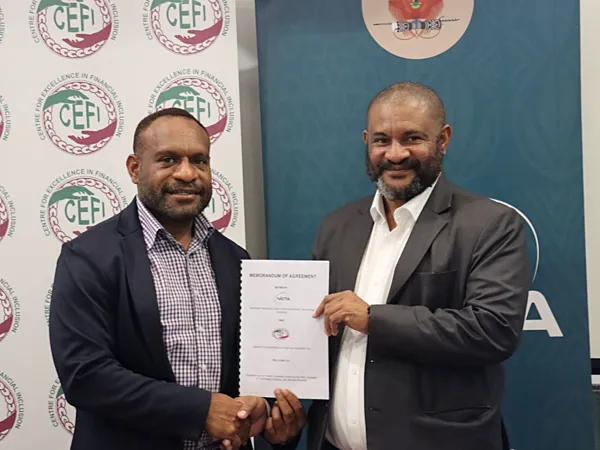
The Centre for Excellence in Financial Inclusion (CEFI) and the National Information and Communications Technology Authority (NICTA) have signed a two-year Memorandum of Agreement (MoA) to establish a dedicated Fintech Incubation Centre at the Papua New Guinea University of Technology (Unitech) Taraka Campus in Morobe Province.
The agreement was formalised on 12 January 2026, with CEFI Acting Executive Director Mr Peter Samuel and NICTA Acting Chief Executive Officer Mr Polume Lume signing the MoA at the Unitech campus.
The centre is designed to support the growth of home-grown financial technology solutions by offering mentorship, funding opportunities, technical expertise and networking support to aspiring fintech entrepreneurs nationwide.
Funding of up to K374,000 will be provided through NICTA’s Universal Access and Service (UAS) Trust Fund, enabling the procurement of fixed broadband connectivity and modern ICT equipment needed to establish a state-of-the-art facility.
Once operational, the incubation hub will provide high-speed internet, a well-equipped resource centre, business development support and access to financial expertise from CEFI, creating an environment that nurtures innovation in areas such as digital payments, mobile banking and other inclusive financial services tailored to the PNG context.
The initiative will place special emphasis on empowering women and youth in the digital economy and strengthening linkages between academia, government and the private sector.
CEFI said the partnership reflects a shared commitment to building a stronger fintech ecosystem that enhances financial inclusion and expands technology-led opportunities in Papua New Guinea.
If you’re pasting this into Word, InDesign, CMS, or email and still seeing size issues, tell me which platform and I’ll adjust it precisely for that format.
Prime Minister James Marape has launched a comprehensive review of Papua New Guinea’s state-owned enterprise (SOE) governance system, citing persistent blackouts, water shortages and underperformance as key concerns.
Speaking during Cabinet, Marape said the government is examining the entire Kumul Consolidated Holdings (KCH) structure and how major utilities, including PNG Power, PNG Water and Air Niugini, report through multiple governance layers.
“We are also looking at the entire KCH structure — how PNG Power reports to the mother board, how PNG Water reports to the mother board, how Air Niugini reports to the mother board,” he said. “I think a couple of layers of boards have become a quagmire. That in itself can be an impediment.”
The Prime Minister noted that excessive bureaucratic layers have delayed decisions, weakened accountability, and slowed urgent investment and maintenance.
“Our citizens have been laboring too much on blackouts, water issues — all of this,” he said. “We are taking a holistic look into all this.”
Fixing structure, not just politics
Marape emphasised that the review is not a political exercise or ministerial reshuffle but a structural reform of the “engine room” of service delivery.
“Just like we are looking at the entire central government structure, we are also looking at the KCH structure,” he said. “This review will not only be at Cabinet level, but more importantly at the structural level of these key government institutions.”
He said the goal is to create a streamlined, professional, and accountable system that allows SOEs to function efficiently while maintaining integrity, due process, and good governance.
“We want a structure that is tidy — that allows for expeditious work without compromising integrity, due process and good governance,” Marape said.
One-month deadline for reform blueprint
The Prime Minister said the government expects the review to be completed within a month, led by the Chief Secretary in close consultation with Cabinet.
“The Chief Secretary is under the pump this week and this month,” Marape said. “Today, as we start our Cabinet, we will be running this work so that we put in place the correct structure of government that is working to serve our people, come what may.”
Marape stressed the reform is designed to create a long-term, sustainable framework that will serve future governments after the 2027 General Election.
“In 2027, whoever takes office must inherit a structure that is already fit for service — not one they must struggle to fix,” he said. “We want a system that can serve our people better, not one that slows them down.”
The review will examine governance, reporting lines, board structures, and accountability frameworks across all major SOEs, with particular focus on electricity, water, and aviation — sectors critical to households, businesses, and national economic growth.
Follow on LinkedIn:
PNG Business News
Be the "First" to get our exclusive Digital Magazine & Weekly Newsletter.