

Papua New Guinea’s newly appointed Minister for the Department of Works and Highways, Peter Tsiamalili Jr, has called for integrity, accountability and uncompromising quality in the delivery of national infrastructure, as he formally assumed office following the passing of former Minister Hon. Solan Mirisim, MP.
Minister Tsiamalili was officially welcomed by the Secretary for Works and Highways, Mr Gibson Holemba, and departmental staff during a ceremony at the Works Headquarters in Port Moresby on January 26 this year. His appointment follows the death of Hon. Mirisim, who passed away in December 2025 after a brief illness.
In his inaugural address, Minister Tsiamalili emphasised that the future of PNG’s infrastructure development depended not only on roads and bridges, but on strong people, systems and values that protect state assets and deliver long-term national benefit.
“Today is more than a welcome ceremony. It is a moment of alignment,” the Minister said.
He described infrastructure as the “lifelines of our people” and a decisive factor in access to healthcare, education, markets and opportunity. The Minister further stressed that while political leadership provides direction, public servants deliver the nation, calling on officers across the department to recommit themselves to service, discipline and results.
Minister Tsiamalili made it clear that public frustration with unfinished or poor-quality infrastructure projects must be addressed.
“The people are tired of promises without progress,” he said. “They are tired of roads completed on paper but broken on the ground.”
He outlined a clear shift in departmental culture, anchored on integrity, discipline, accountability, performance and pride in workmanship, and reaffirmed the Government’s infrastructure vision under the Connect PNG agenda.
“Our theme is simple but powerful: Connect PNG Now to Build Our Future,” he said, noting that national connectivity is fundamental to economic growth, service delivery and social unity.
To achieve this, the Minister called for stronger internal alignment across planning, funding, procurement, supervision, reporting and leadership, with a renewed focus on transparency and quality.
“I want every project we touch to carry one signature: quality,” he said, rejecting shortcuts, weak standards and certification without proper delivery.
He announced plans to strengthen project controls, contract discipline, audit and compliance mechanisms, and on-site supervision, stressing that every wasted kina represents a missed development opportunity.
Message to the Department
Addressing staff directly, Minister Tsiamalili reminded officers of the broader national impact of their work.
“When you put on your yellow uniform, you are not just coming to work—you are building a nation,” he said, adding that enforcing standards and standing up for integrity protects lives, public investment and the department’s honour.
The address concluded with a dedication of the department’s work to God, with prayers for wisdom, fairness, unity and protection for workers on the ground.
“We are not here to manage decline. We are here to deliver progress,” the Minister said.
Transition Marked by National Loss
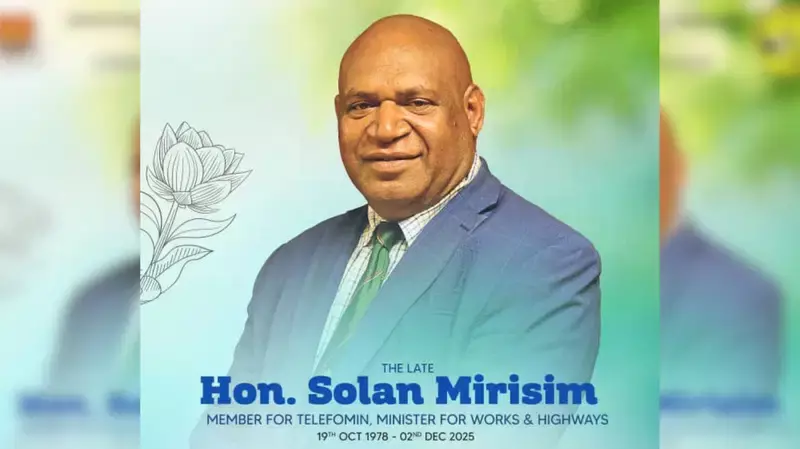
The appointment of Minister Tsiamalili follows the untimely passing of Hon. Solan Mirisim, the Member for Telefomin and former Minister for Works and Highways, who died on 2 December 2025 at the age of 47 after being rushed to Port Moresby General Hospital.
Mr Mirisim was a three-term Member of Parliament, first elected in 2012 and re-elected in 2017 and 2022. Over his political career, he held several key portfolios, including Forestry, Defence, and most recently Works and Highways under the Marape–Rosso Government.
Works Secretary Gibson Holemba described his passing as a profound loss to the department and the nation, adding that Mr Mirisim was widely respected as a nationalistic leader committed to connecting rural communities to markets and essential services.
Champion of Rural Connectivity
Hon. Mirisim is best remembered as a driving force behind the Connect PNG Program, which advanced road and bridge infrastructure into some of the country’s most remote and landlocked regions.
Under his leadership from 2022 to 2025, the program delivered major highway developments and missing-link projects, including the Telefomin–Tabubil Highway, the extension of the Magi Highway from Port Moresby to Alotau, and progress on the Trans-National Highway linking Morobe, Gulf and Port Moresby.
He also oversaw landmark initiatives such as the construction of the country’s longest footbridge at Papa–Lealea, forestry reforms promoting downstream processing and sustainability, and the push to increase the Infrastructure Tax Credit Scheme threshold from 2 per cent to 3 per cent.
Born and raised in Telefomin, Mr Mirisim was a businessman and community advocate before entering politics. He held a Certificate in Business Management from Lae Business College and remained deeply connected to the needs of rural Papua New Guinea throughout his career.
Late Minister’s Final Return Home
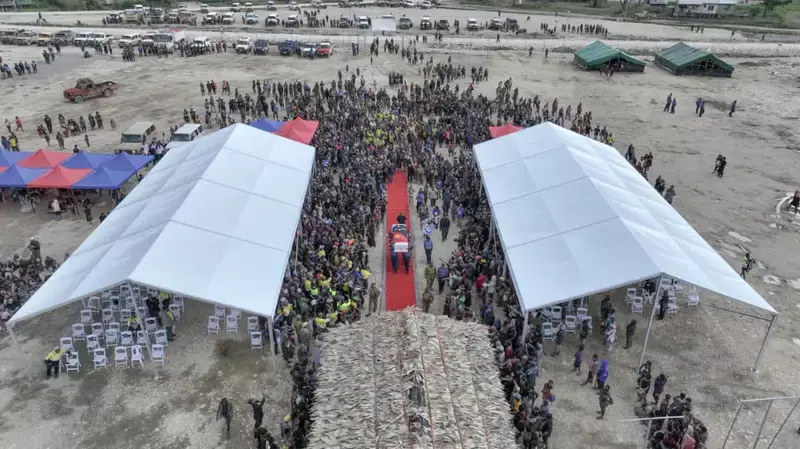
On 17 December 2025, the body of the late Minister arrived in Telefomin, where it was received by family members, community leaders, and a high-level delegation of national and regional leaders, marking a solemn moment of national reflection.
Leaders from the Greater Sepik region, senior government officials, and representatives from Ok Tedi Mining Limited paid tribute to his humility, leadership and enduring contribution to national development. Madang Governor Hon. Ramsey Pariwa described the Connect PNG Program as a lifeline for rural communities, while OTML Managing Director Mr Kedi Ilimbit emphasised the importance of honouring leaders who leave a lasting legacy.
Carrying the Legacy Forward
As the Department of Works and Highways enters a new chapter under Minister Peter Tsiamalili Jr, the transition marks both a renewed commitment to reform and a continuation of the infrastructure vision championed by the late Hon. Solan Mirisim.
While the nation mourns the loss of a dedicated leader, the Government has signalled its intent to build on his legacy—strengthening systems, delivering quality infrastructure and ensuring that connectivity remains central to Papua New Guinea’s economic and social future.


