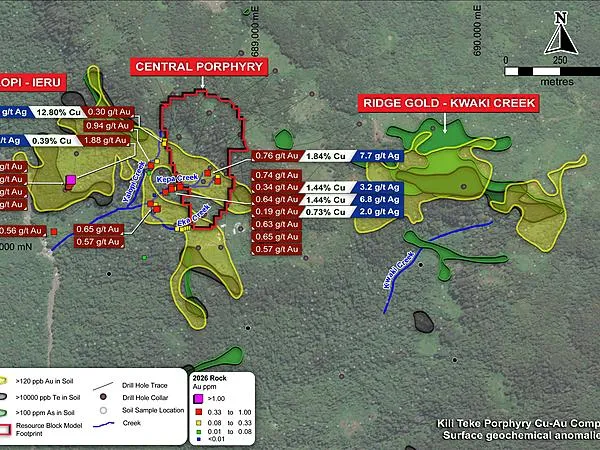
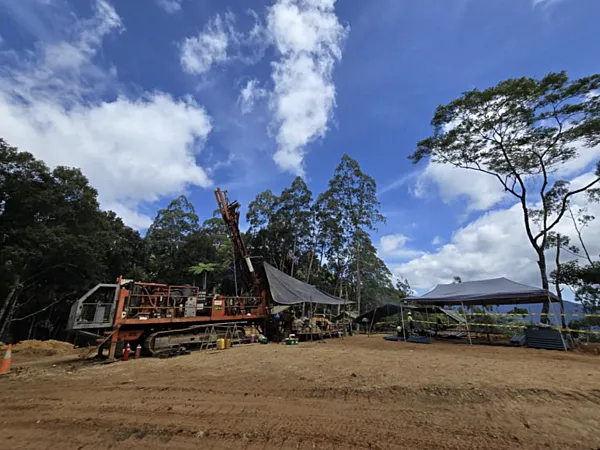
South Pacific Metals Corp has identified new copper-gold targets outside the existing mineral resource at its Kili Teke project in Hela province, Papua New Guinea, after surface sampling returned up to 12.8 percent copper, 0.30 grams of gold per tonne and 104 grams of silver per tonne.
The company said the results from its first-phase exploration programme strengthened evidence of mineralisation west and east of the Central Main Porphyry, which hosts a 237-million-tonne inferred resource. The resource contains 0.34 percent copper and 0.24g/t gold, equivalent to about 4.2 million ounces of gold equivalent.
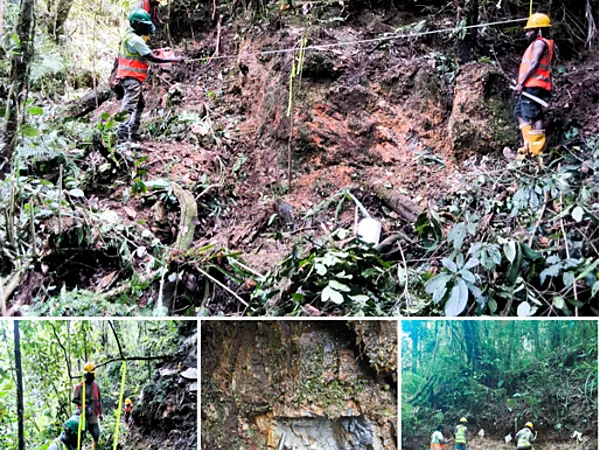
The highest-grade surface result came from an outcrop sample collected from a massive sulphide unit along a north-south fault contact on the western margin of the Central Porphyry. The unit has been mapped for more than 200 metres and remains open.
South Pacific Metals said eight samples collected across part of a historic trench also confirmed mineralisation, averaging 0.36 percent copper and 0.72g/t gold.
The company is focusing its exploration on two areas outside the current resource: the Ieru-Yalopi zone west of the Central Main Porphyry and the Ridge Gold-Kwaki Creek area to the east.
At Ieru-Yalopi, the company is investigating a large gold-in-soil anomaly, the historic Ieru trench and the newly mapped massive sulphide unit. The historic trench returned 132 metres at 0.55 percent copper and 0.6g/t gold, including 27 metres at 0.97 percent copper and 1.25g/t gold.
At Ridge Gold, historic soil sampling returned gold values of up to 9,390 parts per billion, or 9.39g/t, within a strong gold-in-soil anomaly. The company said elevated tellurium could indicate an alkalic, Porgera-style target.
A 205-sample soil grid has been completed at Kwaki Creek, while mapping has identified additional altered and mineralised outcrops, including monzonite. The company said the target area is larger than previously understood.
South Pacific Metals exploration manager Octavio Garcia said the western and eastern targets were developing differently but were both providing useful information for exploration.
“On the western side we have strong outcrop exposure in the creek beds, including sulphide mineralisation we can trace along strike for a couple of hundred metres,” Garcia said.
He said Ridge Gold would be defined more by soil geochemistry than surface exposure, with the company now working to develop a properly ranked, structurally informed drill-target inventory.
South Pacific Metals is also assessing mineralisation at depth beneath the existing Central Main Porphyry resource.
Historical drilling by former operator Harmony Gold covered about 37,500 metres, with the existing resource defined within the upper portion of the porphyry centre. The company said several long and high-grade historical intersections extend below the current resource model, with some holes ending in mineralisation.
One historical hole, KTDD022, returned 187 metres at 1.10 percent copper equivalent, including 0.62 percent copper and 0.44g/t gold, from 501 metres.
Another hole, KTD025, intersected a high-grade skarn zone running 8 metres at 13.31 percent copper and 11.75g/t gold from 920 metres.
The company said these historical results point to potential mineralisation beyond the boundaries of the current resource model and will form part of its deeper targeting work.
South Pacific Metals has a further 205 soil samples and 60 rock samples awaiting assay. It is also undertaking geochemical analysis, structural work, mapping and interpretation, alongside planned LiDAR and airborne magnetic surveys to support drill planning.
The company expects to define drill-ready targets in the two priority areas by the end of October 2026, ahead of a planned maiden diamond drilling programme.
South Pacific Metals chief executive Timo Jauristo said the company's first exploration programme in almost a decade was providing evidence that Kili Teke could extend beyond the historically drilled Central Porphyry.
The company said the current programme represents the first systematic exploration at Kili Teke in about 10 years.
Great Pacific Gold Corp has confirmed broad, shallow gold mineralisation at the Kavasuki target in Papua New Guinea's East New Britain province, identifying a priority near-surface exploration window across its Wild Dog Project.
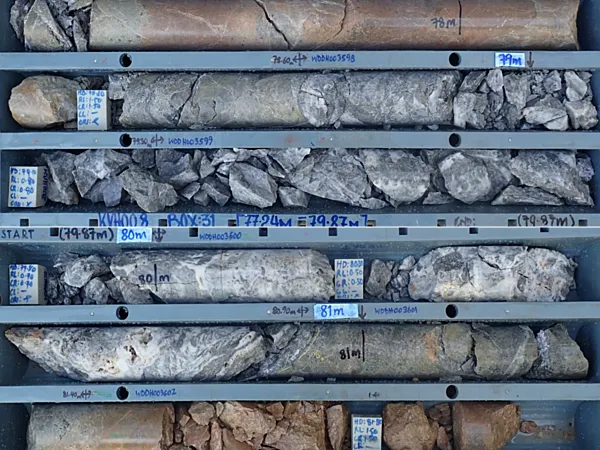
The company said its maiden diamond drilling programme at Kavasuki returned multiple broad gold intersections, including 58.90 metres grading 2.43 grams of gold per tonne (g/t) in hole KVH-01. The programme comprised 12 diamond holes totalling 1,844.8 metres and was designed to confirm historical mineralisation, test the continuity of the Kavasuki vein system and investigate historical geophysical anomalies.
Other significant results included 18.10 metres at 2.08g/t gold in KVH-01, 38.40 metres at 2.07g/t in KVH-03 and 59.90 metres at 1.38g/t in KVH-04. Higher-grade intervals included 1.20 metres at 17.93g/t and 2.20 metres at 15.78g/t.
The company said the strongest gold mineralisation identified to date is concentrated from surface to about 70 metres vertical depth, while the principal Kavasuki vein structure continues below the mineralised horizon.
Great Pacific Gold said drilling had refined its understanding of the Kavasuki system and established an elevation-controlled window for prospective mineralisation.
The Kavasuki target is a structurally controlled epithermal quartz-vein system within the 15-kilometre Wild Dog structural corridor. Drilling confirmed the historically reported mineralised intervals and demonstrated continuity of the main vein structure at depth. Better grades, generally between 1g/t and 2.5g/t gold, were concentrated within the shallow window, with narrow higher-grade zones reaching about 18g/t.
Great Pacific Gold said the deeper holes tested levels below the more favourable mineralised window and returned low concentrations of gold and associated pathfinder elements.
The company also revised its interpretation of historical three-dimensional induced polarisation, or 3DIP, data. It now believes the principal chargeability response at Kavasuki is associated with disseminated pyrite in an interbedded volcanic-siltstone sequence rather than directly with gold mineralisation.
The reinterpretation is expected to provide a new filter for ranking geophysical targets elsewhere along the Wild Dog corridor.
Great Pacific Gold chief operating officer and vice-president exploration Callum Spink said the maiden Kavasuki programme had achieved its core technical objectives.
“Our maiden programme at Kavasuki delivered broad zones of shallow gold mineralisation, including 58.9 metres at 2.43 g/t gold, and achieved its core technical objectives by confirming historical mineralisation, demonstrating continuity of the vein system at depth and resolving the principal source of the historical chargeability response,” Spink said.
He said the results provided the company with a clearer understanding of where higher grades occur and how to target the system, which would also help rank targets across the broader Wild Dog corridor.
Great Pacific Gold plans to undertake further surface work at Kavasuki, including priority trenching south of the drilled area where higher elevation could preserve the prospective mineralisation window.
The company will also conduct trenching and detailed mapping north towards Kavasuki Creek, including follow-up work on a known 3-4-metre-wide vein about 600 metres north-north-east of the drilled area that returned 4.4g/t gold. A future drill test is also planned for the ridge between Sinivit and Kavasuki, combining the revised 3DIP interpretation with the newly defined elevation window.
With Kavasuki drilling complete, Great Pacific Gold said its two diamond drill rigs had moved to Magiabe and Mengmut, ahead of work on the Morgan and EK targets.
The company also disclosed corrections to previously reported Kavasuki results following final database validation. The revised results supersede earlier releases, although Great Pacific Gold said no change was material to its interpretation of the results.
Great Pacific Gold cautioned that the reported drill intercepts represent core lengths and that true widths are not yet known. It also said some final multi-element assay results remain pending and that geological interpretations may be revised as additional data become available.
Geopacific Resources Ltd has reported a series of significant high-grade gold intersections from its latest drilling programme at the 1.98-million-ounce Woodlark Gold Project in Papua New Guinea, highlighting potential for resource growth and an extension of mine life.
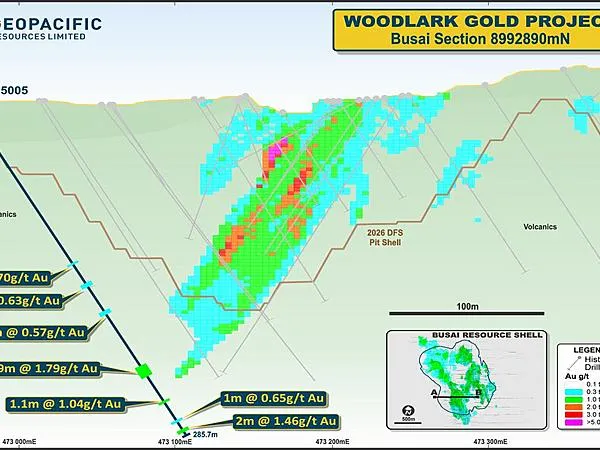
The Australian-listed company said results from 29 reverse-circulation and diamond drill holes confirmed mineralisation across several near-mine and regional targets, including Wayai Creek, Little MacKenzie, Woodlark King, Busai Deeps and Great Northern. The drilling was completed in May, with assays now received for all completed holes.
Among the strongest results was a 1.4-metre intersection grading 29.40 grams of gold per tonne from 257 metres at Busai Deeps. The same hole included a 0.4-metre interval grading 76.30g/t gold.
At Little MacKenzie, drilling returned 2.3 metres at 16.40g/t gold from 114.7 metres, while Great Northern produced 2.7 metres at 9.34g/t from 110 metres. Woodlark King NW also returned a broad 36-metre intersection at 1.48g/t from 60 metres.
Geopacific said the drilling was designed to test potential extensions to existing resources, evaluate emerging discoveries and improve geological understanding needed for future mine planning and development.
At Wayai Creek, drilling tested the southern extension of the main lode and increased drill density for future resource updates. Results included 9 metres at 4.20g/t gold from 141 metres, 11 metres at 2.38g/t from 44 metres and a higher-grade 2-metre interval at 13.40g/t from 59 metres.
The company said the results outlined a coherent zone of shallow, structurally controlled mineralisation, with several significant intersections occurring from surface to about 50 metres. It said this could support near-surface resource growth and improve confidence in the geological model.
At Little MacKenzie, drilling also returned broad mineralised intervals, including 7.2 metres at 3.30g/t gold from 97.8 metres, alongside higher-grade zones. Geopacific said the results supported its revised geological model and indicated that mineralised lodes remained continuous along strike and at depth.
The Woodlark King NW result of 36 metres at 1.48g/t was described as a broad and continuous mineralised zone, providing greater confidence in the geometry and grade distribution of the mineralised domain ahead of future resource updates.
The exploration results come after Geopacific completed a definitive feasibility study for Woodlark, which the company said confirmed the project as a technically robust development opportunity.
The study forecasts annual production of more than 100,000 ounces of gold at all-in sustaining costs below A$2,000 an ounce. It reported a post-tax net present value, discounted at 8 percent, of A$1.3 billion, a post-tax internal rate of return of 50.6 percent and an 18-month payback period.
Geopacific's current Woodlark mineral resource stands at 70.1 million tonnes grading 0.88g/t gold for 1.98 million ounces of contained gold. Its ore reserve totals 34.3 million tonnes at 1.09g/t for about 1.2 million ounces.
Geopacific managing director Hamish Bohannan said the latest drilling had strengthened the company's geological understanding of Woodlark and reinforced the scale of the project.
“The latest results from drilling across Woodlark continue to strengthen our geological understanding of the Project, reinforce the scale of the opportunity ahead of us and provide potential upside to the DFS,” Bohannan said.
He said the company was continuing to develop a pipeline of near-mine and regional exploration programmes, including testing extensions to known mineralisation beneath shallow cover in areas that had seen limited exploration.
Geopacific said it would now undertake detailed geological interpretation and review its geological models, while continuing surface geochemical sampling across selected targets. The company is also assessing the potential use of additional geophysical surveys to guide the next phase of exploration.
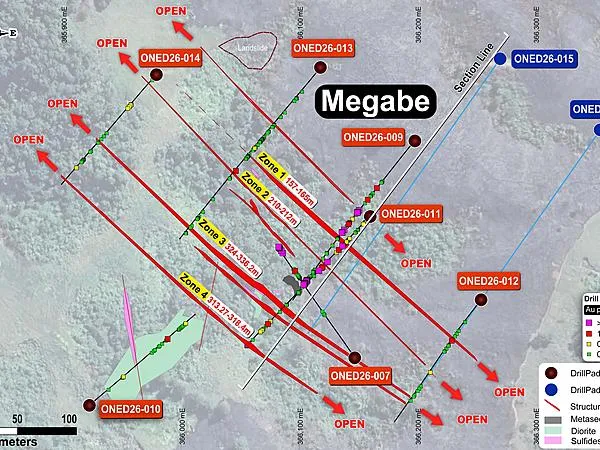
South Pacific Metals Corp has extended the confirmed mineralised strike length of its Megabe prospect in Papua New Guinea to more than 300 metres, with drilling indicating that the structures remain open along strike and at depth.
The Vancouver-based explorer said all five holes drilled at its 100%-owned Osena Project, immediately southwest of K92 Mining’s Kainantu gold-copper mine, intersected mineralised structures. Four step-out holes on the Megabe trend confirmed continuity from the northwest to the southeast, while a fifth hole identified mineralisation beyond the Megabe corridor.
The latest results include 5.1 metres at 1.79 grams per tonne gold equivalent (AuEq), including three metres at 2.66 g/t AuEq, in hole ONED26-011. The intercept was identified as a potential fourth mineralised zone and was located beyond the window predicted by the company’s geological interpretation.
South Pacific Metals said the drilling has helped establish the geometry of the Megabe structures and provides a basis for targeting higher-grade mineralisation at depth.
High-grade targets
The company said four holes were designed to define the geometry and strike continuity of the northwest-trending Megabe structures, with each intersecting the targeted structures.
The mineralised trend now extends for more than 300 metres, while drilling limits rather than the structures themselves define the current boundaries of the system, South Pacific Metals said.
The step-out drilling intercepted the upper part of the system, above the interpreted productive high-grade zone and within a leached horizon that the company believes extends at least 100 metres below surface.
Follow-up drilling is now being directed towards the deeper portion of the system. The company plans to drill below and down-plunge to the southeast of discovery hole ONED26-009, which previously returned five metres at 12.84 g/t AuEq, including two metres at 28.06 g/t AuEq, and 12.2 metres at 6.24 g/t AuEq, including two metres at 16.65 g/t AuEq.
Chief executive Timo Jauristo said the latest drilling suggested the high-grade zones encountered in ONED26-009 may represent only the upper margins of the main system.
“We think the high-grade zones in hole ONED26-009 have only clipped the upper edges of the main system,” Jauristo said, adding that the company would drill deeper holes to test continuity of high-grade mineralisation.
Hole ONED26-010, drilled into a separate group of structures southwest of Megabe, returned 18 metres at 0.25 g/t AuEq, confirming that mineralised structures extend beyond the main Megabe corridor.
Broader Ontenu potential
The Megabe prospect forms part of the broader five-kilometre Ontenu prospective area, where the company has identified at least eight northwest-trending mineralised structures.
Only small portions of three structures — Jorkol, Onki and Megabe — have so far been drill-tested, leaving most of the identified targets undrilled.
Exploration manager Octavio Garcia said the step-out programme had confirmed several geological parameters, including the continuity and geometry of the mineralised structures.
He said geochemical results indicated potential for continuity beyond 300 metres of strike, while the company had also identified subparallel mineralised structures and local leaching similar to that observed at K92’s Kora vein.
The company believes the results provide evidence of an intermediate-sulphidation epithermal system comparable with neighbouring deposits, although further drilling will be required to establish its full extent.
Drilling has continued at Ontenu Central, where two of four planned holes have been completed and two are nearing completion. The programme is testing newly mapped northwest-southeast mineralised trends while drilling advances at Megabe.
South Pacific Metals said the next two Megabe holes would target higher-grade mineralisation below the current drilling and down-plunge to the southeast of ONED26-009.
The company said Megabe remains the most advanced of the eight identified structures at Ontenu, with further geological mapping and drilling planned across the broader prospective area.
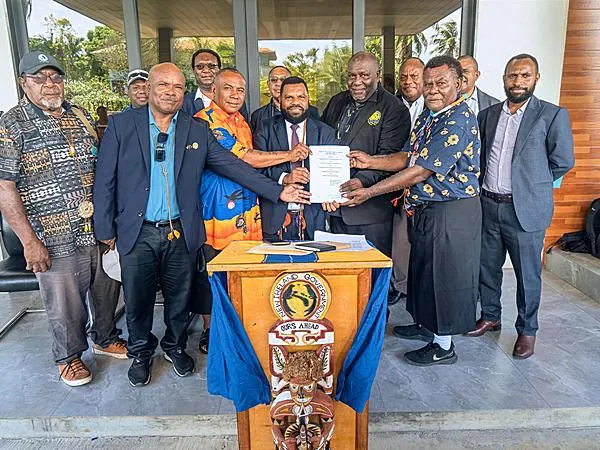
The long-awaited Community Development Agreement (CDA) for the Simberi Mining Project has finally been signed, marking a significant milestone for the Simberi and wider Tabar Island communities after three decades of negotiations and delays.
The agreement was signed on Aug. 28, 2026, at the New Ireland Provincial Government Assembly in Kavieng, bringing together the State, New Ireland Provincial Government (NIPG), Sentral Niu Ailan Local Level Government (SNALLG), Simberi Mining Area Association (SMAA) and Simberi Gold Company Pty Ltd (SGC).
The signing marks the latest step in a process that began with the first CDA in 1996.
Mining Minister Solen Loifa signed on behalf of the State, while New Ireland Governor Byron Chan signed for the New Ireland Provincial Government.
SNALLG President Terence Kamari signed for the local-level government, while SMAA Chairman Pius Vaket Maris signed on behalf of the Simberi mining area landowner association.
Simberi Gold Company Country Manager Randy McMahon represented SGC at the ceremony. However, the company did not sign the agreement because of an administrative hold-up and has indicated it will do so at a later date.
The CDA has undergone an extended process of review, consultation and statutory consideration since the original agreement was signed in 1996.
The agreement was reviewed in 2012 and finalised in 2013. Between 2014 and 2016, statutory approvals were sought for fiscal and legal clearance, alongside the preparation of the Business Development Plan and Training and Employment Plan.
In 2017, the National Executive Council approved implementation of the agreement through NEC Policy Decision No. 95/2017.
Implementation was subsequently delayed after the New Ireland Provincial Government sought increased benefits under arrangements including the Special Support Grant (SSG), Infrastructure Development Grant (IDG) and Tax Credit Scheme (TCS).
Further delays were caused by internal disputes within the Simberi Mining Area Association, the COVID-19 pandemic and a court case over SMAA leadership in 2023.
The signing on Aug. 28 now allows the parties to move towards implementing their commitments under the CDA, with the agreement expected to provide a framework for community development and the distribution of benefits from the mining project.
Benefits and long-term development
Loifa congratulated all parties for reaching the agreement and commended them for their patience, understanding and cooperation throughout the prolonged process.
He also urged Simberi landowners and communities to take a long-term view of the benefits generated by mining.
The minister said the gold resources on the islands are finite and will eventually be exhausted, making it essential to invest current mining benefits in sustainable projects and businesses.
Such investments, he said, would help ensure future generations continue to benefit from the resources after mining operations end.
Mineral Resources Authority Acting Managing Director Harry Kore reaffirmed the authority’s commitment to facilitating implementation of the CDA.
Kore said the MRA would continue working closely with all stakeholders, particularly landowners, to ensure benefits are delivered in accordance with the agreement.
For the New Ireland Provincial Government, the signing also marks a significant achievement for landowners who, according to Governor Chan, had missed out on benefits for about 10 years while the agreement remained unresolved.
Chan congratulated all parties and particularly acknowledged Simberi landowners for their patience throughout the lengthy process.
Landowners welcome historic agreement
For SMAA Chairman Pius Vaket Maris, the signing represents more than the conclusion of a lengthy administrative process. He described it as a historic achievement and the beginning of a new chapter for the people of Simberi Island and the wider Tabar community.
“Today is a proud day for the people of Simberi Island and the wider Tabar community. We are not simply signing a Community Development Agreement — we are signing a new chapter in the history of our people,” Maris said.
He said the wealth generated from Simberi’s mineral resources must translate into lasting improvements in the lives of the people living in the mining area.
As chairman of the association, Maris said he carries the hopes and aspirations of thousands of people across Simberi and the wider Tabar Island group, including previous generations and the children who will inherit the islands after mining has ceased.
He acknowledged that the community’s relationship with large-scale mining has brought both opportunities and challenges.
While development is welcome, Maris stressed that land cannot be viewed solely as an economic resource.
“Land is identity, history, culture, livelihood and the foundation of the future,” he said.
He said the responsibility of the current generation is to safeguard the land for those who come after them.
“Our ancestors did not inherit land to sell it away; they held it in trust for future generations. Likewise, we hold it in trust today for those who will come after us. That is why this agreement is so important,” Maris said.
He acknowledged that reaching the agreement required extensive discussions, consultations and negotiations, including difficult conversations among stakeholders.
However, he said the parties were ultimately able to reach agreement through mutual respect and a shared commitment to progress.
With the CDA now signed, the focus shifts from negotiation to implementation.
For the Simberi and Tabar communities, the agreement is expected to provide a structured pathway for community development and stakeholder benefits while strengthening the relationship between the mining operation, government and landowners.
The signing also renews the focus on converting finite mineral wealth into sustainable economic opportunities that continue supporting communities beyond the life of the Simberi mining operation.
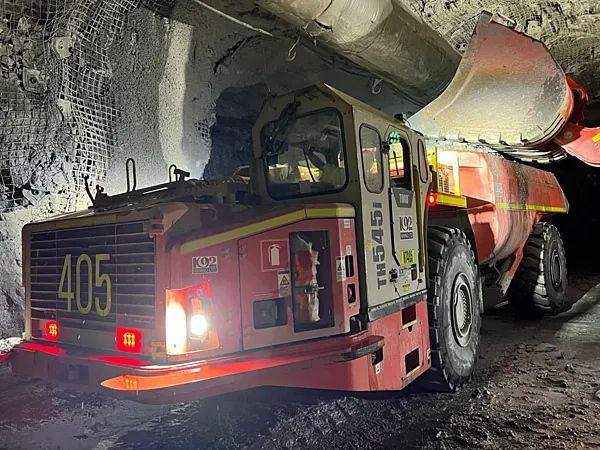
Tolu Minerals Limited (TML) has recorded a significant improvement in its underground operations following a notable increase in production under new Underground Leadership at the Tolukuma site.
The improved performance reflects the continued commitment, teamwork and dedication of the underground workforce, whose efforts have contributed to significant progress across the operation.
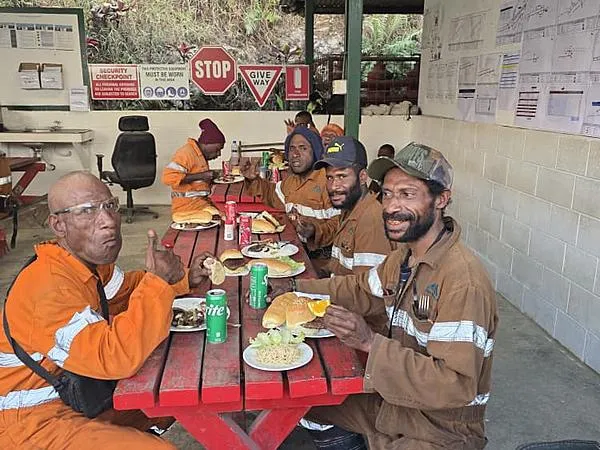
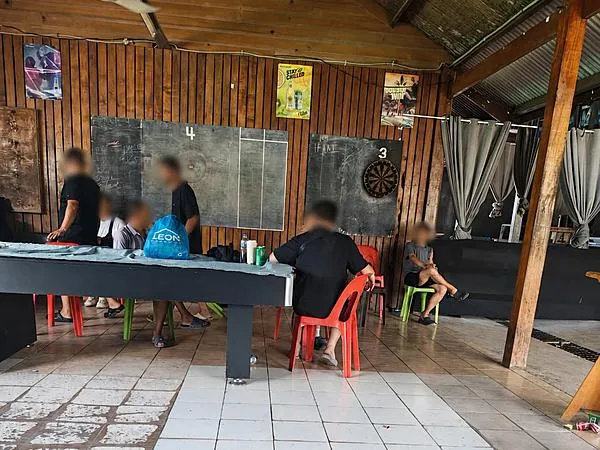
To recognize and celebrate the Underground team’s achievements, TML held a special “Rockstar BBQ” at the Tolukuma site, bringing employees together to acknowledge the hard work behind the operation’s recent performance.
iPi Catering provided catering for the celebration, including a BBQ and refreshments for the Underground team. The event was well received by employees, with positive feedback on the quality of the food and the professionalism of the catering team.
The Integrated Site Service Manager commended the iPi Catering team for its contribution, particularly its effort and professionalism in supporting the workforce.
“From VIP breakfast in the morning to the BBQ provided for the Underground team in the evening, the energy, effort, dedication, and professionalism shown by everyone was greatly appreciated.
“The UG miners were absolutely over the moon with the spread provided for them. They were genuinely thankful and I witnessed firsthand their delight and the smiles on their faces. It was great to see how much they appreciated the effort that had gone into making the BBQ a special occasion for them.”
TML also acknowledged iPi Catering for its contribution to the event and for its continued provision of quality food, professional service and support to the Tolukuma workforce.
The achievement marks an encouraging milestone for the Tolukuma operation as the team continues to focus on maintaining strong performance, teamwork, safety and operational excellence.
Tolu Minerals Limited is committed to responsible mining operations and supporting the development of its people, operations and surrounding communities.
iPi Catering is part of the iPi Group and provides catering and food-service solutions for corporate, industrial and remote-site operations. The business is committed to delivering quality food and reliable catering services tailored to the needs of its clients.
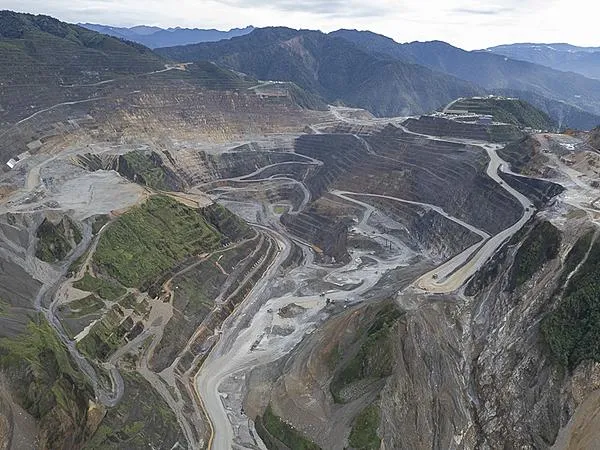
Ok Tedi Mining Ltd. is maintaining mining and processing operations despite dry weather conditions and lower-than-normal water levels on the Fly River, the company said.
Ok Tedi said it is closely monitoring river conditions and has activated contingency measures to maintain the supply of fuel, critical consumables, equipment and other operational requirements to its mine site.
Parts of the Fly River are currently not being used for normal freight movements because of the low water levels, prompting the company to source alternative logistics arrangements.
"As part of our business continuity planning, Ok Tedi has been actively managing the impacts of the dry conditions through a range of mitigation measures, including pursuing alternate supply routes and careful management of key resources," Managing Director and Chief Executive Officer Kedi Ilimbit said.
"At present, mining and processing operations continue, and the company remains focused on delivering its operational objectives safely and responsibly. While the current conditions present additional logistical challenges, Ok Tedi has contingency plans in place and continues to adapt its operations as required," he said.
Ok Tedi said it was experiencing increased costs associated with managing the dry weather, particularly in logistics and supply chain management.
The company said it was taking measures to manage the impacts and maintain operational resilience.
Ilimbit said the Kiunga-Aiambak road was now accessible and a trial tanker run was planned for this week.
Work is also continuing to improve access along the Alice Pit to Butmabin-Yetekun border crossing route, he said.
Ok Tedi said it would continue monitoring weather patterns, river conditions and supply chain risks.
"The safety of our employees, contractors and communities remains our highest priority, while ensuring the ongoing reliability of our operations," the company said.
"While the current dry weather conditions require us to be agile and proactive, it is business as usual at Ok Tedi. We anticipated the potential impacts and have activated contingency measures to support our operations. Our teams continue to do an excellent job managing the situation, and we remain focused on safely delivering our operational commitments," Ilimbit said.
Ok Tedi Mining Ltd. operates an open-pit copper, gold and silver mine in the Star Mountains of Western province. The company is majority state-owned and has operated in the region for more than 40 years.
The company ships copper concentrate to smelters and ore refineries in Japan, the Philippines, Indonesia, South Korea, India and Germany.
Ok Tedi is also expanding into Milne Bay province through the acquisition of Gallipoli Exploration Ltd., a wholly owned subsidiary of Australian mining company Kingston Resources Ltd., for the Misima mine.
Great Pacific Gold Corp. has expanded the interpreted footprint of two high-grade gold vein systems at its Wild Dog Project in East New Britain following new mapping and channel-sampling results.
The company said its latest work at the Elamaraka and Kargalio vein systems had identified additional mineralized quartz-sulphide veins beyond historically mapped areas, strengthening the potential of the southern Wild Dog structural corridor.
At Elamaraka, continuous channel sampling returned 9 meters grading 4.81 grams per tonne of gold, 41.96 grams per tonne of silver and 0.02% copper.
Individual samples included grades of up to 26.86 grams per tonne of gold and 233.4 grams per tonne of silver. Additional vein exposures along the interpreted corridor returned 4.22 grams per tonne of gold from a grab sample, while channel samples returned 1.20 grams per tonne and 1.05 grams per tonne of gold.
Great Pacific Gold said mapping indicated Elamaraka was broader than a single historical vein, with multiple quartz-sulphide veins showing similar structural orientation and mineralization styles.
The Elamaraka system is about 2 kilometers southwest of the Sinivit deposit and forms part of the southern continuation of the Sinivit-Kavasuki epithermal corridor.
At Kargalio, a 6-meter channel interval returned an average grade of 7.29 grams per tonne of gold, 12.83 grams per tonne of silver and 0.24% copper, including 2 meters at 16.20 grams per tonne of gold.
A second 6-meter channel interval about 40 meters south returned 2.85 grams per tonne of gold, 8.20 grams per tonne of silver and 0.15% copper.
Another quartz-sulphide-clay breccia zone about 260 meters east of the Kargalio vein returned about 10 meters at 1.77 grams per tonne of gold.
The company said mapping had identified additional mineralized structures at Kargalio, supporting its interpretation that the prospect represents a broader mineralized corridor rather than a single historical vein.
Great Pacific Gold Chief Operating Officer and Vice President Exploration Callum Spink said the results had strengthened the company’s understanding of the southern Wild Dog corridor.
“Historical work reported high-grade gold mineralization at the EK Target Area. Our recent mapping and systematic sampling indicate that these prospects form part of broader mineralized corridors containing multiple quartz-sulphide veins,” Spink said.
The company has also begun work in the South Zone of the 15-kilometer Wild Dog structural corridor, with earthmoving equipment clearing an access track south of Elamaraka and Kargalio.
An exploration team has been mobilized to conduct initial geological mapping and rock-chip sampling at South Zone prospects including Lost Dog, Steel Creek, Cut-hand Creek, Muruk and Regess.
Great Pacific Gold said the initial South Zone results would be reported after assays are received and reviewed.
The company currently has two diamond drill rigs operating at Wild Dog and plans to extend systematic drilling into the southern corridor as priority targets are developed.
Great Pacific Gold said its Wild Dog Project includes a 15-kilometer structural corridor in East New Britain, with the company pursuing multiple epithermal and porphyry exploration targets. The company also holds the Kesar, Arau and Tinga Valley projects in Papua New Guinea.
PORT MORESBY, Papua New Guinea — Production of contained nickel at the Ramu Nickel-Cobalt operation in Papua New Guinea fell 4% in the second quarter of 2026, while nickel and cobalt sales increased and prices strengthened, according to Nickel 28 Capital Corp.
Ramu produced 8,234 tonnes of contained nickel in mixed hydroxide precipitate (MHP) in the three months to June 30, compared with 8,564 tonnes in the same quarter of 2025. Cobalt production rose to 811 tonnes from 787 tonnes.
Nickel sales increased 14% to 8,967 tonnes from 7,846 tonnes, while cobalt sales rose 23% to 881 tonnes from 719 tonnes.
Nickel 28 holds an 8.56% joint-venture interest in Ramu, which is operated by Metallurgical Corporation of China.
The company said the operation maintained strong production despite completing one of three scheduled annual high-pressure acid leaching, or HPAL, train maintenance shutdowns during the quarter.
For the first half of 2026, Ramu produced 17,019 tonnes of contained nickel and 1,666 tonnes of contained cobalt, compared with 15,534 tonnes and 1,435 tonnes, respectively, in the first half of 2025.
Nickel prices also provided support during the quarter. The average London Metal Exchange nickel price rose 20% year over year to US$8.24 a pound, while the average cobalt price increased 68% to US$25.65 a pound.
However, higher sulphur prices pushed production costs higher. Costs, net of byproduct credits, rose to US$4.81 a pound of nickel produced in MHP from US$3.21 a pound a year earlier. First-half costs increased to US$3.78 a pound from US$3.39 a pound.
Nickel 28 Chief Executive Officer Craig Lennon said the results demonstrated the reliability of the Ramu operation despite the scheduled maintenance shutdown.
“Ramu delivered another strong quarter of operational performance during the second quarter of 2026, with robust production and sales volumes that continue to demonstrate the reliability and consistency of the operation,” Lennon said.
He said the remaining two planned shutdowns were completed shortly after the end of the quarter, leaving the operation positioned for a strong second half of the year.
Lennon said market conditions remained supportive, with higher nickel and cobalt prices and strong payable terms for both metals supporting operating cash flow.
He identified sulphur as the project’s main cost pressure, citing tight global supply following disruptions that have kept prices elevated across the HPAL industry.
The company also highlighted Indonesian government production quotas under the RKAB system as a key factor for the global nickel market, saying future quota allocations could influence Indonesian supply and global nickel prices.
Ramu’s nickel inventory stood at 1,094 tonnes at June 30, down from 1,828 tonnes at March 31.
Nickel 28 said the operating figures were preliminary and unaudited and remained subject to audit, final adjustments and potentially material changes.
K92 Mining Inc. has appointed President and Chief Operating Officer David Medilek as chief executive officer and director, succeeding John Lewins as the company prepares for its next phase of growth at the Kainantu Gold Mine in Papua New Guinea.
The leadership transition will take effect on Oct. 1, 2026, with Lewins stepping down as CEO to become non-executive chair. Anne Giardini will move from independent chair to lead director, while K92 Vice President, Projects & Engineering Chris Kinver will become chief operating officer.
K92 also appointed Susan Scheepers as vice president, human resources, effective Aug. 1. She had been serving as the company's acting vice president for human resources.
Lewins has been a founding director of K92 since 2016 and became CEO in August 2017. During his tenure, the Kainantu operation progressed from mine restart in late 2016 to commercial production in early 2018, followed by the Stage 2 and Stage 2A expansions and substantial completion of the Stage 3 Expansion.
As of June 30, 98% of Stage 3 Expansion capital had been spent or committed and the project remained on budget. A new 1.2 million-tonne-per-year processing plant has been fully operational since December 2025 and is performing above design expectations, with the mine ramp-up underway.
Lewins said the transition was timely given K92's production growth outlook and exploration pipeline.
“With an exceptional production growth outlook and exploration pipeline ahead of us, this is the right time to transition leadership,” Lewins said.
He said he would continue supporting K92, including through engagement with the PNG government and the resources industry. Lewins has also served for many years on the council of the Papua New Guinea Chamber of Resources and Energy and intends to remain involved in industry engagement.
He also plans to continue supporting K92's social development initiatives through the Kainantu Foundation. Last month, Lewins was appointed Pro-Chancellor of the University of Goroka in Eastern Highlands Province, where the Kainantu Mine is located.
Medilek, who joined K92 in 2019, said his immediate priorities would be to operate safely and responsibly, execute the Stage 3 Expansion ramp-up and Stage 4 Expansion, advance exploration around Kainantu and deliver sustainable value for Papua New Guinea and shareholders.
Medilek has more than 19 years of mining capital markets, corporate strategy, technical and operating experience. Before joining K92, he worked as an equity research analyst covering precious metals companies at Macquarie Group, a mining investment banker at Cormark Securities and a mining engineer at Barrick Gold.
Kinver, the incoming COO, has more than 20 years of experience in underground operations and mine development. At K92, he has led major expansion and engineering programs and previously served as project director for the Kora Expansion and mine manager. He also worked on OceanaGold's Didipio Underground Mine in the Philippines and held senior operational roles with BHP Billiton and Barrick Gold.
Scheepers has more than 20 years of human resources leadership experience in the global resources industry, including roles with Aurelia Metals, Geopacific Resources and St Barbara. Her experience includes work at the Simberi Gold Mine and operations in Papua New Guinea.
K92 operates the Kainantu Gold Mine in Eastern Highlands Province, producing gold, copper and silver. The company is pursuing further expansions and exploration around the mine, with the stated objective of becoming a Tier 1 mid-tier producer.
Papua New Guinea's Mining Minister Solen Loifa has cleared the way for the revised Community Development Agreement (CDA) for the Hidden Valley Mining Project to be signed, saying concerns raised by Bulolo MP Sam Basil Jr. do not warrant any further delay.
Loifa said the concerns had been assessed against applicable laws, government policies, administrative processes and agreements reached during negotiations for the revised CDA.
He said several of the issues raised relate to future negotiations for the Wafi-Golpu project or are matters that can be pursued separately by the Morobe Provincial Government, Bulolo District Development Authority and other relevant government agencies.
“I am satisfied that there are no outstanding issues that warrant any further delay to the execution of the revised Hidden Valley Mine Project CDA,” Loifa said.
Royalty distribution confirmed
One of the key issues raised concerns the distribution of mining royalties and calls for the royalty share to be increased from 2 percent to 5 percent.
Loifa said the royalty distribution incorporated into the revised Hidden Valley CDA reflects Morobe Provincial Executive Council (PEC) Decision No. 2 of Feb. 3, 2025, made during the tenure of the late Morobe Governor Luther Wenge.
Under the revised CDA, the royalty distribution includes:
Wau Rural LLG — 1 percent
Watut Rural LLG — 1 percent
Wau Urban LLG — 1 percent
Bulolo Urban LLG — 1 percent
The minister said negotiations on the revised CDA were concluded on June 13, 2025, with the positions of the relevant parties captured in the agreement.
State equity remains unresolved for Wafi-Golpu
Calls for a 5 percent state-paid equity allocation to Bulolo District in both Hidden Valley and Wafi-Golpu were also raised.
Loifa said the State has not exercised its option to take equity in the Hidden Valley project, while equity arrangements for Wafi-Golpu remain subject to future negotiations.
He also rejected attempts to incorporate Wafi-Golpu-specific financial and benefit-sharing matters into the Hidden Valley CDA process.
A proposed K200 million allocation, for example, relates to Wafi-Golpu project infrastructure development grant (IDG) funds and will need to be discussed through the Wafi-Golpu forum.
Similarly, proposed royalty allocations for Wau-Waria District, its three LLGs and the three landowner groups in relation to Wafi-Golpu will be considered during negotiations for the Wafi-Golpu CDA.
Future Generations Trust Fund
Loifa also addressed a proposal for a 1 percent environmental levy on gold extracted for sale to be paid into a Future Generations Fund.
He said future generations trust funds are established to benefit landowners, particularly through a portion of landowner royalties.
Under the revised Hidden Valley CDA, a Future Generations Trust Fund will be established after the agreement is formally executed and signed.
The government also pointed to infrastructure commitments associated with the mining project and surrounding districts.
Loifa said Menyamya District has been considered under the revised CDA through a 5 percent royalty distribution, while the Lae-Bulolo-Wau-Menyamya road is included under the Tax Credit Scheme program in accordance with National Executive Council Decision No. 172/2026.
Proposals for an Anga Wau Special Authority to coordinate infrastructure and socioeconomic development across Bulolo, Wau-Waria and Menyamya, however, are matters that can be pursued separately between the Morobe Provincial Government and Bulolo DDA.
Loifa said similar arrangements concerning Morobe's proposed Benefits Sharing Authority could also be pursued outside the Hidden Valley CDA.
Section 98 amendment
Loifa also rejected the argument that recent amendments to Section 98 of the Organic Law on Provincial and Local-level Governments require the Bulolo DDA to become a signatory to the Hidden Valley CDA or a future Wafi-Golpu agreement.
He said the amendment applies prospectively to new mines and does not retrospectively apply to existing CDAs or the revised Hidden Valley CDA.
The minister further pointed to the distinction between mining projects subject to a Special Mining Lease and those operating under other mining leases.
Hidden Valley operates under a Mining Lease (ML) and, according to Loifa, does not require a Development Forum under the Mining Act 1992.
Wafi-Golpu negotiations remain separate
Loifa maintained that issues relating to Wafi-Golpu should be addressed through the project's own Development Forum and CDA negotiations rather than being used to delay the Hidden Valley agreement.
He said questions involving the distribution of benefits to non-impact districts, including Kabwum, Finschhafen, Markham and Tewai-Siassi, could be considered through the Wafi-Golpu Development Forum and a consolidated PEC decision.
The minister's position effectively removes the remaining government-level objections to the execution of the revised Hidden Valley CDA.
For the mining sector and Morobe's local communities, the agreement is significant because it establishes the framework for the distribution of project benefits, royalties and development commitments associated with the Hidden Valley operation.
Loifa said matters already settled through the CDA negotiation process should not be reopened, while issues outside the scope of the Hidden Valley agreement should proceed through their respective legal and administrative channels.
“Accordingly, I am satisfied that the revised Hidden Valley CDA should now proceed to signing as scheduled,” Loifa said.
K92 Mining Inc has reported a 116% increase in quarterly net income to US$84.6 million, as its Kainantu operations in Papua New Guinea delivered record ore processing and mine development during the second quarter.
The Vancouver-based miner reported revenue of US$205.2 million for the three months ended June 30, up 113% from the same period in 2025. Net income rose to US$0.34 per share, while EBITDA increased 136% to US$140.7 million.
The strong financial performance was underpinned by a significant increase in production at Kainantu, where K92 processed a record 225,965 tonnes of ore during the quarter, 73% higher than in the second quarter of 2025 and 59% above the previous quarter.
The operation produced 46,093 ounces of gold equivalent, comprising 42,931 ounces of gold, 1.78 million pounds of copper and 50,109 ounces of silver.
The company also recorded 46,682 ounces of gold, 1.81 million pounds of copper and 49,004 ounces of silver in sales during the quarter.
K92 said the new 1.2-million-tonne-per-year Stage 3 expansion process plant in PNG continued to perform well after becoming fully operational in December 2025. Gold recovery reached 93.8% in the quarter, exceeding the 92.6% recovery parameter in the company's updated definitive feasibility study for the ninth consecutive quarter.
The strong processing performance coincided with record mine development at Kainantu.
The operation advanced 3,326 metres of mine development during the quarter, a 35% increase from the second quarter of 2025 and an 11% increase from the first quarter of 2026.
A further monthly record of 1,220 metres was achieved in July, taking development rates above the 1,000 metres per month requirement for Stage 3 and the 1,200 metres per month requirement for the planned Stage 4 expansion.
K92 chief executive officer John Lewins said the company expected production to be strongest in the second half of 2026, with the fourth quarter expected to be the strongest quarter of the year.
Expansion advances in PNG
The financial results come as K92 continues to invest heavily in expanding its PNG operation.
As of June 30, 98% of Stage 3 expansion growth capital had either been spent or committed, with the project remaining on budget.
Several major infrastructure projects supporting the expansion have also been completed or are nearing completion.
These include the second material pass, which became operational in June and is expected to significantly improve material handling capacity at the Main Mine and Lower Kora.
The company's Phase 2 expansion of its primary power station was completed in May, increasing prime power output to 15.3 megawatts from 10.7MW. K92 said the expanded facility now meets the total power requirements of the Stage 4 expansion and provides additional standby capacity during potential disruptions to the local hydroelectric grid.
Infrastructure work has also extended beyond the mine.
The Baupa Bridge was completed in April, while the Kokomo Bridge was completed in late July and the Kasese River Crossing is expected to be completed in the third quarter.
K92 said the projects will enable a tripling of surface haulage payload from 20 tonnes to 60 tonnes while reducing haulage cycle times, supporting higher throughput under the Stage 3 and Stage 4 expansions.
The company is also expanding its mining and haulage fleet. Four new Sandvik LH517i underground loaders had been added during 2026 as of the end of the quarter, while a larger LH621i loader is scheduled to arrive in the fourth quarter.
Four new 60-tonne surface trucks have also been delivered and are expected to enter service in the third quarter, with another four units due by year-end.
Arakompa exploration expands
K92 is simultaneously advancing exploration around Kainantu, with drilling at Arakompa continuing to identify high-grade gold mineralisation.
The company reported the sixth set of results from its maiden surface diamond drilling programme at Arakompa during the quarter. The programme has now reported results from 100 holes, with all holes intersecting mineralisation.
K92 said 40 intersections exceeded 5 grams per tonne gold equivalent, including 20 intersections above 10g/t AuEq.
The drilling has expanded and upgraded the near-surface AR1 high-grade zone, which is now defined over about 400 metres of strike and up to 300 metres vertically. The zone has a weighted average grade of 9.47g/t AuEq and an average true width of 4.32 metres.
Drilling has also identified a substantial near-surface bulk-tonnage zone, while surface sampling indicates mineralisation extends to the surface over more than two kilometres of strike.
K92 is targeting a maiden mineral resource estimate for Arakompa in the second half of 2026.
The company said exploration will continue alongside the Stage 3 and Stage 4 expansion programme, supported by additional drilling capacity. A new rig arrived at site in April, while a second additional surface rig was undergoing commissioning, potentially bringing the operation's drilling fleet to as many as 16 rigs.
K92 ended the quarter with US$349.4 million in cash and cash equivalents and a record net cash position of US$310 million.
Lewins said the strong balance sheet would allow K92 to continue delivering the Stage 3 and Stage 4 expansions while increasing exploration activity in Papua New Guinea.
The company reiterated its 2026 production guidance and said the combination of higher development rates, additional mining fronts, infrastructure upgrades and fleet expansion was expected to support stronger production in the second half of the year.
The Autonomous Bougainville Government has removed 30 Chinese nationals from a suspected illegal mining site in Kopani following a joint enforcement operation involving police, immigration and mining authorities.
The operation was conducted at about 4 a.m. Sunday by officers from the Bougainville Police Service in Arawa and Buka, together with officials from Immigration and the ABG Department of Mining and Petroleum.
The 30 Chinese nationals were extracted from the site, where they were allegedly involved in unauthorized mining activities.
Preliminary immigration checks identified issues with the nationals’ immigration documentation and status in relation to their presence and activities in Bougainville, according to the ABG.
Their passports were confiscated pending further action.
Under immigration directions, the nationals have been ordered to leave Bougainville within five days and travel to Port Moresby for further processing at Bomana. The costs of their travel will be borne by people associated with the unauthorized mining operation, the ABG said.
President and Minister for Mining and Petroleum Ishmael Toroama said the operation demonstrated his government’s determination to protect Bougainville’s mineral resources, environment and communities from unlawful exploitation.
“Our resources belong to the people of Bougainville and must be developed responsibly, lawfully and for the benefit of our people. Anyone who comes into Bougainville must respect the applicable laws. Where those laws are breached, necessary enforcement action will be taken,” Toroama said.
Equipment linked to the suspected illegal mining operation remains secured at the site under police instructions pending further enforcement action.
Toroama said the ABG was also pursuing amendments to strengthen offense, prosecution and penalty provisions under Bougainville’s mining laws.
The government is appealing similar unauthorized mining cases in which court decisions have been unfavorable to the prosecution, seeking further judicial consideration and clarification of relevant provisions of the mining legislation.
In the meantime, authorities are using immigration, environmental and other applicable laws to address the current case and other suspected unauthorized mining activities.
Illegal mining may also constitute separate offenses under environmental legislation, including the Environment Act 2000, where mining is carried out without required environmental approvals or causes unlawful environmental harm, the ABG said.
“This is not simply a mining law issue. Persons involved in illegal mining may expose themselves to investigation and prosecution under mining, environmental, immigration and other applicable laws,” Toroama said.
“We will use the legal mechanisms available to protect Bougainville, our people, our land and our resources.”
Investigations are continuing and will also examine the involvement of local people who may have facilitated, financed, organized, supported or otherwise participated in the suspected illegal mining activities.
Toroama thanked police, immigration and mining officials involved in the operation and said the government would continue to support coordinated enforcement against illegal activities in Bougainville.
Great Pacific Gold Corp. has begun diamond drilling at the Magiabe Vein target within its flagship Wild Dog Project in East New Britain Province, Papua New Guinea, after completing its maiden drilling campaign at the Kasie Ridge prospect.
The company said one of its two diamond drill rigs had been relocated to Magiabe, the fourth exploration target to be drilled at Wild Dog this year. The programme forms part of an approximately 8,000-metre drilling campaign planned for the second half of 2026 across the Kavasuki, Magiabe, Mengmut, Morgan and EK targets.
The initial programme at Magiabe comprises up to 11 diamond drill holes covering around 2,240 metres to test the Magiabe and the newly identified Magiabe West veins. Hole depths are expected to range from about 150 metres to 280 metres.
Recent exploration identified the previously undrilled Magiabe West Vein, where rock-chip sampling returned grades of up to 137 grams of gold per tonne, 76 grams of silver per tonne and 3.97 per cent copper. Channel sampling also returned 8 metres grading 17.10 grams of gold per tonne, including 3 metres grading 45.26 grams per tonne. Historical drilling at the main Magiabe Vein intersected gold grades of up to 23 grams per tonne over 1.6 metres.
"Magiabe is one of the strongest near-term drill targets in the Wild Dog corridor," Chief Operating Officer and Vice President for Exploration Callum Spink said.
"The first two holes have been deliberately designed to answer the key geological questions quickly. Together, these holes will give us an early indication of the scale, orientation and continuity of the multi-vein system and help guide the remainder of the programme," he added.
Spink said Magiabe represents an important next step in systematically testing the broader high-grade potential of the Wild Dog Project, with two drill rigs now operating across the Main Zone.
Meanwhile, the company has completed the second drill hole at Kasie Ridge to a final depth of 346.6 metres, concluding the current two-hole maiden drilling programme at the target. Assay, multi-element geochemical and X-ray diffraction mineralogical results from both holes remain pending.
Great Pacific Gold said geological observations from the second hole indicate extensive silicification and sulphide-bearing hydrothermal alteration consistent with a well-developed high-sulphidation epithermal system, although laboratory results are still awaited. The company expects to release a comprehensive update incorporating assay and mineralogical results later this month.
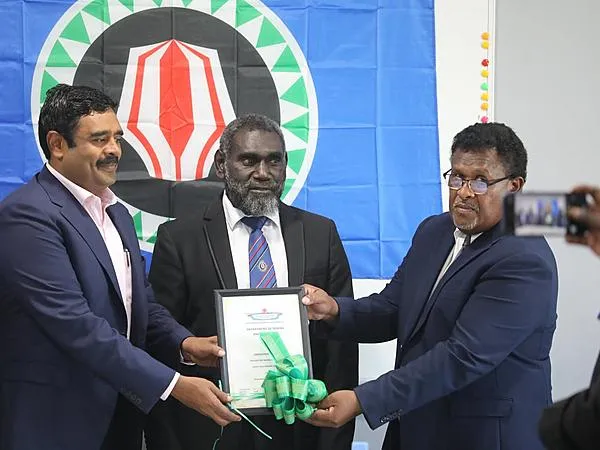
Autonomous Bougainville Government President and Mining & Petroleum Minister Ishmael Toroama has issued the LSML-01 Preparatory Works and Feasibility Commencement Certificate to Bougainville Minerals Ltd, allowing initial technical and feasibility activities to begin for the proposed redevelopment of the Panguna mine.
The certificate, presented to Bougainville Minerals Ltd in the presence of its approved development partner, Lloyds Panguna Metals & Energy Ltd, was issued under the special redevelopment pathway established by the Bougainville Mining (Amendment) Act 2026.
The commencement certificate authorises Bougainville Minerals, through Lloyds Panguna Metals & Energy, to undertake an approved programme of preparatory works and feasibility studies for the Panguna project.
The activities include technical, engineering, environmental, social and economic assessments needed to evaluate and plan the proposed redevelopment of the mine.
The Autonomous Bougainville Government said the certificate does not permit mine construction or commercial production. Those phases will require separate statutory approvals and additional commencement certificates.
Toroama said the issuance marks an important milestone in the redevelopment process while reaffirming the government's commitment to responsible resource development under Bougainville's legal framework.
"The issuance of this Commencement Certificate today marks the beginning of a new chapter for Bougainville. It reflects our confidence in our own laws, our institutions and our ability to responsibly manage our natural resources," Toroama said.
"The redevelopment of Panguna will proceed one step at a time—guided by transparency, accountability, respect for our landowners and communities, and a shared commitment to ensuring that our mineral wealth creates lasting opportunities and prosperity for all Bougainvilleans," he added.
Ok Tedi Mining Ltd. (OTML) says it continues to operate safely and maintain production despite dry weather conditions affecting parts of Papua New Guinea and disrupting transport along the Fly River.
The company said it is closely monitoring the impact of the dry conditions, which have lowered river levels and limited normal freight movements on sections of the Fly River.
To minimise disruptions, OTML has activated contingency measures, including alternative logistics arrangements to transport fuel, critical consumables, equipment and other supplies to its mining operations in Western Province.
Managing Director and Chief Executive Officer Kedi Ilimbit said the company had anticipated the potential effects of the dry weather and incorporated mitigation measures into its business continuity planning.
"As part of our business continuity planning, Ok Tedi has been actively managing the impacts of the dry conditions through a range of mitigation measures, including the use of alternative supply routes and careful management of key resources," Ilimbit said.
Mining and mineral processing operations remain unaffected, with the company continuing to pursue its production targets while adapting its logistics and supply chain to changing conditions.
"At present, mining and processing operations continue, and the company remains focused on delivering its operational objectives safely and responsibly. While the current conditions present additional logistical challenges, Ok Tedi has contingency plans in place and continues to adapt its operations as required," Ilimbit said.
The company acknowledged that the prolonged dry weather has increased operating costs, particularly for logistics and supply chain management, but said it is taking prudent measures to maintain operational resilience.
OTML said it will continue to closely monitor weather patterns, river conditions and supply chain risks while prioritising the safety of employees, contractors and surrounding communities.
Ok Tedi is a majority state-owned company operating an open-pit copper, gold and silver mine in Western Province. It is also expanding its mining portfolio through the planned development of the Misima mine in Milne Bay Province following its acquisition of Gallipoli Exploration Ltd.
Follow on LinkedIn:
PNG Business News
Be the "First" to get our exclusive Digital Magazine & Weekly Newsletter.