

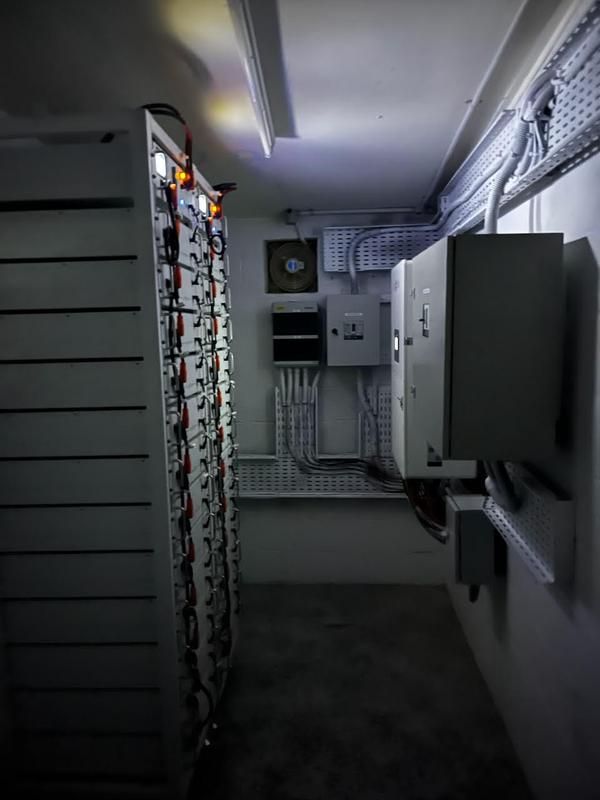
South Pacific International Academy (SPIA) is at the forefront of Papua New Guinea’s renewable energy transition, having installed a 130 kW solar mini-grid at its Port Moresby campus. The system, powered by Trinasolar Vertex S+ 445W modules and supported by 244 kWh of Sunsynk lithium batteries, produces approximately 89 MWh of clean electricity annually, enough to meet the school’s energy needs reliably and reduce dependence on diesel generators.
The project was designed to balance efficiency with practical sustainability. “We conducted a detailed load analysis with PNG Solar Supply to ensure the system was correctly sized. An undersized system would require constant generator backup, while an oversized one would mean paying for unused capacity,” said Matt Allen, Chairman of the School Board. During peak demand, the system delivers 67 kW to immediate consumption while storing over 60 kW in batteries for night-time use, providing consistent power even during periods of high usage.
The installation also illustrates the economic benefits of advanced solar technology. Following recent amendments to PNG’s rooftop solar policy, SPIA reports that its monthly electricity bill from PNG Power Ltd has fallen from K12,000 to under K2,000, with particularly sunny months seeing bills as low as K384. Blackouts across both the school and staff housing have been eliminated, while generator usage has dropped to roughly one hour per month. Currently, all solar power is self-consumed, as PNG Power does not yet provide a feed-in tariff for exporting excess electricity.
Beyond operational savings, the mini-grid represents a broader educational and sustainability mission. “Our core values of faith, truth, and growth emphasise stewardship, integrity, and lifelong learning. By operating a 100% solar-powered, grid-independent campus, we model responsible environmental stewardship while demonstrating practical innovation and resilience,” Allen said. The mini-grid functions as a living classroom, giving students and the wider community hands-on exposure to renewable energy technologies.
.jpg)
The site also serves as a model for national capacity-building initiatives. In 2025, the mini-grid was used for a JICA-conducted training programme for NEA inspectors, providing a practical environment to complement classroom instruction. It will again feature as the site visit for the upcoming “Capacity-Building Workshop for Institutions and Decision-Makers on Solar Energy Transition in PNG” from 17–19 February 2026.
Staff and families residing on campus have experienced tangible improvements in quality of life. Stable electricity has safeguarded appliances and equipment previously damaged by brownouts, including air conditioners and water pumps. The project also enhanced campus safety, with solar-powered street lighting along the perimeter and a solar-powered electric fence protecting staff residences.
SPIA plans to expand the solar array in line with campus growth. Phase 3 of the school, set to include new classrooms, offices, and an indoor dining facility, will be supported by an additional 50 kW of solar capacity. The project was funded through a zero-interest loan from a sister non-profit organisation, requiring no special licensing from NEA, as the installation is below 1 MW. NEA inspections and guidance ensured smooth implementation despite the regulator’s relatively young age and developing framework.
The academy is exploring complementary renewable initiatives, including solar water heating and future EV charging infrastructure, although local serviceability remains a constraint. “We hope to be a model for others to follow,” Allen said.
By combining operational savings, hands-on education, and community benefits, SPIA’s mini-grid demonstrates how high-performance, durable solar technology can support energy security, sustainability, and real-world learning in PNG—a model increasingly relevant as the country seeks resilient, low-carbon solutions for schools and institutions.


