Great Pacific Gold Corp. has reported further high-grade drilling results from its flagship Wild Dog Project on New Britain Island, East New Britain Province, Papua New Guinea. The company also outlined an extensive district-scale 2026 exploration programme designed to expand and define gold mineralisation across the 15-kilometre Wild Dog Structural Corridor.
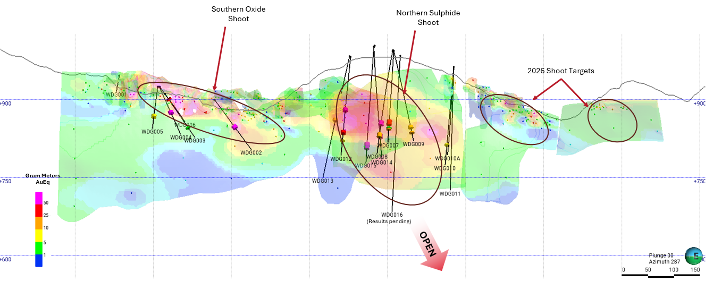
Diamond drilling at the Sinivit target commenced in May 2025 with a single drill rig. Sixteen holes were completed over 3,000 metres, defining two high-grade shoots: the Southern Oxide Shoot and the Northern Sulphide Shoot. Previous results from holes WDG-01 to WDG-14 included 8.4 metres at 50.1 grams per tonne (g/t) gold equivalent (AuEq) and 9.5 metres at 13.75 g/t AuEq, confirming the potential for high-grade epithermal mineralisation at depth.
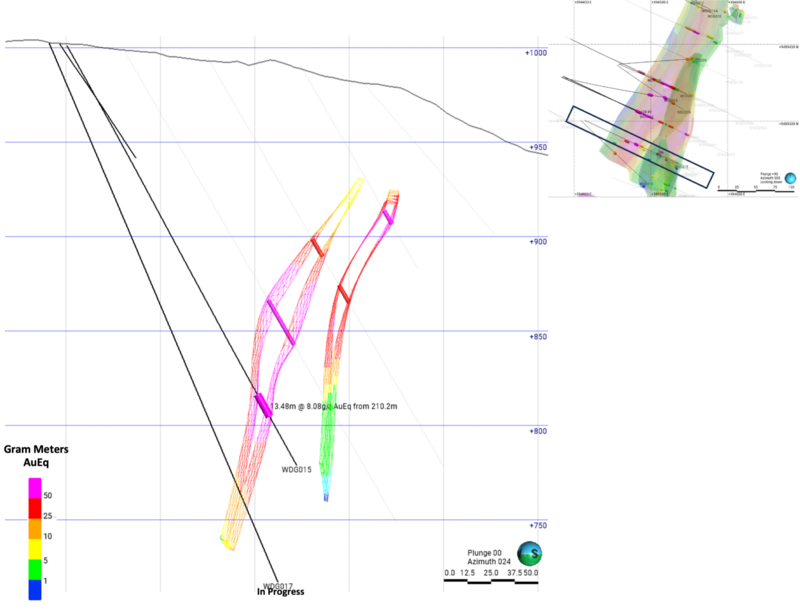
The latest results from hole WDG-15 in the Northern Sulphide Shoot returned 13.48 metres at 8.08 g/t AuEq from 210.22 metres, including a 4.50-metre interval at 14.62 g/t AuEq. This intercept lies approximately 50 metres below the deepest previously drilled hole, confirming the continuity of the system at depth. Drilling of hole WDG-17 is underway, extending the Northern Sulphide Shoot by a further 50 to 60 metres below WDG-15.
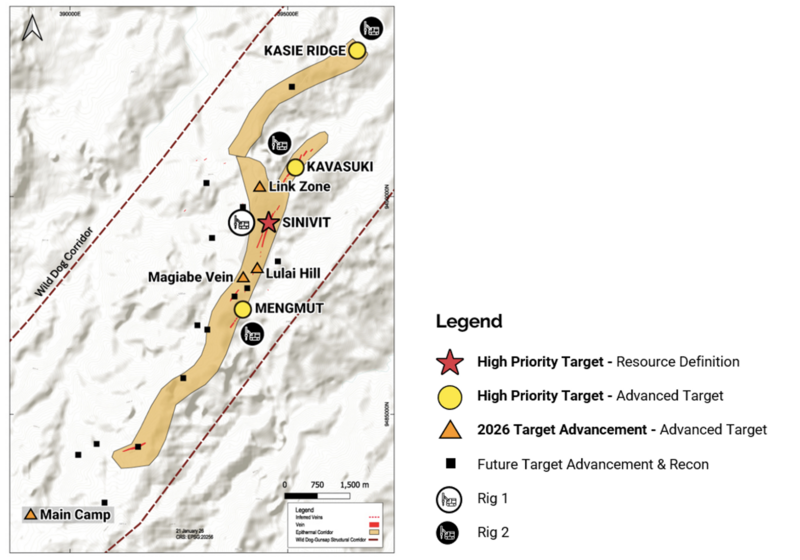
The company has completed expansion of the Wild Dog camp and supporting infrastructure to accommodate increased drilling activity. A second diamond drill rig is scheduled to arrive in early February, allowing simultaneous testing of multiple targets along the 15-kilometre corridor, including Kasie Ridge, Kavasuki, and Mengmut.
Kasie Ridge, located at the northern end of the corridor, is a high-priority target defined by a 400–500-metre wide advanced argillic lithocap. Integration of MobileMT geophysics and high-resolution LiDAR has identified a large-scale high-sulphidation epithermal target beneath the lithocap, suggesting potential for a new district-scale discovery.
Kavasuki, approximately one kilometre north of Sinivit, is a known epithermal vein system with historical drilling and trenching demonstrating high-grade gold mineralisation over a 900-metre strike. Previous shallow drilling returned intercepts of 15.6 metres at 2.5 g/t Au and 17.2 metres at 5.8 g/t Au, with trenching extending mineralisation over 3.5 kilometres. The system remains open at depth and along strike.
Mengmut, 1.5–2.0 kilometres south of Sinivit, exhibits high-grade surface geochemistry and potential for a Sinivit-style discovery. Historic mapping and trenching identified gold grades up to 19.1 g/t Au with associated copper, highlighting continuity beyond surface samples and confirming its priority for follow-up drilling.
The 2026 programme will continue to focus on expansion of the Southern Oxide and Northern Sulphide shoots at Sinivit, while systematically testing district-scale targets along the corridor. Rig 1 will advance drilling at Sinivit and nearby high-priority targets, while Rig 2 will undertake first-pass reconnaissance at Kasie Ridge, Kavasuki, and Mengmut. The exploration strategy is designed to rank and test high-priority targets sequentially, while advancing earlier-stage targets through parallel evaluation.
Since the start of the programme in May 2025, Great Pacific Gold has completed 16 drill holes at Sinivit, with hole 17 in progress. The results support continued high-grade gold potential at depth and along strike and reinforce the project’s district-scale exploration potential.
For further details, visit gpacgold.com.