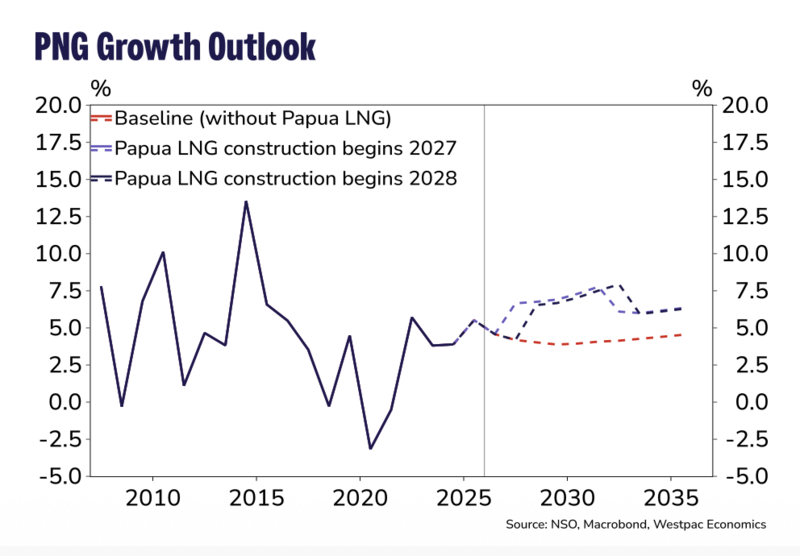
Papua New Guinea’s economy is forecast to expand by 4.6 percent in 2026, with prospects shaped by its recent grey listing by the Financial Action Task Force (FATF) and the anticipated Final Investment Decision (FID) on the US$13–14 billion Papua LNG project later this year, according to Westpac’s Westpac Wailis: PNG Economic Update and Outlook (February 2026).
Westpac upgraded its 2025 growth estimate to 5.5 percent from 4.7 percent, citing strong performance in mining, industry and services. The official 2024 growth estimate of 3.9 percent was below Westpac’s projection.
Mining and exports drive 2025 rebound
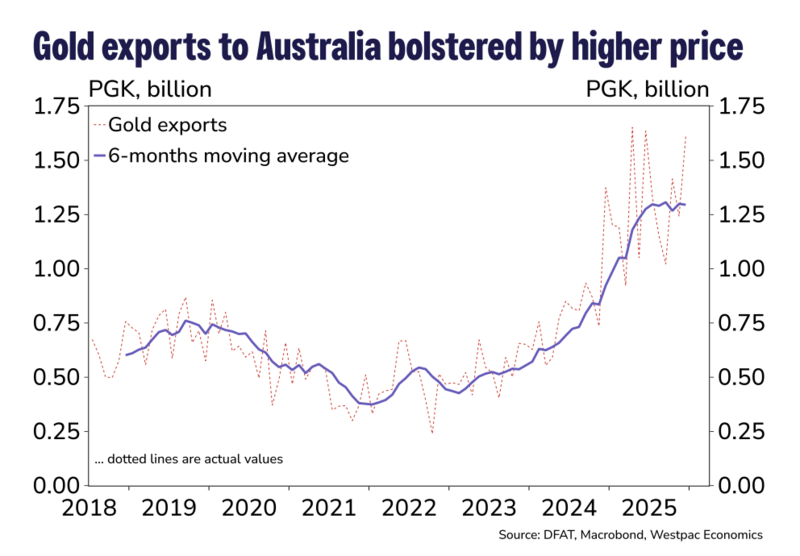
The report said 2025 was marked by robust mining output amid favourable global commodity prices. Elevated gold and copper prices, the restart of the Porgera gold mine and a standout year at Ok Tedi underpinned strong outcomes in the resource sector.
Porgera delivered 376,000 ounces of gold in 2025, contributing around 1 percent of GDP and declaring K1.7 billion in dividends while paying K986 million in taxes. Ok Tedi produced 106,000 tonnes of copper and 298,000 ounces of gold, generating K9.3 billion in revenue and more than K1 billion in dividends.
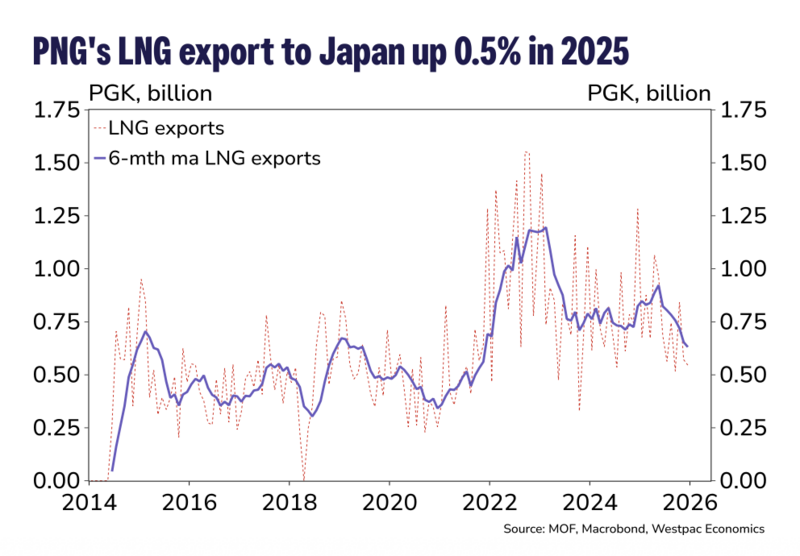
PNG LNG operated above nameplate capacity in 2025, exporting more than 8.3 million tonnes of LNG, up 8.4 percent year on year, and has fully repaid its project finance debt, boosting the state’s future dividend and tax flows.
Agriculture also benefited. Coffee exports exceeded 1.5 million bags in 2025, lifting rural incomes. Palm oil output is projected to rise to 727,300 tonnes in 2026 from 696,800 tonnes in 2025, while cocoa exports are forecast at 51,200 tonnes in 2026.
Inflation easing but uneven
Headline inflation slowed to 4.1 percent year on year in the December 2025 quarter from 4.7 percent in September, while underlying inflation eased sharply to 0.8 percent. Betel nut prices, up 29 percent year on year in the fourth quarter, remained the largest source of volatility in the consumer price index.
Price pressures are uneven. Inflation in Port Moresby and Lae stood at 0.5 percent and 1.6 percent respectively, while the Goroka-Hagen-Madang region recorded 17.4 percent and the Alotau-Kimbe-Kokopo/Rabaul region 13.6 percent.
Westpac said inflation is now broadly within the 3–4 percent range, allowing Bank PNG to maintain a stable policy stance.
Fiscal consolidation strengthens
The 2026 National Budget sets record expenditure of K30.9 billion against projected revenue of K29.3 billion, with the deficit targeted at 1.1 percent of GDP — down sharply from 8.9 percent in 2020. The debt-to-GDP ratio is projected to fall to 45.5 percent in 2026 from 48.4 percent in 2025.
International reserves cover more than seven months of imports, and foreign exchange backlogs have largely cleared. The kina has depreciated gradually under a managed crawling peg, with the PGK/USD at 0.2327 in January 2026 and forecast to bottom at 0.2150 in late 2026 or early 2027 before appreciating.
A Treasury Bills auction in February was oversubscribed, with bids of K650.48 million against K270 million on offer, reflecting strong demand for government securities.
Grey listing impact seen as contained
Westpac expects the impact of FATF grey listing to be limited and contained, noting that authorities have introduced an 18-point action plan backed by a K10 million allocation to strengthen anti-money-laundering controls. Business leaders remain cautiously optimistic, viewing the development as a catalyst for reform.
Papua LNG could reshape growth path
Under Westpac’s baseline scenario without Papua LNG FID, growth moderates to 4.2 percent in 2027 and 4.0 percent in 2028, stabilising around 3.9–4.1 percent over the longer term.
However, if the US$14 billion Papua LNG project proceeds, the construction phase — modelled over five years — could lift annual GDP growth by 2.5 to 3.4 percentage points, pushing growth to between 6.7 percent and 7.3 percent during peak years. Once production begins, mining growth could rise from a baseline of 1.6 percent to 7.6 percent, lifting overall GDP growth to about 6.1 percent in 2032.
The project is projected to produce 5.6 million tonnes per annum, generating estimated annual revenues of US$2.7 billion at an assumed average price of US$9.91 per MMBtu.
Taken together, Papua LNG could lift PNG’s growth trajectory from a 4 percent baseline to a 6–8 percent range during peak years, making it the most consequential driver of economic expansion over the coming decade.
Despite structural challenges and external headwinds — including commodity price volatility and potential global LNG oversupply — Westpac concludes PNG enters 2026 with solid growth momentum, improving fiscal metrics and a strong pipeline of resource projects.