Category:





K92 Mining Announces Strong Q2 Production Results - Record Mine & Mill Throughput, Significantly Exceeding Stage 2 Expansion
Photo credit: K92 Mining Inc.
K92 Mining Inc. announces production results for the second quarter (“ Q2 ”) of 2022 at its Kainantu Gold Mine in Papua New Guinea, of 26,085 oz AuEq or 22,934 oz gold, 1,229,961 lbs copper and 25,224 oz silver. Sales during the second quarter were 23,674 oz gold, 1,349,816 lbs copper and 27,033 oz silver.
During the second quarter, Kainantu delivered its third consecutive quarter at Stage 2 Expansion run-rate throughput, processing a record 108,853 tonnes, an increase of 44% from Q2 2021. Mine performance was also strong, exceeding mill throughput, with a record 114,471 tonnes of total mill feed mined, an increase of 59% from Q2 2021.
Importantly, in June, the mill delivered a monthly average throughput record of 1,251 tpd, significantly exceeding the Stage 2 Expansion target of 1,100 tpd. During May and June, 29 days (48% of the period) exceeded 1,300 tpd throughput and a daily record of 1,559 tonnes was set on June 29, 2022. Subsequent to quarter end, on July 6, a new daily mill tonnes processed record was achieved of 1,638 tonnes. The plant continues to demonstrate much higher throughput rates than the Stage 2 Expansion design (400,000 tpa / 1,100 tpd) and potentially higher than the Stage 2A Expansion design run-rate (500,000 tpa / 1,370 tpd).
As an update on the Stage 2A Expansion, the new filter press is installed and operational, the additional TC-1000 secondary crusher was installed in late 2Q and is currently being commissioned, while the new flotation tanks are scheduled to arrive in Q4 2022. The estimated growth capital cost for the plant expansion is US$2.5m and was approved in October 2021 ( see October 7, 2021 press release: K92 Mining Announces Stage 2A Expansion to Increase Throughput +25% to 500,000 Tonnes Per Annum at Kainantu Gold Mine) .
During the quarter, long hole stoping continued to perform to the design, with operations focused on Kora’s K1 and K2 veins, and Judd’s J1 Vein for a total of 9 levels mined. Mining on Kora was conducted on the 1150, 1170, 1205, 1225, 1265 and 1285 levels, and Judd on the 1235, 1265 and 1285 levels.
The operation delivered head grades of 8.2 g/t AuEq or 7.2 g/t gold, 0.56% copper and 9.9 g/t silver in Q2. Gold grades were below budget due to stope sequencing. Metallurgical recoveries averaged 91.0% for gold and 90.9% for copper during the quarter and we see further upside once the flotation tanks are installed that will double the rougher tank capacity. Q3 2022 will also mark the first quarter with the gravity circuit fully operational and utilized as the dore export license was granted in late April 2022. The strong throughput and higher grade stoping sequence planned for 2H 2022, well positions Kainantu to achieve its 2022 production guidance of 115,000 to 140,000 oz AuEq.
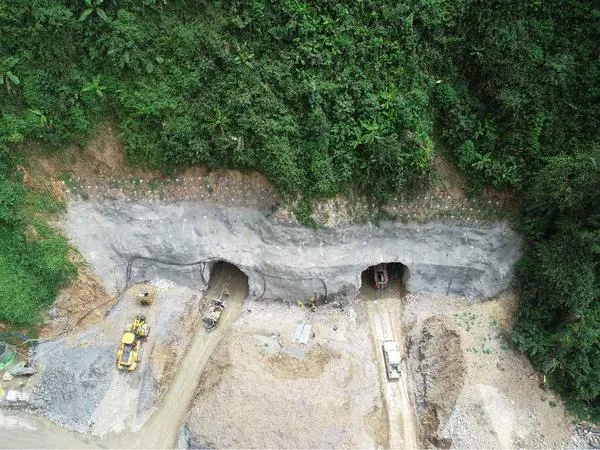
Twin incline development made significant progress, advancing 58% above budget during Q2. As of June 30, 2022, incline #2 (6m x 6m) advanced to 1,276 metres and #3 (5m x 5m) advanced to 1,317 metres. Year-to-date, twin incline development has advanced 38% above budget. Overall, mine development performed well, advancing 1,826 metres in Q2 (including the twin incline), a 75% increase from Q2 2021, the 2 nd highest quarter on record.
COVID-19 Operational Resiliency
The Kainantu Gold Mine operates under a comprehensive COVID-19 Management Plan that has continuously operated during the pandemic. A considerable focus is on health and safety and risk-mitigation. Under the COVID-19 Management Plan, K92 has: established a Government-recognized testing lab facility utilizing qualified medical personnel on site; set up quarantine and isolation facilities for incoming staff; and implemented enhanced hygiene, disinfecting and training systems and procedures. Additional controls were implemented in 2021, requiring external COVID-19 testing prior to travel and quarantine at site in addition to testing on arrival at site before reporting to quarantine. A focus has been supporting Government efforts at a national, provincial and local level through the 1.5 million PGK (Papua New Guinea Kina) COVID-19 Assistance Fund and a further 1.0 million PGK of additional assistance funding to Eastern Highlands Province.
In addition to its various control measures, K92 continues to make considerable progress increasing resiliency through vaccinations of our expatriate and PNG national workforce, with vaccinations continuing to be administered on site. Over 75% of our workforce (employees and contractors) have received at least one vaccine dose. The Company is in close communications with the provincial and national health authorities of Papua New Guinea and the Government of Australia, in addition to the Papua New Guinea Chamber of Mines and Petroleum to deliver an effective pandemic response.
Table 1 – Q2 2022 & 2021 Annual Production Data
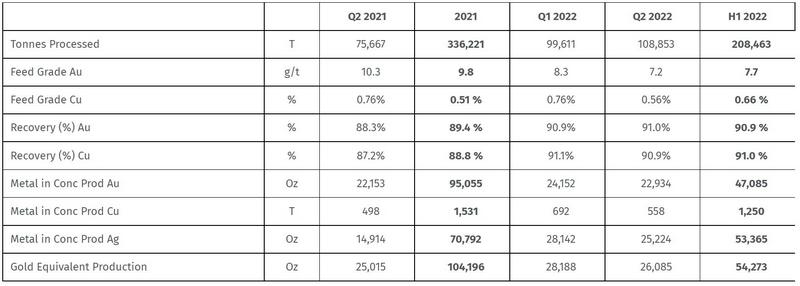
Note - Gold equivalent for Q2 2022 is based on the London Metal Exchange quarterly spot average price: gold $1,870 per ounce; silver $23 per ounce; and copper $4.32 per pound. Gold equivalent for Q1 2022 is based on the London Metal Exchange quarterly spot average price: gold $1,879 per ounce; silver $24 per ounce; and copper $4.53 per pound. Gold equivalent for 2021 is based on the following prices: gold $1,800 per ounce; silver $25 per ounce; and copper $4.35 per pound.
John Lewins, K92 Chief Executive Officer and Director, stated, “The second quarter once again marked another major step forward for the Kainantu Gold Mine. Mill throughput and mill feed delivered from the underground mine were both records, increasing 9% and 14% quarter-over-quarter and 44% and 59% versus Q2 2021, respectively. Development was also strong, increasing 19% from the previous quarter, and the 2 nd highest on record.
The performance at the mill is particularly impressive; at an average of 1,196 tpd in Q2, it is not only significantly exceeding the 1,100 tpd Stage 2 Expansion run-rate but it is also showing the potential to exceed the Stage 2A Expansion run-rate of 1,370 tpd. In June, mill throughput averaged 1,251 tpd with a daily record of 1,559 tonnes processed on June 29. Last week, on July 6, another new daily record was set with 1,638 tonnes processed. Importantly, the Stage 2A Expansion plant’s two major outstanding upgrades have not yet been commissioned, with the additional TC-1000 crusher recently installed and the additional flotation cells, which will double rougher tank capacity, planned for installation in Q4.
The strong throughput and a higher grade stoping sequence planned for the second half of 2022 bodes well for the operation and we are well positioned to meet our annual production guidance of 115,000 oz to 140,000 oz AuEq.
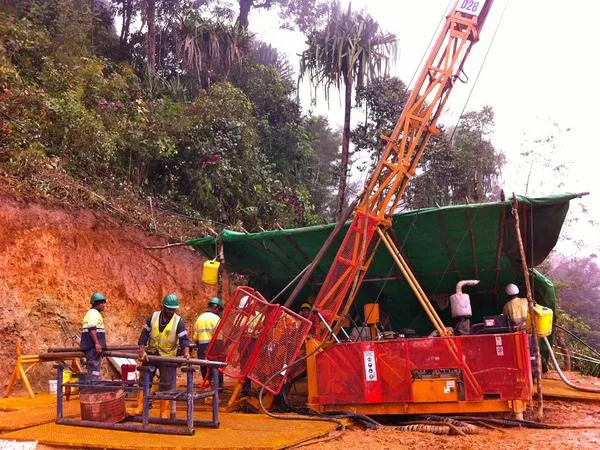
Beyond production expansions, exploration is also a major focus for K92. There are 10 drill rigs currently operating, focusing on resource growth. With our financial position the strongest it has ever been by a significant margin, we expect to increase our exploration budget near-term.”
The full press release can be found HERE


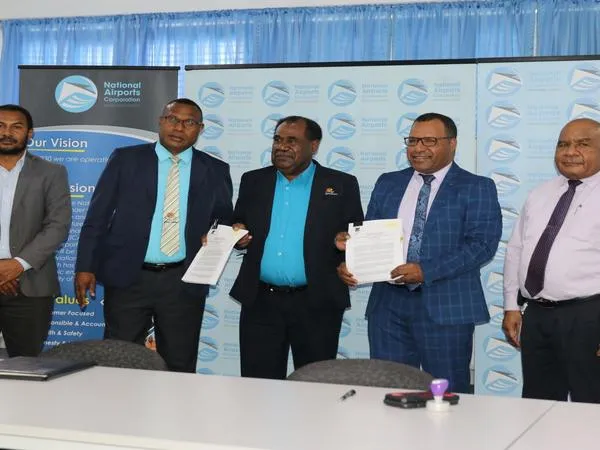
NAC Sign CADIP Phase Two MoU With The Asian Development Bank
Photo credit: National Airports Corporation Papua New Guinea Facebook Page
The key partners in the Civil Aviation Development Investment Program (CADIP) in Papua New Guinea have signed a Memorandum of Understanding (MoU) for the Phase-2 of CADIP.
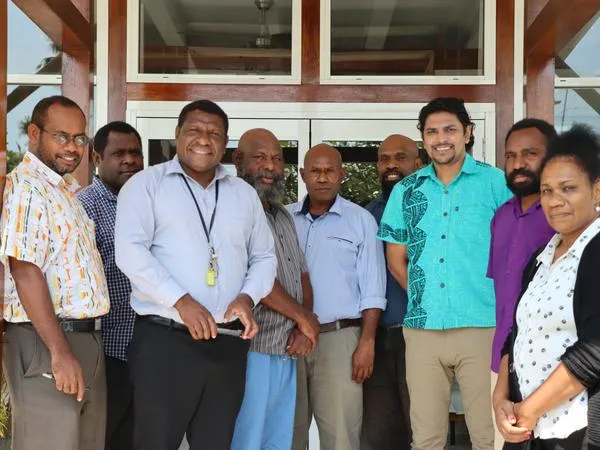
The National Airports Corporation, Asian Development Bank ADB in the Pacific, Department of National Planning & Monitoring, Department of Transport together with Civil Aviation Agencies, signed the MoU in Port Moresby yesterday (Monday July 4, 2022).
The signing of the MoU is a significant step taken by the development partners prior to and in the lead up to the implementation of high impact aviation projects under phase 2 of the program.
The MoU is a result of a series of discussions between the Asian Development Mission (the Mission) and the Government agencies (Department of Treasury, Department of National Planning and Monitoring; Department of Transport), aviation entities (National Airports Corporation, NiuSky Pacific Limited, Civil Aviation Safety Authority, PNG Accident Investigation Commission) and other key stakeholders.
It (MoU) contains information on the ABD Mission’s findings and agreements reached with GoPNG on the following;
- Project scope of works;
- Cost estimates and financings plans;
- Implementation arrangements;
- Project due diligence
- Proposed loan assurances and conditions
- Draft project administration manual; and
- Loan processing schedule.
The proposed CADIP Phase 2, is expected to be financed at an estimated cost of USD$ 171.5 million (ADB loan of USD$ 162.9 and the Government’s counterpart funding of USD$8.6 million).
This means the ADB’s ordinary capital resources loan will be 95% of the total cost whilst the Government’s component will be 5% of the overall cost.
The loan will finance identified projects by National Airports Corporation (NAC), Niusky Pacific Limited (NSPL), Civil Aviation Safety Authority (CASA), PNG Accident Investigation Commission (AIC), National Weather Service (NWS) and Rural Airstrip Agency (RAA) under the following scope; civil works, goods and equipment, consulting services and capacity building.
The implementation period of the second phase will be five (5) years with the loan envisaged to take effect in December 2022. However, prior to that the proposed loan will go through ADB’s approval process which include; interdepartmental review then an internal loan negotiation will be conducted, then the ADB Board’s approval and finally the loan will become effective afterwards.
All projects are expected to be completed by the 30th of June 2028 with the loan closing on the 31st of December 2028.
CADIP Phase 2 will be governed by the Project Steering Committee (PSC) comprising; ADB, the Department of Finance, the Department of National Planning and Monitoring, the Department of Treasury, the Department of Transport (DOT), NAC, CASA, New Sky Pacific Limited (NSPL), PNG Accident Investigation Committee, Air Niugini and Link PNG.
The executing agencies of CADIP Phase 2 will be NAC and NSPL and the implementing agencies will be CASA, DOT, National Weather Services (NWS) and PNGAIC.
CADIP-2 aligns with the Medium-Term Transport Plan, 2019 to 2022 to rehabilitate the national airports in PNG and to ensure they are in compliance with the PNG Civil Aviation Rules Part 139 and the International Civil Aviation Organization (ICAO) Standards and Recommended Practices.
In addition, CADIP Phase 2 aims to improve a selection of Rural Regional Airports. This is to encourage and create business opportunities such as tourism, agriculture and connectivity to boost economic growth and sustainability for our people in the rural and urban areas of PNG.
The proposed CADIP Phase 2 will commence after the successful closure of CADIP 1 which ended after the ADB’s Multi- Tranche Financial Facility (MFF) loan expired on the 24th of November 2021. Under CADIP 1 several high impact aviation infrastructure were successfully implemented through a series of tranches (Tranches 1, 2 & 3). Few projects that were not covered under CADIP 1 will be implemented in the second phase.
Article courtesy of National Airports Corporation - Papua New Guinea