Category:
Signs of fiscal recovery in Papua New Guinea?
by Kingtau Mambon and Stephen Howes
Papua New Guinea has been facing fiscal problems since the end of its economic boom almost a decade ago, with large deficits, increasing debt, falling revenue, and a rapidly growing salary bill. The COVID-19 pandemic has made things worse by depressing revenue. But the recently released 2021 Final Budget Outcome contains some promising signs.
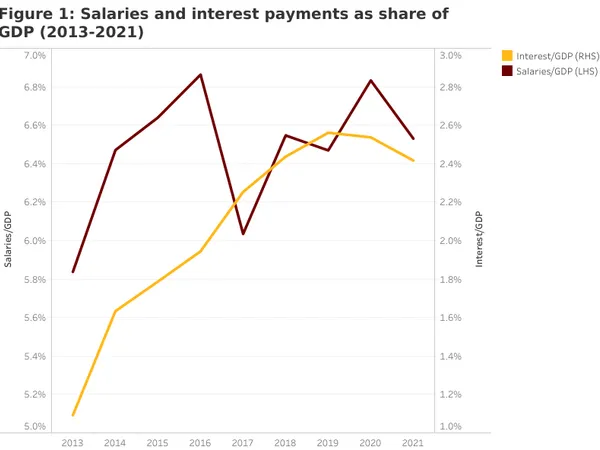
First, interest payments and the salary bill, both of which have increased rapidly since the boom ended in 2013, have been brought under control, at least for now. As the graph below shows, they have both started to fall relative to GDP.
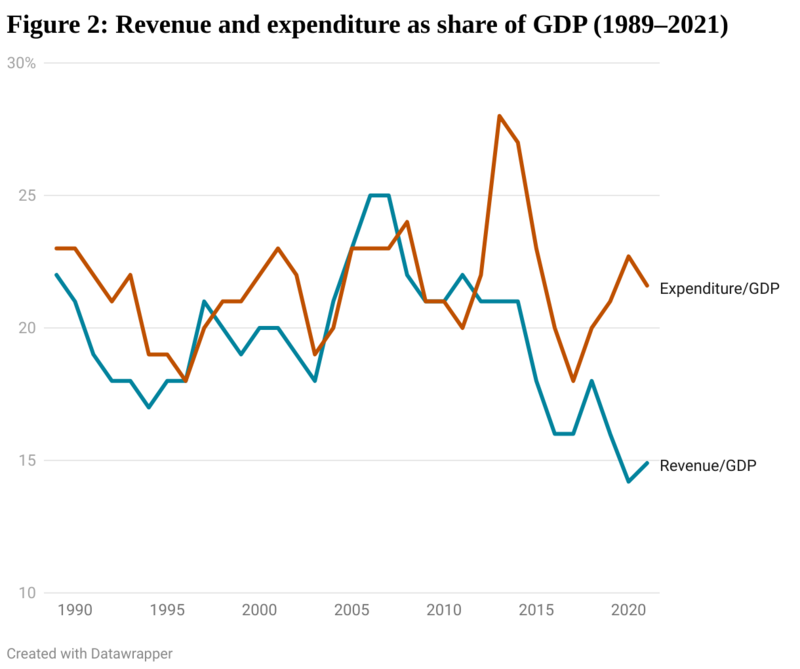
Second, after two years of negative growth, revenue grew strongly, by 9.7% after inflation, or from 14.2% of GDP in 2020 to 14.9% in 2021. This is more than the target in the government’s ambitious plan to achieve a balanced budget in 2027, which requires 7% annual revenue growth.
The revenue increase in 2021 was largely driven by mining and petroleum taxes, reflecting higher commodity prices. Grants (foreign aid) also increased by 47%, indicating strong support from foreign governments and multilaterals during COVID-19, including the first budget support grant after two decades from Australia.
Third, the fiscal deficit fell from 8.6% of GDP in 2020 to 6.7% in 2021. This reflects the revenue growth noted above, as well as expenditure restraint. Expenditure grew in 2021 by slightly less than the rate of inflation. As a share of GDP, expenditure fell from 22.7% in 2020 to 21.6% in 2021.
However, despite these promising indications, PNG is far from achieving a fiscal recovery. The basic budget problem that PNG faces is a structural gap between expenditure and revenue. As the next graph shows, expenditure now hovers above 20% of GDP, and revenue around 15% of GDP.
This is not only an issue for debt sustainability, but also for service delivery. PNG has a rapidly growing population. It is useful to divide revenue and expenditure by the population, as the next graph does. Adjusting for inflation, expenditure per capita in 2021 was around its long-term average of K2,200 (in 2021 prices). But revenue per capita was about K1,500, around its lowest level for three decades. With falling revenue per capita, it will not be possible to support expanded education, health and roads spending.
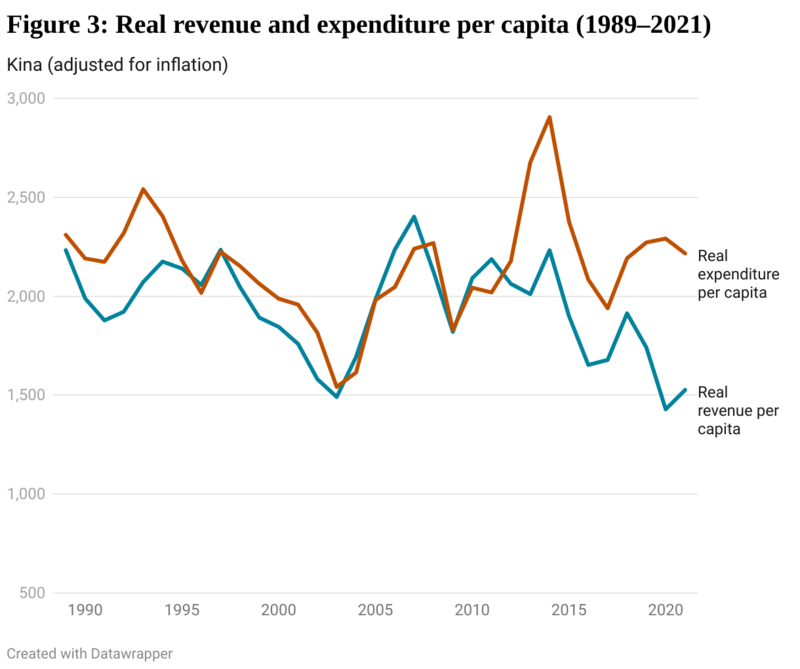
A lot more work needs to be done. Revenue is still below its pre-COVID level. Adjusting for inflation, revenue in 2019 was K14.9 billion (in 2021 prices); in 2021, it was only K13.9 billion.
While recovery from the COVID-19 downturn will take time, reforms are also needed. The worst revenue performer is dividends from state-owned enterprises (SOEs). Outside of mining and petroleum, the SOEs paid no dividends at all for the 2021 fiscal year. This is not a new issue. The 2019 and 2020 fiscal years also saw zero dividends coming from SOEs.
With their poor performance and estimated consolidated debt of 5.1 billion kina, it is perhaps unrealistic to expect much more from the non-resource SOEs. But Ok Tedi Mining Limited (OTML) only contributed K81 million to the budget, down from K370 million the previous year. A note in the budget indicates that most of OTML dividends went to Kumul Minerals Limited rather than the budget, another case of questionable diversion of funds.
The National Fishery Authority also paid nothing to the budget against a target of K146 million, despite being flush with funds from the auctioning of fishing licences.
On the expenditure side, while, as mentioned earlier, the salary bill was under control relative to earlier years, expenditure on salaries still went over budget by K180 million. The salary bill for MPs' salaries increased by K8 million from K71 million to K79 million. There was a spike in the unclassified or ‘other’ portion of the salary bill, which increased from K16 million in 2020 to K73 million in 2021, raising questions of transparency and accountability.
In conclusion, the final budget outcome for the 2021 fiscal year shows strong growth performance in revenue collection and constraint over spending with lower deficits compared to 2020 outcomes. Despite these promising signs, it’s too early to say PNG has turned the fiscal corner. The large structural gap between revenue and expenditure existed before COVID-19, and closing it will not be easy.
The PNG Budget Database has been updated to reflect the 2021 Final Budget Outcome figures. (see devpolicy.org for hyperlinks to these).
Disclosure: This research was undertaken with the support of the ANU-UPNG Partnership, an initiative of the PNG-Australia Partnership, funded by the Department of Foreign Affairs and Trade. The views are those of the authors only. This article appeared first on Devpolicy Blog (devpolicy.org), from the Development Policy Centre at The Australian National University. Kingtau Mambon is an economics tutor at the University of Papua New Guinea School of Business and Public Policy (SBPP). Stephen Howes is the Director of the Development Policy Centre and a Professor of Economics at the Crawford School.
Watou and Talpos RC drilling – reinforces Mining Lease and regional exploration potential
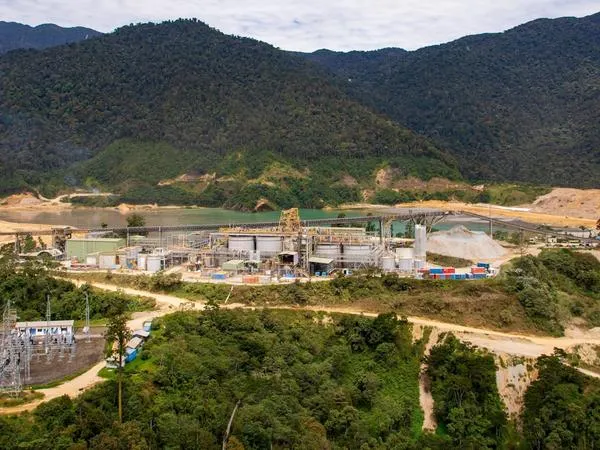
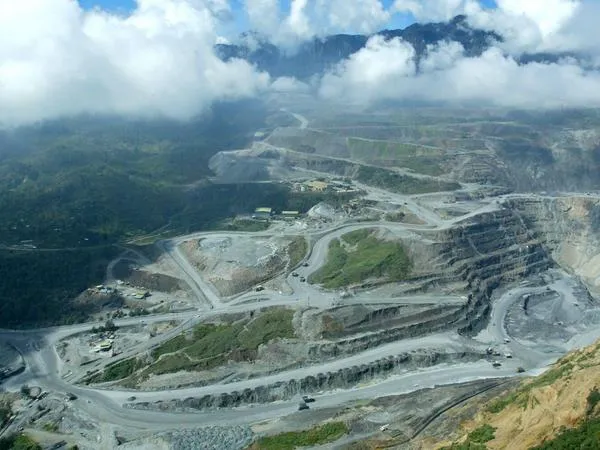
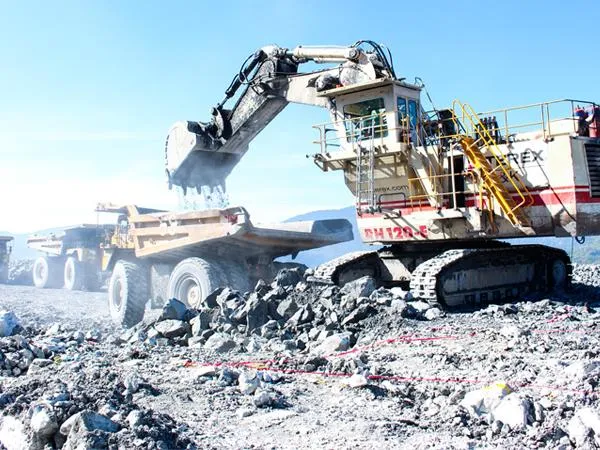
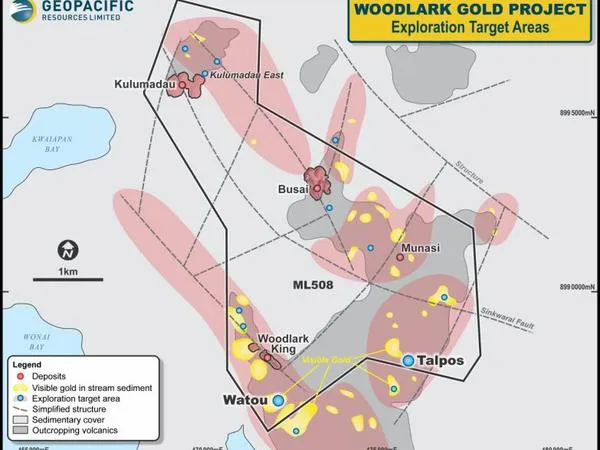
Photo credit: Geopacific Resources - Figure 1: Mining Lease exploration target areas
Geopacific Resources Limited is pleased to provide an update on its exploration drilling campaign at the Woodlark Gold Project.
Highlights
- Drill holes in to the Talpos and Watou targets generated several positive results including:
Talpos
- TARC22008: 11 metres at 3.04g/t Au from 49 metres and 11 metres at 0.74g/t Au from 63 metres; and
- TARC22003: 3 metres at 2.66g/t Au from 32 metres.
Watou
- WTRC22006B: 10 metres at 2.80g/t Au from 68 metres, including 4 metres at 5.35g/t Au from 69 metres.
- The Company has received the first 18 holes from the recently undertaken regional drilling campaign at the Project.
- Results highlight the potential of the Talpos and Watou targets, located at the southern end of the Mining Lease, and demonstrate the broader regional exploration opportunities on Woodlark Island.
- A further 7 holes from the exploration campaign have been completed with samples currently in the laboratory awaiting assay.
- The RC drilling program is ongoing and drilling activities will accelerate following the arrival of a diamond drill rig.
- These results at Watou and Talpos continue to grow the broader geological understanding of the Woodlark Gold Project and reinforce the potential for resource growth to be delivered by testing priority exploration targets across the Mining Lease.
Chief Executive Officer, Tim Richards commented “The infill, resource extension and now Mining Lease exploration drilling programs are essential inputs into the ongoing Woodlark Island re-evaluation and optimisation process. These drilling programs deliver key technical inputs that are integral for project reassessment. Geopacific remains on target to deliver a resource update in Q4 2022 along with further drilling to validate of the exploration potential on the Mining Lease and potentially other targets.”
Mining Lease Exploration
Geopacific continues to execute the resource and exploration strategy outlined in the May 2022 Corporate presentation. The company continues to deliver on the drilling activities and timeline outlined in the 2022 Planned work program. Post the completion of the grade control drilling campaign at Kulumadau, the Company commenced an exploration drilling program across the broader Mining Lease. The Mining Lease contains a number of targets that have not previously been subject to drilling and the campaign is designed to begin to test the prospectivity of these targets. The Talpos and Watou targets in the southern end of the Mining Lease were the initial focus of the campaign, and to date an initial 25 exploration holes have been drilled. Mining Lease exploration drilling will continue into the future, to test these and other targets.
Full press release can be found HERE
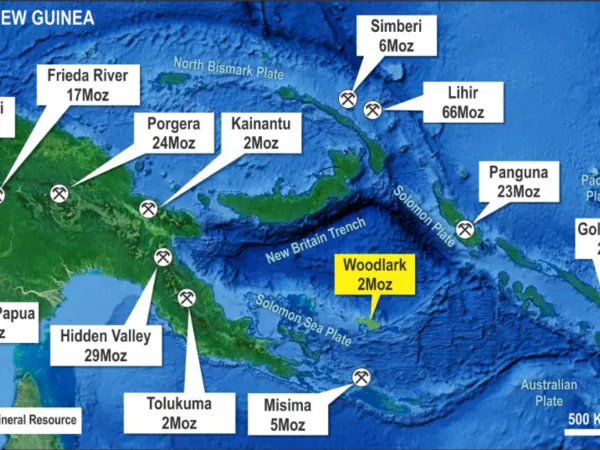
Geopacific Resources Releases Quarterly Report
Geopacific Resources Limited (‘Geopacific’ or ‘the Company’; ASX: GPR) is pleased to provide an update on its activities and cashflow for the quarter ended 30 June 2022.
Highlights
- Trading recommenced on the ASX on 31 May 2022 following the implementation of an intensive business transformation program in response to the previously identified material capital cost increases at the Woodlark Gold Project (‘Woodlark’ or ‘the Project’).
- The Company advanced a number of concurrent work programs to progress the Project and optimise its future development pathway including:
- an ongoing drill campaign aimed at growing the existing Mineral Resource and Ore Reserve;
- commencing studies to assess the implications of the potential Mineral Resource growth on the design and economics of a future project development; and
- a Strategic Review to assess alternative options to maximise shareholder value, including potential corporate and asset-level transactions.
- Positive results were received from the ongoing drilling campaign at the Project, highlighting upside potential within the existing pit shells and the broader exploration potential across the Mining Lease.
- Assays were received from:
- 25 grade control holes, including several significant high-grade intercepts (all within 60 metres of surface); and
- 46 resource extension holes from Kulumadau, Kulumadau East (new zone) and Busai which reinforced the potential for pit extension.
- Geopacific remains committed to engagement with the local communities on Woodlark Island and activity on the village relocation works and other important community initiatives continued.
- The Company held $20.6m of cash at 30 June 2022, no debt and $21m materials cost of Project long lead equipment assets, which are potentially available for sale.
Post Quarter End
- The process of board renewal was completed, with Ian Murray and Colin Gilligan resigning as directors and Mike Brook, Richard Clayton and Hansjoerg Plaggemars appointed as directors on 7 July 2022.
- Encouraging results returned from drilling at Talpos and Watou, including the identification of a new mineralised zone at Talpos.
Chief Executive Officer, Tim Richards commented “Along with completing the intensive commercial and corporate program to achieve reinstatement of ASX trading by 31 May 2022, we continued to progress our exploration and project review work streams. Our focus remains on maximising the value of the Project. The grade control drilling campaign has increased our understanding of the geology that exists within the existing pit shells. The broader resource extension drilling campaign continues to identify encouraging prospective targets outside the current pits, such as Talpos and Kulumadau East, which demonstrate the exploration potential that exists on Woodlark Island. With a second drill rig now mobilised to site, exploration activity will continue to provide valuable knowledge for our studies aimed at re-assessing the Project design and seeking to identify and capitalise on targeted economies of scale.”
Full press release can be found HERE
Kingston Resources Release Quarterly Report
Photo credit: Kingston Resources
Kingston Managing Director, Andrew Corbett, said: “The June quarter has been another period of significant activity, with the headline being the announcement of Misima’s much anticipated DFS results confirming the Project’s potential for a large-scale, long-life, low-cost gold mine. The DFS delivered total production of 2.4Mozs at an extremely low all-in sustaining cost of A$1,217/oz over a 20-year mine life, alongside a 28% increase in Reserve. I’m extremely proud of our Misima team for delivering such a highquality, comprehensive study, in a challenging operational environment.
“The DFS represents a tremendous milestone for Kingston, and these achievements reflect incredible work from our technical and operational teams who have exceeded project expectations. With all the necessary foundations now in place for a return to gold production at Misima, we look forward to advancing all the necessary approvals, strategic and funding options to bring the mine to production. I would like to thank our loyal shareholders for their ongoing support enabling us to deliver this milestone, and, very importantly, our Misima community who have strongly supported our progress.
“In addition, the Company has made considerable progress at the Mineral Hill Gold & Copper Mine during the quarter, delivering excellent initial diamond and RC drilling results at both the Pearse and SOZ deposits. With the conclusion of our highly successful initial drilling program, the team is now underway on a number of work programs to expedite mine production, these include Resource and Reserve updates, mine design work and plant refurbishment studies. This exciting progress forms part of the Company’s recently announced development pathway which comes as a result of the rapid advancements at the project. We look forward to another successful quarter ahead as we continue to rapidly advance both our Misima and Mineral Hill Projects.”
The full report can be found HERE
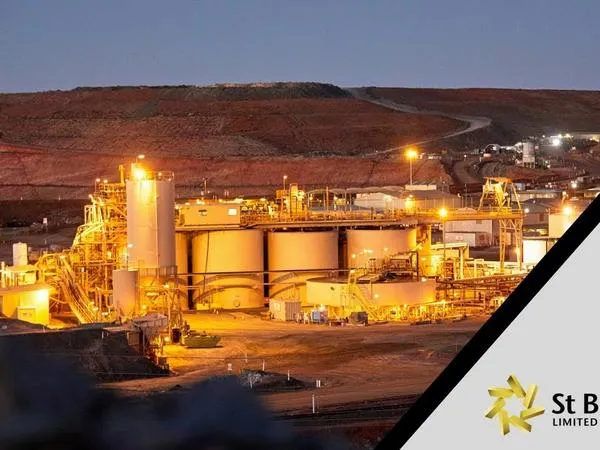
St Barbara Releases Quarterly Report
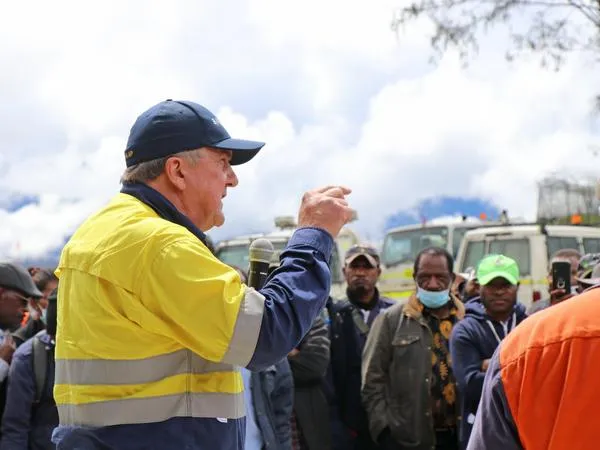
St Barbara Managing Director and CEO Craig Jetson said, “St Barbara has finished the year strongly, achieving both our production and cost guidance at a site and group level for FY22. Against the headwinds of cost inflation and COVID-19 impacts on our workforce availability as well as associated travel restrictions this is a rewarding result. It was achieved with improved safety performance with a lower TRIFR of 3.4 injuries per million hours worked.
Today we announce a further increase to our extensive Mineral Resource base in the Leonora province with the release of our inaugural Mineral Resource for Old South Gwalia. This initial Mineral Resource is the first instalment from Old South Gwalia from between 600 metres below surface down to 1000 metres below surface. Further resource extension drilling is planned for the coming year to grow a productive new mining front at Gwalia.
Management's focus on Gwalia and the Leonora province plan is generating early rewards with expansion of Mineral Resources and Ore Reserves and our expanded footprint across the region. We continue to execute our Leonora Province Plan. St Barbara is central to any regional consolidation with the largest Mineral Resource and Ore Reserve base in the Leonora region, a host of near term growth options, growing production from the new Zoroastrian underground mine and a cash generating processing facility which is expected to increase its processing capacity by 50% to 2.1mtpa. Following our acquisition of Bardoc, the assets have been promptly assimilated with Zoroastrian on track for first ore at the start of FY24.
Our development of the Leonora Province has provided invaluable insights that we are now applying in considering alternative pathways for scheduling our Atlantic Province projects, together with plans to maintain production at the Touquoy mine. With travel restrictions lifted, we have strengthened our relationships with the Government and First Nations people in Nova Scotia. In collaboration with the Government, a new permitting approach has commenced and has already yielded promising results with two permits already granted. These results provide encouragement that outstanding permitting issues can be addressed and the potential of Atlantic can be realised. Furthermore, our decision to place Simberi Operations under strategic review is aligned with our clear focus on leveraging the highest value options for the St Barbara Group.
We have made progress on plans to consolidate our corporate offices as we strive to deliver the appropriate level of support for our sites and optimise our cost base. Having already identified $5 million in ongoing cost reduction we have an aspiration to increase cost savings to $10 million in FY23 with a further $10 million in FY24.”
The full report can be found HERE