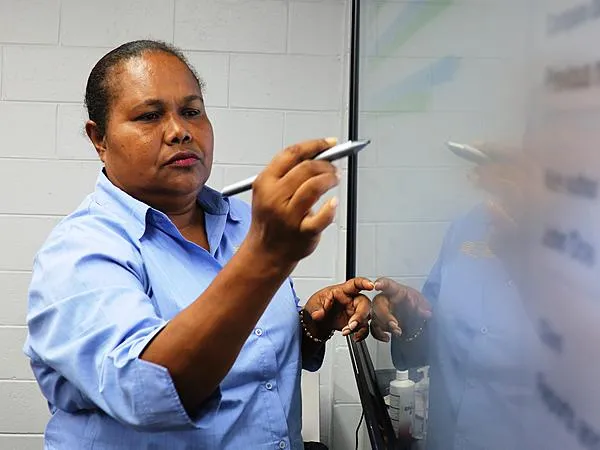
For five years the Business Coalition for Women’s leadership training program has been getting results for PNG women and the businesses that employ them. Nearly 200 women from 60 organisations representing a diversity of industries all over the country have graduated from the Coalition’s Certificate IV in Leadership & Management, with many of them being promoted as a direct result. Numerous organisations are repeat customers of the program and readily acknowledge its business benefits.
BSP, Dentons Lawyers, Digicel, Eda Ranu, NCS and Pacific Towing have been the most frequent repeat customers of the Cert IV in Leadership Program. Acting Managing Director of Eda Ranu, Raka Taviri Jnr, reports that “female staff performance has improved significantly and we’ve received an obvious return on our training investment. Eda Ranu will continue to send female employees on the course to improve their customer service skills internally and externally, as well as to enhance their overall professionalism in the workplace.”
It is not just businesses that are benefiting from the Coalition’s Cert IV program. All graduates report having acquired new skills and capabilities. Eda Ranu’s Vagi Kala (Snr Executive Assistant to MD) credits her new assertiveness, time management and work prioritisation skills, as well as improved working relationships with colleagues and clients, to having undertaken the training. She also reports that the Cert IV has enhanced her leadership and management skills, better positioning her for more challenging roles and future promotions.
The Certificate IV in Leadership and Management was developed in direct response to the business community’s demand for best practice and culturally nuanced leadership training for high potential female staff. Executive Director of the Coalition, Evonne Kennedy, believes that one of the reasons the Cert IV training has been so successful for both trainees and their employing businesses is that although it is Australian certified, it was developed in PNG for PNG. “This is not an off-the-shelf training package from Australia, New Zealand or some other country. We worked extremely closely with training specialists, PNG business leaders and PNG women to craft a program that 100 per cent meets the requirements of PNG’s businesses.”
The Coalition has conducted the Cert IV training for 15 cohorts of trainees since 2015 and has plans for another four cohorts in 2021. To date the training has predominantly taken place in Port Moresby although it has also been run in the Autonomous Region of Bougainville and will potentially be run in Lae next year.
“COVID impacted our plans to diversify our delivery geographically in 2020 but in accord with the ‘new normal’ and government health protocols we now have the necessary measures in place to continue our training in a COVID-safe way. As long as travel restrictions don’t prohibit us from getting trainers safely around the country then we will be able to service more of our non-Moresby customers in 2021 and beyond.”
Originally developed to provide leadership and management training to women employed in the corporate sector, the Cert IV has become very popular with the public sector and aid organisations. Abt Associates for example, has assisted several government departments to enrol 41 staff in the program and 32 law enforcement personnel have been enrolled via JSS4D.
“There is a huge appetite for high quality leadership and management training for female staff” acknowledges Kennedy. “We realised that we needed to open up our program to career women in other sectors. We also realised that we needed to offer courses for not just lower level managers, some of whom had already done the Cert IV with us, had been promoted, and were looking for additional professional development.” Therefore in 2019 the Coalition launched its Senior Executive Women Program in partnership with the Asian Development Bank, as well as its PNG Directorship Course (open to both women and men) in partnership with the Australian Institute of Company Directors. Although both of these programs were interrupted in 2020 due to COVID they have been rescheduled to run in 2021.
Numerous other trainings in addition to those focusing on leadership and management are available through the Coalition. The organisation is at the forefront of trainings that maximise workplace safety for women, reduce sexual harassment and support staff impacted by family and sexual violence. Member businesses also have access to bespoke consultancy services to assist them to meet their gender equality objectives.
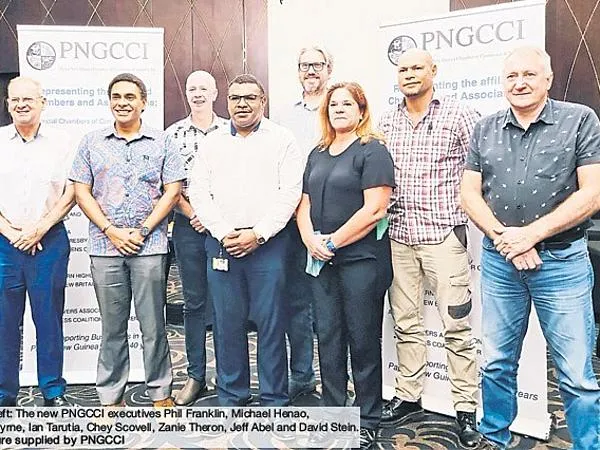
After an election of its new executives led by President Ian Taruita, the Papua New Guinea Chamber of Commerce and Industry (PNGCCI) said that it will build a 100-day work plan for its profile.
Aside from Taruita, elected are the following: John Byrne (vice-president Momase and Highlands), Jeff Abel (vice-president Southern), David Stein (vice-president Islands), Zanie Theron (treasurer), Phil Franklin (secretary), Michael Henao (board appointment coordinator), Peter Del Monte (regional coordinator) and Chey Scovell (international affiliations).
Tarutia said that the new executives were a mix of youth and experience.
“An immediate 100-day plan for the new team would be to focus on building the profile of the chamber, engaging more with key peak bodies and stakeholders on matters of mutual interest, advocating for its provincial members and adequately resourcing its secretariat,” he said.
In welcoming the new leaders, Taruita thanked the outgoing president and listed his role and his achievements.
The election was preceded by a meeting in which amendments were passed to let new positions of regional vice presidents to be part of the executive structure.
Meanwhile, the president of the Papua New Guinea Women’s Chamber of Commerce and Industry, Zanie Theron, becomes part of the executive.
In a statement released by the Independent Consumer Competition of the suggested take over bid, Paradise Company Limited has verified that they are in a dialogue with Kraft Heinz about obtaining Hugo Canning Limited.
This makes submission seeking clearance for Hugo Canning Company Ltd, a subsidiary of Kraft Heinz Group.
According to Paradise Company Ltd Group chief executive officer James Rice, the Independent Consumer and Competition Commission public notice was posted early and was published while discussions are going on.
But on behalf of the Board of Paradise Company, Anthony Smare, said that the firm is in discussions with the owner of Hugo Canning - which are subject to confidentiality.
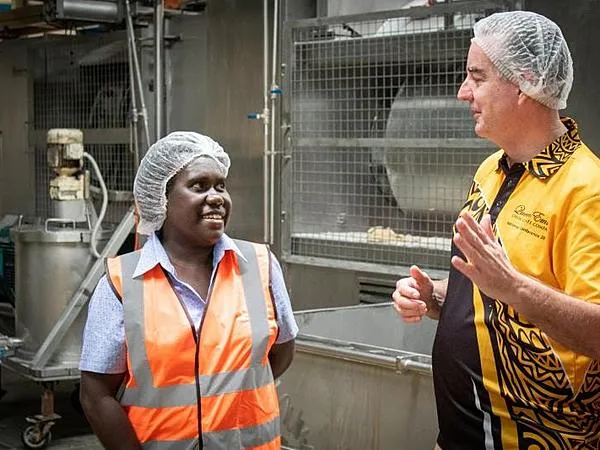
“If Paradise is successful in this acquisition of Hugo Canning, it will be business as usual for Hugo Canning with the manufacturing site and staff unaffected,” he said.
Mr Smare said that the firm should make public communication in due course - should all agreements be finalised.
According to ICCC in the public notice which was recently issued, Hugo Canning will exit the Papua New Guinea market. ICCC further clarified that the clearance is a statutory process under the ICCC Act which lets a consultative and transparent assessment of such proposed business acquisitions.
Kumul Training Institute – School of Aviation Studies, a privately-run institution, was recently given the signal to provide aircraft engineering training in the country.
PNG Civil Aviation Safety Authority (CASA) acting managing director and chief executive officer Wilson Sagati has presented the school with Certificate Number 141/003 at CASA headquarters in Port Moresby.
He added that the certificate was issued after due consideration over a five-phase compliance verification process, and awarded in compliance to Global Aviation Standards. He cited that Kumul is the second institution in PNG to offer an aircraft engineering course.
Meanwhile, Deputy Director for CASA retired Captain Tom Waqa also congratulated the Kumul Training Institute for its achievement.
“As we know, Aviation is a highly regulated sector and to work in it, we need to be properly qualified and undertake all requirements to run training programs,” he said. “Aviation industry has strict compliance certification and CASA wants the Kumul Training Institute to prove to the country.”
Furthermore, Kumul Training Institute director Max Kuri said that this was a milestone, and the institute took three years to complete its requirements. He added that the school’s objective was to use Papua New Guinea’s own human resources to impart their knowledge, skills, and expertise.
“We have experienced Papua New Guineans, we have resources, expertise and capability,” he said. “There is no need to send our children for aircraft engineering training off-shore. This is why Kumul Training Institute has invested to localize aircraft engineering training here in Papua New Guinea.”
He said that the course will start in 2021 with a diploma and certificate courses on basic aircraft maintenance.
An economist said that in light of the pandemic, the economy will come off as weak next year.
According to Westpac senior economist Justin Smirk, “We expect that there will be weak economic growth in 2021 following the after-shock and recovery of the Covid-19 on businesses and the economy with mining output also expected to be low. The medium-term recovery will be driven by non-resource sectors such as agriculture, fisheries and forestry, dependent on the return to production of Porgera mine.”
However, Prime Minister James Marape said recently that a budget analysis done by an accounting firm said that the economy is set to rebound at 3.5 per cent next year. This is due to the recovery across most industries and improved global demand and consumption.
“This will see growth rise to an estimated 10.6 per cent in nominal terms (which is an increase from an initial 7.4 per cent forecast in the 2021 Budget strategy paper) totalling K90.3 billion and is expected to increase in 2022 to reach an estimated growth at K99.4 billion,” Marape said. “The forecast increase of 10 per cent per annum in both 2021 and 2022 is the highest in PNG’s history and is larger than the growth from 2013 to 2015 when the PNG LNG project commenced production. Economic growth is projected to grow at a steady annual growth rate of 3.1 per cent over the medium term, in line with an estimated 3.7 per cent growth in the non-mining sector.”
Marape said these figures represent a vote of confidence for the policies and programmes of the government.
The initiative of the government in subsidising freight services for fresh produce through the transport freight subsidy scheme is continuing.
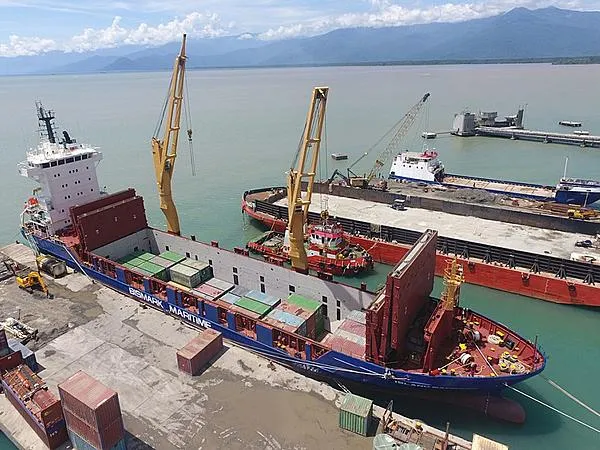
According to Secretary for National planning and monitoring Koney Samuel, the program is still running. He added that they worked on the first phase with the Bismarck Maritime Limited which was done around July and was 100 per cent subsidised by the government.
“We concluded that phase and we are in the second phase where we presented another K3 million to the same company that we had service level arrangement with and they are still continuing with the second phase of the program,” Mr Samuel said. “The government will decide as to whether we continue with the same arrangement going forward into 2021.”
He said at this phase, their team has finished an assessment on the impact and they appreciate that a lot of SMEs and farmers have benefited from this specific measure.
“Now the second scheme, we are looking at 75 per cent to 25 per cent. That means 75 per cent will be subsidised by the national government whilst the other 25 per cent will be put up by the farmers and business houses,” added Mr Samuel.
Westpac Group has announced the sale of its businesses to Kina Securities Limited (ASX:KSL) (Kina Bank) for up to $420 million.
These are Westpac Fiji and Westpac’s 89.91% stake in Westpac Bank PNG Limited.
According to Westpac Group Chief Executive, Specialist Businesses & Group Strategy Jason Yetton, the sale follows the decision of the group to focus on business, consumer, and institutional banking in New Zealand and Australia.
“We are taking another step in becoming a simpler, stronger bank while ensuring a high standard of banking services is maintained for our Pacific customers, as well as providing new opportunities for our people,” he said. “Choosing the right purchaser for our businesses is important to us, our people and the communities we serve. We are pleased our Pacific businesses are being acquired by Kina Bank. Kina is a strong brand in the region and is well-positioned with deep local knowledge to continue to help our consumer and business customers succeed.”
The sale price consists of $315 million payable at completion and $60 million paid six-monthly over the following 18 months for Westpac PNG. The sale price is also composed of earn-out payments of up to $45 million scheduled to happen yearly over 24 months after completion and are subject to the business performance of Westpac Fiji.
It is also expected that an accounting loss on the sale of an estimate of $230 million will happen - which includes a foreign currency translation reserve (FCTR) loss based on exchange rate on completion.
Completion is expected to happen in the Second Half of FY 2021 and is also subject to regulatory approval in PNG and Fiji and a Kina Bank shareholder approval.
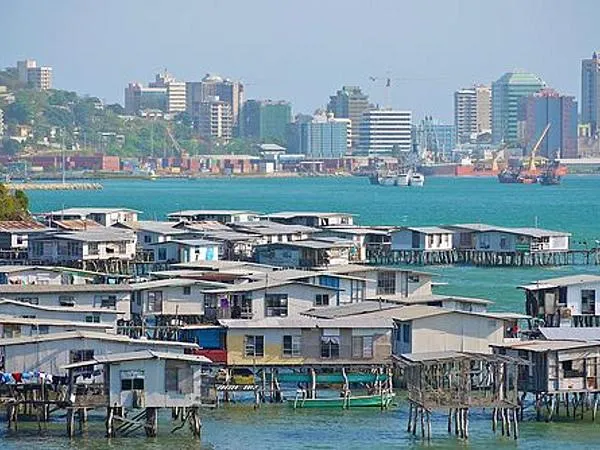
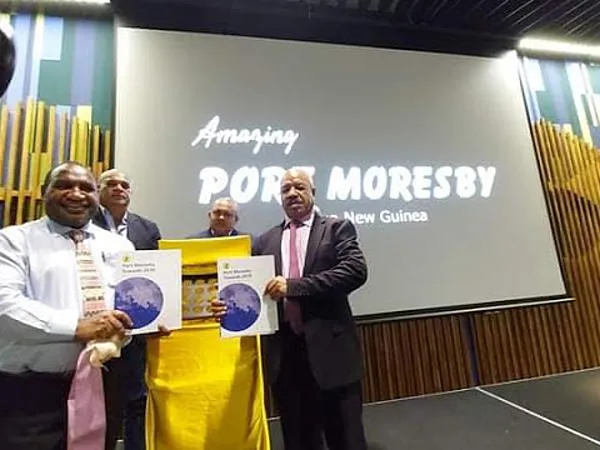
To keep PNG in line with the newest global trends on urbanisation, Papua New Guinea Prime Minister James Marape has launched the National Capital District (NCD) Urban Development Plan in Port Moresby.
He thanked NCD Governor Hon. Powes Parkop for ensuring that the services for the people continue to function, for continuing to work to improve the lives of Papua New Guinea in Port Moresby.
“In the 1960s, 33 per cent of the world population lived in urban areas,” he said. “Today, on average, the world population living in urban areas has gone past 50 per cent. In fact, 52 per cent live in urban areas all over the world.”
Prime Minister Marape said that in search of employment, people were moving to urban areas. In fact, he had observed that a great number were moving to NCD and Lae, as compared to other towns.
He supported the statement of Governor Parkop that NCD interventions contributed to national outcomes.
“This is one place that can have the greatest influence on the outcome of the mindset, behaviour and the progress of our country,” Prime Minister Marape said. “I am happy to be here to launch a plan that directs what our capital city will look like into the future.”
Prime Minister Marape has called out the people of NCD and neighbouring countries to work together to bring Port Moresby to further development. He also added that this was 2020 and leaders now are able to make better and informed decisions.
The budget for 2021 is critical after an economic downturn this year, said Kina Bank.
In a budget review, the bank said that next year’s budget showed a shift in focus towards the non-resource sector - with the goal of establishing a foundation for tangible economic growth outside the resource sector. It added that fiscal consolidation was part of its over-arching medium-term goal and required tightening of public service expenditure, enhancing the delivery of services and expanding the tax base sustainably.
“Public investments and similar levels of borrowing towards this end are expected until 2022, with budget repair projected to start in 2023,” the bank said. “This past year saw shortfalls in revenue, increased expenditure, and a global pandemic that forced changes in fiscal priorities and precipitated unprecedented levels of the national debt. The likelihood of pandemic lockdowns is still high and restrictions on business activity continue with varying degrees of severity. The fiscal priorities, and the framework of policies and principles that underpin them, look good on paper and inspire some confidence for the medium term. Increased public spending in infrastructure and capital investment in the 2021 national budget bodes well for PNG’s medium-term outlook.”
The bank continued, “Capital expenditure injections worth 8.3 per cent of gross domestic product in the 2021 Budget will provide a much-needed stimulus to the PNG economy after the Covid-19 downturn. Capital expenditure has increased by 16.9 per cent from the 2020 Supplementary Budget, while operational expenditure increased by 4.6 per cent. Continuous outlays by the Government in similar proportions through subsequent Budgets will set a solid foundation for inclusive and sustainable growth in the non-resource economy. The Government has also tightened spending in the public sector decreasing by 2.6 per cent as a proportion on the full Budget but increasing by K247.1 million in kina terms. The payment of capital and operational arrears remains a top priority in the 2020 national budget.”
It said, “The political uncertainty has given rise to the creation of the finance and treasury miscellaneous vote which holds funds for big-ticket expenditure. The miscellaneous vote coordinates spending on arrears for rentals, superannuation payments, utility bills, and capital arrears.”
The United States has begun rebuilding its relationship with the government of Oro.
In a recent visit to the province, US Ambassador to Papua New Guinea, the Solomon Islands and Vanuatu, Erin McKee said that her courtesy visit to the historical sites around the area was an initial step in strengthening their relationship.
To understand better service delivery from the national and provincial governments and to know how the US government can best help development, she spent two days in Oro, meeting with the Oro assembly members which included Northern Governor Gary Juffa.
For his part, Governor Juffa said it was an honour to host the US team. “People appreciated Ambassador McKee’s visit, it motivated them, especially people in the historical sites like Buna, Kokoda and Tufi,” he said. “The US government still cares for the people of PNG, especially Oro.”
In the past 18 months, strong international friendships have helped the government in its continuing economic reform policies.
According to Treasurer Ian Ling-Stuckey, this included the chance to meet with the Australian High Commission last December 3 - which included a conference call with Australian Treasury officials - to discuss the robust strategic relationship and PNG’s multi-year budget economic program.
“We are now exploring other options, including making direct contact again with the Australian Treasurer Josh Frydenberg. As another Treasurer having to deal with the COVID-19 challenges, he will be putting out the Australian MYEFO later this month,” said Ling-Stuckey. “This will highlight once again the massive budget hole that the pandemic has been creating around the world.
He continued, “Australia one year ago estimated its 2020/21 Australian Budget deficit would be 0.3 per cent of GDP. Because of the bushfires and COVID-19, Australia’s budget deficit estimate increased to 11 per cent of GDP – a massive increase of 10.7 per cent of GDP (PNG’s deficit in 2020 increased by 3.1 per cent of GDP – less than one-third as much). Australian debt levels as a share of GDP are expected to increase because of COVID-19 from 34.5 per cent in 2019/20 to 44.8 per cent in 2020/21 to 55 per cent in the medium-term. Sharing our experiences with friends, even across very different economies, makes it easier to understand the impacts of the global pandemic and stay true to the reform course. We cannot slow down the process of PNG’s budget repair by the Marape Government in these most difficult of COVID-19 times.”
The K400 million 23-storey Noble Centre building in downtown Port Moresby is set to finish early next year.
According to China Railway Construction Engineering Group (PNG) Real Estate Company Ltd marketing manager Maksim Neil, the work was delayed because of the ongoing pandemic.
“We have obtained the occupancy certificate from the National Capital District Commission, fire certificate from PNG Fire Services and power acceptance certificates from PNG Power Ltd,” Neil said. “We plan to open the building in early 2021. Our office has been allocated in the building since October.”
Neil added that the delay of the work was also due to 70 per cent of the workers and managers returning to China for the Chinese New Year when the COVID crisis hit. They could not return for a couple of months.
“Similarly, building materials to be purchased from overseas were delayed for a long period. “2020 had been a difficult year for construction,” he said.
Part of the efforts of the government to drive enhancement in the performance of state-owned enterprises by venturing into different strategies is the merger between Water PNG and Eda Ranu. This is also to key in reforms to the sector.
Kumul Consolidated Holdings Chairman Peter Aitsi said that the reforms are targeted in delivering improved results in two key areas - achieving improved financial performance from all state-owned companies, and efficient services to the public and the customers.
He added that in 2018, the National Executive Council had approved this merger - with a decision to the office of state solicitor to draft instructions to modify the National Water Supply and Sanitation Act 2016 and repeal the National Capital District Water Supply and Sewerage Act 1996.
In September 2016, Mr. Aitsi said that the National Parliament passed the National Water Supply and Sanitation (Amendment) Bill 2019 to implement the merger. This was certified by the Speaker on November 2, 2020, and gazetted later on November 4, 2020.
“KCH has worked with the board and management of both entities to assist the merger and ensure the transition arrangements were properly managed,” he said. “Managing director for KCH Isikeli Taureka is working closely with the designated officer in charge Mr Parkop Kurua and the Board and management of Water PNG to manage the expectations from key stakeholders to ensure the successful completion of the merger.”
Mr Aitsi noted that the objective of KCH is to enhance the availability of water not only in Port Moreby but to leverage the capabilities of a merged company to improve the services and water supply and services at both the provincial and district level.
Meanwhile, outgoing board chairman William Sweet, who has been chairman in the water sector for the last 14 years, said that there are mixed feelings - both sad and happy, especially in the efforts in formulating the merger.
“As for Eda Ranu, the checklists of seeing it merge was important to me simply because having Water PNG on its own without NCD, it cannot survive, in order to deliver the vision of the government, it needs Eda Ranu to make that vision a reality,” he said. “To cross-subsidise profits, I hope everyone understands the importance of working together, we have a country of 8 to 10 million people with only a small percentage that have access to clean water and we need to look at the bigger picture and that is the rest of the country.”
Water PNG Ltd OIC Parkop Kurua remarked the merger of Water PNG and Eda Ranu is a strategic move by the government to reach these outcomes.
A report by the Bank South Pacific (BSP) has shown that all economies have witnessed important contractions in economic activity which resulted in cutting back of profits and dividends by companies.
The report also revealed that global firm dividend payments were touted to decrease by 17.5 to 20 per cent this year.
On whether this was caused by travel restrictions and lockdown measures, BSP chief executive officer Robin Fleming said, “As a consequence, the profits generated by many companies worldwide have reduced in comparison to previous years. Given that dividend distributions are a function of profit generation and capital management, many companies are likely to pay lower dividends in 2021 than would have been the case this year.”
He added, “PNG is no different to other countries and many businesses will be reporting lower profits this year due to the difficult trading conditions. Some businesses will take a decision to preserve capital until the economy picks up and may not pay dividends for cash management and capital management purposes. Other businesses may take a different approach and maintain their dividend payout ratios at similar levels than previous years but as the profit generated will be lower the actual amount of the dividend will be less than previous years as well.”
Fleming said that in June on its 2019 audited profit, BSP paid a dividend of K0.96 per share - when including the interim dividend, paid in October 2019, showed a payout ratio of 70 per cent as compared with a payout ratio of 75 per cent last year.
“We paid an interim dividend of K0.25 per share in October 2020, which was lower than the interim dividend of K0.38 per share in October 2019, due to a combination of a lower reported profit due to the reduction in our indicator lending rate of one per cent on April 1 and increased lending provisions in consideration of the impact of the Covid-19 on our customers’ businesses,” he said.
The business community faces a great deal of uncertainty in 2021.
According to Port Moresby Chamber of Commerce and Industry President Rio Fiocco, this was because of the present political instability in connection with the 2021 budget and the commencement of major resource projects.
“There is a great deal of uncertainty at the moment both on the political scene and in respect to the budget,” Fiocco said. “The budget shows that there is a significant deficit and there is uncertainty as to how that deficit will be paid by the Government. All the uncertainties are not helping businesses plan because (we do not know) when some of these major resource projects are likely to get started. The budget shows that the government is expecting Porgera to be reopened by July next year which will be fantastic. The earlier it is opened, the better for business generally.”
He added that no one is sure when the Papua LNG project will push through with its construction and production stages.
“Likewise there is still uncertainty on when the government will sit down with the developers to finalise a mine development contract for Wafi Golpu,” he said. “Businesses like certainty. For example, we are unsure who the various ministers are because there have been various changes lately. We don’t know whether some of these appointments will be temporary or new ministers will be appointed and so on. All these uncertainties do not give confidence to the business community.”
Meanwhile, Fiocco said that many businesses had already adapted to doing business in spite of the pandemic. “Businesses have adapted and are carrying on using Covid-19 protocols,” he said. “Businesses are generally picking up from the first half of the year.”
As part of the government’s strategy to re-invest back into the rural areas, the Department of Treasury Secretary Dairi Vele has urged companies to look beyond Port Moresby to do business, and begin their investments in outside centres.
According to Vele, businesses should branch out to the outside centres to offer people more services.
He said, “The Marape government is still finding its feet. Part of this swift response is to develop an economic stimulus package which as much as possible tries to put money into pockets.”
Secretary Vele said that because of the restrictions and lockdowns that COVID has imposed on many cities, the private sector has limited selling their goods and products to neighbouring towns. He added that the reason why they started investing in rural areas was to encourage businesses to work there and to offer their services.
“Sometimes the private sector focuses too much on the urban areas,” he said. “We need to find ways to try and encourage them to get out into some of the other parts of PNG.”
Mr Value added that the concept of special economic zones in countries such as China has worked successfully, therefore telling businesses that, “say if you come and do business here we’ll make it much easier for you.”
“That’s what the special economic zone is trying to achieve,” he said. “We think it’s a good idea and we hope that a lot of these companies also take the opportunity to go and operate out that way.”
Follow on LinkedIn:
PNG Business News
Be the "First" to get our exclusive Digital Magazine & Weekly Newsletter.