Photo Credit: Helifix Papua New Guinea
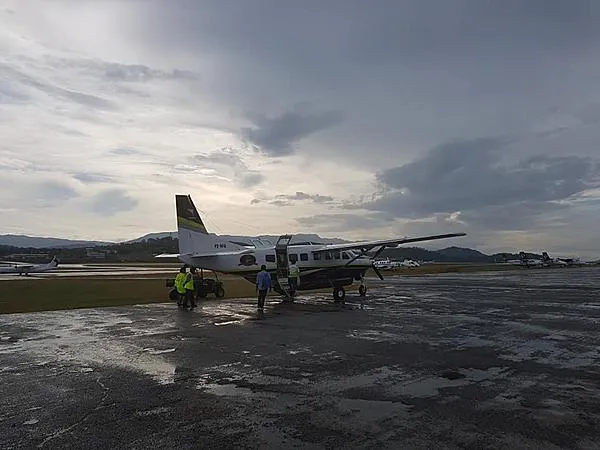
The Fly River Provincial Government and National Airports Corporation have inked an agreement to upgrade the Kuinga and Daru airports in Western Province.
The MOU, according to Western Province Governor Taboi Awi Yoto, is the province's first of its sort.
“Western Province has three big airports –– Daru, Kiunga and Balimo –– which the provincial government has been supporting without any assistance from NAC in the last 45 years, and with this MOU, I hope to see a major improvement to the airports and airstrips in my province,” Yoto said.
At the Daru, Kiunga, and Balimo aerodromes, the MOU will offer a legal framework for both parties to engage on airfield development, business prospects, and technical support, among other major goals.
The MOU was signed at the NAC head office in Port Moresby by provincial administrator Robert Kaiyu and NAC acting managing director Rex Kiponge.
Kiponge said, “The MOU comes under NAC’s strategic business plan 2020-2030 to forge and maintain strategic partnerships with key stakeholders such as the provincial governments.”
Since 2009, he added, NAC has relied on its aviation business to fuel operations at its 22 airports.
“The surplus income NAC generates from our major airports is used to support other smaller airports unable to sustain themselves financially,” Kiponge said.
NAC's current strategic business goal, he added, is to focus on smaller airports and other key difficulties by expanding into the non-aeronautical sector.
According to the MOU, the NAC plans to establish a representative to engage closely with the Fly River Provincial administration on aviation programs and related enterprises at the Kiunga and Daru airports.
Reference:
Post-Courier (15 June 2021). “Upgrade of Daru, Kiunga Airports Set”.
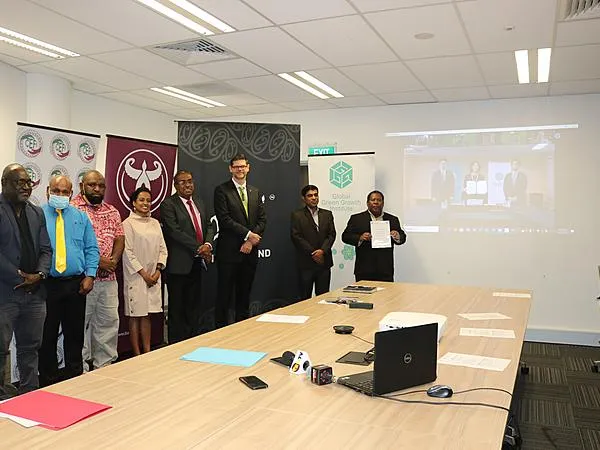
Papua New Guinea yesterday launched a new project to develop a National Inclusive Green Finance Policy for the banking sector to boost financial inclusion and guide public and private sector investment towards Low Emission and Climate Resilient Development.
Bank of Papua New Guinea Assistant Governor Ellison Pidik representing Mr. Loi M Bakani, Governor of BPNG, H.E Dr. Nathan Ross New Zealand Acting High Commissioner to PNG, Mr. Saliya Ranasinghe, Executive Director, Centre for Excellence in Financial Inclusion and GGGI´s Deputy Director General Ambassador Jenny Kim, jointly initiated the project.
Inclusive Green Finance is a new and evolving policy area that countries are beginning to devise and implement policies, regulations and national strategies to mitigate or build resilience to sweeping environmental, health, social and economic effects of climate change.
The project will deliver two main outputs: first, a green taxonomy based on PNG’s goals and priorities; and second, and a diagnostic report on the state of green finance in PNG. Both are expected to steer financial flows (loans, equity, and guarantees) towards technologies and services that contribute to the government’s financial inclusion and green growth goals.
Bank of Papua New Guinea Assistant Governor Ellison Pidik representing Mr. Loi M Bakani, Governor of BPNG pointed out, “We understand that dual threats of financial exclusion and climate change are recognized as key barriers to financial stability. As a member country of the Alliance for Financial Inclusion (AFI), and implementing the work on Green Finance, we have identified Inclusive Green Finance (IGF) as a key priority area in the financial inclusion space.
Similarly, Acting High Commissioner of New Zealand H.E. Dr. Nathan Ross stated that “Climate change is the most significant security and development issue facing the Pacific region, and we can only meet its challenges through collective action. This includes the private sector, and the Inclusive Green Finance Policy will be an important step towards helping businesses to contribute to PNG’s low-emissions, climate resilient development.”
Ambassador Jenny Kim states GGGI´s role in the project will be on scaling up access to green finance, “we hope that this project will serve as a strong foundation for future cooperation between New Zealand MFAT, BPNG, CEFI, and GGGI for more ambitious and impactful cooperation on climate change.”
At the event, an MOU was signed. The MOU between GGGI and CEFI is under the initiation of the regional program, Low Emissions Climate Resilient Development Program (LECRDP), a regional collaborative effort between GGGI, NZ/MFAT and the governments of Kiribati, Tonga, Vanuatu, Papua New Guinea, and Fiji to support regional resilience and emissions reductions, by working with these Pacific Islands Countries to transition to inclusive, low emissions and climate resilient development.
Treasurer Ian Ling-Stuckey has revealed the terms of reference for a review of the Bank of PNG, as well as the members of the review panel. Former Chief Secretary Robert Igara will lead the study, which was planned in the Supplementary Budget for 2020. Former central bank governor Sir Wilson Kamit and Australian professor Dr Stephen Howes are the two members.
“These very eminent people, all of whom have detailed experience of the PNG financial system and reform, will be working to a term of reference approved recently by the NEC,” Ling-Stuckey said. “It is the first review of the central bank and the Central Banking Act 2002 since Sir Mekere Morauta’s financial system reforms when he was prime minister from 1999 to 2002.
“Much has changed since then, and the effects of the coronavirus pandemic, along with substantial technological advances, have made the need for a review even more urgent.
“The aim is to modernise the bank and the legislation in line with international developments, and make it more responsive to prevailing circumstances while preserving its independence.”
The study is scheduled to be finished in time for Parliament's November session.
“An independent advisory group was also established by the late Sir Mekere when looking at the changes that led to the Central Banking Act 2000,” he said. “Igara, currently the University of Papua New Guinea chancellor, was chief secretary at the time, and Sir Wilson was the governor of the Central Bank. “Prof Howes, head of the Development Policy Centre at the Australian National University, has long been involved in PNG research and advice and consultation, particularly in relation to national development.”
The National (8 June 2021). “BPNG going for review”.
According to the Investment Promotion Authority, foreign direct investment into the nation has decreased by around 45 per cent in the last two years (IPA). Investment interest plummeted from over 1,000 in 2019 to roughly 300 in the first quarter of this year, said managing director Clarence Hoot.
“Global FDI (foreign direct investment) outflow has drastically reduced by 45 to 50 per cent,” Hoot said. “(It) means for us that foreign direct investments will have to be more than 10 times or 20 times than what we are currently doing. We have to relook at ourselves, what we have in place, what we want and where we want to be.”
“We have witnessed a decline of 40 to 45 per cent in terms of FDI interest coming to PNG,” Hoot added, speaking from the perspective of a regulator.
“In 2019, the total number of foreign direct investment documents that we received was 1,116. In 2020 that reduced to about 800. And in the first quarter of 2021, it is 300. From IPA perspective, that is a real concern.
“While we appreciate that it may be a direct result of the impacts of the Covid-19, I think we should look beyond the Covid-19. We also have to look at what we have in terms of domestic policies, laws and regulations,” Hoot said.
He also stated that there were indicators that PNG's standing in terms of business-friendly locations has decreased. PNG was ranked 108th out of 190 countries in 2018/2019. It dropped 12 positions to 120/190 in 2019/2020.
Mauludu, Shirley. The National (9 June 2021). “Foreign investment drops by 45pc”.
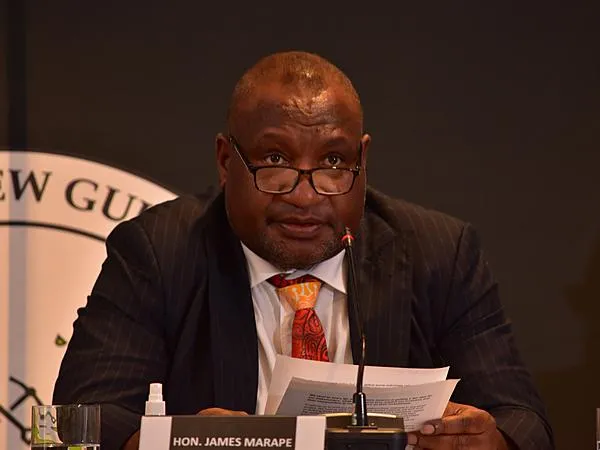
Prime Minister James Marape has said that there will be no change in the benefit sharing regimes currently being used in the mining and petroleum sectors, without extensive consultation with all players in the resources sector.
Prime Minister Marape delayed his planned meeting in Porgera toward the end of last week to be present at the Papua New Guinea Chamber of Mines and Petroleum’s first Webinar Event for the year.
He delivered the keynote address with the reassurance of the government’s recognition that the mining and petroleum sector remains the number one economic sector in the country.
“On record, the mining and petroleum sector remains our number one economic sector in our country, and that is acknowledged, and will remain so, and our government will do everything possible to ensure that the sector is not harmed.”
On the back of industry having to cope with major uncertainty over proposed changes to the Organic Law on Ownership of Minerals and Hydrocarbons, and the introduction of a fiscal regime change for the sector for the past 12 months, Prime Minister Marape also reassured the sector, that all stakeholders would be consulted.
“Whether it’s a production sharing regime or a hybrid between production sharing and existing regimes, I think there is a view that I take from these presentations thus far that the signal we are giving is not absolutely clear, and so I will take the month of June to ensure that the clarity is made to the mining and petroleum sector with respect to the direction we are trying to go into but for this occasion and a taker right now let me inform every one, regime change is not taking place as yet, the intention is there but whatever form it will take place, as I said earlier, 2025 is an important benchmark date,” the prime minister said, after participating in the events three key presentations.
PNG Chamber of Mines and Petroleum Council Member, John Chambers of Santos, presented discussions on the true value of the mining and petroleum sector.
“According to the World Bank, PNG is in the ‘Top Ten’ of most Resource Industry-dependent economies in the world. We cannot underestimate the importance of the resource sector to the PNG economy.
“Continued investment in resources, plus diversification of the economy, need to occur in parallel,” Mr. Chambers said, while highlighting that financial institutions like ANZ have estimated that the resource sector’s total contribution to GDP 1.3 times its direct contribution to GDP.
Mr. Chambers explained that fiscal regimes need to balance state and landowners’ interests with investment risks and returns. He stressed that higher taxed regimes, would result in no exploration or projects being sanctioned; that resource sector stability was important in the areas of policy and legislation; and that the current tax royalty system used in PNG is the only regime in the world, which provides landowners with a share of cashflows from resource projects.
The two other main presentations were from global industry research and analysis organisations, Wood Mackenzie, who explained that different fiscal system designs can be employed to deliver a ‘fair share of returns’ while stressing the point that governments and oil and gas companies are usually closely aligned in their objectives on return on investment.
MineHutte UK focused on the need for countries to achieve a balanced legal framework, and that reform efforts built around the introduction of Production Sharing Arrangements (PSAs) would not be viewed as balanced, and would hinder, rather than help a country’s mineral sector.
MineHutte presented world examples of countries who had tried using PSAs in their mining sectors, and who had all, eventually reverted to their previous regimes, because of the negative impacts they experienced.
Prime Minister Marape, in responding to the presentations, said he would ensure that there is stronger collaboration with industry on any and all proposed reforms.”
“I would like to encourage investors who are tuning in from across the world, in these times of COVID19 sensitivities, we have been, and are still open for business. I will bring further clarity to the reforms we have planned, and with consultation with the mining and petroleum sector in the next month or two.
“Toward the end of June or July, the industry will know with clarity, what the government wants for the sector. It does not dilute the fact that PNG remains a very robust place of investment, and we are open for business.”
Chamber Vice President Leon Buskens was sincere in his closing remarks, in recognizing the importance Prime Minister Marape had given to the event.
“Mr. Prime Minister, thank you for your opening remarks, and for your closing remarks. We have listened, and heard loud and clear the assurances you have given the industry to work together, and importantly, you mentioned the deep consultation process.
“We are all on the same page, and the strategic intent of the Chamber is to ‘create understanding of the importance of the industry, and to build local expertise, to attract investment, and to empower Papua New Guinea to capture sustained, nation-building benefit from our natural resources’.
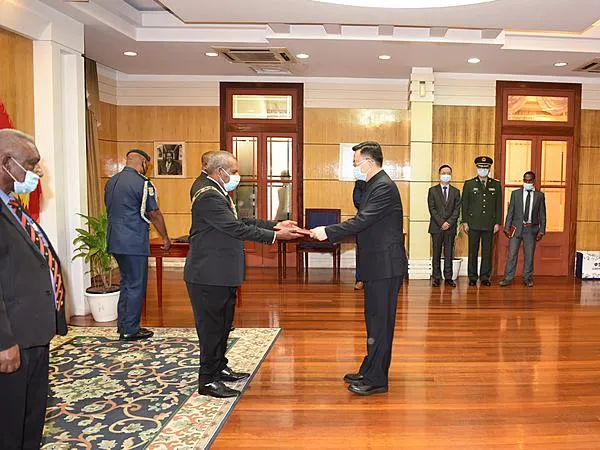
Zeng Fanhua, the People's Republic of China's new ambassador, recently submitted the letter of accreditation to Governor-General Sir Bob Dadae, the country's head of state.
Ambassador Zeng succeeds Ambassador Xue Bing, who was recalled after completing his service in Papua New Guinea.
Ambassador Zeng stated the President of the People's Republic of China, Xi Jinping, who visited the nation in November 2018, offered greetings to the Governor-General, the Government, and the people of Papua New Guinea while handing the letter of credential to the Governor-General.
He described Papua New Guinea as a significant Pacific island nation that has gone a long way in preserving its sovereignty and independence while advancing socially.
Ambassador Zeng stated that China and PNG are members of the Asia-Pacific region and that the people of the two countries have had a long-standing relationship since the establishment of diplomatic ties in October 1976.
During President Xi's state visit to PNG in 2018, the two countries established a comprehensive strategic partnership based on mutual respect, ushering in a new chapter in bilateral relations with fruitful outcomes in the areas of energy, resources, infrastructure, agriculture, forestry, fisheries, and other practical cooperation and people-to-people exchanges.
These, he noted, contributed to the people's well-being as well as the region's economy and stability.
Ambassador Zeng stated that in the battle against Covid-19, China and PNG have stood united in their efforts to strengthen bilateral relationships.
He expressed his gratitude for the opportunity to serve as the 15th Ambassador to Papua New Guinea, saying that he will do all possible throughout his term to foster a win-win partnership between the two countries.
Ambassador Zeng stated that he hopes to work with PNG to execute major agreements reached by the two countries' leaders, enhance friendly interactions and cooperation in a variety of sectors, and help the China-PNG Comprehensive Strategic Partnership continue to thrive.
He also stated that he would require the assistance of the PNG government.
Elapa, Jeffrey. Post-Courier (2 June 2021). “New Ambassador For China Takes Up PNF Post”.
If Papua New Guinea wants to maintain its economy, resource projects should continue to come online, according to an industry expert. This was said by Chris Chambers, Santos PNG's general manager and a PNG Chamber of Mines and Petroleum council member, during the chamber's webinar series. He stressed the need for collaboration between the government and the industry in securing pipelines.
“It is also important to see that sanctioning of large projects such as the PNG LNG gives a very quick economic fill up to the economy as getting taxes, (the different taxes) and increase in employment,” he said.
The resource business accounts for 88 per cent of the country's overall export and 28 per cent of its gross domestic product (GDP) in 2019, according to a snapshot of a study from the PNG Extractive Industries Transparency Institute (PNG EITI). According to the World Bank, PNG is one of the top ten resource-dependent economies in the world.
“It’s not necessarily a great thing, but it’s something we have to work within and try to maximise,” Chambers said.
The following are some of the country's noteworthy resource projects:
Prime Minister James Marape stated that the government will continue to work on the Wafi-Golpu project as well as other outstanding resource projects.
“We have already issued an environmental permit and we will progress Wafi-Golpu after Porgera is moved,” he said. “In the petroleum space, Pasca has been discussed. We thank ExxonMobil for reopening discussions on P’nyang, and we are remobilizing for Papua LNG. We have been active in business in the midst of Covid-19 as far as the mining and petroleum sector is concerned.”
According to Marape, the government welcomes and will work with all investors in the nation since they are entitled to a high return on investment while also ensuring that locals get a fair part of the resources.
Moi, Clarissa. The National (7 June 2021). “Bring in more projects: Expert”.
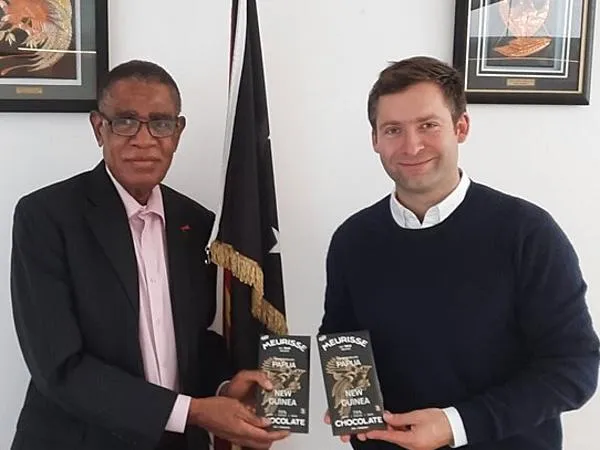
Mr. Henray van Vyve, Managing Partner of Meurisse Chocolate NV (right), a Belgian Chocolate manufacturer that uses PNG cocoa beans, presents the Papua New Guinea brand to Ambassador Joshua Kalinoe at the PNG Embassy in Brussels, Belgium. (Photo-courtesy of the Embassy of Papua New Guinea, Brussels, Belgium).
A Belgian chocolate manufacturer has included PNG cocoa beans in one of its leading organically grown chocolate product brands.
Meurisse Chocolate NV, established since 1845, is using 100 percent cocoa beans from PNG farmers to produce the dark PNG chocolate brand that is 73% cocoa.
The company also mixes the PNG cocoa with nuts and other ingredients to produce several brands, including the dark caramel and almond brand.
Papua New Guinea's Ambassador to Belgium and the European Union, H E Joshua Kalinoe said the Embassy in Brussels has been promoting PNG products, including cocoa and it is really satisfying to see that the country now has its own brand of chocolate that can be sold in the EU market.
Ambassador Kalinoe who is also Papua New Guinea's Commissioner General to Expo2020 in Dubai said that he has invited the company to join the PNG pavilion to tell the PNG cocoa story from the manufacturer's perspective.
"We are inviting other companies, including those in PNG to join us in telling the PNG story about their products as well, including those in the agriculture sector.
"Our emerging brands like Queen Emma Chocolate and Highlands Honey have been invited to partner with the PNG Expo2020 team as well.
"Apart from telling their stories, the idea is to also expose them to niche market opportunities in their respective products for both market access and technology transfer, he said.
Ambassador Kalinoe said that the PNG Expo2020 team is facilitating a win-win atmosphere where companies create demand for their products for increased sale that would create more demand for our farmers to produce and export, hence facilitating domestic economic growth by creating more jobs in the value chain and also strengthening the country’s balance of payment in the medium to long terms.
“The potential benefits for PNG are convincingly overwhelming if the bureaucrats and policy makers in Waigiani could understand this simple fact and start investing adequately in our participation in Expo 2020. This opportunity of bringing participants from the world together in one village to connect and tell their stories on innovations, technology, culture, and wealth creation amongst themselves happens once every four years,
“The partnership with businesses and other stakeholders that the Government is forcing at the Dubai Exposition is consistent with objectives of our participation strategy and the sub-theme, Connecting Minds and Creating Opportunities for Sustainable Development.” he said
Ambassador Kalinoe said Expo2020 is different from past World Expositions. It's about sharing ideas and learning from each other as well as creating opportunities for trade and investment.
"It is participative in nature where businesses, Governments, academics, artists, city planners, infrastructure specialists, sustainable development experts, research and development as well as mobility experts and others who have a story to tell can participate in the different forums and events of the Expo Program," Ambassador Kalinoe said.
He said the PNG Expo2020 Media and Public Affairs team is developing a number of communication mediums, including a Website, as part of the Communication strategy to inform Papua New Guineans and other stakeholders on the country’s participation and Events.
“We plan to formerly launch these platforms by end of June or early July for access by the public,” Ambassador Kalinoe said.
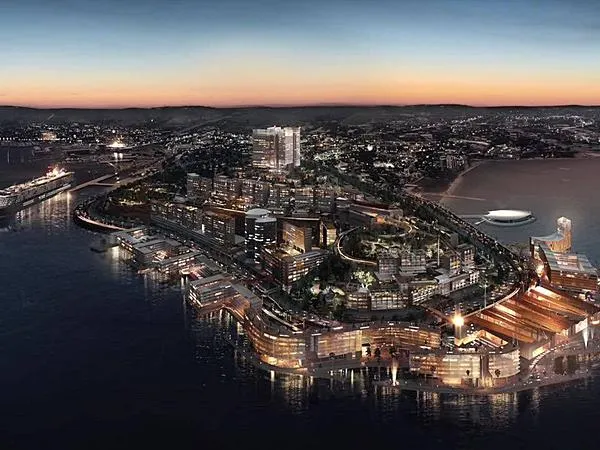
Photo Credit: Paga Hill Development Company - PNG Ltd
In accordance with the Marape-Basil government's Special Economic Zone concept, a new multi-million kina casino would be built in Port Moresby to encourage tourists and stimulate other economic activity.
The National Gaming Control Board (NGCB) and the Paga Hill Development Corporation (PHDC) have agreed to create a K150 million entertainment complex that would feature a hotel, restaurants, retail malls, theatres, and a casino, among other things.
The agreement was signed at the Stanley Hotel in Port Moresby by NGCB chairman Clemence Kanau and PHDC chief executive officer Gudmundur Fridriksson to clear the way for the development.
According to Kanau, a casino has been on the Government's approved agenda for a long time, and this was a chance to finalize the deal with the developer, PHDC.
He stated that Port Moresby would be home to the country's first casino, and he was pleased to report that the NGCB has been at the forefront of ensuring compliance with all legislation and criteria.
He also stated that the NGCB will introduce lottery, bingo, online betting, and other gaming activities in order to increase income and stimulate economic activity, employment, and other prospects.
Meanwhile, PHDC CEO Fridriksson stated that the project's first phase will cost about K150 million and would be managed by an international contractor.
“The casino will focus on tourists, foreigners and the well-to-do population.
We know that more than 300 tourist ships pass through PNG every year and we want to embrace the opportunity,” he said.
“Once the casino facility is established, we are anticipating attracting 80 tourist ships within 18 months and that means more than $US250 million in 18 months.
There will be opportunities to bolster small and medium enterprise (SME) and also showcase local produce.”
According to Fridriksson, the casino will produce jobs both directly and indirectly through local subcontractors.
Both Fridriksson and Kanau stated that this was an exciting period for PNG following the COVID-19-induced economic downturn.
Rai, Frank. Post-Courier (31 May 2021). “Deal For Casino Inked.”
Photo Credit: Oxford Business Group
According to ANZ PNG managing director Mark Baker, the country's long-term survival rests on diversifying its economic base to allow agriculture and manufacturing to thrive.
Baker stated that it will need increased investment in infrastructure, particularly roads and power.
“The source of that significant investment can come from the economic benefits that major resources do bring,” he told The National. “The announcement of progress on Papua LNG is very welcome.
“It will be important that all parties involved in the project reach an agreement early to allow the project to enter front end engineering and design (Feed) in 2022 and final investment decision (FID) in 2023.
“This has the potential to make a significant and positive impact across the PNG economy from 2023 onwards.”
Baker said that the Wafi-Golpu project has the potential to have a significant and good impact on the economy in general and Morobe in particular, "as well as strengthening international investor confidence."
While foreign currency reserves have remained reasonably stable, he said the availability of foreign currencies to the market remained a challenge for PNG's import-dependent economy.
“This was exacerbated by the extended shutdown at Porgera which is a major supplier of foreign currency to the market.”
Governor Loi Bakani of the Bank of PNG (BPNG) has stated that the country's foreign reserves are at US$2.5 billion (K8.92bil).
Foreign exchange inflows this year, according to Bakani, were mostly from overseas government borrowings, while outflows were mostly from overseas government debt repayments.
Luma, Dale. The National (27 May, 2021). “Expanding economy for agri, manufacturing vital”.
The publication of the PNG Extractive Industries Transparency Initiative reports are meaningless if they do not give rise to critical policy debates for a robust mining and petroleum sector in Papua New Guinea, an official says.
Head of PNGEITI National Secretariat Mr. Lucas Alkan told leaders at the 36th Australia Papua New Guinea Business Forum on Wednesday that EITI work in PNG is progressively helping to shape public policy discussions through EITI report recommendations, and open discussions within the PNGEITI Multi Stakeholder Group (MSG).
Papua New Guinea to date has published a total of seven (7) EITI country reports since the PNG Government signed up to join other 50 plus mineral resource rich countries in 2014 to implement the EITI Global best practice Standard.
To promote transparent and accountable conduct of business in the mining and petroleum industry the core function of EITI implementation is the publication of annual EITI country reports consistent with the requirements of the EITI Global Standard.
Mr. Alkan said those reports must form part of policy discourse in mining and petroleum sectors of the economy as opposed to collecting dust in the shelves.
“Producing EITI reports are meaningless if these reports do not give rise to critical policy and legislative reforms for better management of the sector, “he said.
Mr. Alkan said important progress had been made since PNG’s first EITI report in 2015, providing greater transparency over revenue received by the government from the country’s mining and oil and gas industry.
He said the PNG Government and resource owners receive maximum resource project benefits, with that EITI reporting process identifies revenue leakages to improve corruption perception which would in turn boost investor confidence.
“To improve the country’s investment climate, we have to be transparent in all forms of payments, starting with the negotiation process for development projects to how licenses are issued.
“EITI is a platform that enables all stakeholders to work collaboratively and build trust to realise PNG’s vision for resources development,” Mr. Alkan added.
“Some of the improvements and reforms arising from the work of EITI in PNG are that EITI;
“In addition, a National Policy Framework on Transparency and Accountability was approved by Cabinet in 2018,” he said.
Mr. Alkan said among the achievements made so far in EITI implementation in the country, the National Policy Framework on Transparency and Accountability has set the basis for the creation of EITI PNG as an independent administrative body to sustain its operation and the draft law is now being finalised.
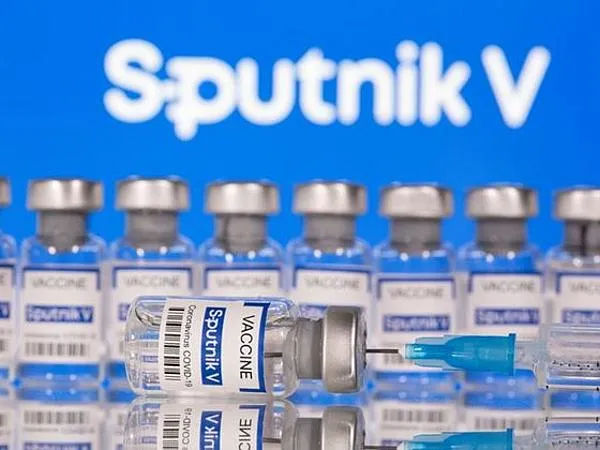
The Russian Federation has declared that it is happy and willing to supply the Sputnik V vaccine to Papua New Guinea.
It said that once the pandemic is over, Prime Minister James Marape will be welcomed to Russia.
The Russian government is negotiating with Papua New Guinea to create a reciprocal visa-waiver deal.
This was said by Ludmila Vorobyova, Russian Federation's Ambassador Extraordinary and Plenipotentiary in Indonesia and Papua New Guinea, during an online symposium attended by leading Russian and Papua New Guinean academics, officials from the Ministry of Foreign Affairs, lawmakers, and community leaders.
The symposium was opened by Nicholai Miklouho-Maclay, a descendant of the world-famous explorer of the same name, founder and director of the Miklouho-Maclay Foundation, and head of the Russian Academy of Sciences' Research Centre for South Pacific and South-East Asia, Australia and Oceania Institute of Oriental Studies.
He thanked the symposium attendees for their contributions to the development and deepening of Russia-Papua New Guinea ties.
“We aim for comprehensive cooperation within a whole range of projects which can be implemented in spite of pandemic,” Vorobyova said. “We have a unique opportunity to hold dialogue which we hope to continue our projects, considering the planned visits of the Prime Minister of PNG, as well as our cooperation in healthcare, humanitarian and cultural spheres. The Russian Federation is open for cooperation to deliver the Sputnik V vaccine and we need to strengthen bilateral commercial, economic, cultural, scientific, educational and humanitarian cooperation.”
She expressed the expectation that Prime Minister James Marape would be able to visit Russia as soon as the situation permits.
Ms Vorobyova suggested that the parties sign a memorandum of understanding on trade and investment, as well as a visa-waiver deal.
On behalf of Marape and the government, Northern Governor Gary Juffa expressed willingness to work with Russia in a variety of fields.
Russia, he said, has enormous molecular, historical, and cultural diversity, similar to PNG.
“We are happy to welcome investors from Russia to cooperate and develop bilateral relations,”
Juffa said. “Our motto is “friend to all and foe to no one. We are friends to all nations and we are trying to use this ideology in our cooperation with other countries.”
As soon as all COVID constraints are lifted, Sir Peter Barter, president of the Melanesian Tourist Services tour agency, said he is happy to host Russian visitors and support the Miklouho-Maclay Foundation's mission.
Post-Courier (24 May 2021). “Russia set to supply PNG With Vaccine.”
Trafigura Group Ltd has received approval from the Independent Consumer and Competition Commission (ICCC) for its planned acquisition of an additional interest in Puma Energy Group Ltd.
Puma is now controlled by Trafigura, which owns the majority of the company, and will have a majority stake in Puma after the takeover.
While Trafigura and Puma were both private entities registered in Singapore, the parties applied to the ICCC for approval, according to ICCC commissioner and chief executive officer Paulus Ain.
This was due to Puma's three wholly-owned subsidiaries in Papua New Guinea, Puma Energy Bunkering PNG Ltd, Puma Energy PNG Ltd, and Puma Energy PNG Refining Ltd. Oil refining or refinery at Napa Napa, wholesale and retail distribution of refined petroleum goods, liquefied petroleum gas, and bitumen production are also part of the activities in PNG.
Trafigura also provides significant inputs to Puma's refining and wholesale businesses, both abroad and in PNG, under a long-term supply agreement.
“The proposed acquisition will only result in the change of ownership and controlling interest within Puma,” Ain said. “Hence, this would not have any serious competition effects on the overall structure of the markets in PNG, if any. Based on available information the ICCC wishes to inform all concerned parties that the ICCC is satisfied that the proposed acquisition of further interests in Puma by Trafigura will not have, and will not be likely to have, the effect of substantially lessening competition in any market(s) in PNG. The ICCC, therefore, has granted clearance to Trafigura to proceed with its proposal to acquire a further interest in Puma.”
The National. 24 May 2021. “Trafigura Group given clearance”.
Photo credit: Loop PNG (2020)
Fisheries and Marine Resources Minister Dr Lino Tom says the National Fisheries Authority (NFA) and the Fisheries and Marine Resources Department are working on two main fishery ventures in Morobe and Madang.
“The Voco Point facility will cost about K100 million,” he revealed. “Funding for the project is ready. We are just waiting for the final business plan to be completed and other necessary requirements before the project go on tender in August.
“Tender for the Wagang fisheries wharf feasibility studies will be awarded soon while the Pacific Maritime Industrial Zone (PMIZ) project in Madang has been given a ministerial economic committee approval and should start any time after the Treasury approved the loan.”
Tom, who recently visited Lae, Morobe, said that the Voco Point project will serve as a fishery centre for local fish farmers.
“Fishery products in the province will be brought to this facility and, from here, it will facilitate the trade,” he explained.
The NFA and department intend to develop Voco Point as the first such project in the region, with similar projects planned in other maritime provinces.
“The building of such facilities will give much-needed chances for local fish farmers (both in-land and coastal) to market their fishery products and generate income,” he added.
NFA managing director John Kasu also said that jetties will be constructed in the immediate future in Huon Gulf, Finschhafen, and Tewae-Siassi to assist local fish farmers.
The National (24 May 2021). “Multi-million kina fishery projects set for Morobe, Madang”.
President of the Autonomous Bougainville Government, Ishmael Toroama, stated that Bougainville must achieve independence over the next four years, with members of the independent state's parliament being elected by June 2025.
This comment was made by President Toroama as he explained the ABG's official stance as Bougainville starts the first post-referendum consultations with the international community.
President Ishmael Toroama and Prime Minister James Marape recently met with their respective consultation teams to discuss Bougainville's political future.
Following the overwhelming result of the Referendum in 2019, in which 97.7% of Bougainvilleans voted in favour of separation from PNG, the two governments are meeting to negotiate on the results, as mandated by the Bougainville Peace Agreement and Part XIV of the National Constitution.
The systematic consultation process started just 5 months ago, on January 11, when both governments signed the Joint Communique on the Bougainville Referendum Outcome.
“When both governments signed the Bougainville Peace Agreement in August 2001, we committed ourselves to a “deferred 15-year referendum” period.” President Toroama said.
“This was to allow time to our people, on both sides, to heal the wounds of the conflict, and ponder over what we need to find as a final solution for Bougainville and Papua New Guinea,” President Toroama added.
“For those who fought for independence we wanted independence at that time of our negotiations over the Bougainville Peace Agreement; but in all fairness to our people, we were prepared to wait 15 years, to allow our them to have their say, through a free and fair referendum vote, at some later stage,” he said.
President Toroama stated that both governments have worked together in good faith for the past 20 years to enact the BPA with the expectation that a referendum will be held.
In understanding the referendum results, President Toroama stated that Bougainvilleans have clearly opposed greater autonomy, having already existed, observed, served, and witnessed the slow development of autonomy under the existing Bougainville Peace Agreement arrangements for the past 16 years.
He stated that autonomy, under current or future arrangements short of independence, is not a choice for Bougainville's solution.
“All we have done in the last 20 years, whether in the weapons disposal or autonomy space, were intended to bring us closer to this day, when we should consult over the outcome of the referendum, and reach an agreement on the future of Bougainville,” President Toroama said.
“Our position on the future political status of Bougainville is clear and that is independence,” President Toroama said.
References:
Autonomous Bougainville Government Website (18 May 2021). “Toroama Outlines ABG Position.”
Autonomous Bougainville Government Website (18 May 2021). “PM Marape at Joint Consultations.”
RNZ (19 May 2021). “Bougainville's president seeks independence by 2025”.
The PNG Fisheries Strategic Plan 2021-2030 was recently approved by the National Executive Council for the next ten years.
It lays out the Strategic Road Map and Vision for an internationally dynamic, equitable, and sustainable broad-based fisheries market and industry.
PNG Fisheries Strategic Plan 2021-2030, according to Prime Minister Hon. James Marape, MP, has implemented and matched its sustainability and growth plans to the Government's policy guidelines, Vision 2050, PNG Development Strategic Plan 2010-2030, and the Medium Term Development Plan (MTDP).
“The Plan is intent on taking PNG’s fisheries sector forward by improving the status quo to a state where it will resonate with the Government’s high-level strategic agenda to ‘Take Back PNG’ and to specifically respond to our shared vision to realize equitable benefits for our people.
“The evolution of such policy directions over the last 12 months has culminated to two high-level strategic pieces of work at hand. These are the project on creating a Fisheries Commercial Entity to be responsible for the Government’s commercial interests as approved by Cabinet and the National Fisheries Board decision to formulate a 10-year Fisheries Strategic Plan,” said Prime Minister Marape.
He said that transitioning the fisheries sector from an artisanal and informal to a commercial state, one that provides formal jobs and cash income earning opportunities for people, has been extremely difficult. This is because fish and aquatic resources, which live in oceans that stretch through international waters, are affected by natural phenomena such as tides, which affect their migratory behaviour. This is especially true of the tuna stock, which cannot be domesticated in Papua New Guinean waters.
The NEC, according to Prime Minister Marape, has also acknowledged that supply dynamics in the tuna stock have necessitated regional countries entering into governance regimes that require all of them to handle moving stock across their borders independently.
“Commercialization and strategy together with sustainable management of the fishery resources going forward will be necessities and requirements to take into consideration under such regional interdependent considerations,” Prime Minister Marape said.
As a result, the strategic plan is PNG's response to these regional and national growth concerns. For this Government and their people, putting in place the fundamental structural building blocks, with a strong balance of policy prescriptions and encouraging political measures, is a must in the domestic economy of the country.
As a solution to the emerging threats, the National Fisheries Board and the National Fisheries Authority have been working on developing a conceptual road map over the last few months.
“Therefore, the 10-year Fisheries Strategic Plan is aimed at guiding the Government’s development intentions for the sector to invest smartly to awaken and consolidate the latent commercial and socially inclusive potential of the fisheries sector, whilst at the same time, position the State’s body, the National Fisheries Authority to purposefully perform its mandated functions in overseeing the governance and management of the development of the sector going forward,” said Prime Minister Marape.
The strategic plan was developed through a consultative process with provinces and stakeholders, who examined the industry's success over the previous two decades and established the major roadblocks to development. It suggests a growth path map take advantage of the prospects.
It also recommends a set of strategic supporting measures aimed at repositioning the industry to not only adapt to the Government's vision, but also to consolidate the industry's diverse operating infrastructure in order to grow the sector into a large, broad-based, diversified, and value-adding industry that is globally competitive and domestically inclusive.
Papua New Guinea Press Release (18 February 2021). “NEC Endorses National Strategic Plan 2021-2030”.
Follow on LinkedIn:
PNG Business News
Be the "First" to get our exclusive Digital Magazine & Weekly Newsletter.