


May 02, 2022

According to Vodafone PNG, the country's third mobile operator would spend K3 billion in the country, offering chances for Papua New Guineans in terms of growth, prosperity, job creation, and telecommunications affordability and accessibility an official said.

Regional chief executive officer Pradeep Lal said the telco (telecommunications company) was rolling out a 3G/4G+ network, and customers would experience much faster speeds and improved customer services.

“We have various other attractive and unparalleled daily, weekly and monthly bundles to suit every market segment.

“Our competitive pricing and product propositions are designed with low margin tariffs and high-value benefits with an overall value ranging from 30 per cent to 100 per cent when compared to competing offers in the market.”

Lal said introductory free sims, which would have a preloaded value of 1GB data, unlimited on-net calls and SMS, valid for seven days, would be available from any of Vodafone’s 15 retail outlets and kiosks and over 100 roadshow outlets.

“On the business front, we have numerous solutions designed to facilitate more reliable connectivity to drive improved business effectiveness, efficiencies and cost reductions,” he added.

“Along with value-packed mobile and data bundles, shared and pay as you go plans, the suite of ICT products include wide-area networking, dedicated internet, cloud PBX, SD WAN, disaster recovery and cyber security to name a few.”

He said Vodafone planned to bring a suite of value-added services that had been highly triumphant its other markets that would help solve the challenges of PNG customers.

“Vodafone PNG is building a brand new greenfield network from the ground up and constructing all new towers.

“We initially had tower leasing and sharing discussions with both Digicel and Telikom/BeMobile, however, no arrangements were reached, hence our decision to construct new towers. We are launching with just over 500 base stations, covering Port Moresby, Lae, Madang, Mt Hagen and Goroka. By Christmas, we intend to have 800 sites live, progressively expanding coverage to 22 provinces.”


Reference: Luma, Dale. The National (22 April 2022). “Vodafone investing K3bil”.

April 25, 2022

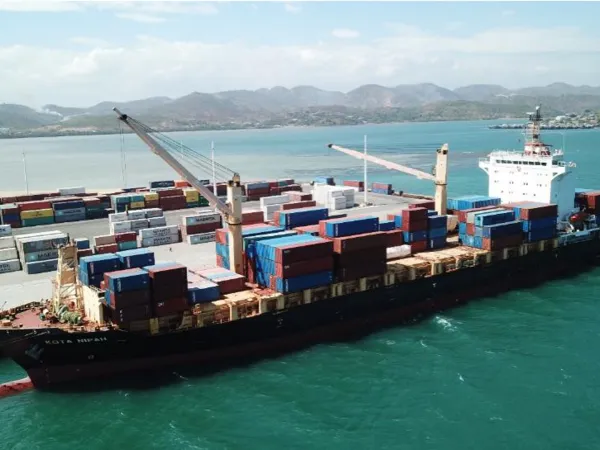
Since 2020, international shipping rates for general and containerised cargos have climbed dramatically, having a considerable influence on domestic products pricing.

According to statistics accessible to the ICCC, the surge in maritime freight prices was caused by the COVID-19 epidemic and trade imbalances, which resulted in international container shortages.

According to Mr Ain, rates fell for a brief period between September and December 2021, but then rose again in March 2022 as a result of the current global economic shock.

“Given that PNG relies heavily on the imported food products and other basic essential items and necessities are mainly imported, when international freight charges increase, they also affect the domestic prices,” Mr Ain said.

He said that structural reasons such as low-income, land-locked, and island countries like PNG endure higher inflation as shipping costs, fuel prices (particularly bunker prices), and international food prices rise due to a significant reliance on imports.

Mr Ain said that variations in foreign currency rates, which affect import costs, are another underlying cause driving up international transportation costs for general and containerised cargo.

“The depreciation of the PNG against the currencies of major trading partners has sustained PNG’s inflation for some time now and the recent shock in global crude oil prices and increase in international costs of shipping and logistics have exacerbated the increase in domestic prices of many countries including PNG over the past two years,” he said.


Reference: Post-Courier (21 April 2022). “Cargo Shipping Costs To Increase”.

April 21, 2022

Despite no new resource projects coming online, Prime Minister James Marape claims that the country has been able to report positive growth.

According to the Asian Development Bank (ADB), the country's GDP would increase by 3.4 per cent this year and 4.6 per cent next year.

Marape stated that the government was handling a debt to GDP (gross domestic product) ratio of K51 billion, including K39 billion in obligations left by the previous administration.

“That’s how we are tracking our economy,” Marape said.

“I just want to encourage our people out there, not all is bad as it may seem.

“Without any new projects, while Porgera is coming on and others are coming on, we are still able to post a positive growth rate however small it may be but we are still posting significant growth over the last two to three years of managing our economy.

“We are rebounding at extraordinary times, hard times, Coronavirus-induced and now with the Russia-Ukraine war-induced hard times.

“In a K51 billion debt to GDP level in hard times and many nations globally also have a higher debt to GDP but for us it’s manageable.

“We are on a fiscal consolidation pathway going forward.

“The way we are posting positive growth this year at 3.4 per cent, next year at 4.6 per cent as forecasted by ADB, its an indication to our country that we are managing our economy responsibly, making interventions at the flow of the economy, especially where people, the ordinary Papua New Guineans are facing hard times.”

PNG's economy improved in 2021, according to the ADB's economic projection for 2022, thanks to a 3.7 per cent growth in agriculture, forestry, and fisheries.

Rising global commodity prices and the elimination of trade bottlenecks boosted palm oil, cocoa, and coffee output. The output of logs and fish has changed somewhat since 2020.

As mineral production increases and more normal global economic circumstances return, the ADB predicts that the country's economy will rise steadily.


Reference:  Luma, Dale. The National (19 April 2022). “Marape remains upbeat about state of economy”. 

April 18, 2022

Photo: PM Marape congratulating Sohe MP Hon. Henry Amuli on his appointment as Minister for Commerce and Industry

Minister for Environment Conservation and Climate Change Hon. Wera Mori has been decommissioned by Prime Minister Hon. James Marape in a Cabinet reshuffle made recently (April 13 2022).

PM Marape also announced the reshuffle of Minister for Justice Hon. Bryan Kramer to Immigration, Minister for Provincial Affairs Hon. Pila Niningi to Justice, and Minister for Immigration Hon. Wesley Nukundj to Provincial Affairs.

“This has nothing to do with their performances,” he said.

“They have performed very well in their respective portfolios but as a whole-of-Government, especially in this transitional period leading up to the elections, we made these changes.”

Mori’s decommissioning follows his resignation from the ruling Pangu Pati to lead another political party.

“I was tasked by the Pangu Pati Caucus, as well as the Pangu Pati Council, to give the portfolio to a member of the party,” PM Marape said.

“The Hon. Wera Mori, of his own accord, has chosen to move away from Pangu Pati.

“His portfolio will be passed on to a member of the Pangu Party, in this instance, Daulo MP Hon. Pogio Ghate.

“I will also be bringing in Pangu Pati member and Sohe MP, Hon. Henry Amuli, into Cabinet sometime next week.

“This will be following the burial of our Pangu strongman, Minister for Commerce and Industry and Goilala MP, Hon. William Samb.

“Their swearing in will be done next week following the burial of late Hon. William Samb.”

PM Marape said Cabinet would be functional during the period of the 2022 General Election, which starts on April 28, right up to when writs were returned and the new government was formed.

“There will not be any Caretaker Government,” he said.

“Cabinet will be functional all the way up until the writs are returned, and then there will be a Caretaker Cabinet.”

PM Marape thanked Mori for serving his Government as Minister for Commerce and Industry, and then Environment Conservation and Climate Change, where he was his Special Envoy to the COP26 Conference in Glasgow last year.


Reference: PM James Marape News Page (13 April 2022). “Minister Wera Mori decommissioned in Cabinet reshuffle”.

April 18, 2022

Photo credit: RNZ - Timothy Masiu

According to Information Communications Technology Timothy Masiu, the introduction of two new telecoms providers into the nation would likely lower internet rates.

According to Masiu, internet rates in the country are not falling as quickly as planned.

However, he believes that once Telstra and Digitec-Vodafone join the PNG market, internet costs will alter.

Masiu stated that the National Information and Communication Technology Agency (Nicta) and Internet Service Providers (ISP) were collaborating to fix the situation.

“A lot of people are complaining and I am worried that this (internet price decrease) is not happening quickly,” he said.

“There are factors and issues that needs to be looked at.

“Nicta does its due diligence very cohesively to make sure that no one is being misled and no unnecessary burden is being put on our people especially at this very time.

“With the Digicel acquisition by Telstra coming in, and Digitec-Vodafone coming up, there’s going to be some very important changes in the internet (prices).”

Nicta's chief executive officer, Kila Gulo-Vui, said that a public inquiry into retail internet prices had been launched.

“That process will determine the kind of levels of prices for voice, data,” he said.

“There is a discussion paper and we expect the operators and interested parties to make submissions.

“Decisions by Nicta are based on evidence.

“We will make decisions and regulatory interventions based on facts and not on speculations.”


Reference: The National (12 April 2022). “Entry of telecom companies likely to cut internet prices: Masiu”.

April 18, 2022

Photo credit: Mick Tsikas - Telstra Logo

Following the approval of Telstra's purchase of Digicel PNG Ltd, the country would benefit from K200 million in capital expenditures in the telecommunications industry over the next two years.

The National Information and Communications Authority (Nicta) has given Telstra final approval to transfer licensing rights in the planned Digicel Pacific purchase.

Timothy Masiu, the Minister of Information, Communications and Technology, said it was the first time a major Australian telecoms corporation had made such a large investment in PNG.

“This means a lot to PNG because we are expecting more areas to be covered by the service that they (Telstra) are bringing.

“They will be building towers in areas which are not covered right now.”

Digicel PNG Ltd and Hitron Ltd are the only ICT service providers in the nation with their own operator licenses.

Kila Gulo-Vui, Nicta's chief executive officer, stated the company will invest up to K200 million in PNG over the next two years, including "capacity improvements from 3G to 4G of surviving Digicel networks."

“It also includes a buildup of additional communication infrastructure towers, upgrade of quality of services from 96 per cent to about 99 per cent,” he said.

“There is no question on Teltra’s capacity in terms of its technical expertise and financial ability. We expect that to flow into our economy that will contribute to the sectors development and aspirations.”

Responding on their thoughts on the approval by Nicta, a Telstra spokesman said: “We are pleased to receive unconditional approval from Nicta on our proposed acquisition of Digicel Pacific. We are working through the final completion steps of the acquisition.”


Reference: Luma, Dale. The National (12 April 2022). “Telstra gets nod from Nicta”.

April 11, 2022

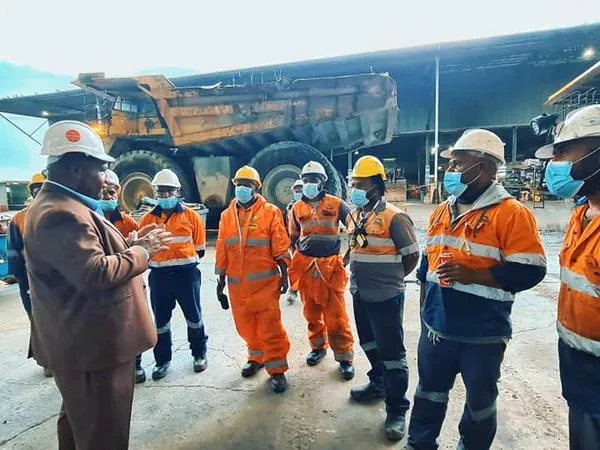
Following the recent signing of stakeholder agreements, more than 3,000 workers will be employed when the Porgera mine reopens.

“Over the next couple of weeks, the company will hire 3,100 people, most of them Papua New Guineans, (who) will head back to Porgera valley, open the gate and start digging the ground,” State negotiation team chairman Dairi Vele said.

“We are hoping that they can announce that the first gold has been processed during June, July, and August.”

According to Mark Bristow, president and chief executive officer of Barrick Niugini Ltd (BNL), the cost of restarting the Porgera mine is roughly US$300 million (K1.052 billion).

The signing of the agreement at Port Moresby, according to Vele, "signified the reopening of the project."

“The main one is the shareholders’ agreement, that is, the coming together to build the company.

“That’s not for the Government.

“That’s for Kumul Minerals Holdings Ltd (KMHL), the landowners and Barrick.

“The company is born today – it is the beginning of the mine.”

Vele said the company should be registered in the next 48 hours.

“Kumul will own the company with 36 per cent, landowners 15 per cent, and Barrick 49 per cent,” he said.

However, the government will receive 53% of the advantages, while Barrick will receive 47%.

The 51% government share in the new Porgera firm, according to KMHL managing director Dr John Kuwimb, is made up of 15% for the landowners and the Enga government and 36% for Kumul Minerals.

Barrick and the State, he claimed, would each have four directors.

“We will work to run Porgera, and this company that we are incorporating will appoint Barrick as the operator,” he said.


Reference: Pacific Ming Watch (7 April 2022). “Over 3000 Mine Workers in PNG to work when Porgera Mine reopens”. 

April 11, 2022

Photo credit: Costplan Group 

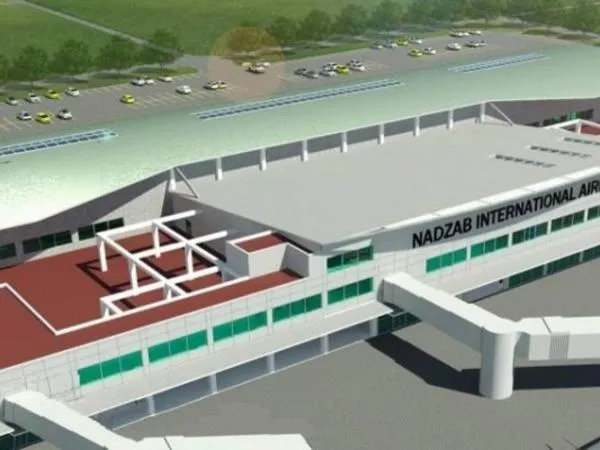
The 1600-meter runway at Nadzab Airport has been finished, with another 800 meters to be renovated by the end of the year before it is completely operational.

The final 800 meters of the runway, according to Oriental Consultants Global architect Satoru Ijiri, should be entirely improved by the end of this year.

He stated that the airport terminal building is halfway completed and will accommodate both international and local flights. He also stated that airport aeronautical ground lights would be placed to allow planes to land at night by the end of the year.

On a visit to the Nadzab Airport Redevelopment project site, Japanese Ambassador Nobuyuki Watanabe noted that refurbishing the airport is a big step toward expanding the airport's function and developing Lae's economy.

According to Amb Watanabe, the airport's expansion will increase the capacity of international planes landing and departing straight from Lae's Nadzab International Airport.

“I am very happy to see that progress, and I hope the airport will enhance the locals and to improve and upgrade the internationalisation of Lae and to develop the whole economy of Lae,” he said.

“Due to the COVID situation, the construction has been suspended for 10 months, but the construction was normalised at the end of last year and is proceeding very smoothly.”

The Nadzab Airport Redevelopment Project is a JICA-funded project with a contract signing expected for November 2019.

Construction on the project began on February 4, 2020, and it will be finished in April 2023.


Reference: Wafi, Abbegail. Post-Courer (8 April 2022). “1600m Of Nazdab Airport Runway Done”. 

April 11, 2022

Photo credit: Post Courier - Treasurer Ian Ling-Stuckey 

Treasurer Ian Ling-Stuckey said the Papua New Guinea government had launched a K350 million package to assist households with the rising cost of living.

He stated that the government will do so responsibly, striving at a temporary decrease with expenditures restricted to K350 million as part of a "program of responsible budget repair."

The current idea, according to Ling-Stuckey, is to target GST cutbacks on vital household items such as gasoline, wheat, rice, corned beef, canned fish, biscuits, cooking oil, and women's sanitary products.

“Given feedback from the community and sectoral interests, we are also examining options for partial or full tax relief on fuel, including import taxes on fuel and excise charges on fuel,” he said.

“The necessary legislative changes will be introduced in the Parliament session on April 19.

“The National Executive Council will need to consider workable options before then.

“I have instructed the acting Treasury secretary to convene and continue talks with the Internal Revenue Commission, Customs and the Independent Consumer and Competition Commission (ICCC) to develop a full set of costed options.

“Meetings will occur this week with PNG peak business groups on how best to implement such important administrative changes.

“The war between Ukraine and Russia continues to impact cost-of-living pressures on PNG families.

“As announced in the March session of Parliament, the Marape-Basil Government is determined to make life easier for families and small businesses through GST tax cuts.

“As previously stated in response to some industry groups, just cutting income taxes will only benefit the small proportion of our people in the formal economy, and even then, there will be no benefit for those on minimum wages as they already pay no income taxes.

“The preference is GST and fuel excise and fuel import tax cuts.

“We need to work with businesses to determine a fair, efficient and fast way to deliver these tax cuts. We need to work with the ICCC to ensure these tax cuts are passed on to families.

“I am listening to advise on the proposed household items to benefit from a GST cut.

“I am very concerned about the health of our people, including the increase in obesity levels (some say fatness), which increases the chances of diabetes and heart attack and other health conditions.

“On this basis, I have recommended the removal of sugar from the proposed GST tax cuts with savings allocated to other key household items.

“I look forward to the outcome of consultations with local businesses on how best to deliver these important cost savings for our families.

“I understand that our businesses will need to make these changes and there will be some costs.

“I hope they understand that this is important for our people.

“It is also good for business in that the increased spending power to our families also means that businesses will benefit from that.

“The good, steady hand of budget repair and responsible fiscal management under the Marape-Basil Government and quick responsive targeted and balanced understanding the cost of living pressures on families, targeted tax increases through the additional company tax on those that can afford to pay, and targeted tax reductions flowing through to all families and businesses.”


Reference: Papua New Guinea Today (7 April 2022). “PNG Government Sets K350 Million to help Families”.

April 07, 2022

Photo credit: Asian Development Bank

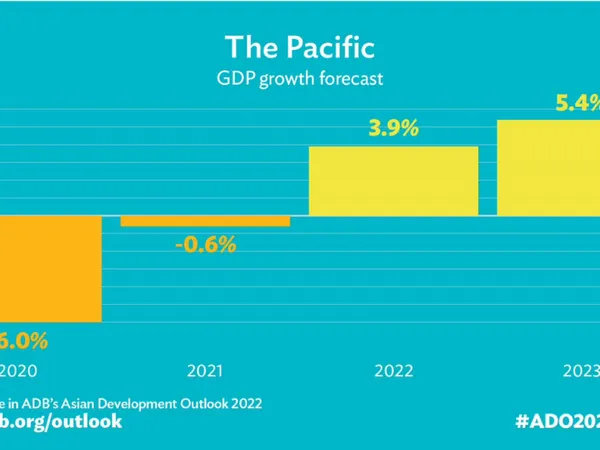
After 2 years of recession caused by the coronavirus disease (COVID-19) pandemic, the Pacific is expected to return to positive growth this year, according to the Asian Development Outlook (ADO) 2022, ADB’s flagship economic publication, which was released today.

The economies of ADB’s Pacific developing member countries contracted by 0.6% on average in 2021 as the COVID-19 pandemic continued to weigh down tourism and trade. Growth in the Pacific is expected to resume at an average of 3.9% in 2022 and 5.4% in 2023. Although most Pacific economies are projected to return to growth in 2022, led by the subregion’s tourism-dependent economies as borders reopen, economic contraction is seen to persist in Solomon Islands with COVID-19 community transmission in the first half of the year, as well as in Tonga due to the impacts of an undersea volcanic eruption and tsunami in January.

“Rising vaccination rates will help most of the economies of the Pacific recover from the effects of the pandemic by allowing the safe opening of borders and enabling a return to positive economic growth,” said ADB Director General for the Pacific Leah Gutierrez. “This suggests the Pacific has turned a corner, and that is good news. Now is not the time to be complacent about the vaccine rollout. It is critical for all countries in the subregion to reach a high vaccine coverage. At the same time, efforts to wind back heightened COVID-19 response expenditures, attention to bringing down debt levels, and careful monitoring of inflationary pressures are needed to underpin sustainable and inclusive economic recovery.”

High global fuel prices due to the Russian invasion of Ukraine are compounding inflationary pressures in the Pacific through elevated transportation costs and rising prices of imports. On average, inflation in the Pacific is projected to rise sharply to 5.9% in 2022, before easing to 4.7% in 2023. High inflation poses a risk to recovery by potentially constraining economic growth through reduced purchasing power and consumption spending.

In 2021, growth in Papua New Guinea (PNG), the biggest economy in the Pacific, was dampened by two COVID-19 surges, underpinned by a very low vaccination rate. Some relief has come from strong commodity prices and fiscal stimulus sustained by ADB and other development partners. Increased mining activities in the second half of the year should contribute to growth of 3.4% in 2022. ADO 2022 says growth in PNG is expected to rise to 4.6% in 2023.

Fiji, the subregion’s second-largest economy, is projected to record 7.1% growth in 2022 and 8.5% in 2023. The opening of the country’s borders in December 2021 gives hope for a revival of tourism, which remains key to a quick economic turnaround and restored employment. However, international competition among travel destinations is likely to be intense, says the ADB report.

After successfully keeping COVID-19 at bay for almost 2 years, community transmission of the virus broke out in Solomon Islands in January this year. ADO 2022 expects the Solomon Islands economy to contract by 3% in 2022 because of restrictions on mobility and domestic transportation, and associated health impacts of the pandemic. While logging activities are expected to decline in 2023, the expected easing of COVID-19 restrictions will increase construction, fishing, and mining, leading to an economic recovery of 3%.

Vanuatu’s economic growth is forecast at 1% in 2022, with growth in public services as well as a recovery in agriculture and construction offset by the domestic transmission of COVID-19, which has delayed the reopening of international borders. Growth is projected to rise to 4% in 2023 as tourism activity revives.

The South Pacific economies of the Cook Islands, Niue, Samoa, and Tonga were, until recently, largely spared the health impacts from community transmission of COVID-19, which allowed time for near-universal vaccine coverage. The report projects growth in the Cook Islands to be 9.1% in 2022 and 11.2% in 2023, supported by a vaccination rate of more than 96% of the eligible population and the acceleration of infrastructure projects to enhance readiness to receive tourists. The economic recovery in Niue will similarly depend on safely easing restrictions and reopening to tourists in the coming months. With no clear sign of borders reopening in Samoa, growth in 2022 is expected to be tepid at 0.4%. Constrained by scarring in the tourism sector, only a slight increase in growth to 2.2% is projected for 2023. The biggest risk to the economic outlook would be any escalation in the community transmission of COVID-19 and a consequent delay in restoring tourism. The delayed reopening of borders in Tonga due to the recent volcanic eruption and community transmission of COVID-19 are likely to slow long-term tourism recovery. ADO 2022 projects an economic contraction of 1.2% for 2022 and a return to positive growth of 2.9% in 2023 assuming borders reopen.

The North Pacific economies contracted in 2021, as travel and mobility restrictions continued to stifle tourism in Palau and trade in the Federated States of Micronesia (FSM) and the Marshall Islands. In the FSM and the Marshall Islands, border reopenings are expected to boost recovery, but this rests on further progress with vaccinations. Economic expansion of 2.2% is expected in the FSM in 2022, accelerating to 4.2% in 2023, while the Marshall Islands economy is projected to return to growth of 1.2% in 2022, picking up to 2.2% in 2023. Growth in the tourism-driven economy of Palau is expected to reach 9.4% in 2022 before accelerating to 18.3% in 2023, provided the effects of the pandemic dissipate, allowing for a gradual return to pre-pandemic levels of international arrivals.

The report projects a pickup in growth in the Central Pacific economies of Kiribati and Tuvalu and slower growth in Nauru in 2022. Surging global oil prices will significantly affect inflation in these import-dependent economies. Growth of 1.8% is expected in Kiribati in 2022, picking up to 2.3% in 2023. Nauru’s economic growth will slow to 1% in 2022 and rise to 2.4% in 2023. Tuvalu will experience 3% growth in 2022 and again in 2023.

ADB is committed to achieving a prosperous, inclusive, resilient, and sustainable Asia and the Pacific, while sustaining its efforts to eradicate extreme poverty. Established in 1966, it is owned by 68 members—49 from the region.


Article courtesy of the Asian Development Bank

April 06, 2022

According to James Marape, the 2022 General Election will go place as planned and will not be postponed.

He stated this to calm worries that the polls will be postponed, which had been fueled by speculation and bogus news on social media.

“The elections will not be delayed and will go ahead as scheduled,” PM Marape said.

“We are working together with the Electoral Commission to ensure that the elections are on time.”

PM Marape stated that there would be a lot of adjustments in this year's elections.

“For purposes of transparency, we will have Transparency International, National Research Institute and civil society representation in the Elections Planning Committee,” he said.

“We will have separate voting queues for men and women to cast their votes without undue influence, as in the past.

“It is the right of voters to make their choice based on their God-given wisdom – not on inducements, bribery, cash, food, wantok system or hype

“We will have CCTV used for counting to make the elections fair and friendly for all.”

PM Marape further stated that election officials who engaged in "improper and unlawful behaviour" during polls would face serious punishment.

“There will be severe penalties for election officials engaged in corrupt practices at polling places,” he said.

“A vote is the sanctified responsibility of each individual to cast his or her vote for a leader, who they feel will represent them in Parliament.

“It’s a high calling of each individual and must not be tampered by an ineffective process or corrupt election officials, campaign managers and officials, or candidates themselves.”


Reference: PM James Marape News Page (4 April 2022). “PM Marape says 2022 elections will go ahead as scheduled”.

April 06, 2022

According to the Independent Consumer and Competition Commission (ICCC), there are still concerns with internet price regulation in the nation.

Following consumer complaints over the costs of retail broadband internet services, the ICCC launched a preliminary investigation into the industry.

Consumers were concerned that PNG DataCo Ltd price reductions for wholesale internet broadband services in 2021 were not being passed down to them at the retail end, according to ICCC commissioner and chief executive officer Paulus Ain.

From December through March, the ICCC investigated consumer complaints to find out what was going on.

Internet Service Providers (ISPs), DataCo, Digicel PNG Ltd, Daltron PNG Ltd, Telikom PNG Ltd, and Datec were among the significant industry stakeholders interviewed.

“The ICCC raised consumer concerns, seeking information as to why advertised reductions in wholesale prices were not passed on, why consumers were not seeing corresponding price reductions at the retail level,” Ain said.

“The National Information and Communications Technology Authority (Nicta), the ICT regulator, was also consulted.” The ICCC found:

  • Different cost structures for ISPs in PNG - mobile network operators and traditional ISPs in the town area have different cost structures that impact their retail price for internet services;
  • Only if the ISP purchases the wholesale service from DataCo is the wholesale pricing a cost input into the retail service pricing.
  • DataCo's National Transmission Network (NTN) is mainly unstable, with too many extended outages, thus ISPs can't rely on it entirely. Additional expenditures paid as the source through different sources - 03B satellites – to retain connectivity;
  • Despite DataCo's claims of a 66% price decrease in their metro fibre service, pricing for this service remain quite costly when compared to equivalent services supplied by foreign service providers.
  • DataCo has vertical integration concerns. DataCo not only owns and operates important wholesale infrastructure, but it also participates in the retail sector. This has caused alarm among the ISPs surveyed by the ICCC, and it may cause future competition problems for the ICCC.
  • Mobile network providers' (Vodafone) potential entry and roll-out might boost market competitiveness. It's also good for DataCo since it gives the NTN another big customer. This might put pressure on DataCo, as the NTN's owner, to increase service offering in order to improve standards and coverage while also being more efficient.

“The ICCC understands that Nicta will be conducting an enquiry this year into the retail market for internet broadband services in PNG,” Ain said.

“This is due to create regulatory oversight in this segment of the market and enable ISPs to compete efficiently, in providing services to consumers.”


Reference:

The National (4 April 2022). “ICCC looks into internet prices”.

April 06, 2022

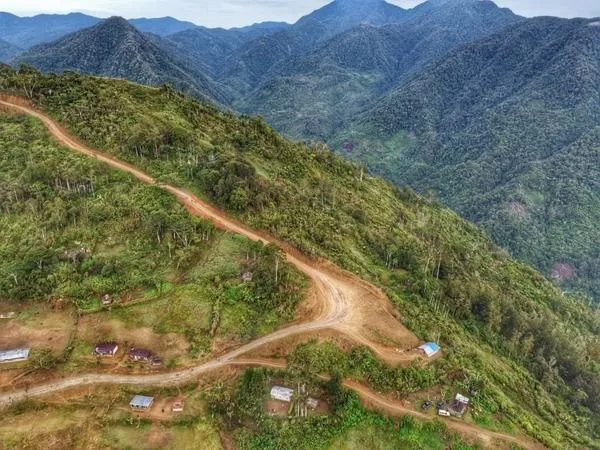
Photo: The Maramuni Road at Maramuni Station

James Marape claims that his government's trademark 'Connect PNG' program links rural Papua New Guinea like never before.

He remarks when unveiling the K15 million 57-kilometre Maramuni Road, which connects Maramuni to Wabag, and launching the Enga-Sepik Highway, which would connect Maramuni to Karawari in East Sepik.

The Wabag District Development Authority (DDA) and the Enga Provincial Government built the Maramuni Road across some of the country's most steep and hardest terrain at a low cost.

The area is famed for its gold and agriculture and its great unrealized tourism potential; unfortunately, there was no road, so people had to hike to Wabag, which took several days.

PM Marape went to Maramuni as soon as he arrived in Port Moresby from Jakarta, Indonesia. He led a government and business group and spent the night before returning to Port Moresby on Saturday.

The Prime Minister pledged K10 million in additional funds for the Maramuni Road, as well as K8 million to begin construction on the portion from Maramuni to Karawari.

The Maramuni Health Centre was also inaugurated by PM Marape.

His entourage included Enga Governor Hon. Hon. Sir Peter Ipatas, Minister of Works and Highways Hon. Michael Nali, Member of Parliament for Angoram Salio Waipo, represents the people of East Sepik, and Hon. Salio Waipo, Minister of Tourism, Arts, and Culture Hon. Isi Henry Leonard, Minister of Labour and Industrial Relations and Member of Parliament for Lagaip-Porgera Hon. Tomait Kapili, Fisheries Minister and Wabag MP, and Hon. Tomait Kapili, Tomait Kapili, Tomait Kapili, Dr. Lino Tom, who served as the event's host.

Representatives from various government departments and agencies were also present, including Works and Highways Secretary David Wereh.

PM Marape praised Sir Peter and diligent Dr. Tom for his insight and vision for Maramuni's "lost" people.

“We are trying to connect all rural areas right throughout the country,” he said.

“In this year’s Budget, we have allocations for 163 roads.”

PM Marape stated Maramuni was one of the "missing connections," which included Tabubil-Telefomin, which connects Western and West Sepik, Karamui-Kundiawa in Chimbu, Finschhafen-Lae in Morobe, and others.

“We are trying to connect all these missing links,” he said.

PM Marape said that his predecessor, Peter O'Neill, had focused solely on Port Moresby, neglecting rural communities such as Maramuni.

“Over the last three years, we have spent K15 million on the Maramuni Road – which is not a lot of money,” he said.

“To break down mountains along the Maramuni Road would require K50 to K60 million.

“I want to thank the leader of Enga, especially Governor Ipatas, and Dr. Lino, for making it possible.”

PM Marape also praised the construction crew for being honest and hardworking in their efforts to build the road while avoiding the use of unneeded costly contractors.

“I want to thank Dr Lino, Governor Ipatas, the team on the ground, including local boys who handled the machines, for putting smiles on both young and old faces at Maramuni,” he said.

“This place has gold, coffee, and so many other resources.

“However, we have forgotten them until now for so long.”


Reference: PM James Marape News Page (2 April 2022). “PM Marape opens Maramuni Road, launches Enga-Sepik Highway

April 06, 2022

Photo credit: Australian Infrastructure Financing Facility for the Pacific

Australia will provide $158 million for repairs and refurbishments to Papua New Guinea's electricity and transportation networks under the Australian Infrastructure Financing Facility for the Pacific.

A $86 million finance package for the Laitim Hauslain project to upgrade national electricity infrastructure is part of Australia's contribution. This initiative will provide power to 30,000 to 40,000 houses, schools, and clinics in the provinces of Morobe and East New Britain, many of which will be connected for the first time.

The Australian funding is part of the PNG Electrification Partnership, which aims to reach 70% electrification by 2030, an important goal for the Papua New Guinean government. Improved access to electricity would help Papua New Guineans achieve better economic and development results, as well as assist economic growth in local communities and enhance the delivery of essential services.

Australia has also committed $72 million to the national road network, which will help link communities and enhance access to markets. The funds will help the Papua New Guinea Department of Works and Highways repair and maintain roughly 359 kilometres of road along the Wau Highway in Morobe Province and the Sepik Highway in East Sepik and West Sepik (Sandaun) provinces.

The money will help with the design of the projected Trans-National Highway. This will help the Papua New Guinean government move on with its key Connect PNG Strategy, a 20-year strategy to improve critical links throughout the country's four regions.

Both investments will create jobs for Papua New Guineans and use local resources to help the country grow.


Reference: Australian Infrastructure Financing Facility for the Pacific (31 March 2022). “Lighting houses and connecting communities in Papua New Guinea”.

April 06, 2022

Photo: Judah Waffi (Head of Special Projects – Nasfund) & Saliya Ranasinghe (CEFI Executive Director)

The National Superannuation Fund (Nasfund) Limited signed a Memorandum of Understanding (MoU) with the Centre for Excellence in Financial Inclusion (CEFI) on March 31, 2022. 

This MoU is a 12-month partnership between Nasfund and CEFI that enables both organizations to work together in providing financial literacy training to Nasfund’s more than 623,000 members. The Fund’s collaboration with CEFI is important as it empowers Nasfund employees to be champion advocates of the savings culture through financial literacy. Commenting on this development, Nasfund CEO Ian Tarutia was pleased with the partnership, which would benefit the Fund’s membership and the communities it operates in. 

“The importance of saving for retirement is a priority for the Fund, especially when engaging with our members right across the country. Educating our members on the pathway to a comfortable living after active employment, including how much is required to fund a meaningful retirement is a key focus for us. There is also the challenge of the unbanked segment of our population which is being addressed through the BPNG initiative to extend financial inclusion across the country. We support this program and will play our part in increasing coverage. This is why working alongside CEFI under this partnership is especially meaningful in preparing our staff to drive financial literacy to our membership. A well-informed membership makes well-informed decisions – this is crucial, especially in retirement.” 

Under CEFI’s Training of Trainer (TOT) program, 60 selected Nasfund staff will undergo a 5-day training session conducted by CEFI aimed at equipping and upskilling Nasfund staff on the planning, delivery and monitoring of financial literacy training for Nasfund members. 

CEFI’s reach for financial inclusion through Nasfund’s branch network and continuous engagement with its membership will be extensive. Nasfund is looking forward to working together with CEFI to promote financial inclusion through education. 

Similar sentiments were shared by CEFI Executive Director Saliya Ranasinghe. “Financial education plays a very important role as it brings new knowledge and changes attitude,” said CEFI Executive Director Mr Saliya Ranasignhe. “We hope this initiative will change the lives of Papua New Guineans to have a better standard of living,” Mr Ranasinghe added.


Article courtesy of CEFI