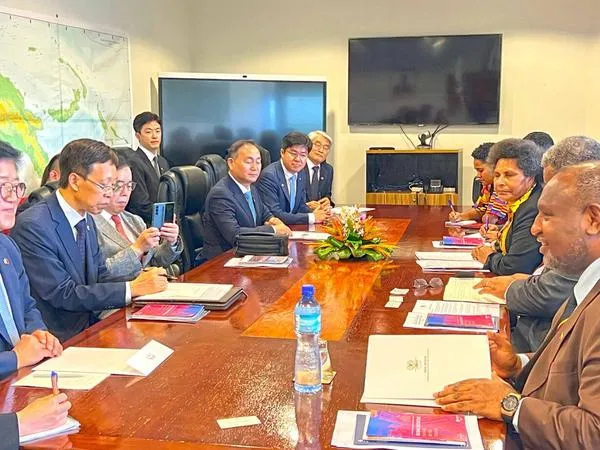
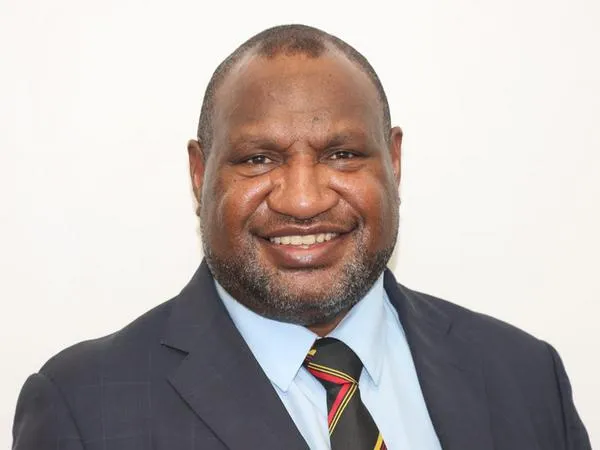
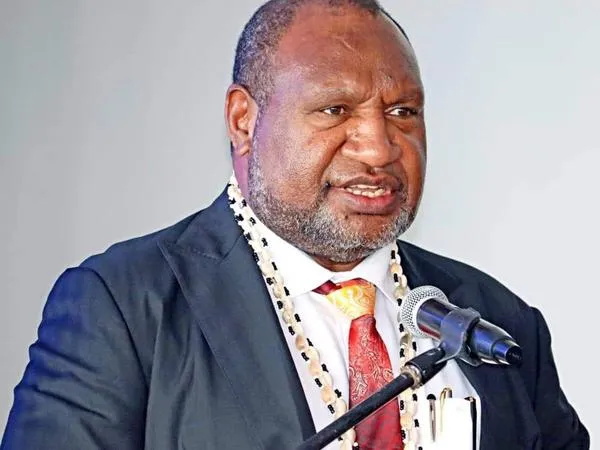
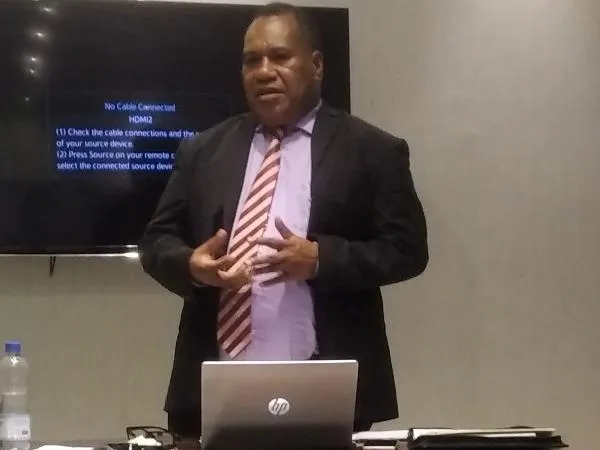
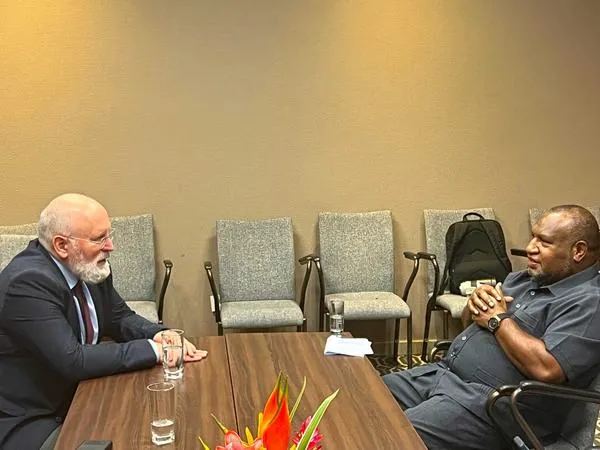
Photo: PM Marape meeting with the Korean delegation leader Park Byeong-seug, who is representing Korean President H.E. Yoon Suk Yeol.
Trade between Republic of Korea and Papua New Guinea was worth US$1.8 billion (K6.33 billion) in 2022, a massive 240 per cent increase from 2021, according to a high-level Korean delegation visiting PNG.
The delegation is made up of politicians, government officials and leaders of business in Korea.
Delegation leader Park Byeong-seug, who is representing Korean President H.E. Yoon Suk Yeol, revealed this to Prime Minister Hon. James Marape during a meeting at Sir Manasupe Haus in Port Moresby today (March 21, 2023). He said this was largely due to the leadership of PM Marape.
“Trade volume last year (2022) between Korea and Papua New Guinea recorded US$1.8 billion dollars, which was a 240 per cent increase compared to the previous year,” he told PM Marape.
“I believe it shows how our economic relations are complementary to each other, which means there is greater potential for both development and cooperation.
“Korea and Papua New Guinea, and their economies, are complementary because because Korea has the experience of growth and high-level technology, while PNG has high-growth potential as well as rich resources.
“Korea has grown from one of the poorest countries in the world to one of the G10 countries in the world, which is why Korea is wanting to establish win-win relations with PNG – based on mutual understanding.”
Mr. Byeong-seug invited PM Marape, on behalf of President Yoon, to attend the first Korea-Pacific Islands Summit in Seoul in May, to discuss issues of climate change as well as furthering bilateral relations. He also asked for PNG’s support to host World Expo2030 in Busan, which PM Marape pledged.
“Korea sees Papua New Guinea as the hub nation of Pacific Island countries and values the potential of bilateral relations for both cooperation and development,” Mr. Byeong-seug said.
PM Marape said the big increase in trade between Korea and PNG had not gone unnoticed by his Government, and there was room for even more growth.
“I want to offer my country as an investment destination for Korean companies, as well as for our producers to export to your country’s markets,” he told Mr. Byeong-seug.
“We have energy sources; we have raw materials. My Government is pushing for downstream processing and we invite companies in relevant industries in your country to come into our Special Economic Zones (SEZs).
“Our GDP (gross domestic product) is well-placed to expand rapidly in the next 10 to 15 years, based on the resources we have, so we are inviting companies from friends of PNG – including Korea – to come and do business here.”
PM Marape also said there were several outstanding bilateral issues between Korea and PNG over many years which needed to be resolved.
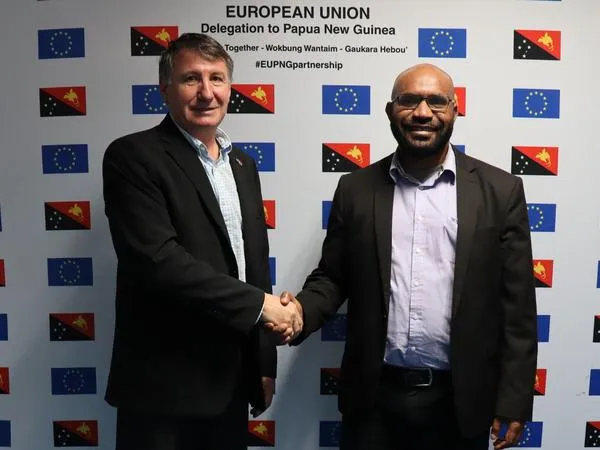
Photo: On January 17th, Ambassador Jacques Fradin met with Hon. Mannaseh Makiba, Minister for Bougainville Affairs, to discuss important matters of mutual interest. Photo credit: European Union in Papua New Guinea
European Union (EU) shares the same values of nation building as Bougainville according to Ambassador Jacques Fradin, Head of Delegation to Papua New Guinea.
Ambassador Jacques Fradin, was in the Autonomous Region of Bougainville to build bilateral relations with the Autonomous Bougainville Government (ABG) and the people last month.
Ambassador Jacques Fradin started his mission to Papua New Guinea in September 2022 and visited the region for the first time with a small delegation to accompany him in a short tour around the north-east part of the North Bougainville.
The EU team were welcomed at the Buka airport and then taken to the Nazareth Centre for Rehabilitation to be guests at a panel discussion with the Member for Selau Constituency Hon. Paul Cheong and the women peace advocators in the Selau Constituency.
In the panel discussion the EU heard for themselves what the women normally do to make a difference to the lives of the mothers and youths who have been traumatized by violence-related abuse and their concerns of what was working in the communities and what was not working in terms of peace building and resilience.
He said that Bougainville and the European Union (EU) shared the same values of nation building and that his visit to the region was to maintain the bi-lateral relations with the government and the people of Bougainville.
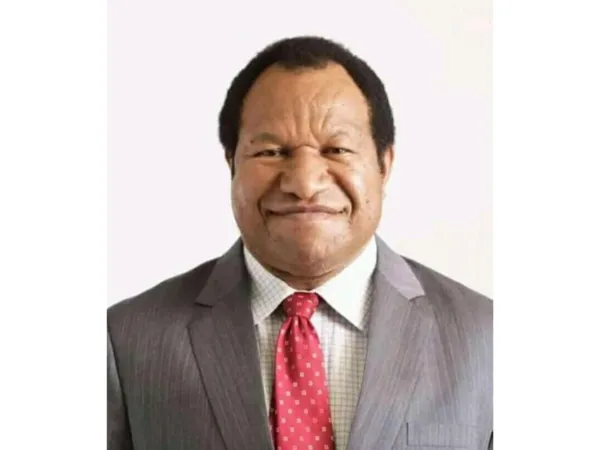
Photo: State Enterprises Minister William Duma
State Enterprises Minister William Duma has acknowledged that the state of the economy is a result of global events beyond the government's control. In his words, "We have just come out of a global pandemic, an ongoing war in Europe between Ukraine and Russia, and an increase in the price of oil and gas globally. All these are contributing factors to the situation our country is facing... The government is doing all it can to navigate the country through this challenging time, but it can only do so little. It needs the support from all citizens, stakeholders, and business houses to drive the country forward."
Duma has pointed out that other countries are facing similar or tougher circumstances than PNG. He also noted that PNG has yet to resort to printing more money, which has kept inflation in check. According to him, "We are still way above the inflation line, and that should be a good motivation for people to be optimistic about the future instead of panicking."
In response to the temporary closure of operations by Lae Biscuit Company, Duma expressed sympathy for the company and assured that the government would provide a response. He recognised the company's significance as one of the largest employers in the country. Duma maintained that the rising prices of goods and services are part of the measures taken to stabilise the economy, and expressed confidence that the closure of Lae Biscuit Company is temporary and that it would resume production. He said, "I believe the closure is temporary, and Lae Biscuit Company will come back to production. But this and many other issues happening across the country are all noted while we (Government) work on the best possible ways to ensure our economy is operational and that the Government can still deliver to the people."
However, recent reports indicate that the company's chairman, Ian Chow, has warned that the company might consider moving offshore if the government does not intervene. Duma assured that Prime Minister James Marape was aware of the situation and would address it. He said, "The government will give its response to this situation this week... The Prime Minister is aware of the closure, and we will address the issue."
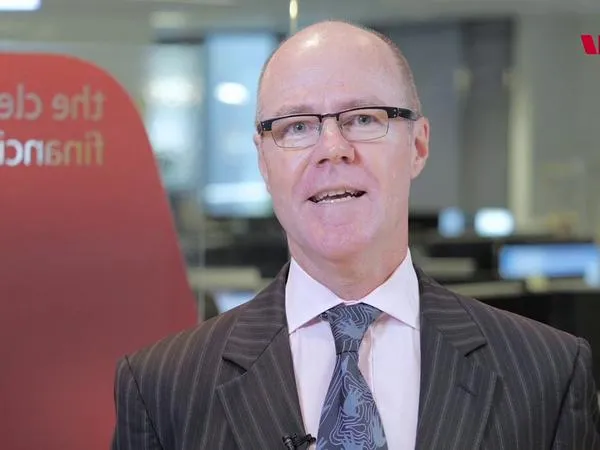
Photo: Westpac Bank Senior Economist, Justin Smirk. Credit: Westpac Bank
The postponement of the Papua Liquefied Natural Gas (LNG) investment until next year will maintain the lack of foreign exchange as an issue this year, slowing down growth, said Justin Smirk, a senior economist at Westpac Bank. He noted that Papua New Guinea's economy was projected to rebound strongly this year, but the delays in LNG project implementation will likely lead to more restrained growth, as the investment surge is postponed to 2024.
Nonetheless, Smirk identified a window of opportunity for Papua New Guinea in the next five years, as he explained, "there’s an underinvestment in carbon-based energy, but carbon-based energy has not completely vanished from our society yet; demand for it is still rising on many components." He also mentioned that "LNG is an important transition field; its demand will remain elevated during this time of inadequate investment in LNG worldwide."
Smirk stated that there is a shortage of carbon-based energy due to western banks and investors becoming less confident in purchasing and holding carbon energy-based assets to decrease their carbon footprint. He commented, "We're observing that oil and gas prices remain well-supported outside the Ukraine crisis. That puts PNG LNG in a good position to capitalise on this window of opportunity during this transitional period."
Furthermore, Smirk highlighted that the LNG shortage is unlikely to disappear, as he stated, "unlike expectations of a few years ago where people believed there would be too much LNG in the world, this shortage will not dissipate." He added, "its demand will remain elevated during this time of inadequate investment in LNG worldwide. Therefore, unlike expectations of a few years ago where people believed there would be too much LNG in the world, this shortage will not dissipate."
Photo: James Marape
Prime Minister Hon. James Marape says the Pangu Pati-led Government he leads has “total belief and sees great value” in the provincial government system.
PM Marape said this on Monday, March 13, 2023, at the end of the two-day Governors’ Meeting in Port Moresby.
“We subscribe to decentralisation – which is deeply entrenched in our Constitution. That is the reason why our nation remains together,” he said.
“In the midst of many challenges, 47 years on, we now have the Special Region of Bougainville under autonomy, we have many performing provinces who want to be functionally autonomous, we also have some provinces who in terms of their internal revenue are weak.
“How do we balance this conversation so that the system and structures of government we set up do not become impediments, but assist in service delivery to the masses of our people? At the moment, as we speak, 80 per cent of our people remain in the provinces and districts.
“Recognising the importance of the provincial government system, and the functions they have, the National Government came in this afternoon to give respect to them.”
PM Marape said Minister for Inter-Government Relations, Hon. Soroi Eoe, would take recommendations of the Governors to the Government.
“This is so that, together with the Governors, we can tailor make a system that is complementary to National Government in as far as service delivery and ensuring our people are better served going forward,” he said.
The Prime Minister commended the Governors for coming together in a bipartisan approach, whether in Government or Opposition, to make decisions for the good of the people.
“This all leads on to our nation celebrating 50 years of independence. By September 16 this year, we hope to have total clarity on what are the roles, responsibilities and functions of provincial government, national government, districts and local level governments,” he said.
“We hope to be expeditious in the way and manner in which we do business to deliver services to our people.”
The Department of Commerce & Industry has finalized the NEC Policy Submission on the Gold Bullion Policy and has submitted it to the NEC for endorsement. The Gold Bullion Policy is an initiative of the Marape-Rosso Government to ensure our non-renewable and renewable resources are properly harnessed to increase revenue streams to support our national budget, grow our rural economy and improve the quality of life for our people.
The Government requires a vibrant and competitive national gold bullion program to support its macroeconomic and fiscal policy functions which will grow and sustain our economy and create wealth for the nation.
The submission in essence brings to reality the Government’s commitment to industrialize and downstream process of natural resources to add value to PNG’s primary commodities including gold and precious minerals, oil and gas, agriculture, forestry and fisheries products, which is an integral part of our policy directive deemed as ‘Take Back PNG, said Prime Minister James Marape.
“I am therefore greatly honored to announce this milestone National Gold Bullion Policy developed by my government to charter a new direction for the gold bullion industry particularly to add value through downstream processing and manufacturing.
“In view of the above, I call upon all relevant stakeholders to support the Department of Commerce and Industry, Department of Treasury, Department of Mining, Bank of PNG and Mineral Resources Authority to mention a few, to take full ownership of this policy and support its implementation,” the Prime Minister said.
Photo: Chief Censor of the Office of Censorship, Mr Jim Abani
Papua New Guinea has been faced with cybersecurity issues and accessibility of indecent and harmful materials on the internet over the past couple of years.
In light of this, Chief Censor of the Office of Censorship, Mr Jim Abani, has called for a public private partnership to tackle cybersecurity issues in the country.
Speaking at the signing of an MOA between the Office of Censorship and PNG Dataco last week, Mr Abani said the partnership is vital in the fight for a safer and secure accessibility of information on the internet.
PNG Dataco Managing Director Paul Komboi reiterated similar sentiments.
Mr Abani admits the responsibility his office holds to monitor and control what's been disseminated through different media platforms has become very difficult, therefore he said a partnership is imminent to tackle this challenge and ensure that media platforms are monitored.
"The approach that we are taking now is to engage and maintain public private partnership. The government cannot work alone to ensure that its goals are achieved, we need to partner with the private sector to ensure that we deliver tangible results," Mr Abani said.
Mr Komboi said Dataco is the state-owned enterprise responsible for the supply of internet services in the country, and is quite concerned that there is no proper legislation to control and monitor what has been accessed on the internet.
However, he stated that partnering with government agencies and private companies in the ICT sector will be a way forward to control cybersecurity issues and most of the illicit content that are accessed on the internet.
"The people of Papua New Guinea need to have confidence now that government agencies are working together in partnership and collaboration with the companies in the private sector to be able to address issues relating to cybersecurity,” he said.
"These are indecent illicit materials that are coming through our network and we must put a stop to it in a way that will not deprive other useful information whilst we pursue our objective of digitalising the country," Komboi said.
Photo: Indian High Commissioner to PNG, Inbasaker Sundaramuthi
Papua New Guinea is one of the best and most ideal places on earth for tourists. White sandy beaches, beautiful people, and local traditions are among some experiences the country has to offer to its visitors.
Recently, Indian High Commissioner to PNG, Inbasaker Sundaramuthi, revealed that India is willing to send tourists to Papua New Guinea – however, PNG is yet to formally honor an agreement it signed with India to have visa on arrival for its nationals.
The agreement was signed in 2016, but nothing has come to fruition, as PNG mainly receives tourist from Australia, Sundaramuthi said.
He noted that India is the third largest economy in the world with a high population, and PNG can benefit immensely from India through tourism.
The Indian High Commissioner is of the view that this potential can bring in more monetary benefits to Papua New Guinea if only the government expands the tourism market to other countries in the eastern hemisphere, such as India.
In 2021, arts and cultural agencies from India and Papua New Guinea established ties in working towards signing an agreement on a cultural exchange program for 2022 – 2025.
The National Cultural Commission’s (NCC) Executive Director at that time, Mr Steven Enomb Kilnda, visited Sundaramuthi and made a presentation on the achievements, activities and plans of the commission, with a view to sealing an agreement on cultural and arts program between the two countries.
He received a positive response from the Indian envoy, who said his office will be working on a proposal to supply help to boost the efforts of NCC to deliver cultural services to the people of Papua New Guinea.
India is the second-most populous country in the world, after China, with an estimated population of 1.4 billion people, and is the seventh largest country in the world, Sundaramuthi explained.
An agreement with the Indian High Commission to grant visa on arrival would be ideal for PNG to understand and learn how India - which also has a diverse culture - promotes, develops, and preserves its largest collections of the intangible cultural heritage of humanity like songs, music, dance, theatre, folk traditions, performing arts, rites and rituals, paintings and writings.
India's high population offers the biggest market for Papua New Guinea in terms of tourist visitors annually apart from the country's traditional market Australia.
The reason for the delay is unknown, but according to the Indian High Commissioner it is important for PNG to honor such national agreements.
Sundaramuthi urged the government to work closely with his office to pave a way forward to enhance tourism in PNG and forge stronger ties between the two countries.
PNG’s visa on arrival arrangement currently in place is with Australia and other Pacific Island countries, especially those who are members of the Melanesian spearhead group.
Papua New Guinea's tourism potential is massive, and can be able to generate substantial internal revenue annually to the state coffers if only the market is expanded and much attention is given to address issues that are affecting the tourism industry’s potential, he added.
Photo: The Autonomous Bougainville Government has had a major cabinet reshuffle and appointment of new Ministers.
Three Ministers have been decommissioned with three new appointments to replace them and a reshuffle within cabinet saw several Ministers reassigned to new portfolios.
President Hon Ishmael Toroama in welcoming the new Ministers and announcing the reshuffle said this was the first major reshuffle made in his capacity as the President and chairman of the Bougainville Executive Council (BEC).
He reiterated that during past ministerial reshuffles he had stated that changes in cabinet were required to maintain the confidence and trust our people have in the government to effectively deliver services and to ensure our resolve for an independent Bougainville is not compromised.
“I have said so often that change enables progress and progress is a sign of growth, maturity and independence,” he said.
The new ministers that were sworn in today include Honorable Dennis Lokonai, Member for Bolave Constituency as Minister for Health, Honorable Junior Tumare, Member for Makis Constituency as Minister for Lands, Physical Planning, Environment Conservation and Climate Change and Honorable Robin Wilson, Member for Terra as Minister for Mineral and Energy Resources.
President Toroama welcomed the three new Ministers to the cabinet and called on them to fulfil their new responsibilities with commitment and pragmatic leadership.
He further congratulated the incumbent Ministers of the BEC through the reshuffle who have assumed new portfolios in the BEC and this included Hon. Amanda Masono as the appointed Minister for Public Service, Minister Joseph Mona as the appointed Minister for Technical Services, Minister Hon. Theonilla Matbob as the appointed Minister for Community Government and Minister Hon. Thomas Pata’aku as the appointed Minister for Education.
Toroama stressed that he expected the same commitment and energy that the incumbent Ministers had given to their former ministries in their new portfolios.
The Ministers were reminded that the Toroama/Nisira government has a focal point to introduce reforms and prepare Bougainville for independence and it required innovative and committed leadership at the political level by the respective Ministers of the cabinet to achieve that.
President Toroama reiterated that the six point strategy of his government were the guiding principles in achieving the ultimate goal of making Bougainville independent politically, socially and economically and called on the Ministers to utilize them.
“Every Minister in the Bougainville Executive Council (BEC) is expected to utilize the six point strategy to achieve your respective ministry and departments’ strategic plans and development goals,” he said.
The Six Point Strategy include:
The Ministers were reminded that the Six Point Strategy is the basis for Bougainville Government’s prerogative to achieve political independence and at the same time improve the lives of Bougainvilleans through the effective provision of basic services and generating revenue.
He called on the Ministers to work with their Heads of Department who are their foremost advisors in political matters and the collaboration must be based on mutual trust and commitment to serving this government and the people of Bougainville.
Meanwhile President Toroama extended his gratitude to the former Minister for Police and Correctional Services Hon. Thomas Tari Member for South Bougainville Veterans, former Minister for Technical Services Hon. Dr. Joe Kim Suamaru Member for Kopi and the former Minister for Mineral Energy Resources Hon. Rodney Osioco Member for Kokoda for their time and effort as ministers of the Bougainville Executive Council.
“You have served the government loyally in the last three years and I thank you for your service to the government and the people,” Toroama said.
The Cabinet Ministers have been called on to build the human resource capacity through education, improve health services through an effective Bougainville health system, provide infrastructure to improve transportation and the movement of services to create an environment that is conducive and able to sustain growth in Bougainville’s economy and prosperity in the communities.
“These are all very achievable goals if we collaborate effectively at the political and administrative levels of the Autonomous Bougainville Government.”
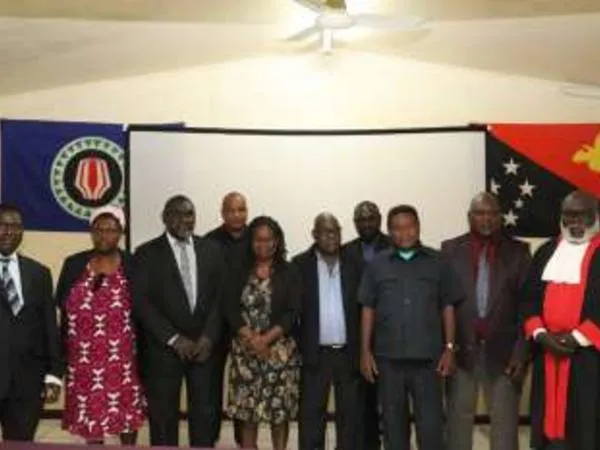
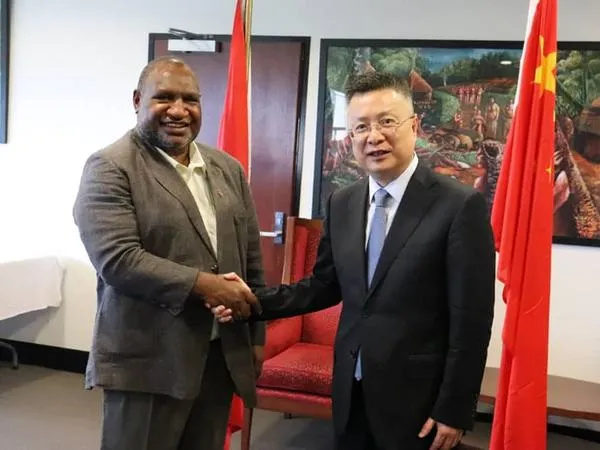
Photo: PM Marape and Ambassador Qian in Port Moresby
Prime Minister Hon. James Marape has reaffirmed Papua New Guinea’s relationship with the People’s Republic of China in the ‘Friends to All; Enemy to None’ diplomatic policy when he welcomed visiting Special Envoy, His Excellency Qian Bo recently (07.03.23) to PNG.
Ambassador Qian was appointed by the Chinese Government in February this year as the Special Envoy for Pacific Island Countries and starts a tour of the Pacific beginning in PNG.
At a high-level meeting at the Prime Minister’s Office, Sir Manasupe House in Waigani, Port Moresby, PM Marape and Ambassador Qian discussed various bi-lateral matters concerning their respective countries and the relationship both countries share.
“We are friend to all, enemy to none; we relate with East, West, North and South in the manner that do not compromise each other’s positions. We respect the sovereignty of nations,” said PM Marape.
“China has been a very important partner to PNG in all sense of a bilateral relationship – in politics, government-to-government, and business-to-business. We certainly welcome you to PNG. You are here in a country that is a very close friend of China.
“Your appointment as Special Envoy for the Pacific reflects your President’s commitment for a close rapport between your country and us in the Pacific. We appreciate this.”
The Prime Minister reiterated the Free Trade Agreement between the two countries and asked for the detailing of this to entail downstream processing and business operations in PNG, adding that this was the number one focus of his government.
“There is no relevance in government-to-government conversations if there is no security in my economy, and I would like China to embrace that line of thinking. We ask for a deep economic relationship that seals our people-to-people engagements, business-to-business, and on the basis of that, a good government-to-government relationship.”
PM Marape said with China’s capability in business and trade, PNG welcomed China, especially in the “upper industrial level in the economic zones”.
The Prime Minister also reiterated his earlier calls for China to consider opening up direct flights between Port Moresby and Shanghai in a co-sharing arrangement to tap into the Chinese tourism market.
“PNG will not compromise its relationship with China. Our Foreign Minister is working on our foreign policy that is coming out – key among them is the respect of the sovereignty of each nation,” he said.
PM Marape thanked Ambassador Qian for reaffirming China’s relationship with PNG.
Meanwhile, PM Marape has been invited to address the government of China in an important dialogue toward the end of this month, an offer the Prime Minister is yet to officially accept.
The invitation was delivered in person by visiting Chinese Special Envoy to the Pacific, Ambassador Qian Bo this morning in Port Moresby.
PM Marape in return thanked Ambassador Qian for the invitation as he paid special compliments on Chinese President Xi Jinping with whom he had a one-on-one dialogue during his visit to Bangkok for the Asia-Pacific Economic Cooperation meeting at the end of last year.
“I have great respect for President Xi Jinping. I appreciate the invitation to engage at the leadership dialogue. It is a high honour for PNG to be picked possibly among many other nations.
“I want to also offer my congratulations on his re-election for an historic third term.
“Chinese stability ensures global world economy has a stable outlook. That is the contribution his re-election has given to the world.
“All economies depend on the stability of certain parts of the world and China is the leader in trade and commerce in our region. Where there is stability in leadership, the rest of the economies that depend on China can focus, plan and work better together".
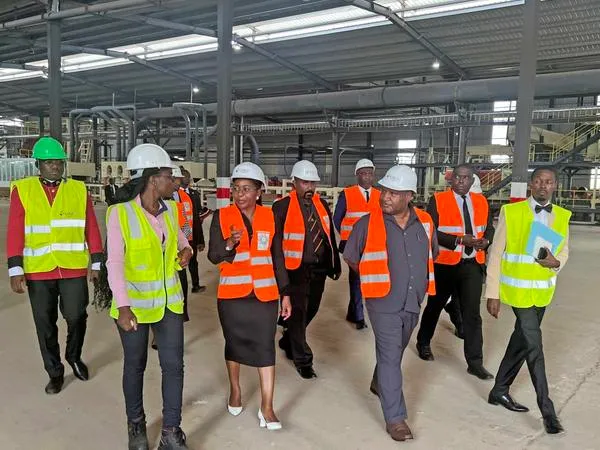
Photo: PM Marape being shown around the Gabon SEZ (GSEZ) at Nkok.-Pictures by PM’s Office Media
Prime Minister Hon. James Marape says there is so much Papua New Guinea can learn from Gabon in Central Africa about Special Economic Zones (SEZs).
An impressed PM Marape said this today after visiting the Gabon SEZ (GSEZ) at Nkok, a multi-sectoral industrial park established in 2010, and located 27 km from capital Libreville. On 1126 hectares (ha), it includes an industrial zone, a commercial zone and a residential zone. The SEZ brings together 144 companies from 19 countries operating in 22 industrial sectors, including a cluster dedicated to wood processing which brings together 84 companies.
PM Marape was given a comprehensive briefing by Gabonese managers of GSEZ before a tour of the wood processing cluster.
The Gabon SEZ has: • Created 16,000 direct and indirect jobs; • Exported US$265 million worth of products exported annually; • Processed 820,000 cubic metres (m3) of timber in 2020; and • Generated US$1.7 billion in direct foreign investments.
“This is the path I have been envisaging since I took office and I now ask those in the forestry industry to switch to downstream . We will still stick to 2025 as cut off mark for round log exports,” PM Marape said.
“We will have four log ponds in our country – Port Moresby , Rabaul/Gazelle , Lae and Vanimo – and State will start off by exercising its rights to get 30 per cent of all round logs harvested to feed our downstream ambitions.
”I am aware the industry is feeling the pinch of extra taxation and there will be a meeting this month on the tax issue as well as the push for downstream and sustainable logging in PNG.
”Logging, fisheries , livestock and agriculture are sectors of the economy that can create more businesses opportunities and employment for our people.”
GSEZ started in 2010 as a joint venture between Olam International Ltd, the Republic of Gabon, and Africa Finance Corporation with a mandate to develop infrastructure, enhance industrial competitiveness and build a business-friendly ecosystem in Gabon.The SEZ offers a unique fiscal status which provides a stable and competitive economic climate for companies intending to settle. Presently, the zone is home to more than 144 investors coming from 19 different countries. GSEZ is rapidly emerging as West Central Africa’s manufacturing hub.
NKOK SEZ was ranked the best industrial zone of the world in wood sector by FDI Intelligence-Financial Times in 2020.
“There is so much that PNG can learn from Gabon about SEZs. PNG has so much forest resources in PNG, which is exported as round logs, rather than going into downstream processing as Gabon is doing,” PM Marape said.
“My visit to Gabon is very timely, given our vast forest resources, and that we are now venturing into establishment of SEZs.
“We will be looking to draw from the experience of Gabon in establishment of our own SEZs dedicated to downstream processing of our forest resources.”
Covered 85 per cent by forest, on 22 million hectares, Gabon has a stock of exploitable wood of 130 million cubic metres (m3) of Okoumé and 270 million m3 of other species. GSEZ has enabled the country to develop and modernise a wood sector that was previously not very promising by relying on specialisation, one-stop services and alignment with the national development strategy. With 3.4 million m3 produced each year, Gabon has become Africa’s leading producer and exporter of tropical plywood, and the world’s second largest exporter. The country intends to go further in adding value to its wood products by transforming GSEZ into a centre for the manufacture of “Made in Gabon” furniture by 2025.
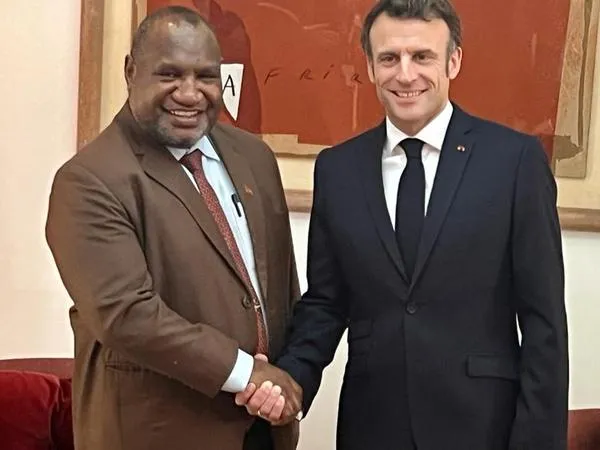
Photo: PM Marape with France President H.E. Emmanuel Macron in Libreville, Gabon.
Prime Minister Hon. James Marape says his bilateral meeting with France President H.E. Emmanuel Macron is very good for relationships between France and Papua New Guinea.
He said this after the two leaders met in Libreville, Gabon, on the sidelines of the ‘One Forest Summit’ on Thursday, March 2, 2023.
It was President Macron, in fact, who invited PM Marape to attend the ‘One Forest Summit’ in Gabon – its former colony - during their last meeting at APEC 2022 in Bangkok, Thailand, last November
PM Marape said the meeting covered matters of sustainable logging, climate change and France assistance to PNG in other matters. This includes defence cooperation, especially in areas of training, between the two countries.
“I am hoping for a partnership with the France Government to see similar projects like what is being done in Gabon, including downstream processing of logs,” PM Marape said.
“The Government of France does not have any direct projects in PNG relating to forestry, conservation, biodiversity or carbon markets. France, however, is part of the European Union (EU), and there is an existing EU-Pacific Green-Blue Alliance.
“The EU is also preparing a new cooperation project on ‘Forest, Climate Change and Biodiversity (FCCB)’ in PNG that is in its consultation stage.
“The new initiative is a concrete implementation of a ‘Global Gateway’ in the Pacific Region, as it will offer sustainable partnership for a green and digital transition, focusing on the ‘Green Deal.
“It is fully in line with the EU strategy for cooperation in the Indo-Pacific, which identifies the ‘Green Transition’ as a priority area of work with partners in the Pacific. The new project aims to support PNG in the areas of forestry, climate change and biodiversity.”
Photo: PM Marape meeting with Frans Timmermans, Vice President of the European Commission, on the sidelines of the One Forest Summit in Libreville, Gabon, recently.
Prime Minister Hon. James Marape has welcomed a new cooperation project with the European Union on ‘Forest, Climate Change and Biodiversity’ in Papua New Guinea.
He welcomed the project during a meeting with Frans Timmermans, Vice President of the European Commission, on the sidelines of the One Forest Summit in Libreville, Gabon.
“This project comes at the right time to support us with the preservation of our forests and biodiversity and help us to fight climate change through carbon markets among other green growth initiatives,” PM Marape said.
“Papua New Guinea has extensive forests and biodiversity that we want to properly harness and develop to support sustainable livelihoods for our rural communities.
“The action supports our ambition to ensure sustainable management of our natural resources and our goal to move to a green, carbon neutral economy by 2050.”
On the occasion of the ‘One Forest Summit,” the EU and PNG invited other Team Europe members to join these efforts and work together to support PNG in protecting its forests and increase resilience against climate change.
The EU acknowledged PNG’s leadership at the global stage on climate change and biodiversity and expressed interest to partner bilaterally as part of efforts to raise ambition on climate action.
With approximately 78 per cent of its landmass covered by forest, PNG is one of the most biodiverse countries in the world. It is home to the third-largest tropical rainforest in the world and more than 7 per cent of the world’s biodiversity.
The new project aims to support Papua New Guinea in the area of forestry, climate change and biodiversity around these main axes:
The European Union and the Pacific region have a shared ambition of achieving a low-carbon and resilient global economy by 2050. The EU-Pacific Green-Blue Alliance, launched at COP26 in Glasgow in November 2021, focuses on climate action, resilience, and sustainable use of natural capital as the basis for inclusive and sustainable economic development, while respecting the rule of law, human rights and fundamental values.
As part of the EU-Pacific Green-Blue Alliance, the EU is preparing a new cooperation project on ‘Forest, Climate Change and Biodiversity’ in PNG. The new initiative is a concrete implementation of Global Gateway in the Pacific region, as it will offer sustainable partnership for a green and digital transition, focusing on the Green Deal. It is also fully in line with the EU strategy for cooperation in the Indo-Pacific, which identifies the Green Transition as a priority area of work with partners in the Pacific.
Photo credit: International Trade and Investment Ministry of Papua New Guinea
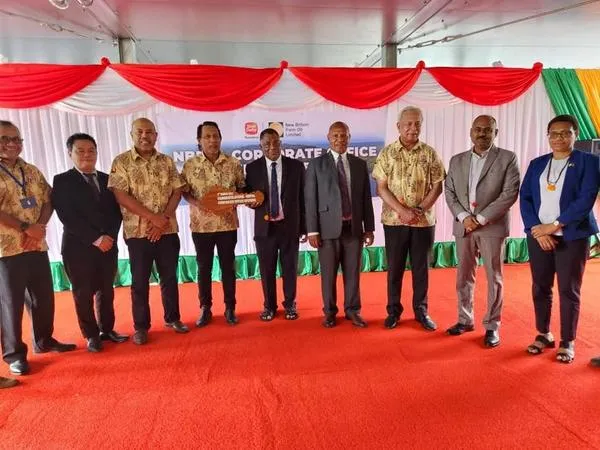
Minister for International Trade and Investment, Hon. Richard Maru wants greater partnership between New Britain Palm Oil Limited (NBPOL) and the Government. Minister Maru expressed this sentiment while giving the keynote address at the recent official opening of the new NBOPL headquarters in Kimbe, West New Britain Province on Thursday. Minister Maru encouraged NBPOL to keep the spirit of partnership with the Government to help the Government address development issues for mutual benefit. He encouraged partnership with NBOPL in the areas of addressing law and order, power generation, and further downstream processing of oil palm into finished high quality cooking oil for the domestic market.
“The National Government is ready to commit resources into the tax credit scheme to address law and order issues in West New Britain Province. All we need is the province and the company to partner and work together with to reduce crime in the province,” said Minister Maru.
Minister Maru added that downstream processing was also a key priority of the Marape-Rosso Government.
“We cannot continue to import cheap and unhealthy cooking oil when we have the resources and technology here. I strongly appeal to the Board and Management of NBPOL to refine the palm oil further into high quality cooking oil in Kimbe or in Lae. Let us go down this path and Government is ready to assist to make this a reality,” said Minister Maru.
“We also do not want any more importation of sugar. The Government provided a twenty-year infant industry protection to sugar in the hope to replace all imports, but we are still importing sugar. This cannot go on. The industry should be expanded by increasing out growers or planting more sugar- that is what the Government would like to see in our country,” added Minister Maru.
Minister Maru said he was grateful that NBPOL had developed a cattle industry.
“The Government is ready to partner NBPOL and locate savannah land for cattle industry. We cannot continue to import beef from Australia and New Zealand when we have the land to rear cattle and expand existing farms. The Government would also like to encourage NBPOL to look into the production of swine and chicken feed. We cannot continue to import feed for poultry and pig rearing,” said Minister Maru.
Minister Maru also encouraged the NBPOL Board and Chairman to be a lot more proactive as a responsible corporate citizen to find solutions on how they could assist with increasing their power to stop the frequent blackouts in Kimbe when the company has electricity supplied by its biogas plant.
“The country needs cheap and reliable power, and the Government is looking to partner with companies such as NBOPL. We have to find a way to solve this issue of constant power black outs for our mutual benefit. If it means to bring more private sector partners to invest in this space then let it be,” said Minister Maru.
“The world is in transition and biofuel will be the next big thing. Prices of palm oil will go up and countries like Indonesia are making decisions to go down that path in a big way. There is real opportunity for us to expand the industry here and look into biofuel,” said Minister Maru.
“We need to seriously look at partnership between NBPOL and the PNG Government. We need employment and technology; NBPOL have it all, they can be an important partner,” added Minister Maru.
Minister Maru thanked the Chairman and the Board of NBPOL for making the very important decision to bring its headquarters back to Kimbe.
“This signals to Government that NBPOL is here to stay and that it has a long-term commitment to the industry, the Government, and the people. Oil Palm is the most important industry in the agricultural sector and a K20 million investment is significant. On behalf of the National Government, I want to thank NBPOL for bringing back its headquarters to where it should be, in West New Britain Province,” said Minister Maru.
“The opening of this new office should signal the start of a new era of enhanced relationship with PNG, one that is based on partnership between both the National Government and the Provincial Government that host all the investments,” said Minister Maru.
Minister Maru added that NBPOL should think of the host provinces if it was planning to offload some of its shares.
“They (the host provinces) should be given equal rights to take up shares. They have the right to benefit from oil palm by being involved and having shares and benefiting from hosting the industry,” said Minister Maru.
“NBPOL must anchor its future on the back of a social license- make sure that the landowners are benefiting, and the hosting provinces are also benefiting,” added Minister Maru.
Photo credit: World Bank / Denisa Maňásková, 2023
The World Bank has predicted that Pacific economies will return to growth this year after three years of economic contraction due to the COVID-19 pandemic. Stephen Ndegwa, the Country Director of Papua New Guinea and the Pacific, noted that "Pacific countries' economic prospects were clearly improving after three years of the Coronavirus (Covid-19) lockdown." Ndegwa further stated that "the Pacific is well placed to accelerate its post-Covid-19 economic recovery throughout this year." However, the report also cautioned that "fiscal balances, debt sustainability, and inflation will remain a concern."
The World Bank's Inaugural Pacific Economic Update report stated that "Pacific nations will have to consider reforms and policies to boost equitable growth and sustainable investments." The report predicted that "Palau and the Solomon Islands will see an 18 per cent and 2.3 per cent (slow growth) growth in Gross Domestic Product respectively on the back of a resurgent tourism industry." However, "the closure of borders from 2020 to 2022 during the Covid-19 pandemic has eased, but left a severe blow to the tourism-dependent economies of Fiji, Vanuatu, Samoa, Tonga, and Palau."
While "Pacific economies can expect growth this year," the region should prepare for shocks from inflation and global uncertainty. David Gould, the World Bank's lead economist for the Pacific, noted that "after being severely hit by the Covid-19 and tepid signs of recovery in 2022, Pacific economies can expect growth this year." Gould explained that "for example, in Fiji, after three years of economic contraction, growth in 2022 is estimated to have climbed to 15 per cent, yet output is expected to remain below the previous years until 2024."
Furthermore, the report highlighted that "Pacific Island countries have not been immune from the economic impacts of the war in Ukraine." The region has been dealt another shock as "rising global energy and food prices have strained Pacific budgets, added to inflation, and ultimately increased the cost of living for families across the region." Therefore, "Pacific nations will have to consider reforms and policies to boost equitable growth and sustainable investments," considering the challenges posed by the pandemic and other external factors.
As Stephen Ndegwa said, "Pacific countries' economic prospects are clearly improving, but we need to continue to take action to ensure that our economies can grow sustainably and equitably."
Photo credit: PNG Office of the Prime Minister Facebook Page
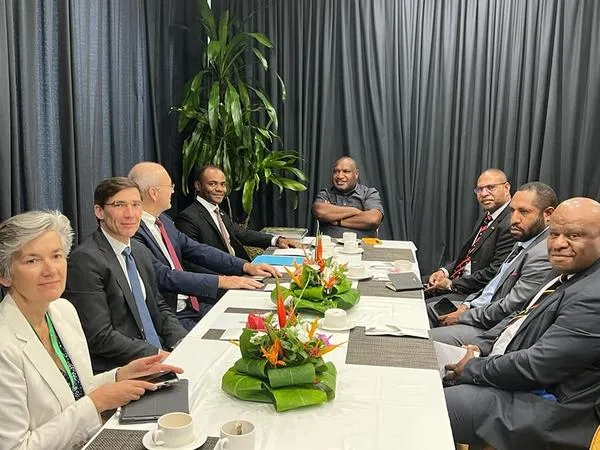
Prime Minister Hon. James Marape met with officials of TotalEnergies and Compagnie des Bois du Gabon (CBG), in Libreville, Gabon, recently.
He was accompanied by Forests Minister Hon.Salio Waipo and Environment and Conservation Minister Hon. Simon Kilepa.
Compagnie des Bois du Gabon (CBG) has partnered with France-headed global oil, gas, and energy major TotalEnergies SE to develop a forward-looking model of sustainable and responsible forest management that combines sustainable harvesting, biodiversity conservation, and long-term carbon storage.
CBG is a key player in Gabonese forestry, recognized for its responsible and sustainable management of 600, 000 hectares (ha) of forest, certified to the highest international standards of the Forest Stewardship Council (FSC), and for its ongoing contribution to protecting biodiversity.
PM Marape wants such an arrangement in PNG.
“TotalEnergies and CBG have a very good partnership here in Gabon,” PM Marape said after the meeting.
“They are also in partnership with the government here on land use in regards to forest management.
“Such a partnership has already started in Papua New Guinea at Kuriva in Central Province.
“TotalEnergies is also looking at more such partnerships in PNG to offset their carbon footprint (through the Papua LNG Project).
“I also want major oil and gas companies in PNG, such as ExxonMobil and Santos, to get involved in such partnership.”
Meanwhile, the two-day ‘One Forest Summit’ in Libreville started today.
The Libreville meeting, on 1 and 2 March 2023, aims to lead to new commitments and concrete initiatives concerning the advancement of knowledge and the promotion of scientific cooperation on forest ecosystems, the promotion of sustainable value chains in the forest sector, the development of innovative sources of financing, notably by exploring market-based solutions for biodiversity conservation.
The One Forest Summit also expects to promote solidarity between the world’s three major tropical forest basins, the Congo Basin, the Amazon Forest and the forests of South East Asia including PNG.
Follow on LinkedIn:
PNG Business News
Be the "First" to get our exclusive Digital Magazine & Weekly Newsletter.