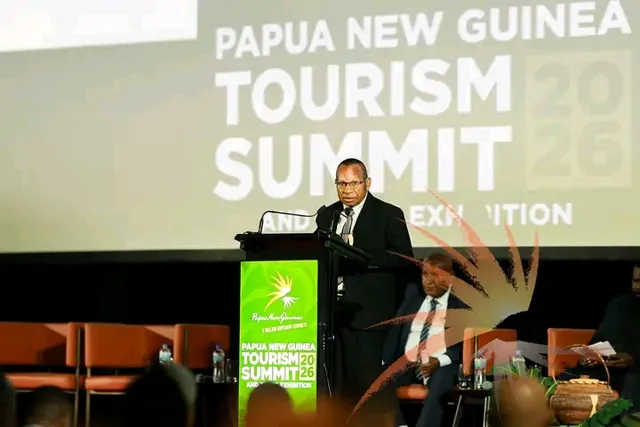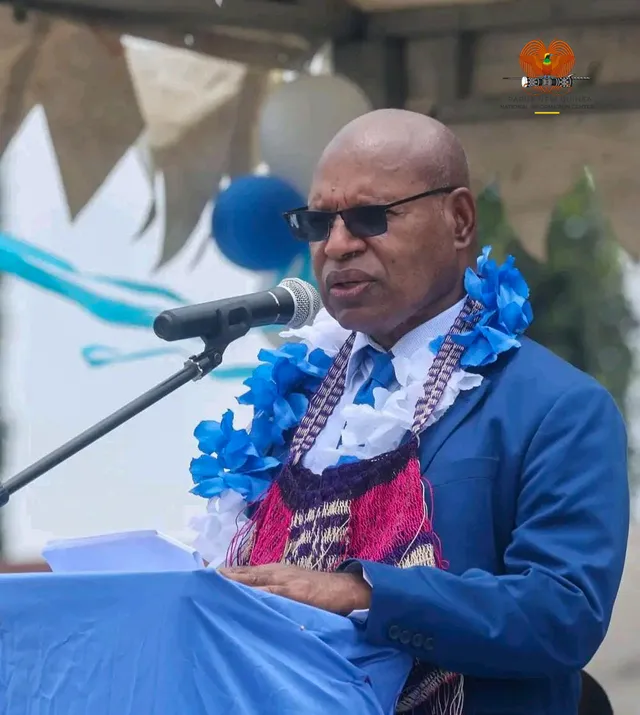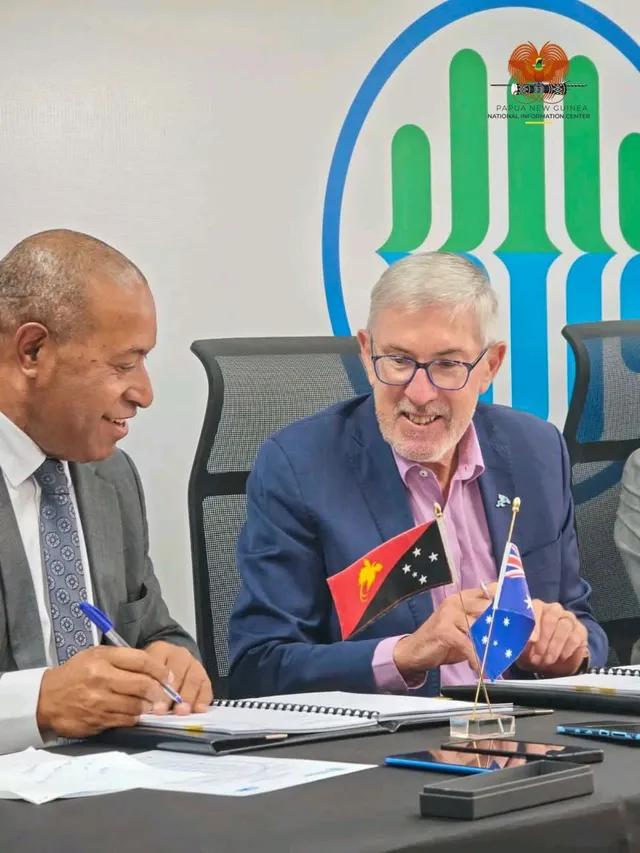
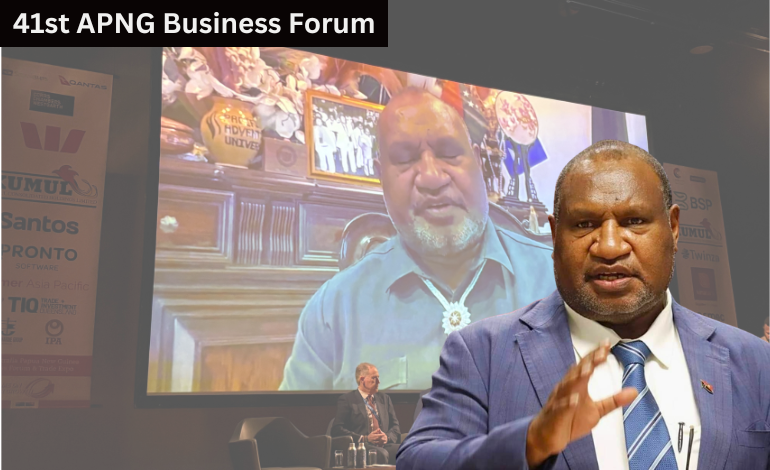
Papua New Guinea Prime Minister James Marape used a video address to the 41st Australia Papua New Guinea Business Forum & Trade Expo in Brisbane to reassure investors of the government's commitment to business, economic reform and long-term growth, while urging companies to look beyond the country's traditional mining and petroleum sectors.
Unable to attend the forum in person, Marape told delegates that his “thoughts, heart and support” were with participants gathered during Papua New Guinea's 50th anniversary year.
He described the Australia-PNG relationship as permanent and deeply intertwined, repeating a line from his address to the Australian Parliament that the two countries were “joined at the hips”.
Marape thanked the business community for continuing to invest in Papua New Guinea and said the government remained committed to supporting investors and addressing policy issues affecting profitability and growth.
“We continue to place our appreciation to every businessman and businesswoman, every company that chooses to operate in Papua New Guinea,” he said.
“If there are any policy matters you feel we need to attend to that help and enhance your profit, we will attend to them.”
At the same time, he said investment and business success must also translate into broader economic benefits for the country.
“When the company wins, the government is able to roll back to the economy, make sure health is okay, education is okay, infrastructure is okay, including power,” he said.
The Prime Minister said PNG remained committed to free-market principles and an independent court system, while reforms were underway to strengthen dispute resolution mechanisms through additional judges, mediation and arbitration processes.
Marape said the economy had grown steadily since 2019, when it was valued at about K79 billion, with annual growth averaging about 4 percent.
“PNG is much bigger than just mining and petroleum,” he said, pointing to opportunities in manufacturing, agriculture, logistics, fisheries and trade.
Marape also flagged plans to reduce corporate taxes as the economy grows toward his target of a K200 billion economy and encouraged investors to “look deep into PNG”.
Infrastructure pipeline attracts investor interest
Infrastructure investment emerged as a major theme during the forum, with government agencies, development financiers and state-owned enterprises outlining major projects across transport, ports, energy and digital connectivity.
Rachael Thompson, Acting Head of the Australian Infrastructure Financing Facility for the Pacific, said the facility had committed A$2 billion toward 59 projects in 13 Pacific countries since its establishment in 2019.
Papua New Guinea accounted for 11 projects valued at about A$1 billion, including major port upgrades, road projects, rural electrification and digital connectivity initiatives.
“These projects include the A$621.4 million package to refurbish, replace and upgrade five ports,” Thompson said.
She added that AIFFP was also exploring support for Papua New Guinea's digital ambitions through the Puk Puk Digital Connectivity Initiative.
Speaking on behalf of Kumul Consolidated Holdings, Chief Investment and Infrastructure Officer David Kitione said Papua New Guinea's infrastructure agenda was being guided through a structured national framework.
“What we are presenting to you today are not aspirations,” he said.
“They are the outputs of a structured, nationally owned infrastructure development process.”
Kitione highlighted plans for the Portside Business Precinct in Port Moresby, describing it as a strategically planned waterfront commercial development aimed at attracting long-term investment.
Ports seen as critical economic infrastructure
PNG Ports Corporation Managing Director Neil Papenfus said the country's ports handled 10.8 million tonnes of cargo in 2025 and supported 22 percent of national GDP.
“When ports work well, supply chains work well,” he said.
Papenfus said the A$621 million port infrastructure upgrade program was the largest in the corporation's history and was designed to rebuild infrastructure for the next 50 years.
Australia expands focus on digital connectivity
Australian Minister for Pacific Island Affairs Pat Conroy and Papua New Guinea Deputy Prime Minister John Rosso highlighted the growing scope of bilateral cooperation between the two countries.
Conroy said the relationship had entered a new phase built on trade, investment and people-to-people links, in addition to traditional security cooperation.
Much of his address focused on telecommunications, which he described as essential to economic development.
Conroy said low internet penetration and high telecommunications costs continued to constrain business activity, education, healthcare and financial inclusion in Papua New Guinea. He announced work on a telecommunications blueprint intended to create a more connected and digitally ready nation while improving cyber resilience and reducing connectivity costs.
Conroy also highlighted the potential role of low-Earth orbit satellite technology and new submarine cable infrastructure under the Puk Puk Digital Connectivity Initiative.
Rosso said Papua New Guinea and Australia were increasingly working together across law and order, infrastructure, labour mobility, land reform, digital systems and sport.
“When PNG grows, Australia benefits,” Rosso said.
Rosso also praised Australia's willingness to listen and work as a partner. “We talk, they listen, they talk, we listen,” he said.
Maru calls for shift toward value-added industries
International Trade and Investment Minister Richard Maru used the forum to argue that Papua New Guinea needed to accelerate investment in sectors capable of creating jobs and expanding economic participation.
Maru said more than one million young Papua New Guineans remained unemployed despite decades of resource-sector development. “The resource sector is not the answer,” he said.
“We have to refocus on the non-resource sector. I'm talking agriculture, forestry, fisheries, manufacturing and tourism. That is the future for Papua New Guinea.”
Maru said Papua New Guinea's economy remained too dependent on exporting raw materials and importing finished goods.
“We are still a major exporter of raw material. That needs to stop,” he said. “We need downstream processing. We need manufacturing. We need to create jobs.”
Maru said Papua New Guinea's economy stood at about US$32 billion and argued that the country could no longer continue exporting raw materials while importing products that could potentially be produced domestically.
He pointed to Indonesia's nickel processing industry as an example of how investment in downstream industries can generate large-scale employment.
Maru also revealed that Papua New Guinea would sign a Comprehensive Economic Partnership Agreement with China and said Asian markets would play an increasingly important role in future economic growth.
He encouraged Australian companies to invest in agriculture, hydropower, tourism, manufacturing and processing industries, saying the government was prepared to offer incentives including tax holidays and joint-venture opportunities.
Agriculture positioned as pathway to inclusive growth
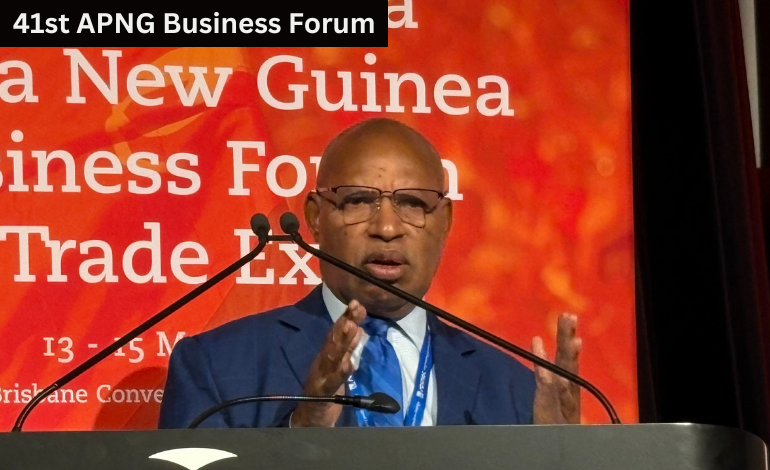
East Sepik Governor Allan Bird argued that agriculture offered Papua New Guinea its strongest opportunity to achieve inclusive and sustainable economic development.
Delivering the Henry Kila Memorial Address, Bird said between 80 percent and 85 percent of Papua New Guineans live in rural areas and depend heavily on agriculture and fisheries, yet the sector contributes only about 25 percent to 30 percent of GDP.
“PNG's best pathway to sustainable development lies in transforming its agriculture sector,” he said.
Bird said agriculture was not only an economic sector but also a critical foundation for social and economic development because it generates direct income for rural households while supporting food security and local businesses.
Using East Sepik's cocoa industry as an example, he said targeted interventions had doubled production and helped expand cocoa cultivation across 19 provinces.
According to Bird, more than K1 billion had flowed directly to villages through cocoa-related activity in recent years.
He also called for better alignment between infrastructure investment and production areas, saying roads, ports, storage facilities and shipping services should support regions where agricultural activity is growing.
Bird further urged reforms involving land access, investment protection, intellectual property and public-private partnerships to attract greater investment into agriculture.
Development partners outline financing support
Representatives from major development institutions also outlined ongoing support for infrastructure development in Papua New Guinea.
Laura Darlington, Assistant Secretary for Indo-Pacific Infrastructure in Australia's Department of Defence, said defence infrastructure investment was generating economic opportunities alongside security outcomes.
“Defence infrastructure is not just about facilities,” she said.
“It is about supporting the economic development of local communities.”
Darlington said future investment under the Defence Cooperation Program and the proposed Pukpuk Treaty would create opportunities for Papua New Guinea businesses and workers.
World Bank Senior Procurement Specialist Amin Saskai said the World Bank's Papua New Guinea portfolio stood at approximately US$677 million across sectors including energy, transport, agriculture, education and water.
“Please engage with our clients,” Saskai told businesses attending the forum. “Let them know about the new trends.”
Asian Development Bank representative Leonardo Storni said Papua New Guinea's infrastructure pipeline remained strong, particularly in transport and energy.
“We are trying to buy right, not buy cheap,” he said, referring to procurement approaches that place greater emphasis on quality and value for money.
Presentations during the forum covered investment opportunities in infrastructure, digital connectivity, ports, agriculture, manufacturing and downstream industries as Papua New Guinea marks 50 years of independence.