

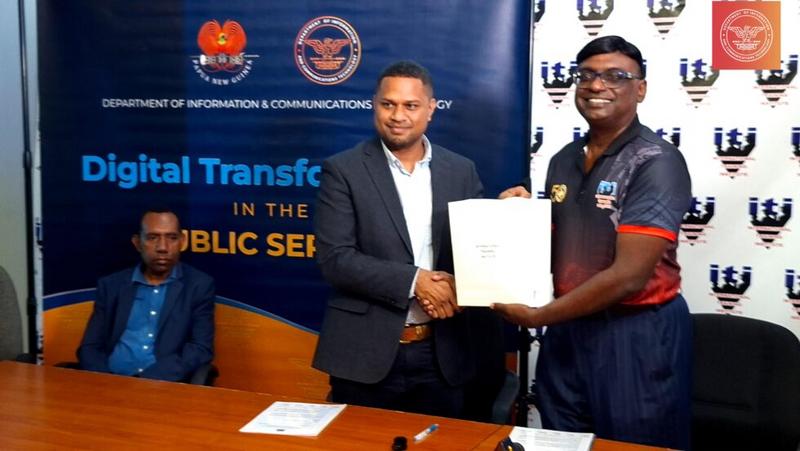
Papua New Guinea's Department of Information and Communications Technology (DICT) and the International Training Institute (ITI) have signed a five-year memorandum of understanding aimed at strengthening cooperation in artificial intelligence, digital skills development, research and innovation.
The agreement, signed in Port Moresby on June 9, seeks to build national ICT capability through curriculum enhancement, internship opportunities, corporate training, staff upskilling programs and the joint development of AI-driven use cases aligned with Papua New Guinea's digital transformation agenda.
A technical working group will be established to coordinate and oversee implementation of the partnership over the next five years.
The signing ceremony was attended by DICT Secretary Steven Matainaho, Deputy Secretary for Policy and Emerging Technology Flierl Shongol and senior departmental officials. ITI was represented by Chairman and Co-Founder Senthil Kumaran Sentheyval, Director and Dean of Studies Sivanathan Sivaruban and members of the institution's academic leadership team.
Sentheyval said the agreement reflects a shared commitment to advancing technology, education and innovation in Papua New Guinea.
"We want to progress, we are also going into IT and AI, so this is something we would like to do — to find out where we can share," he said. "DICT has its own summit and conference, and we have ours. Working together in the same direction is good, and it is encouraging to collaborate with the department to progress further."
He said ITI's role extends beyond training to supporting innovation and the development of emerging technologies.
"As an institution, we are here for the training side, but also to be part of the innovation of future progress in digitalization and AI. It is always good to have the educational side involved in that as well," Sentheyval said.
Matainaho said the partnership supports the government's broader objectives for digital government, digital economy development and implementation of Papua New Guinea's national AI strategy.
He emphasized that artificial intelligence must be linked to practical applications to deliver tangible benefits.
"AI alone is nothing, but AI pegged to a use case — that's where you start to see the value," Matainaho said. "This partnership is about exploring and incubating those ideas and use cases, and what better way to do it than with higher education institutions."
Matainaho identified small and medium-sized enterprises as a key area of focus, saying AI technologies can help businesses reduce costs, improve efficiency and access new markets.
He said DICT's AI Adoption Framework and National AI Strategy are intended to be implemented through collaborative partnerships that translate policy objectives into practical solutions.
Under the agreement, the two organizations will collaborate on AI training programs, development of industry and government use cases, AI laboratory experimentation and wider adoption of digital technologies across the public and private sectors.
The partnership will also be featured during the Digital Transformation Summit 2026 as part of broader efforts to accelerate digital transformation and technology adoption across Papua New Guinea.
The five-year agreement is expected to support the development of digital skills, strengthen national AI capability and encourage innovation across government agencies, businesses and educational institutions.


