Papua New Guinea has reaffirmed its commitment to attracting responsible long-term investment in the mining sector, unveiling a package of regulatory, legislative and digital reforms aimed at strengthening investor confidence while ensuring resource development delivers lasting benefits to communities.
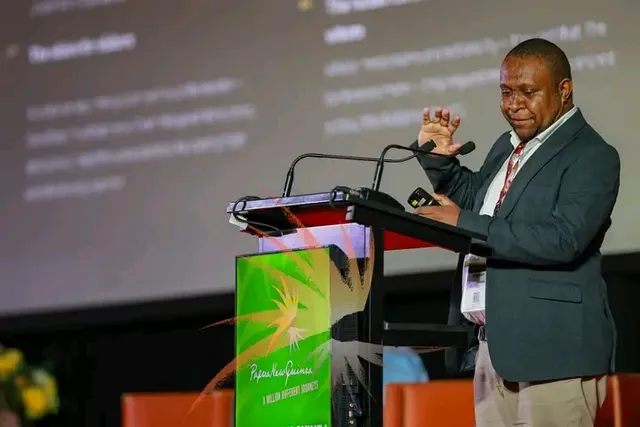
Speaking at PNG CORE Resources Week 2026 at APEC Haus, Mining Minister Solen Loifa said mining remains one of the country's strongest economic pillars and a key driver of PNG's long-term development agenda under the conference theme, PNG Resources Beyond 50.
Loifa said Papua New Guinea welcomes credible investors committed to long-term partnerships and sustainable growth.
Mining, together with the oil and gas sector, accounts for more than 80% of PNG's export earnings and remains a major source of government revenue, foreign exchange, employment and infrastructure development.
Mineral exports reached a record K32 billion in 2025, while the alluvial and small-scale mining sector generated more than K1 billion in export revenue. Mining communities also received more than K474 million in royalty payments.
"However, the value of mining must also be measured by the improvements it brings to the lives of our people. Mining must support stronger communities, better infrastructure, local employment, business opportunities and sustainable development," Loifa said.
Reforms aimed at boosting investor confidence
To improve PNG's competitiveness as a mining destination, the government is pursuing reforms designed to provide greater certainty for investors.
Loifa said the Mineral Resources Authority (MRA) has begun reviewing the Mining Act, with proposed amendments including extending exploration licence terms to five years, introducing a new Mining Retention Licence, enabling online mineral tenement applications and modernising the country's mineral tenement administration system.
The reforms are intended to give exploration companies more time to complete geological studies, drilling programmes, feasibility assessments and stakeholder engagement, while streamlining regulatory processes.
The government is also drafting new mine safety and health legislation to align PNG's workplace standards with international mining practices.
Digital overhaul
A central element of the reform programme is the digitalisation of the mineral tenement application system.
Loifa said the MRA is migrating its mineral tenement database into Papua New Guinea while introducing an online application platform to improve accessibility, transparency and regulatory oversight.
"The online system will improve accessibility, transparency and the monitoring of applications. It will also reduce unnecessary delays and provide investors with a clearer and more accountable process," he said.
Stable regulatory environment
Loifa reaffirmed the government's commitment to a stable legal and regulatory framework.
"Investor confidence depends on consistency, certainty and respect for the law. The Government will ensure that mining decisions are made in accordance with the Constitution, the Mining Act, environmental legislation and other applicable laws," he said.
He added that investors are expected to meet their environmental, taxation and community obligations, with disputes resolved through established legal and administrative processes.
Communities at the centre
Loifa said community support remains essential to the success of mining projects and stressed that resource development must deliver tangible benefits through improved roads, schools, healthcare, water supply, communications, employment, skills training and greater participation by local businesses.
The government will continue working with provincial governments, landowners and industry to strengthen Community Development Agreements and maximise regional economic benefits.
He also urged landowner groups to resolve leadership disputes so communities can fully benefit from resource development.
Positioning for critical minerals
Loifa said PNG is positioning itself to benefit from rising global demand for critical minerals used in renewable energy, battery storage, electric vehicles and advanced manufacturing.
The government is developing a policy framework for critical minerals and rare earth elements while expanding geological surveys and strengthening the country's mineral database through new partnerships.
Improved geological information, he said, will reduce exploration risk, attract investment and support future discoveries, helping keep the sector competitive well beyond 2060.
Tackling illegal mining
Loifa also highlighted efforts to curb illegal mining and gold smuggling.
The government is strengthening inter-agency enforcement, improving gold traceability systems and considering international responsible sourcing standards to boost confidence among global buyers, refiners and investors.
Invitation to investors
Loifa reaffirmed the government's support for commercially viable, environmentally responsible and socially sustainable mining projects.
He said Papua New Guinea would continue improving regulatory certainty, modernising mining legislation, strengthening government coordination and promoting transparent decision-making.
"Our task is to convert our geological potential into sustainable prosperity," Loifa said, inviting investors to partner with the government, landowners and communities to responsibly develop the country's mineral resources.