Category:

PNG’s Economic Outlook Improving but Challenges Remain — ADB
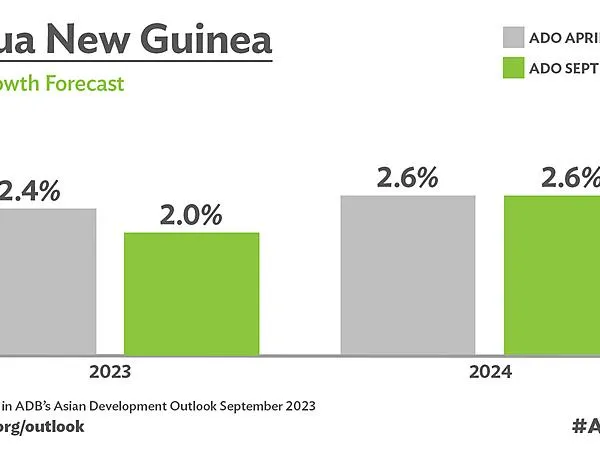
Papua New Guinea’s (PNG) economy is forecast to grow by 2% in 2023 and 2.6% in 2024 amid challenges in various fronts, says the Asian Development Outlook (ADO) September 2023.
Difficulties in accessing foreign exchange, power and water supply disruptions, frequent domestic flight cancelations, and issues in the banking sector are some of the economic challenges the subregion’s largest economy is facing. In addition, the mining industry's contribution to growth weakened due to lower gold production. The ADB report also says import volumes plunged by 61% year-on-year in the first quarter, indicating delays in private investments.
“The government must be commended for initiating an IMF-supported reform agenda to help address macroeconomic policy challenges,” said ADB Country Director for PNG Said Zaidansyah. “The reforms aim to enhance debt sustainability and improve governance by strengthening PNG’s anticorruption framework.”
The inflation forecast is retained at 5% for 2023 and 2024.
The ADO September 2023, notes that while economic challenges remain, sectors such as international travel-related services, communication, and real estate are showing resilience. Government spending initiatives and improved liquified natural gas production contribute to the positive outlook.
The report says PNG’s economy faces significant upside potential related to Porgera Gold Mine’s reopening and the announcement of a final investment decision for Papua LNG that is expected in early 2024. Start of these resource projects will likely stimulate economic activity, boost tax revenue, and help alleviate foreign exchange shortages.
ADB is committed to assisting the government with its Connect PNG Plan which aims for complete countrywide road connectivity by 2040. This will give market access to previously remote and underserved areas, which will promote economic diversification and job creation in non-resource sectors such as agriculture, construction, and tourism. ADB is also working in other sectors such as energy, education, and health. In addition, ADB also provides support on public sector strengthening in PNG including through governance reform of state-owned enterprises and public financial management.

East Asia and Pacific: Sustained Growth, Momentum Slowing
Growth in developing East Asia and Pacific is projected to remain strong at 5% in 2023 but will ease in the second half of 2023 and is forecast to be 4.5% during 2024, the World Bank said recently in its semi-annual economic outlook for the region.
According to the World Bank’s East Asia and Pacific October 2023 Economic Update, regional growth this year is higher than average growth projected for all other emerging market and developing economies but lower than previously projected. Growth in China in 2023 is projected to be 5.1% and in the region excluding China to be 4.6%. Growth among Pacific Island Countries is expected to be 5.2%.
In 2024, improving external conditions will help growth in the rest of the region but persistent domestic difficulties in China – the fading of the bounce back from the re-opening of the economy, elevated debt, and weakness in the property sector, structural factors such as aging – will weigh on growth in China, slowing it to 4.4% in 2024. Growth in the rest of the region is expected to edge up to 4.7% in 2024, as recovery in global growth and easing of financial conditions offsets the impact of slowing growth in China and trade policy measures in other countries.
An intensification of geopolitical tensions, and the possibility of natural disasters, including extreme weather events, are additional downside risks to the region’s economic outlook.
“The East Asia and Pacific region remains one of the fastest growing and most dynamic regions in the world, even if growth is moderating,” said World Bank East Asia and Pacific Vice-President Manuela V. Ferro. “Over the medium term, sustaining high growth will require reforms to maintain industrial competitiveness, diversify trading partners, and unleash the productivity-enhancing and job-creating potential of the services sector.”
The services sectors can play an increasing role in driving development in a region known for manufacturing-led growth, a Special Focus section of the report says. Services sectors have already become key contributors to aggregate labor productivity growth over the last decade. Services exports have grown faster than goods exports. And the growth of foreign direct investment in services has exceeded that in manufacturing by a factor of five in China, Indonesia, Malaysia, the Philippines, and Thailand.
The diffusion of digital technologies and services reforms are improving economic performance. In the Philippines, the adoption of software and data analytics by firms increased the productivity of firms by 1.5% on average over the period 2010-2019. In Vietnam, the reduction in policy barriers such as restrictions on foreign entry and ownership in transport, finance, and business services led to a 2.9% annualized increase in value-added per worker in these sectors over the 2008-2016 period. The elimination of such barriers also led to a 3.1% increase in labor productivity in the manufacturing enterprises that use these services, benefiting small and medium private enterprises most significantly.
The combination of services reform and digitalization is not only creating new opportunities, it is also enhancing the capacity of people to take advantage of these opportunities. For example, distance education and telemedicine supported by well-selected, trained, and motivated local staff have led to better learning and health outcomes in the region, though there remains significant inequality in access.
“Services reform and digitalization can generate a virtuous cycle of increasing economic opportunity and enhanced human capacity, powering development in the region,” said World Bank East Asia and Pacific Chief Economist Aaditya Mattoo.