Category:



Policy Reforms Will Help Enhance Nontax Revenue Collections in PNG — ADB
Policy reforms that strengthen legal frameworks will help Papua New Guinea (PNG) boost nontax revenues, says the latest issue of the Asian Development Bank’s (ADB) Pacific Economic Monitor (PEM)..
“Subdued economic growth of 2% in 2023 is largely due to foreign exchange shortages, 20%–30% lower sales in various sectors, and a weakened contribution to growth from mining, one of the economy’s largest sectors,” said ADB Country Economist for PNG Marcel Schroder. ”PNG has become heavily reliant on revenue from its natural resource sector and is wisely embracing policy reforms to allow the government and statutory bodies to transparently and accountably share nontax revenue.”
The PEM says the Non-Tax Revenue Act of 2022 sets clear guidelines for handling and remitting nontax revenue, including dividends, fees, and charges, to the national budget, promoting transparent and accountable revenue sharing between the government and public and statutory bodies.
The PEM is ADB’s biannual review of economic developments and policy issues in ADB’s 14 developing member countries in the Pacific. In combination with the Asian Development Outlook (ADO) series, ADB provides quarterly reports on economic trends and policy developments in the Pacific.
Domestic Resource Mobilization Instrumental for Economic Recovery and Resilience in the Pacific — ADB
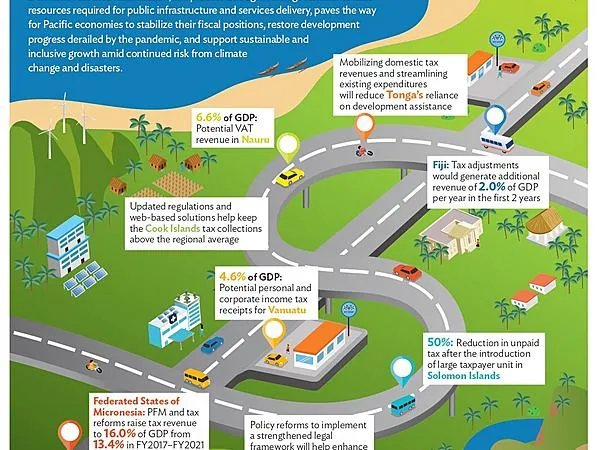
The Pacific economy is projected to continue expanding in 2023–2024, but supporting further growth requires additional government resources, according to the latest issue of the Asian Development Bank’s (ADB) Pacific Economic Monitor (PEM).
Growth for the Pacific is forecast to be 3.5% in 2023 and 2.9% in 2024. Tourism-dependent economies including Fiji, the subregion’s second-largest economy, are seeing recovery in visitor arrivals while resumption of public construction projects is reviving growth in other Pacific economies. Subdued growth of 2.0% in 2023 is seen for Papua New Guinea (PNG), the subregion’s largest economy, due to slower-than-expected expansion in the nonresource sectors. Growth in PNG is expected to pick up to 2.6% in 2024.
However, while tourism and public infrastructure spending are expected to sustain economic expansion in 2024, capacity constraints pose significant downside risks. Vulnerability to disasters and extreme climate events also continue to have potential implications for growth.
“Recovery in tourism and infrastructure spending is driving growth in the Pacific, but continued improvements in the quality of public infrastructure and services remain necessary,” said ADB Director General for the Pacific Leah Gutierrez. “Domestic resource mobilization (DRM) is key to supporting these essential engines for realizing poverty alleviation and economic development.”
DRM is the process through which governments fund their operations. Besides setting tax rates, this involves simplifying related filing, administration, and audit procedures.
This issue of the PEM examines various dimensions of DRM across the Pacific subregion. Country write-ups look at the Cook Islands’ experiences with tax revenue management; progress and opportunities in tax reform across the subregion, including in Fiji, Nauru, the North Pacific, Solomon Islands, and Vanuatu; prospects for enhancing nontax revenues in PNG; and options for improving DRM in Samoa and Tonga.
The policy briefs in this issue make the case for improving DRM in the Pacific; explore digital transformation in tax administration; and present the key findings of an upcoming ADB report on tourism, which is an important sector in many Pacific economies and thus has a role to play in contributing to DRM.
The PEM is ADB’s biannual review of economic developments and policy issues in ADB’s 14 developing member countries in the Pacific. In combination with the Asian Development Outlook series, ADB provides quarterly reports on economic trends and policy developments in the Pacific.



A PNG-Australia Security Framework: Not a Treaty but Solid Nonetheless
by Henry Ivarature
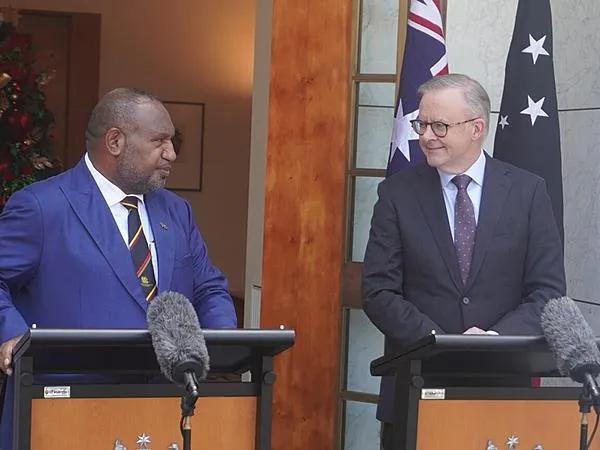
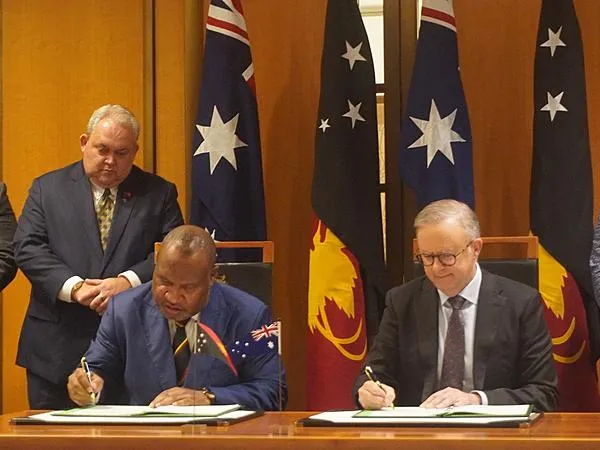
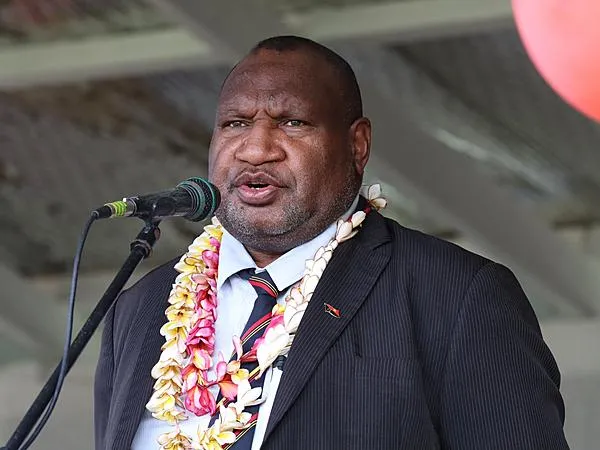
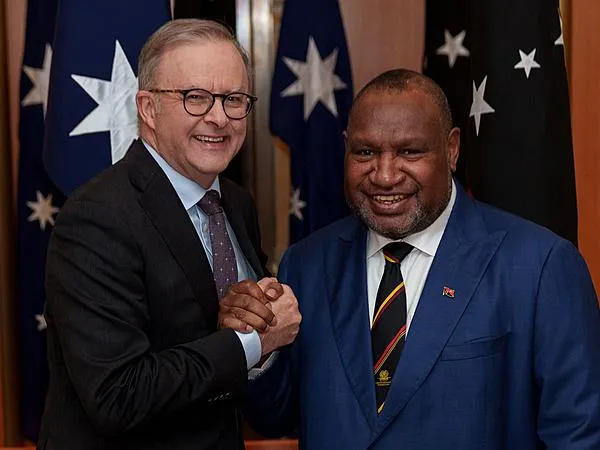
On 7 December 2023, the prime ministers of Australia and Papua New Guinea signed an historic security agreement in Canberra. It has taken approximately three years to conclude since both countries signed the Comprehensive Strategic and Economic Partnership on 5 August 2020, which committed the parties to develop a bilateral security treaty. Titled “Agreement between the Government of Australia and the Government of Papua New Guinea on a Framework for Closer Security Relations”, it is described as a “framework”, so not quite what Australia had hoped for, which was a treaty. Nevertheless, I think, it is as reasonable and pragmatic as it could be in addressing PNG’s serious internal security challenges. Australia has certainly prevailed in working with PNG to get this security framework over the line.
The security framework is largely developmental in nature. It covers defence, police, law and justice, violence against women and children, national security, border, maritime and aviation security, cyber security, health security and biosecurity, as well as infrastructure, humanitarian assistance and disaster relief, and climate change and environment. Its implementation depends on PNG’s political and bureaucratic thought leaders, especially its security sector leadership, who will need to take real ownership of the above-listed “common security interests”, as set out in Article 3 of the agreement, in order to realise the security outcomes Prime Minister James Marape seeks for PNG. Otherwise, the agreement’s noble security and developmental intentions may not be fully realised.
Internal security appears to be the main focus of the agreement. Sadly, PNG is a country plagued by endemic law and order problems including tribal violence and horrible sorcery-related crimes against women. In recent years, tribal violence has increased in frequency, getting more violent and destructive, and is exerting enormous pressures on an already under-resourced police force. This state of lawlessness not only makes life unsafe for everyone, especially women and children, but also frightens away potential foreign investors. In this respect, Australia’s investment in policing and the law and justice sector more generally is a pragmatic and necessary step toward addressing a problem that is long overdue for fixing.
According to my own sources, the protection of PNG’s sovereignty, particularly in relation to Australia’s request for the granting of privileges and immunities for Australian police officers, was a contentious point in the negotiations. Immunity provisions are notably absent from the security framework. However, this could be dealt with under subsidiary agreements in the future. With respect to possible cross-border deployments to engage in security cooperation, Article 4 of the agreement states that the operating framework will be provided by the existing Agreement between Australia and Papua New Guinea regarding the Status of Forces of Each State in the Territory of the other State, signed in 1977. The security agreement has been kept broad and by sidestepping the contentious question of immunities has reduced any perceived impact on PNG’s sovereignty.
Although sovereignty issues might have slowed progress on the agreement, in hindsight it is probably better to have had these matters thoroughly addressed. It is also better to avoid adopting a security framework that skirts around unresolved issues which may later come back to haunt both countries, especially in the “land of the unexpected”. In this respect, credit is due to PNG’s negotiators for not allowing themselves to be rushed, and for waiting until all contentious issues they considered to have implications for national sovereignty were satisfactorily addressed.
Kudos, also, to the patient Australian negotiators working on “PNG time” since August 2020.
Prime Minister Marape’s next challenge will be to navigate the allegations of inadequate consultation from the Chair of the Foreign Affairs Committee, Belden Namah, and reactions from the general public over the coming days and weeks. Although Namah welcomes the security framework, he says Prime Minister Marape’s government is repeating the same mistake it made with the PNG-US defence cooperation agreement – that is, not adequately consulting parliament.
On a broader level, and in this period of intense geopolitical contestation in the Indo-Pacific region, the security framework marks another significant milestone in Australia’s efforts to thwart China’s security interests in the Blue Pacific. It comes less than a month after Australia and Tuvalu signed the Australia-Tuvalu Falepili Union Treaty at the Pacific Islands Forum Leaders Meeting in Cook Islands. Australia has extended its hand to other Pacific states after signing the Treaty with Tuvalu, the first of its kind.
Both developments, nonetheless, will further fuel geopolitical competition in the region. China will likely attempt corresponding measures to maintain its influence. I think that, for now, Australia should be relieved that it has signed a security framework agreement, if not a treaty, with PNG. The security framework at least establishes a broad foundation for building closer security relations with Australia’s closest neighbour.
This article appeared first on Devpolicy Blog (devpolicy.org), from the Development Policy Centre at The Australian National University. Henry Ivarature is the Deputy Director at the Australia Pacific Security College, Crawford School of Public Policy, The Australian National University.