
July 25, 2025

Prime Minister Hon. James Marape has successfully concluded a high-level visit to Japan, marking a milestone in Papua New Guinea–Japan relations as both nations celebrate 50 years of diplomatic partnership.

The visit, which included key engagements in Osaka and Tokyo, showcased deepening cooperation in trade, investment, fisheries, energy, education and infrastructure — and reaffirmed Japan’s role as one of PNG’s most enduring and strategic partners.

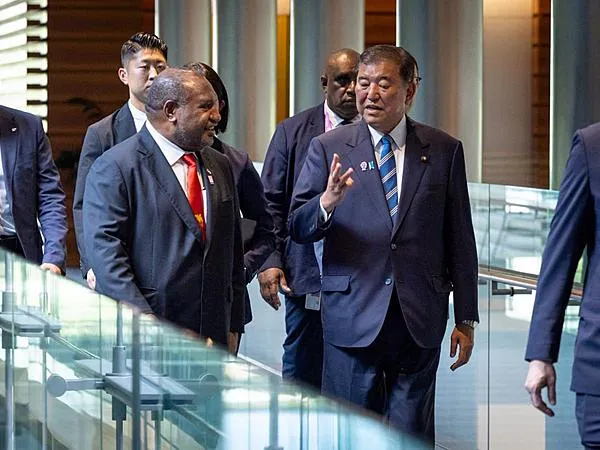
On 22 July, Prime Minister Marape became the first Head of Government to formally congratulate the re-elected Prime Minister of Japan, His Excellency Shigeru Ishiba. The two leaders met at the Japanese Prime Minister’s office in Tokyo for a highly productive bilateral dialogue centred on strengthening ties in trade, investment and development.

The leaders discussed the strategic direction of PNG–Japan relations for the next 50 years, reaffirming mutual respect and shared aspirations for peace, prosperity and regional cooperation. The meeting built on the legacy of five decades of partnership with both Prime Ministers pledging to elevate economic and technical cooperation to a new level.

“It was a great honour to be the first national leader to personally congratulate Prime Minister Ishiba on his re-election. Japan is one of Papua New Guinea’s most trusted and enduring partners — a friend who stood with us before and after Independence,” said Prime Minister Marape.

Prime Minister Marape expressed PNG’s appreciation for Japan’s ongoing support, including:

  • The proposed upgrade of Tokua Airport to a standard similar to Nadzab Tomodachi International Airport
  • Continued investment in agriculture and fisheries
  • A reaffirmed commitment to long-term economic cooperation

During the bilateral meeting, Prime Minister Marape proposed the establishment of a new framework to reset and elevate the economic relationship between the two countries. He formally suggested a Comprehensive Economic Partnership Agreement (CEPA) to govern trade and investment between PNG and Japan over the next 50 years.

“We proposed a fresh framework — a CEPA — that would institutionalise the next chapter of our bilateral relations,” PM Marape stated. “Our aim is to reset and expand trade, create more investment opportunities and improve market access.”

Prime Minister Marape noted that while Papua New Guinea exported more than K6 billion worth of goods to Japan last year, imports from Japan totalled less than K1 billion — highlighting a significant trade imbalance in PNG’s favour. Japan currently purchases approximately 40% of PNG’s LNG, 51% of its minerals and over 50% of its seafood exports.

“The Japanese Prime Minister asked us to continue supplying minerals, energy and food — with a particular interest in rice,” PM Marape said. “We also proposed a tariff-free trade arrangement with Japan. Our respective officials will now begin reviewing these proposals ahead of formalising a long-term agreement.

“We are grateful for Japan’s consistent partnership — from infrastructure to education, fisheries to finance. Our talks were frank, forward-looking and built on the mutual belief that we can achieve more by working together,” he added.

PM Marape Courts Japanese Investors

In addition to high-level government meetings, Prime Minister Marape also met with leading Japanese private sector stakeholders across agriculture, manufacturing, forestry, banking and mining, reinforcing Papua New Guinea’s position as an attractive investment destination.

“We are opening our doors wide to Japanese investors — not just in resources but in agriculture, tourism and clean energy. Our reforms are creating a more stable and transparent environment for long-term partnerships,” he said.

Japan has remained a consistent partner to Papua New Guinea since the opening of its JICA office in 1974 and the formalisation of diplomatic ties in 1975. Japan’s bilateral investment has exceeded K6 billion with ongoing trade in minerals (notably from Ok Tedi), liquefied natural gas, cocoa, coffee and up to 30% of PNG’s seafood exports.

PNG Showcases Culture and Progress in Osaka

In Osaka, Prime Minister Marape officiated Papua New Guinea National Day at the 2025 World Expo, commemorating 50 years of PNG–Japan diplomatic ties. He called for enhanced collaboration in innovation, tourism, cultural exchange and sustainable development while showcasing PNG’s cultural identity and emerging economy.

“This Expo is more than an exhibition — it’s a platform to show the world who we are and the values we stand for. Japan has given us this wonderful opportunity and we are here to strengthen a friendship that has lasted half a century,” he said.

Tokyo Engagements Drive Economic Transformation

In Tokyo, Prime Minister Marape held several key bilateral meetings:

  • Japan Bank for International Cooperation (JBIC) reaffirmed its commitment to renew its Memorandum of Understanding with PNG by Independence Day (16 September), enabling resumed investment cooperation in major resource projects
  • ENEOS Xplora Inc., a major LNG stakeholder, was invited to partner with Kumul Petroleum and Kumul Minerals to expand energy collaboration
  • JOGMEC (Japan Organisation for Metals and Energy Security) was encouraged to support clean energy and battery technology investments in PNG

“These engagements are part of our broader economic transformation. We want Japanese companies to be at the forefront of new investment in PNG — from LNG and gold to battery tech and carbon-free energy,” said PM Marape.

Fisheries Sector to Benefit from Major New Projects

Multiple fisheries agreements and investments were announced during the visit:

  • A K111 million fisheries development project in Kavieng, with K92 million from JICA and K20 million from PNG’s National Fisheries Authority (NFA)
  • JICA pledged another K92 million for the redevelopment of the National Fisheries College, including a new research and surveillance vessel
  • Mr Kiyoshi Kimura, Japan’s famed “Tuna King” and head of Kiyomura Corporation, expressed interest in investing in PNG’s seafood value chain — including cold storage, onshore processing and a distribution hub in Japan

“Our fisheries sector is poised for transformation. These new partnerships — from college upgrades to private investment — will help us build a world-class seafood industry,” said Prime Minister Marape.

PNG Presents Itself as Trusted Investment Destination

Speaking at the PNG Mining Seminar in Tokyo, themed “Investing in Impact”, Prime Minister Marape assured Japanese investors that PNG offers a stable, resource-rich and democratic business environment with a strong track record of delivering on international contracts.

He highlighted opportunities in:

  • Wafi-Golpu and Frieda River mines
  • Long-term copper and gold production at Ok Tedi
  • Renewable energy, clean technology and agriculture

“We’ve never failed to deliver on our mining and energy contracts — and we never will. PNG is a trusted partner and our resources will be there for the long haul,” he said.

Prime Minister Marape’s visit not only celebrated 50 years of PNG–Japan relations but also charted the course for the next 50 years of collaboration. With over K6 billion in past investments, rising trade volumes and expanding people-to-people ties, Japan remains a foundational partner in PNG’s journey toward becoming a K200 billion economy by 2030.

“Our partnership with Japan is built on trust and mutual respect. As we celebrate 50 years of friendship, we are planting seeds for the next 50 years — a future of prosperity, sustainability and shared progress,” PM Marape concluded.

July 25, 2025

PORT MORESBY — In a landmark move for cultural preservation, the Gulf Provincial Government has become the first in Papua New Guinea to financially align with the National Cultural Commission (NCC), reinforcing a shared commitment to protect and promote the nation’s diverse traditional heritage.

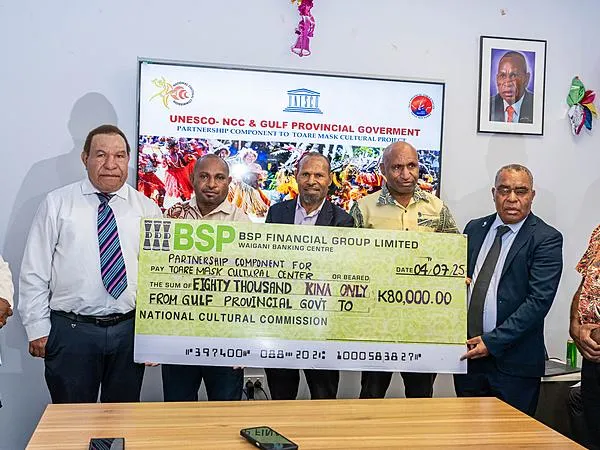
On 4 July 2025, at the NCC head office in Port Moresby, Gulf Provincial Administrator Clement Tare officially handed over a K80,000 (approximately USD 21,600) cheque to NCC Executive Director Steven Enomb Kilanda. The funding marks the province’s state party contribution towards completing the Toare Cultural Centre — a major community-driven project based in Toare Village, Gulf Province.

Kilanda welcomed the partnership as a “historic milestone” for PNG’s cultural sector.

He also expressed appreciation to Gulf Governor Chris Haiveta and Administrator Tare for their firm commitment to culture. This support, he said, will ensure the Centre’s proper completion, operation, and future cultural programmes in the province.

Jointly developed by the NCC and UNESCO, the Toare Cultural Centre forms part of a broader initiative to have the Toare Mask Culture nominated for inscription on UNESCO’s Urgent Safeguarding List.

With the Gulf Provincial Government’s K80,000 (USD 21,600) contribution now secured—adding to NCC’s initial support of K20,000 (USD 5,400)—the project is on track for completion. The Centre is scheduled to officially open on Friday, 11 July, with the Annual Toare Mask Festival taking place from 12 to 13 July.

Administrator Tare commended NCC’s grassroots-led approach, saying the Centre would become a “beacon of pride” for the people of Gulf and serve as “a powerful tool for youth education and cultural revival.”

He pledged continued support, including further financial assistance for the Toare Mask Festival and other heritage initiatives.

“Our commitment reflects a broader vision to place culture at the heart of community development and identity restoration,” Tare said.

This three-way partnership among the Gulf Provincial Government, the National Cultural Commission, and UNESCO marks Papua New Guinea’s first provincial-level cultural development collaboration of its kind — setting a new precedent for provinces across the country.

As the official opening draws near, the Toare Cultural Centre stands as a powerful symbol of cultural unity, government leadership, and international cooperation, safeguarding PNG’s irreplaceable heritage for future generations.

July 25, 2025

PORT MORESBY – Adyton Resources Corporation has reported “very encouraging” preliminary gold assay results from its ongoing diamond drilling campaign at the Feni Island gold-copper project in Papua New Guinea, with multiple broad intersections of gold mineralisation across the first three drillholes.

The standout result came from hole FDD002, which returned 144.2 metres at 1.18 grams per tonne (g/t) gold, including 93 metres at 1.58 g/t Au, starting from 45 metres depth. Drillhole FDD001 intersected 76 metres at 1.43 g/t Au, while FDD003 returned 81 metres at 1.12 g/t Au.

“These preliminary gold assays are very encouraging and demonstrate consistently greater than 100 gram-metre grade intercepts at relatively shallow depths,” said Tim Crossley, chief executive officer of Adyton.

In particular, hole FDD005 was drilled to 839 metres and showed visual mineralisation from 45 metres through to end of hole, for a 794-metre mineralised interval. “This hole in particular has generated a lot of excitement with our geology team as we await with interest for the assays to be reported,” Adyton said.

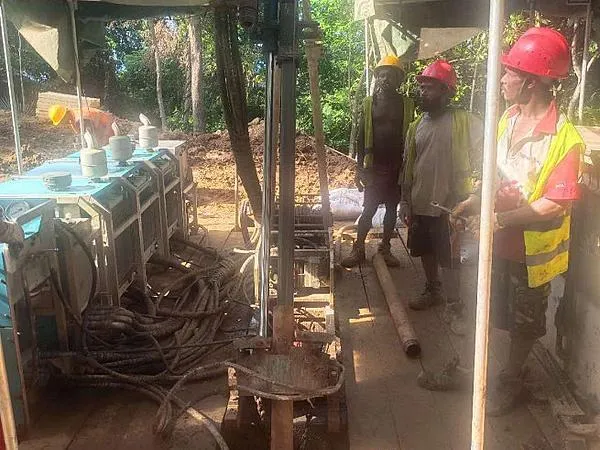
As of 21 July, ten diamond drillholes totalling 3,332 metres had been completed — six finished, two in progress, one terminated early and one abandoned. Core samples from the first five holes have been dispatched to the laboratory, with assays pending.

The drilling programme is targeting both shallow, gold-bearing hydrothermal breccias and deeper porphyry-style mineralisation at the Feni Island project, which already hosts an inferred mineral resource of 1.46 million ounces of gold.

Chris Bowden, chief operating officer and chief geologist, said the assay results support Adyton’s geological model.

“Initial assay results (preliminary gold only) for the first three drillholes confirm the geological model for the shallow, gold-bearing hydrothermal breccias encountered just below the base of the post-mineral tephra cover. These initial assay results give us confidence in the additional drillholes that also show visual observations of strong sulphide mineralization,” Bowden said.

Visual observations from drillholes FDD004 to FDD007 suggest further mineralised zones. In hole FDD005, for instance, widespread sulphide mineralisation was seen from surface to over 800 metres, with zones of semi-massive sulphides up to 10% and deep stockwork veining from 743m to 829m. FDD007 encountered hydrothermal breccias with 5–10% sulphides between 221m and 243m, possibly indicating a high-grade zone.

Drillhole FDD006, drilled outside previous exploration areas, also showed promise with extensive breccias and mineralised intrusives hosting up to 5% sulphides and strong brecciation from 69m to the end of hole at 412.6m.

The Feni Island Project lies on the same island chain that includes the Simberi and Lihir gold mines, and just northwest of the giant Panguna copper-gold deposit on Bougainville. The project is 100 percent owned by Adyton and forms part of the company’s larger Papua New Guinea portfolio, which includes a total inferred gold resource of 2 million ounces across its Feni and Fergusson Island projects.

Adyton’s Fergusson Island Project also hosts an indicated resource of 173,000 ounces of gold and an inferred resource of 540,000 ounces, according to a 2021 NI 43-101-compliant resource estimate.

Further assay results from deeper mineralised intercepts are expected in the coming weeks. Adyton emphasised that visual observations of sulphide mineralisation do not guarantee assay grades, and final laboratory results are required to confirm the extent and quality of the mineralisation.

July 24, 2025

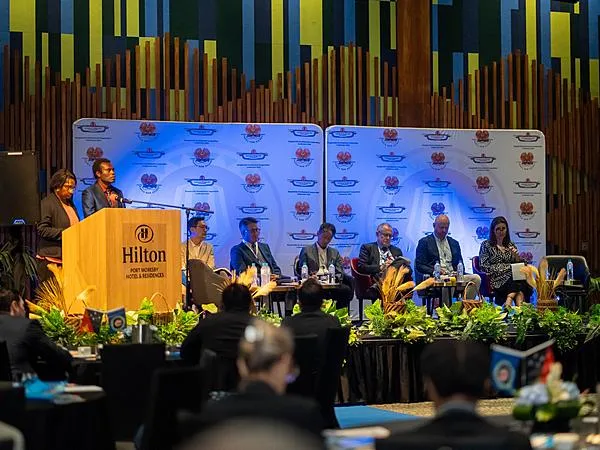
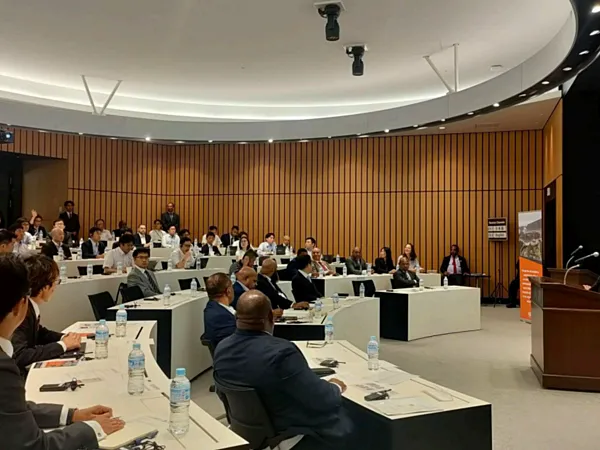
Papua New Guinea’s mining sector took centre stage this week at the inaugural PNG Mining Seminar, held at the Akasaka Intercity Conference Centre in Tokyo.

The event, co-hosted by Ok Tedi Mining Limited, marked a significant milestone in the enduring partnership between Japan and Papua New Guinea, showcasing the country’s untapped resource potential and inviting Japanese investors to join PNG’s journey of growth and development.

Prime Minister James Marape and Minister for International Trade and Investment  Richard Maru both addressed the 60-person audience, which included Japanese smelter partners, industry peers and prospective investors.

Ok Tedi Managing Director and Chief Executive Officer Kedi Ilimbit, who presented at the seminar on the mutual benefits of the PNG–Japan relationship, shared his vision for the future of mining in PNG:

“This seminar marks a new chapter in our relationship with Japan – a country that has stood by Papua New Guinea for decades. We are proud to host this historic event and invite Japanese investors to walk with us into a future of shared prosperity,” Ilimbit said.

“Ok Tedi is not just a mining company – we are a catalyst for change. We invest in growth, but we also invest in people, in communities and in the future of our nation.”

Ok Tedi positioned itself as a partner of choice for Japanese investors seeking long-term, socially impactful ventures.

“Papua New Guinea is a land of opportunity. Our resources are vast, our people are resilient and our potential is still largely untapped. We welcome partners who share our values and our vision,” Mr Ilimbit added.

Kumul Minerals Managing Director Sarimu Kanu also attended the seminar and presented on the theme “Partnering to Build PNG Mines.”

Key themes of the seminar include:

  • Japan’s enduring partnership with PNG, built on decades of trust and trade
  • PNG’s untapped potential in mining and infrastructure
  • Social impact and inclusive growth, with Ok Tedi leading the way
  • Strategic investment opportunities for Japanese stakeholders

The event was co-hosted by the Japan Organisation for Metals and Energy Security (JOGMEC) and the Japan International Cooperation Agency (JICA), whose support reflects Japan’s strategic interest in PNG’s resource sector and the importance of regional cooperation for mutual growth.

July 24, 2025

Economic growth in Pacific island nations is expected to hold steady this year but slow slightly in 2026, according to the Asian Development Bank’s latest Asian Development Outlook (ADO) released 23 July, 2025.

The ADB maintained its 2025 growth projection for the Pacific at 3.9 percent, while the 2026 forecast has been adjusted downward to 3.5 percent. The moderation reflects persistent challenges across the subregion, including limited capacity to scale up tourism, constraints in implementing public infrastructure, vulnerability to disasters, fiscal pressures and a high risk of debt distress.

The outlook is heavily influenced by Papua New Guinea and Fiji, the Pacific’s two largest economies. Growth forecasts for both countries remain unchanged.

Inflation across the Pacific is expected to average 3.4 percent in 2025 and 3.7 percent in 2026, broadly in line with international commodity price trends. However, the regional average conceals diverging movements among smaller island states.

In FY2025, inflation is projected to be lower in Samoa, while Palau and the Marshall Islands are expected to see higher inflation due to domestic price trends. For FY2026, inflation is forecast to rise in Palau, while Samoa and the Marshall Islands may see lower rates.

ADB cautioned that volatile fuel prices, geopolitical tensions and supply chain disruptions remain key risks that could complicate inflation management across the Pacific.

The Pacific’s growth outlook contrasts with broader trends across developing Asia, where the ADB has cut regional growth forecasts due to rising global trade tensions, U.S. tariffs and weakening demand from major economies such as China and India.

Still, the ADB urged governments across Asia and the Pacific to strengthen economic fundamentals and support open trade to drive long-term investment and employment.

Founded in 1966, ADB works across Asia and the Pacific to support inclusive, resilient and sustainable development. It is owned by 69 members, including 50 from the region.

July 24, 2025

Port Moresby, Papua New Guinea – Mayur Resources Limited has officially rebranded as Pacific Lime and Cement Limited, marking a major milestone in its transformation into a fully integrated supplier of building and industrial materia

The name change reflects the company’s evolution from a resource explorer to an operator focused on producing lime, cement and downstream construction products. At the heart of this shift is the Central Cement and Lime (CCL) Project, located in Papua New Guinea.

Key Highlights:

  • Mayur Resources is now trading as Pacific Lime and Cement Limited
  • The rebrand signals the company’s shift from early-stage resource development to project execution and operations
  • Core offerings include cement, lime and building products for PNG and Asia-Pacific markets
  • Leadership team brings decades of industrial project experience across PNG and Australia
  • The CCL Project team includes senior professionals from top global cement and lime companies

“This rebrand to Pacific Lime and Cement reflects our transformation into an integrated industrial materials company focused on nation-building in Papua New Guinea,” said Managing Director Paul Mulder.

“The new name positions us clearly in the market as a supplier of cement, quicklime and processed building products, underpinned by our own quarry, processing plant, power, water and international wharf facilities, all within a dedicated Special Economic Zone,” Mulder said.

He added that the CCL Project is set to become PNG’s first vertically integrated manufacturing hub for cement and lime. “Through the SEZ, we aim to expand downstream into concrete production, castings, bricks, pavers and other building materials—unlocking new economic and social development for the country.”

Since its incorporation in 2011, the company has focused on high-impact development opportunities in PNG. Today, with early construction underway at the Central Lime Project and a final investment decision approaching, the company remains committed to supporting local infrastructure and regional exports.

While lime and cement remain the core focus, Pacific Lime and Cement is also exploring adjacent opportunities in renewable energy, battery minerals, nature-based carbon and industrial development, all contributing to long-term nation-building goals.

Despite the rebrand, the company’s PNG-based subsidiaries will continue to operate under the Mayur name, preserving long-standing relationships and stakeholder recognition built over the years across the country’s provinces and industries.

Meanwhile, Pacific Lime and Cement is expected to begin trading under its new name and ticker symbol “PLA” on the ASX once administrative steps are completed. An announcement confirming the timing will follow.

The company’s new website is now live at www.placltd.com.
July 24, 2025

Port Moresby – Australian gold miner St Barbara is reporting encouraging results from its recent drilling efforts at its Simberi operations in Papua New Guinea, where the company has found more gold mineralization and sulphide-rich rock directly beneath existing open-pit mines.

The new discoveries come from a large-scale drilling programme aimed at extending the life of Simberi by identifying deeper sources of gold beneath areas already being mined.

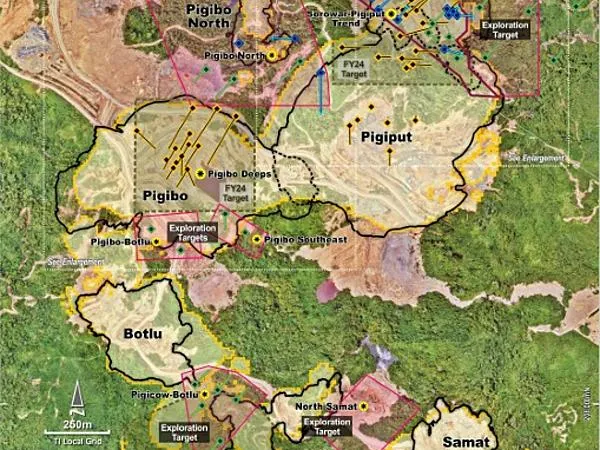
One of the most promising results came from the Samat deposit, where gold was found just below the current open-pit reserve. While the area had been only lightly drilled in the past, new holes revealed high-grade gold in sulphide rock—a denser material that requires different processing but can contain significant value.

Over the past year, St Barbara drilled more than 10,000 metres across 61 holes, targeting both known gold zones and unexplored areas. The latest campaign also included the first-ever diamond drilling at Samat, with results showing strong potential for expanding future mining below the existing pits.

Another key site, the Sorowar–Pigiput Trend, also delivered solid gold intercepts, including high-grade samples that reaffirm the area’s long-term value.

“The identification of additional sulphide mineralisation extending or located immediately below the current sulphide open pit Ore Reserve at Samat and Sorowar – Pigiput Trend is very positive news,” St Barbara Managing Director and CEO Andrew Strelein said in a statement.

Strelein said the company is looking forward to the results of the remaining 10 Samat drill holes to better understand the potential to define additional high-grade sulphide resources where historic diamond drilling is relatively sparse.

Most of the remaining assay results are expected during the September quarter.

“During the September quarter we anticipate the return of assay results for most of the remaining 20 resource definition, exploration and sterilisation holes drilled to date at Samat, Pigicow-Botlu, Pigibo North, PigiboBotlu and Pigiput Northeast Trend.”

St Barbara’s Simberi mine is located in New Ireland Province and forms part of the company’s broader presence in the Pacific, where it continues to explore and develop resources responsibly in partnership with local communities.

In a related development, St Barbara is edging closer to securing the future of its operations in Simberi, as its application for the early renewal of Mining Lease 136 (ML 136) moves into its final stages of review.

The company confirmed that the Mining Advisory Committee (MAC) convened a special meeting on Sunday, 6 July 2025, to assess the early renewal application, after an earlier meeting was rescheduled from late June. Following that session, the MAC sent a formal letter requesting clarifications on several items. St Barbara responded to the queries on 15 July—one day after receiving the letter.

The recommendation from the MAC is the final procedural step before a decision is made by Papua New Guinea’s Minister for Mining Rainbo Paita. However, the company noted that the Minister is travelling overseas until the end of July, with formal approval expected at the earliest in August 2025.

If approved, the renewed lease would extend the company’s tenure at Simberi through to 2038, aligning with the mine’s projected life under the Simberi Expansion Project, which is based on Proven and Probable Ore Reserves.

“The renewal of the Simberi Mining Lease is a key step towards unlocking the Sulphide Ore Reserves at Simberi and expanding gold production to over 200,000 ounces per annum,” In a Strelein said.

St Barbara has operated the Simberi mine since 2008. The lease renewal, once approved, is expected to pave the way for deeper sulphide mining and future investment in processing infrastructure to support increased output.

July 23, 2025

The Papua New Guinea Extractive Industries Transparency Initiative (PNGEITI) Secretariat has commenced its first leg of the Subnational Roadshow and Awareness Program in Goroka, Eastern Highlands Province. This important initiative forms part of PNGEITI’s ongoing commitment to strengthen transparency, accountability, and good governance in Papua New Guinea’s extractive sector, especially at the provincial and local level governments.

The roadshow is focused on conducting EITI awareness programs and capacity building training for subnational stakeholders.

These stakeholders include representatives from provincial and district administrations, local-level governments, civil society organizations (CSOs), landowner associations, youth and women’s groups, and other key beneficiaries of extractive activities in targeted provinces.

The objectives of the program are to:

  1. Raise awareness of the principles, processes, and benefits of EITI implementation in PNG;
  2. Enhance stakeholders’ understanding of extractive revenue flows and reporting mechanisms;
  3. Strengthen capacity at the subnational level to monitor extractive operations and support reform efforts; and
  4. Identify local focal points to coordinate ongoing EITI efforts in the provinces.

The first week of the roadshow began with a courtesy visit to the Eastern Highlands Provincial Administration at Yanepa Haus on July 14, followed by a two-day awareness and engagement workshop on July 15–16 with government authorities and Civil Society Organizations (CSOs) in Goroka. The PNGEITI Secretariat collaborated with the PNG Resource Governance Coalition, a strategic partner in EITI implementation, to deliver sessions tailored for civil society representatives.

On July 17, the team travelled to Kainantu to conduct further engagements with the District administrators, LLG administrators, landowner association leaders and CSOs, culminating in a mine site visit to K92 mine to enhance PNGEITI’s understanding of operational practices and local stakeholder concerns.

The second phase of the roadshow took place in Madang Province, where a workshop was held on Monday, July 21, bringing together stakeholders from the Provincial Administration, District administrators LLG administrators, landowner associations leaders and companies, CSOs, women and youth groups. A follow-up information-sharing session and site visit to the Kurumbukari project is scheduled for Tuesday, July 22, aimed at promoting dialogue and company participation in EITI transparency objectives.

The third leg of the roadshow will head to Morobe Province, starting with a high-level engagement with the Morobe Provincial Government on Thursday, July 24 to establish institutional contacts and secure support for EITI subnational coordination. This will be followed by a workshop in Bulolo on Friday, July 25, focusing on building inclusive stakeholder dialogue, especially in resource-hosting districts.

The roadshow concludes in Lae with a two-day workshop:

  • Monday, July 28: Awareness session with government stakeholders including the Morobe Provincial Administration, District administrators, LLG administrators, and leaders of landowner companies and associations;
  • Tuesday, July 29: A collaborative session with PNG Resource Governance Coalition targeting CSOs and other interest groups, highlighting national EITI progress, promoting inclusive dialogue, and identifying local focal persons.

This Subnational Awareness and Capacity Building Program is not only a major outreach milestone for PNGEITI, but also a crucial step in fulfilling the EITI Standard’s subnational reporting requirement. Through this program, PNGEITI reaffirms its dedication to strengthening subnational involvement in the extractive governance process and ensuring that benefits from the country’s natural resources are managed transparently and shared equitably across all levels of society.

July 23, 2025

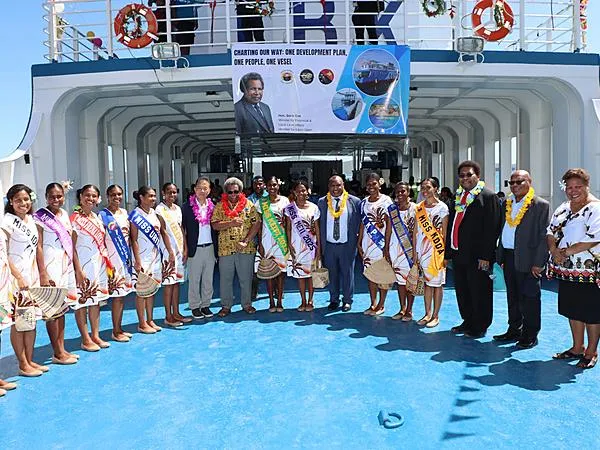
Port Moresby, Papua New Guinea — Prime Minister James Marape on Tuesday officially commissioned the MV IBK, a new landing craft barge representing the people of Ihu, Baimuru and Kikori, and launched the Kikori District Five-Year Development Plan at a ceremony held at Fairfax Wharf.

Under the theme “Charting our way: one development plan, one people, one vessel,” the event marked a significant milestone in Gulf Province’s development journey. The MV IBK is expected to enhance connectivity and economic participation for coastal communities by linking them to markets, services and opportunities across the Southern Region and Papua New Guinea.

“This vessel is more than transport — it is an economic engine and a symbol of unity,” Marape said during his address. “It will sail far and touch every life along the waters of Kikori and beyond.”

The prime minister emphasised that the vessel will support local enterprise, including the transport of sago, crab, fish and other produce to urban markets. He highlighted the exemplary success of Kikori entrepreneur Ella Dodobai, who has built a thriving business selling coastal products in the Highlands and Port Moresby.

The launch of the Kikori District Five-Year Development Plan outlines strategic infrastructure priorities, including jetties in Turama and Kikori, road upgrades and improved airstrips. Marape reaffirmed the importance of District Development Authorities (DDAs) in tailoring solutions to local needs.

“Development must be fit for purpose,” he said. “Where roads are needed, we build roads. Where boats are needed, we commission vessels. This is how we ensure no district is left behind.”

The prime minister also addressed national economic progress, noting that over the past six years, districts have received between K70 million and K80 million (approx. US$18.9 million to US$21.6 million) from Waigani, the national government. He reiterated the government’s commitment to the Kina-for-Kina policy, which rewards districts that actively implement their development plans.

Gulf Fisheries Services was acknowledged as a key private sector partner in operating MV IBK across the South-West Papuan region. Marape also assured the public that work on the Kerema–Kikori road, supported by Chinese funding, would resume soon.

Looking ahead, the prime minister shared his vision for integrated infrastructure connecting Kikori to the Highlands and South Fly, enabling broader participation in the formal economy and unlocking future LNG projects.

“At 50 years of Independence, we must speak well of our country, work hard and hold leaders accountable,” Marape concluded. “MV IBK and Kikori’s development plan are steps toward a more inclusive and prosperous Papua New Guinea.”

July 23, 2025

BUKA — The Autonomous Bougainville Government, through the Department of Treasury and Finance, is modernising its public finance systems with a new contract signed with FreeBalance Inc. to implement a financial management platform aimed at improving transparency, accountability and service delivery.

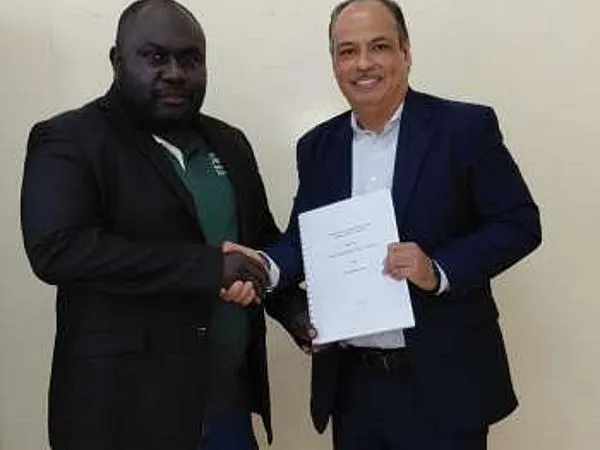
The contract was formally signed last week by Kearnneth Nanei, chief secretary of the Bougainville Public Service and Chairman of the Bougainville Supply and Tenders Board, and Ferdinand Gamboa, global sales director for Asia and Pacific at FreeBalance Inc.

The signing was witnessed by Joshua Tauko, secretary for Treasury and Finance, Fiona Levi, acting secretary for Technical Services, and Aldo Sagastume, vice president for Public Finance Management at FreeBalance.

The procurement of the FreeBalance Accountability Suite was endorsed by the Bougainville Executive Council in March 2025 and later granted a Certificate of Compliance by the National Department of Information and Communication Technology in June, confirming that the system meets national digital government standards.

The total value of the contract is USD4.19 million, spread across a three-year period, and includes:

  • System installation and implementation
  • Capacity building through the FreeBalance Academy
  • One year of Hypercare support
  • Participation in the FreeBalance Lead, Assist and Guide (FLAG) Programme

The project will officially begin in August 2025 and is a key part of the ABG’s financial reform agenda to decentralise services and improve financial controls at all levels of government.

“This marks the beginning of a transformational journey in Bougainville’s financial management architecture,” said Chief Secretary Nanei. “It is not a destination but a gateway to more transparent, efficient and accountable government.”

FreeBalance reaffirmed its commitment to supporting Bougainville’s digital transformation. Implementation will be conducted through both onsite and remote support to ensure uninterrupted progress regardless of travel or operational constraints.

The Department of Treasury and Finance will lead the project in partnership with FreeBalance, the National Department of Finance and other relevant stakeholders. The initiative is designed to strengthen institutional governance and advance Bougainville’s readiness for independence by building robust and self-reliant financial systems.

July 23, 2025

BUKA — The Bougainville Executive Council (BEC) has officially endorsed a 20-year Bougainville Transport Master Plan, setting a clear path for the region’s future infrastructure development and reaffirming its long-term commitment to reliable, inclusive and climate-resilient growth.

As part of the endorsement, the BEC also approved the renaming of the Department of Technical Services to the Department of Infrastructure and Utilities (DIU) — a strategic move aimed at strengthening the Department’s mandate.

ABG Chief Secretary Kearnneth Nanei said the new name signals “a strategic realignment to better position the Department to lead the implementation of the Transport Master Plan towards nation-building.”

Speaking about the Plan’s vision, Mr Nanei said, “This Master Plan brings together our goals and aspirations for transport in Bougainville and sets a clear direction for meeting both current and future needs.”

The Transport Master Plan outlines a two-decade strategy to rehabilitate, improve and expand Bougainville’s transport network. It builds on existing and committed projects while addressing critical issues such as funding constraints, aging infrastructure and weak inter-agency coordination. The region’s vulnerability to natural hazards — including volcanic eruptions, earthquakes and floods — is also a key consideration.

“This integrated approach ensures that both existing projects and new developments work together to build a transport system that is reliable, efficient and sustainable for our people,” Mr Nanei said.

Acting Secretary for the Department of Infrastructure and Utilities, Fiona Levi, said the Plan would be implemented in four stages over 20 years with a strong emphasis on improving access, enabling economic growth and building disaster resilience.

“The Plan will be implemented in four stages over 20 years with a strong focus on improving access and connectivity, enabling economic growth and strengthening climate resilience and disaster preparedness,” Ms Levi said.

She added, “A robust prioritisation process — using multi-criteria analysis — has been built into the Plan to ensure maximum impact from investments in terms of connectivity, resilience and economic return.”

Describing the Plan as a foundational development tool, Ms Levi said, “The Bougainville Transport Master Plan is a critical enabler of our development ambitions, providing a framework for working strategically with the National Government and development partners.”

The Plan aligns with Bougainville Vision 2052, the region’s long-term development strategy. Following the launch of the Vision, all government sectors were tasked with formulating long-term plans to help realise its goals.

Mr Nanei acknowledged the shared effort behind the Plan’s formulation. “I want to sincerely thank all stakeholders — the Department of Infrastructure and Utilities, other government agencies and our development partners who contributed to the development of this critical master plan. Your collaboration has made this possible,” he said.

The endorsement of the Bougainville Transport Master Plan, he added, “reflects the Executive Government’s commitment to responsible long-term infrastructure investment and economic development for the people of Bougainville.”

July 21, 2025

Port Moresby — Prime Minister James Marape has announced the appointment of Gerea Aopi as the new hairman of the board of Kumul Petroleum Holdings Limited (KPHL) as the government moves swiftly to address serious governance concerns raised in a recent Australian media report.

Aopi’s appointment was made prior to the emergence of these allegations but Prime Minister Marape stated that the timing now presents an important opportunity for the new chairman to lead a full and independent review of the issues raised.

“Gerea Aopi is a man of experience, integrity and professionalism in the oil and gas sector,” said the Prime Minister. “He has been appointed to lead the Kumul Petroleum Board at a time when our national oil and gas company needs credible, steady leadership to uphold its integrity and reputation.”

The Prime Minister confirmed that he has written to the media outlet in question requesting all materials and investigative findings relating to the allegations. He has also reached out to the Managing Director of Kumul Petroleum, Wapu Sonk, requesting a formal response and clarification on the matters raised.

“As trustee shareholder I have a responsibility to protect the interests of our country and our people,” said Marape. “The letter to the managing director will seek clarity on his position in light of the issues reported.”

At the same time, Marape urged the public to exercise restraint in passing judgement.

“These matters were raised by the Australian press and are now under international scrutiny. But let me be clear — Mr Wapu Sonk, like any citizen, is innocent until proven otherwise. In the past Papua New Guinean leaders have been wrongly scrutinised in the media only to be vindicated later. One such example is the successful legal challenge brought by Minister William Duma.”

“This is not a witch-hunt. It is about governance, transparency and protecting the reputation of Kumul Petroleum which is a key institution of our economy and has international relationships to maintain.”

The prime minister stressed that all State-Owned Enterprises (SOEs), their chief executive officers and department heads must operate to the highest standard of ethical conduct.

“If you are entrusted with leading a state institution — whether as a departmental head, CEO or managing director — your personal and professional conduct must be beyond reproach. There is no room for impropriety. Our SOEs must be models of transparency and good governance.”

He emphasised that in the modern world, particularly in countries like Australia and Papua New Guinea, all financial transactions leave digital footprints and are subject to scrutiny.

“In today’s global economy, no transaction goes unseen. Every financial movement can be traced. If these allegations have any merit, they will be proven. If not, then they will be dismissed. But either way we must allow proper processes to take place.”

Prime Minister Marape also called on Papua New Guineans — including those active on social media — to refrain from making personal attacks or engaging in premature speculation.

“I appeal to all citizens, especially those on social media, to refrain from rushing to judgement or publishing personal opinions without facts. Kumul Petroleum’s reputation is at stake and so is the national interest. We must protect that reputation while the investigation proceeds.”

He acknowledged that the matter is a setback especially as the Government has been actively lobbying for greater international investment in PNG’s energy sector.

“This unfortunate episode comes at a time when we are engaging with global partners to expand PNG’s oil and gas capacity — including projects like Papua LNG, P’nyang and Pasca A. It is vital we restore trust and credibility as soon as possible so that our development ambitions are not undermined.”

Marape concluded by reiterating the Government’s commitment to acting firmly, fairly and transparently.

“This matter must be resolved quickly, clearly and professionally. I expect a preliminary report on my desk when I return to Port Moresby on Wednesday. The people of Papua New Guinea deserve accountability and the Government will ensure that this issue is handled with integrity and in the national interest.”

July 21, 2025

Ok Tedi Mining Limited (OTML) has signed three road construction contracts worth over K390 million (approx. USD 105 million) to improve infrastructure connectivity in Western Province and ensure communities have access to basic goods and services.

The three projects include:

  • the construction of the Kiunga–Nomad Road, valued at K294,702,331 (approx. USD 79.6 million),
  • the construction of the Balimo–Kawiyapo/Wasua Road in Delta Fly District, valued at K55,187,770 (approx. USD 14.9 million), and
  • the upgrading and sealing of the Balimo Town Road, valued at K44,919,600 (approx. USD 12.1 million).

The 150 km Kiunga–Nomad Road will serve as a critical link, connecting communities in the Middle Fly District to services in Kiunga, North Fly District. The new infrastructure is expected to transform local livelihoods by providing improved access to more affordable goods and services that promote social and economic growth. Similar benefits are expected from the other two road projects.

OTML Managing Director and Chief Executive Officer Kedi Ilimbit said the road links and upgrades are vital for enabling people to travel into town, experience urban life, and, most importantly, access basic goods and services already available to others in the province.

Ilimbit thanked the Western Provincial Government and Administration for attending the signing ceremony and for their continued support of OTML’s ITCS projects, particularly in ensuring due process before contracts are awarded and implemented.

He also challenged leaders in attendance to contribute counterpart funding for sustainable impact projects that will positively affect the lives of their people. He highlighted the Impact Project Agreement (IPA) currently being proposed by Ok Tedi as part of the ongoing Community and Mine Continuation Agreement (CMCA) review.

“I believe the IPA will become a good vehicle for us to deliver sustainable impact projects for our people,” he said.

Leaders present at the signing included Governor Taboi Awi Yoto, North Fly MP James Donald, Middle Fly MP Maso Hewabi, Delta Fly MP Agena Gamai, Provincial Administrator Robert Kayun, and Minister for Works and Transport, Hon. Solan Mirisim.

They said the three road projects have been long-awaited dreams of their constituents, and this announcement marks the beginning of those dreams becoming a reality.

The leaders thanked OTML and the National Government for their cooperation in getting the projects approved for delivery.

China Railway Construction Engineering Group Co. has been awarded the contracts and is expected to begin mobilisation in September.

OTML, a 100% Papua New Guinean-owned mine, remains committed to responsible mining and the delivery of sustainable economic development to its impacted communities and the nation.

July 21, 2025

The PNGX Group Limited, operator of Papua New Guinea’s national stock exchange, has welcomed the strong support of Minister for State Enterprises William Duma for expanding public participation in the local capital markets through the recent sale of BSP Financial Group Limited (BSP) shares.

Minister Duma confirmed that only Papua New Guinean citizens and institutions had purchased the BSP shares previously held by Motor Vehicle Insurance Limited (MVIL) — a move he described as "properly timed and grounded in economic prudence."

“Ownership of these shares in BSP remains within our country, giving the opportunity for everyday Papua New Guineans to own part of BSP,” he said.

In a public statement on 16 July, PNGX said it commends the Minister’s support for investment through PNGX, which is “essential for building a vibrant and inclusive financial ecosystem.”

The group also noted that the approach promotes transparency, strengthens corporate governance, and empowers locals to participate in nation-building through shared economic growth.

The proceeds from the sale, according to Minister Duma, will be reinvested into improving key State-Owned Enterprises (SOEs), especially PNG Power Ltd and Water PNG Ltd, with a focus on enhancing infrastructure and services in Port Moresby and Lae.

“The sale has provided much-needed funding to enhance State-Owned Enterprises as part of reforms to modernise technology and service delivery without having to rely upon allocations from the National Budget and expensive borrowings from banks,” Minister Duma explained.

A prudent sale for national development

The share sale, conducted through JMP Securities Limited, one of the country’s licensed stockbrokers, attracted over 50 Papua New Guinean investors, including individuals, companies and superannuation funds. Duma dismissed speculation about foreign involvement, particularly claims made on social media, saying: “Our people should not be influenced by misleading and baseless allegations.”

Duma also confirmed that Kumul Consolidated Holdings (KCH), the state’s asset manager, will retain a stake of over 18 percent in BSP “to maintain its voice in strategic matters where necessary, while stepping back from material ownership.”

“This divestment is about responsible economic management. It is about transforming state assets into development capital and creating room for the private sector to lead in areas where it has comparative advantage,” he said.

Strategic goals driving the divestment

Minister Duma outlined four key objectives behind the sale:

  1. Fiscal Consolidation – To reduce pressure on the national budget by financing upgrades to critical services such as electricity and water through the proceeds of the sale rather than loans.
  2. Portfolio Rebalancing – KCH is reducing overexposure to single commercial investments, ensuring better risk management of public funds.
  3. Market Development – The divestment promotes broader ownership of BSP shares among citizens and institutions and supports the long-term development of PNG’s capital market through PNGX. KCH recently signed a partnership with PNGX to help SOEs meet Corporate Governance Code requirements in preparation for future partial privatisations.
  4. Refocusing on Core Functions – The state will concentrate on providing essential services rather than acting as a commercial investor. “Divesting from non-core assets enables us to refocus resources on service delivery and nation-building in priority areas,” the minister said.

He added that reallocating capital from investments like BSP into infrastructure helps “push the production possibility frontier and make gains for the state in terms of Total Factor Productivity (TFP) growth.”

PNGX reaffirms support

For its part, PNGX reaffirmed its commitment to facilitating responsible investment and building a resilient market for PNG’s future.

“We welcome the acknowledgement that the private sector is well positioned to drive innovation, efficiency and ensure long-term value creation. A strong private sector, enabled by a functioning capital market on PNGX, is key to unlocking economic growth and long-term national prosperity,” it said.

With the government’s clear policy direction and the capital markets maturing, experts believe that the stage is set for more citizens and institutions to become active participants in PNG’s economic transformation.

July 21, 2025

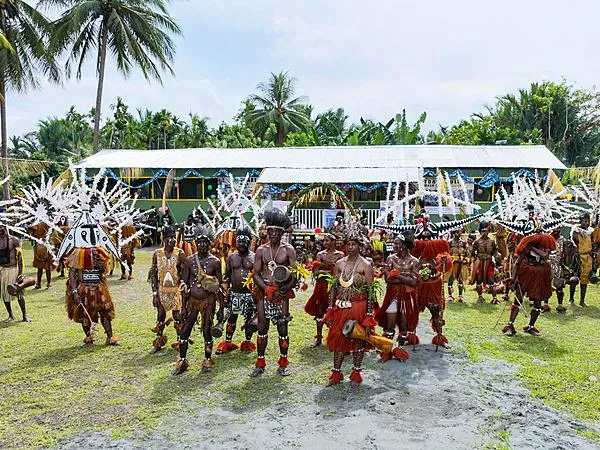
TOARE, Gulf Province — The Toare Mask Festival has been successfully revived through a collaboration between TotalEnergies, the National Cultural Commission (NCC), and the Gulf Provincial Government. The two-day cultural event, held on 12-13 July, marked the 20th anniversary of the festival and the official opening of the Toare Cultural Centre.

First established in 2005, the festival was celebrated annually until 2014. It was revived in 2022 and continues to grow in prominence as a signature cultural event for the Gulf Province.

This year’s celebrations began on 12 July 2025 with an official launch attended by Gulf Provincial Administrator Clement Tare, TotalEnergies Managing Director Arnaud Berthet, and European Union Ambassador to Papua New Guinea Jacques Fradin, along with other distinguished guests.

The following day saw the formal opening of the newly constructed Toare Cultural Centre, attended by Thomas Opa, member for Kerema Open and Minister for Finance; Alex Puki, research manager at the NCC (representing Executive Director Steven Enomb Kilanda); and Doris Apuka, representing UNESCO.

In his remarks, Minister Opa urged the local community to take ownership of the festival, stressing that it is not merely a cultural event but a vital expression of identity.

“We want the Toare Mask Festival to attract tourists from outside Papua New Guinea,” Minister Opa said. “The challenge over the past four to five years has been introducing international visitors to our unique culture through this traditional mask celebration.”

He also encouraged communities to preserve traditional knowledge and artefacts through the new facility.

“All the masks from the villages practising the mask culture must be stored at the cultural centre. We must understand the origins and purpose of each mask — this is an important event for us and must be promoted,” he added.

This year’s festival marked two decades since its inception and a major milestone in cultural preservation. The Toare Mask tradition is now undergoing nomination for inclusion on the UNESCO Intangible Cultural Heritage (ICH) List.

Following concerns about authenticity and the preservation of traditional masks, the NCC deployed two research officers to document the types of masks, their cultural significance, and the traditions associated with them. This research formed the basis for the formal nomination to UNESCO.

The Toare Mask tradition is the first from Papua New Guinea — and the wider Pacific region — to be nominated for inclusion on the UNESCO ICH List, a significant recognition of the country’s rich intangible heritage.

To support the nomination, the Toare Cultural Centre was established. Initial funding of USD 10,000 (PGK 41,169.20) was provided by UNESCO, followed by PGK 20,000 from the NCC as the state party. The Gulf Provincial Government later contributed an additional PGK 80,000 to expand the facility.

Speaking at the event, Alex Puki of the NCC said: “The National Cultural Commission has never partnered with an international organisation like UNESCO to build a cultural centre in a province. This is the first time such an initiative has been undertaken.”

“This achievement reflects our commitment to preserving and promoting Papua New Guinea’s cultural heritage at the community level,” Puki said. “Through this collaboration with UNESCO and the Gulf Provincial Government, we are not only safeguarding the Toare Mask tradition but also creating a permanent space for cultural learning.”

The Toare Cultural Centre is expected to play a vital role in cultural education, particularly for younger generations. Traditionally, masks were stored in family homes, where they were vulnerable to damage or loss. The new centre offers a secure and respectful space for their preservation

July 21, 2025

PORT MORESBY — The Papua New Guinea Resources Golden Exhibition has entered its third week at APEC Haus, with more than 30 exhibitors from the country’s mining, petroleum and energy sectors showcasing their contributions to PNG’s development.

Among the exhibiting companies are Ok Tedi Mining Limited, K92 Mining Limited, Hidden Valley Mine, Simberi (St Barbara Limited), New Porgera Limited, PNG LNG and its project stakeholders, as well as Santos—all representing the strength and scale of PNG’s extractive industries. Over the past two weeks, thousands of school students and members of the public have visited the booths to engage with and learn about the nation’s key economic drivers.

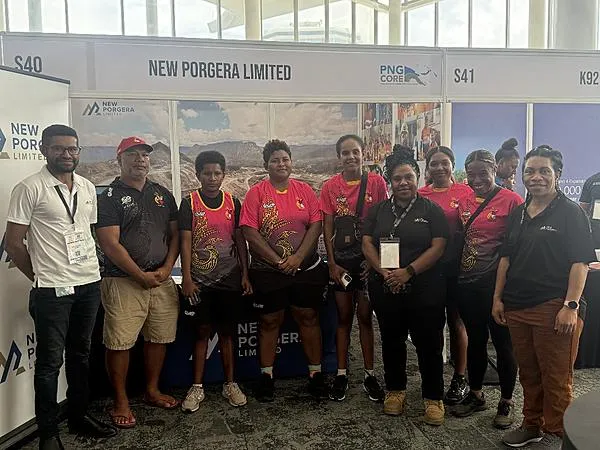
On Saturday, 19 July, the exhibition welcomed visitors from Cricket PNG, including national cricket teams the Barramundis and the Lewas, making them the first sporting organisation and national teams to take part in the 2025 PNG Resources Golden Exhibition.

The teams’ participation reflects the strong connection between the resources sector and sports in PNG, where many companies are also key sponsors of national sporting programmes. Cricket PNG’s involvement aligns with its broader commitment to community development and player education beyond the cricket pitch.

 “On behalf of the PNG Chamber of Resources and Energy and the PNG Resources Golden Expo team, we sincerely thank Cricket PNG for bringing our two champion teams — the Barramundis and the Lewas — to visit the Expo,” said Ruth Waram, curator of the exhibition.

“They are the first sporting teams to attend, apart from the general public and schools. We are really privileged to have them,” Waram said. “We hope the teams have learned something new today, being exposed to the mining and petroleum industry through their visits to the exhibition booths and talking to participants.”

Cricket PNG described the visit as an eye-opening and enriching experience for players, offering a rare opportunity to connect with the industries that shape the national economy, while also encouraging players to explore career pathways beyond sport.

Michael Harrison, chairman of the Cricket PNG Board, expressed gratitude to the PNG CORE and Ms Waram for the invitation. “It was a privilege to witness how deeply the mining, petroleum, and LNG industries have shaped PNG’s development. It was also a proud moment for us to be the first sports team to participate — a true milestone for cricket and sports in PNG.”

The Cricket PNG delegation included players, coaches, and team managers who toured various booths to learn more about sector operations, technological advancements, and the industry’s long-standing support for youth and sport development.

The visit also underscored Cricket PNG’s holistic approach to player development — which not only prioritises elite performance but also encourages personal and professional growth. Exposure to the exhibition helped players broaden their awareness and skill sets beyond the boundary.

“The experience allowed our teams to connect with influential industry stakeholders, potential sponsors, and broadened their understanding of national development,” Mr Harrison added. “It was a truly memorable and meaningful day for the Barramundis and the Lewas.”

The PNG Resources Golden Exhibition runs from 7 to 25 July and will transition into the 2025 PNG Resources Week from 28 to 31 July. Cricket PNG’s participation has set a new precedent for sporting organisations, reinforcing the important relationship between sport, the resources sector, and national progress.

July 18, 2025

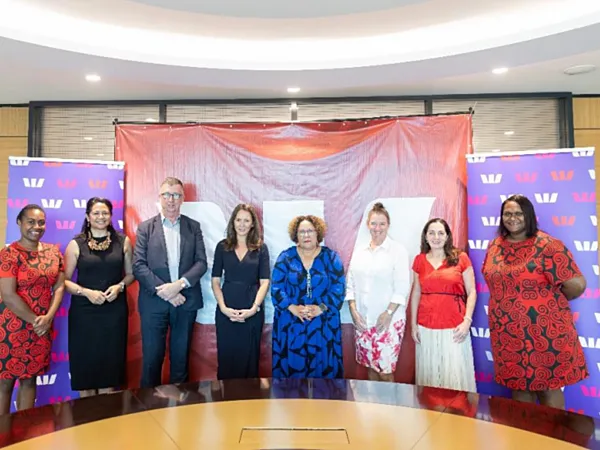
PORT MORESBY — Westpac PNG is pleased to announce the appointment of Tamzin Wardley as chairwoman of the Board, alongside the appointment of Presley Semi and Michelle Hau’ofa as non-executive directors, effective immediately.

These appointments come at a strategic moment for the bank, as Westpac PNG recently welcomed its new chief executive, Andrew Cairns. The strengthened board, comprising both continuing and new directors, will work closely with the executive leadership team to drive sustainable growth, deepen community impact, and ensure sound governance in alignment with the national development agenda.

Andrew Cairns, chief executive of Westpac PNG, said :“I am delighted to welcome Tamzin as Chairwoman and Michelle and Presley to the Board. Their combined experience and leadership will be instrumental in driving the bank’s strategic priorities. Together with the Board, we are committed to building a bank that is fit for the future – agile, inclusive and aligned with evolving needs of our customers, communities and the broader financial landscape.”

Newly appointed Chairwoman Tamzin Wardley shared: “We are committed to strengthening the Board’s ability to guide and support the executive team as we work towards our purpose to provide best practice financial services to our customers nationwide.”

“For over 115 years, Westpac has played a significant role in communities across PNG, and we are proud to continue that legacy as we work together to shape a strong inclusive future,” she added.

Tamzin brings more than 25 years of experience across the commercial, development and sports sectors. A member of the Order of the British Empire and former PNG Institute of Directors’ Female Director of the Year, she has served on the Westpac PNG Board since 2018. Her appointment reflects Westpac PNG’s commitment to values-driven governance and long-term nation-building.

Michelle Hau’ofa, returning to the board after a prior term (2018–2022), commented: “We bring strong compliance knowledge and governance acumen that will serve us well. Westpac PNG is well positioned to make a difference by supporting every banking need and helping communities grow.”

Michelle brings more than 20 years of experience in the private sector and 15 years of leadership across public health, education, and governance-focused NGOs.

Presley Semi, newly appointed non-executive director, said: “I look forward to supporting Westpac’s long-term investment strategy, built on sound governance and accountability. Our role is to challenge and support the bank to remain resilient and relevant in a rapidly changing market.”

Presley is the current CEO of Nimamar Capital Limited and has led several successful technology-led business transformation programmes within PNG’s financial services sector.

Emma Low, managing director of Westpac Pacific and continuing director on the Westpac PNG Board, stated: “As a Board, we value the role that banking plays in building the future prosperity of Papua New Guinea. Our shared goal is to ensure Westpac PNG remains a trusted, inclusive and forward-looking banking partner.”

Emma oversees Westpac’s operations across Fiji and PNG, bringing over two decades of international experience in financial markets and institutional banking.

George Koi, continuing non-executive Director, said: “These appointments strengthen a strategically aligned Board that brings deep governance expertise and national insight to support Westpac PNG’s long-term growth agenda.”

George is a highly regarded commercial lawyer and currently serves as chair of the Westpac PNG Board Audit and Risk Committee.

This announcement marks the beginning of a new chapter for Westpac PNG, with a refreshed leadership structure focused on accelerating strategic transformation, fostering inclusion and delivering long-term value in an evolving PNG economy.

“We are here to work with the executive team to deliver a bank that is resilient, responsible and responsive to the needs of Papua New Guineans today and for generations to come,” said Tamzin.

July 18, 2025

Port Moresby, 17 July 2025 - Westpac PNG is proud to announce the 21 finalists for the 2025 Westpac Outstanding Women Awards (WOW), a prestigious initiative that celebrates the remarkable achievements of women driving progress and transformation across Papua New Guinea.

Initiated in 2002 and relaunched this year, the WOW Awards continue to honour women who are not only leaders but also trailblazers setting new standards of excellence, innovation and impact. This year’s finalists were selected from more than 150 applications nationwide, representing distinction across seven categories: Entrepreneurship, Sustainability, Sports and Arts, Public Sector, Private Sector, Young Achiever and Not-for-Profit.

The finalists by category include:
Entrepreneurship: Annette Sete, Violet Bukon, Agnes Mial Tia
Sustainability: Theonila Roka Matbob, Anne Shirley Korave, Jennifer Baing
Sports and Arts: Rutha-Meu Omenefa, Martha Aaron, Cecilia Kanawi
Public Sector: Dr Janet Rangou, Dr Pamela Toliman, Jenny Kone
Private Sector: Anita Mosby, Raka Numa Raula, Samania Ned
Young Achiever: Julie Rereve, Chelsea Paspalau, Rebecca Ruga Gima
Not-for-Profit: Ruth Injo, Delsie Casper Nick, Dr Rebecca Williams

Each finalist has demonstrated exceptional contributions in her field and their stories reflect the resilience, ingenuity and leadership that define the spirit of PNG’s women.

Tamzin Wardley, chairwoman of the Westpac PNG Board, said, “These awards are more than a celebration — they are a platform for progress. The stories of our finalists are powerful examples of what happens when women lead with purpose and courage.”

The winners of each category will receive a PGK 5,000 grant and a year-long mentorship with Westpac designed to support their personal and professional development.

Emma Low, managing director for Westpac Pacific, said, “The WOW Awards are more than a moment of recognition — they are a celebration of the outstanding contributions of women, a catalyst for opportunity and an inspiration for the next generation of female leaders in PNG. I was truly impressed by both the high volume and exceptional quality of this year’s nominations and I’m proud that our 21 finalists represent a broad geographic spread from across the country.”

Andrew Cairns, Westpac PNG chief executive, said, “The work of these women is shaping industries, uplifting communities and inspiring future generations. The WOW Awards are our way of recognising and investing in their continued success.”

The awards ceremony will be held on Saturday, 26 July 2025, in Port Moresby, where winners from each category will be announced, along with the Overall 2025 WOW Award Winner — a woman whose leadership and impact stand out across all categories.

Join us in celebrating these extraordinary women and their contributions to Papua New Guinea’s growth and future.

The WOW Awards are a cornerstone of Westpac PNG’s commitment to gender equity and inclusive growth. Through this platform, Westpac continues to champion the role of women in building a stronger, more resilient Papua New Guinea.

July 18, 2025

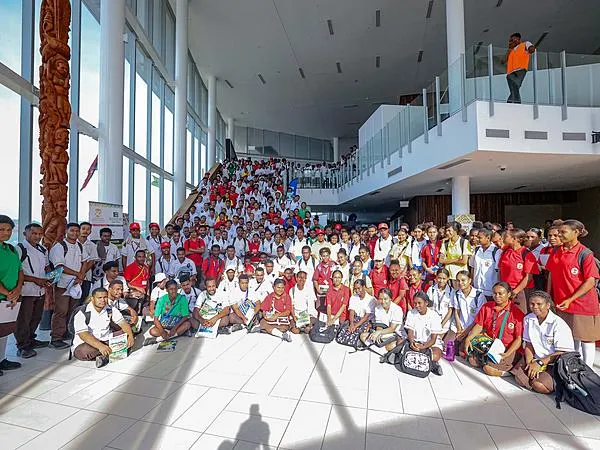
Close to 500 students from Badihagwa Technical Secondary School visited the PNG Resources Week Golden Expo on Wednesday at APEC Haus in Port Moresby, marking the largest single-school attendance since the event began on 7 July 2025.

Badihagwa Technical Secondary School led the attendance figures, sending a large group of Year 11 and Year 12 students to the Expo that afternoon. Gerehu Secondary and Paradise College also visited the Expo on the same day.

More than 1,000 students have now attended the Expo since it opened. Students described the experience as an “eye-opener”, saying it helped them understand and learn about the various mining, oil and gas companies, as well as government entities and their roles, operations, and contributions to nation-building over the past 50 years.

PNG Resources Golden Exhibition project manager Ruth Waram said: “It’s been such a great pleasure having the students come through. The turnout from the 12 schools so far is encouraging, as it reflects the growing enthusiasm among young minds to explore opportunities in this important sector.”

“Providing students with such an engaging and educational experience inspires them to connect not just with resource industries but also with other sectors and government agencies as they envision their future roles in shaping the nation,” she added.

The PNG Resources Golden Exhibition continues to serve as a platform for education and awareness, fostering a deeper understanding of the country’s resource wealth and its potential to drive economic growth.

The exhibition runs until 25 July and is open daily from 9 a.m. Admission is free.

The Expo also commemorates the remarkable journey and enduring contributions of companies that have fuelled the nation’s growth, empowered communities, and positioned PNG as a leading resource economy in the region over the past 50 years.

July 17, 2025

The European Union Ambassador to Papua New Guinea Jacques Fradin reaffirmed the EU’s long-term commitment to PNG, emphasising innovation, climate action and deepening trade and development partnerships under a transformative “global gateway” approach.

The European Union (EU) has been a long-standing partner of PNG since independence, strengthening ties through trade, development aid, green diplomacy and shared interests. In recent years, this relationship has evolved to a more political and strategic level, marked by high-level political dialogues.

Fradin stressed the EU stands as a “reliable and concrete partner” in PNG’s next chapter of growth as the nation prepares to mark its 50th year of independence on 16 September.

“When it comes to our involvement in the country, we are here for the long haul and will continue delivering concrete programmes and projects,” Fradin said in an exclusive interview with PNG Business News.

“The PNG government has laid out a clear vision for how it will develop in the next 50 years and within this vision, the EU stands ready to support the country’s goals,” he added.

Moving beyond symbolic commitments, the ambassador emphasised a practical and sustained approach to engagement with PNG. “We will not change in terms of what we concretely deliver through projects and programmes, but we will adapt to the way we do business.

“Global gateway is simply about connecting with PNG’s reality and delivering support based on what the country actually needs,” the Ambassador said.

Shaping a New Model of Cooperation

Global gateway is the EU strategy to boost smart, clean and secure connections in the digital, energy and transport sectors, and to strengthen health, education and research systems across the world. It brings together the EU, its member states and their financial and development institutions to mobilise the private sector to leverage investments promoting sustainable growth.

To this end, the EU is providing significant grant contributions to complement bank loans that will be extended to the PNG government.

Two new projects under the global gateway banner are currently in development, expected to be signed in 2025 if agreements can be reached on the loan component. These are:

  • Rabaul Port Rehabilitation Project – to optimise operations, improve flexibility and minimise environmental impacts.
  • PNG Water Plan Project – to expand water supply services in four provincial towns: Namatanai (New Ireland Province), Kupiano (Central Province), Misima (Milne Bay Province), and Kurumul (Jiwaka Province).

These projects reflect the EU’s broader ambition to scale up investment in infrastructure, energy, agriculture and climate initiatives by blending EU grants with loans from the European Investment Bank, Agence Française de Développement (AFD), and potentially the Asian Development Bank. This approach is projected to unlock tens of millions of euros in investments.

“That is how we are going to transform the EU business and development model in PNG over the next 10 years,” Fradin said.

A Trade Partnership Anchored in Access and Growth

A cornerstone of EU-PNG trade is the Interim Economic Partnership Agreement (iEPA), ratified in 2011. The iEPA grants duty-free and quota-free access to the EU market—a single market of 447 million people with a GDP of over USD 20 trillion (PGK 81 trillion)—for all PNG exports.

In 2024, this trade relationship continued to deepen. The total trade between the EU and PNG reached EUR 1.074 billion, marking a 9% increase from 2023. In fact, the trade balance continues to favour PNG. The EU imports from PNG in 2024 comprised:

  • 51% agricultural products, notably vegetable fats (palm oil), coffee and tea
  • 24% fishery products, especially canned tuna and smoked loins, amounting to EUR 230 million
  • 25% industrial products, primarily ores, slag and ash including copper and precious metals

On the other hand, PNG imports mainly machinery and appliances (48%), food, beverages and tobacco (13%), and transport equipment (10%) from the EU. Currently, the EU ranks as PNG’s fourth-largest export destination, with about 60% of PNG’s coffee exports going to Europe.

Expanding Climate Cooperation and Green Energy Prospects

The partnership extends beyond trade. The Ambassador highlighted several areas of cooperation under the Forest, Climate Change and Biodiversity (FCCB) programme.

“We are focusing on climate change and biodiversity in collaboration with the PNG Government and agencies. It’s one of our flagship projects. This will continue for the next three years,” he said.

The EU is also exploring future opportunities, particularly in the green energy space. A renewable energy programme is under development, though it remains in the early stages and has yet to be formally announced.

According to Ambassador Fradin, PNG’s geographic and demographic significance—as the Pacific’s largest country in both land mass and population—gives it strategic importance as a “gateway to Asia and the Pacific.”

Boosting Regional Integration Through Trade Agreements

The EU-Pacific interim Economic Partnership Agreement (iEPA), implemented by PNG and three other Pacific countries (Fiji, Samoa and Solomon Islands), serves as a key framework for regional trade cooperation. Its global sourcing provision allows processed fish to be exported duty-free to the EU, regardless of origin, significantly benefitting PNG’s tuna canning industry.

The iEPA also encourages dialogue on trade barriers, health and safety standards and customs cooperation. The 10th EU-Pacific Trade Committee meeting was held in Brussels in February 2025, with senior officials from PNG and prospective members such as Niue, Tonga and Tuvalu in attendance.

To support this regional vision, the EU has committed EUR 37 million (PGK 165 million) to initiatives including:

  • SPIRIT – Strengthening trade institutions and private sector capacity
  • IMPACT – Customs modernisation and border management
  • SAFE Pacific – Market certification and compliance support

Bilateral support also includes efforts to enhance PNG’s National Trade Office and trade-related infrastructure.

At the community level, the EU-STREIT Programme or the  Support to Rural Entrepreneurship, Investment, and Trade is making an impact in East and West Sepik by strengthening cacao, vanilla and fisheries value chains, and investing in sustainable transport and energy infrastructure.

Tackling Sustainability and Compliance

The EU’s Deforestation-Free Products Regulation, in effect since 29 June 2023, will be fully enforced by 30 December 2025 (for medium/large companies) and 30 June 2026 (for small businesses). Covering palm oil, cocoa and coffee—key PNG exports—it requires traceability and quality, enabling products to fetch better prices in EU markets.

The EU is actively supporting PNG producers through the EU-STREIT and FCCB programmes to help them meet compliance requirements.

Growing Investment and Economic Presence in PNG

European interest in PNG is growing, with investment stock rising from EUR 179 million in 2013 to EUR 1.856 billion in 2023. EU firms are active in sectors including LNG, aviation, telecoms and manufacturing.

Leading investors such as the Netherlands, France and Italy continue to play a key role. The upcoming EU-Pacific Business Forum in Fiji this September is expected to see active participation from PNG.

However, the Ambassador noted concerns about PNG’s possible grey-listing by the Financial Action Task Force (FATF) due to anti-money laundering deficiencies.

While this poses a risk to investor confidence, the EU welcomed Prime Minister Marape’s public commitment to address the issue and reaffirmed its offer of technical support.

Building a Green PNG Brand in Europe

The Ambassador believes that PNG is well-positioned to develop a green trade identity in Europe by focusing on sustainable, high-quality exports such as coffee, cocoa, vanilla and tuna.

“About 60% of PNG’s coffee already goes to Europe and while we’re not your biggest cocoa buyer, we do import and we can do more,” he said.

Stricter EU import standards—such as the Deforestation Regulation—present both a challenge and an opportunity, banning products grown on recently deforested land. The EU is working with PNG’s Chamber of Commerce and relevant trade offices to ensure compliance.

“We are not imposing a standard. If PNG wants to export to the EU, then we simply ask for the value chain to be reliable and the importer will be held responsible for the product they do export. The price we offer is higher, which is a win-win situation.”

Responsible Mining and Critical Raw Materials

The EU is also interested in PNG’s critical raw materials (CRMs), with over EUR 959 million in goods imported from PNG in 2024—95% of which were primary products.

Ambassador Fradin confirmed the EU imported nearly EUR 600 million in raw materials last year and stressed the importance of applying Environment, Social and Governance (ESG) standards in the sector.

“Exploit but not destroy. Process but not damage. Trade, but not bad trading,” he said.

The EU is closely following legislative developments in PNG, encouraging policies that promote responsible mining and local value addition.

Investing in PNG’s Greatest Resource: Its People

Beyond trade and investment, the Ambassador turned his attention to human capital development and the importance of preparing PNG’s youth for the future.

“By 2050, PNG’s population will have doubled. Half the population will be under 25,” he said. “If you want to be efficient in the next 25 years, you need to start after the jubilee—or better yet, yesterday.”

“PNG has a brilliant future. The population knows it, officials know it and all the challenges are known. Now, it’s a common endeavour to make the next 25 years the rising of PNG in the region.”

Fradin said the EU looked forward to PNG’s 50th independence anniversary and remained committed to strengthening their long-term partnership.

July 16, 2025

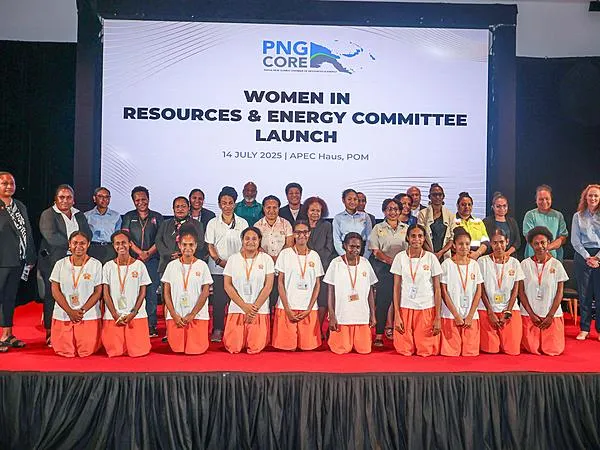
A powerful step towards gender equity in Papua New Guinea’s mining, petroleum and energy sectors was taken today with the official launch of the Women in Resources and Energy (WIRE) Committee, an initiative by the PNG Chamber of Resources & Energy (PNG CORE).

As PNG celebrates 50 years of nationhood and industrial growth, the resources sector continues to evolve. While more women are entering technical and managerial roles, gender representation remains uneven—particularly in operational, trade and underground environments. Many women still face cultural, structural and safety-related challenges that hinder their full participation.

To address these challenges, PNG CORE has established the WIRE Committee to champion diversity, drive systemic change and support women across all levels of the sector.

“Today marks more than just the formation of a new committee. It signals a shared commitment to building a more inclusive, resilient and future-ready resources sector for Papua New Guinea,” said Ms Karo Maha, Chair of the WIRE Committee and Country Manager of New Porgera Limited.

“WIRE is not just about women—it’s about equity across the entire workforce. It’s about recognising the silent achievers—especially the women working in underground mines in other parts of the world, on offshore rigs if we do have them in this country, in remote gas fields, and those in trade and technical roles who are often unseen but essential.”

The Committee will serve as a collaborative platform to celebrate achievements, identify persistent barriers and promote practical, industry-driven solutions that benefit not only women but the broader workforce and communities linked to the resources sector.

WIRE Committee Objectives:
• Promote women’s participation in STEM, trades and leadership roles.
• Identify and address barriers to gender equity in the workplace.
• Recognise and elevate silent achievers, including women in underground, field and frontline roles.
• Foster a safe, respectful and inclusive industry culture.
• Advocate for policy change, including lifting the prohibition on women working underground.

The initiative builds on the efforts of leading resource companies such as ExxonMobil PNG (EMPNG), Ok Tedi Mining Limited (OTML), Newmont, New Porgera, K92 Mining and Santos, who have already introduced meaningful programmes to advance women across mining operations, oil rigs, gas fields, engineering and more.

The launch included a panel discussion with 12 speakers from 11 different companies. The panel called on the National Government to fast-track the enactment of the new Mining (Safety) Act and regulations. These are over 50 years old, and there is general alignment between industry and government on the proposed changes, which should be brought to Parliament as soon as possible.

The launch of the WIRE Committee reinforces PNG CORE’s commitment to building a more inclusive, resilient and future-ready resources industry for Papua New Guinea.

July 16, 2025

"Where would Papua New Guinea be without the resources sector?" That powerful question, posed by Ruth Waram, curator of the PNG Resources Golden Exhibition, set the tone for an evening of reflection, pride and aspiration. Held at APEC Haus in Port Moresby, the formal opening brought together dignitaries, industry leaders, landowners and government officials to celebrate 50 years of independence—and the profound legacy of the resource sector in shaping the nation’s journey.

The Golden Exhibition serves as a collective reflection on how the extractive industries have defined Papua New Guinea’s past and continue to shape its future. Its contributions span far beyond gold, gas and oil—touching lives through education, infrastructure, sports, health and national pride. The sector is not only a cornerstone of economic growth but a wellspring of personal stories that resonate with thousands of Papua New Guineans.

“We all have stories of how this industry has impacted our lives,” Waram said. “This Expo reminds us that behind every pipeline, mine shaft or offshore platform are human stories—of families supported, careers built and futures made possible.”

Representing Deputy Prime Minister John Rosso, Finance Minister Thomas Opa delivered the keynote address, underscoring the central role of resources in the nation's development.

“This Expo commemorates 50 years of independence and celebrates the extraordinary journey of our nation's resource sector,” he said. “The theme, ‘PNG Resources: Building PNG, 1975–2025 and Beyond’, is timely and inspiring. It reminds us that the mining, petroleum and energy sectors have been, and will remain, the pillars of our nation’s economic growth and development.”

Minister Opa reflected on major projects such as Ok Tedi, Porgera, Lihir, Kainantu, Hidden Valley, and the PNG LNG project, all of which have fuelled government revenues and sustained essential public services. Sharing a personal anecdote, he recalled how his uncle’s job with Chevron New Guinea helped pay for his education—a familiar story for many Papua New Guineans.

"Every fortnight, I’m responsible for finding nearly K250 million to pay our public servants. That’s over K7.5 billion annually—and a significant portion of that comes from our extractive industries. Without them, we wouldn’t be able to fund our schools, hospitals or roads,” he stated.

Minister Opa also acknowledged projects such as Panguna, which once contributed nearly 45% of PNG’s export revenue, and the now fully nationally owned Ok Tedi, which continues to deliver direct community benefits. Yet, while the expo celebrates the past, he emphasised the importance of looking ahead.

“Our challenge is to ensure that our resource sector remains strong, competitive and sustainable for the next 50 years and beyond. We must foster innovation, invest in renewable energy and uphold the highest standards of governance and environmental responsibility,” he urged.

He reiterated the government’s commitment to building a stable policy environment that supports responsible investment and deeper collaboration among government, industry and landowners. “The true wealth of PNG is not only in our gold, oil and gas, but in the support and determination of our people,” he added.

Running from 7 to 25 July, the Golden Expo features daily school visits, community engagement sessions and key events including:

·10 July – Supplier Development Forum

·14 July – Launch of the Women in Resource Sector Subcommittee

·16, 22 & 25 July – Inter-school debate (preliminaries, semi-finals and grand final)

·17–18 July – Industry Career Fair

Each activity aims to deepen public understanding of the sector’s role and showcase career pathways for young professionals and students.

“We want people to leave this Expo inspired,” Waram said. “We have so many untold stories of impact—stories that speak to the difference this sector has made in everyday life.”

Although the Golden Expo concludes on 25 July, celebrations will continue during PNG Resource Week from 28 to 31 July, also at APEC Haus. This second phase offers a more focused platform for policy dialogue, investment discussions and planning for the sector’s future.

July 16, 2025

The Autonomous Bougainville Government (ABG) has reaffirmed its commitment to strengthening partnerships with development partners and the National Government, calling for a more coordinated and transparent approach to delivering development programs for Bougainville’s long-term growth.

Speaking during the 2025 Bougainville Development Cooperation Conference in Port Moresby, acting Deputy Secretary Operations and Secretary for Community Government, Mrs. Belinda-Maree Gara-Lanbong, presented the ABG’s new Development Cooperation Framework. The Framework outlines Bougainville’s sectoral priorities and proposes a structured coordination mechanism for development partner support.

Deputy Secretary Lanbong emphasized Bougainville’s Vision 2052 — to become a high-income, healthy, educated, peaceful, and sovereign nation — and stressed the importance of aligning all development efforts with this goal.

“We aim to build a Bougainville that stands on its own feet. For this, we need our development partners to work with us in a coordinated, transparent, and results-driven way, ensuring that every Kina spent makes a meaningful difference for our people,” Mrs. Lanbong said.

Mrs. Lanbong said the ABG is also seeking to explore various delivery modalities for development assistance and welcomes opportunities to collaborate with development partners in this space.

“We are open to working with our partners through different modalities such as co-financing mutually agreed priorities, public-private partnerships, budgetary support to help fill our fiscal gaps, grants, and performance-based financing. These approaches will not only help us deliver priority impact projects but also strengthen our systems and processes in planning, budgeting, and managing development programs,” she stated.

This call from Bougainville was also reinforced by a presentation from the Department of National Planning and Monitoring, which outlined key findings from the review of PNG’s previous Development Cooperation Policy 2018–2022.

The findings confirmed the need to improve cross-agency coordination, build integrated data systems to guide planning and track results, and strengthen stakeholder engagement during policy formulation. They also emphasized the need to review and modernize relevant legislation and promote the consistent use of national coordination mechanisms by all development partners.

These lessons have shaped the formulation of PNG’s new Development Cooperation Framework, which will be deliberately concise, action-oriented, and designed to strengthen ownership, coherence, and practical implementation at all levels of government. The Department of National Planning reaffirmed that under this new framework, PNG will assert full authority over its development agenda, ensuring that every partnership project and dollar serves the country’s national and sub-national priorities — a position that directly supports Bougainville’s call for greater alignment and partnership-based delivery.

The ABG also presented current challenges limiting Bougainville’s development progress, including slow internal revenue growth, under-dispersed grants from the National Government, and uncoordinated partner support.

To address this, the ABG is proposing the establishment of new coordination structures, such as an Inter-Government Projects Committee, Tri-Partite Working Groups involving the ABG, the National Government, and Development Partners, and a unified aid database, to improve transparency and monitoring.

Deputy Secretary Lanbong also outlined Bougainville’s key sectoral priorities for partner support, including major investments in transport infrastructure, energy projects, education, policy and legislative development, land and utilities, the Panguna mine project, and capacity building within government systems.

“We have a clear list of priority impact projects, and we are inviting our partners to align their support to these priorities so that we can deliver tangible outcomes for our people,” she said.