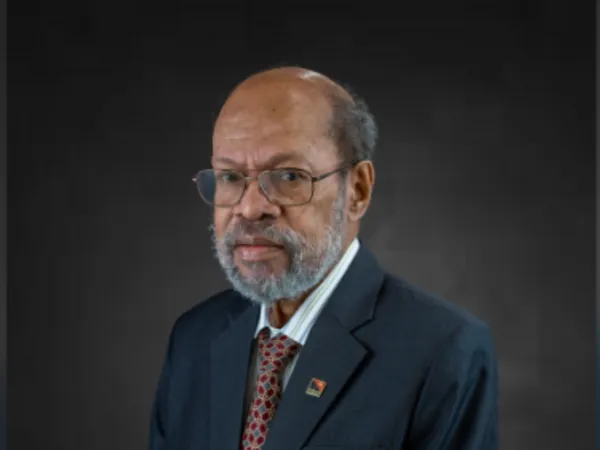
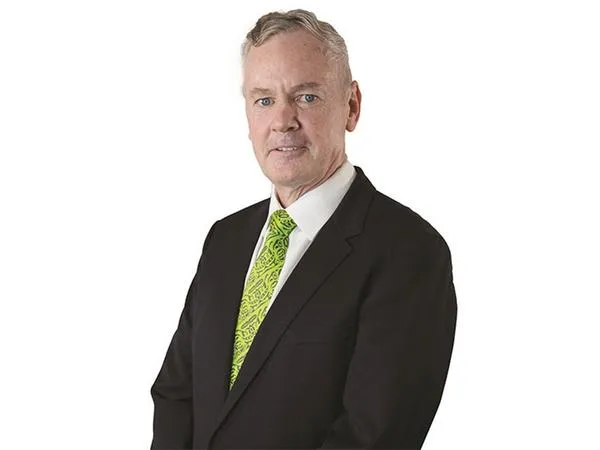
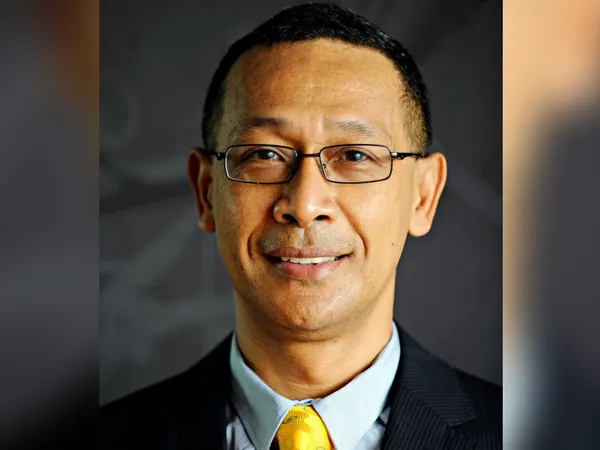
Sir Wilson Kamit has been named chairman of the board of directors of TISA Community Finance Limited, a fully owned subsidiary of Teachers Savings and Loan Society, beginning July 21, 2022.
Sir Wilson, according to TISA's chief executive officer Michael Koisen, brings to the TCF board a wealth of knowledge and managerial experience that will help the subsidiary's focus on offering financial services and products to the retail and commercial segment, including small and medium enterprises, be strengthened even more (SMEs).
The board of TCF is confidence in Sir Wilson's selection as board chair, according to Mr. Koisen, who has extensive leadership experience in the financial sector regulation, business, banking, economics, superannuation, investments, and insurance sector.
“Sir Wilson began his career as a graduate research officer at the Central Bank on July 1975 progressing through many management roles before being appointed Deputy Governor in 1991 then Governor in 1999,” he said.
“As Governor, he was also the alternate Governor representing PNG on the International Monetary Fund (IMF) and was the Registrar of Savings and Loans Societies.
Since then, Sir Wilson has served on various corporate boards, including those of InterOil Corporation, PNG Sustainable Development Program Limited, and Credit Corporation Limited. He is also the alternate executive director for the Asian Development Bank in Manila.
With nearly five decades of experience in a variety of professional and volunteer endeavours, Mr. Koisen claimed that Mr. Wilson is an invaluable addition to the TCF board and its efforts to convert its NBFI License into a full Commercial Banking License. Mr. Wilson is currently a member of the Independent Advisory Group and a member of the University of PNG Interim Council, according to Mr. Koisen.
Reference: Post- Courier (27 July 2022). “Sir Wilson Appointed Chair For TISA”.
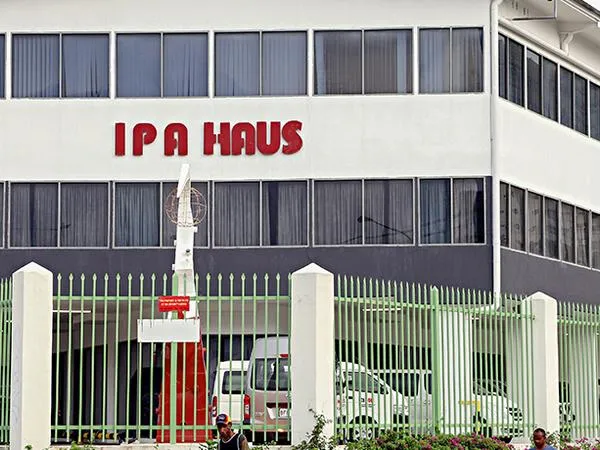
There have been many divestments and reinvestment in the country by foreign enterprises in past years, according to the Investment Promotion Authority (IPA).
According to IPA managing director Clarence Hoot, 165 foreign enterprise certificates were awarded for the first half of this year as opposed to 364 for the entire previous year.
“We are seeing that some foreign enterprises have diversified their activities, and have applied for variations, that include new activities or changing of locations,” he said.
“The effects of the lack of foreign currency, the business had a lot of money to invest.
“We are seeing in our certification process divestments, reinvestment.
“Companies in Port Moresby are investing in Mt Hagen, Kokopo.
“They are moving to other provinces in the same line of business as well as into other business activities.
We hope this continues.”
The Coronavirus (Covid-19), according to Daroa Peter, director of the IPA Investor Servicing and Promotion section, also had a role.
“Due to Covid-19, the borders closed so companies decided to move within the country.”
According to Hoot, the number of distinct entity types registering with the IPA has increased.
At the end of June, the IPA registration included:
Reference: The National (25 July 2022). “IPA says number of foreign firms reinvesting in PNG increasing”.
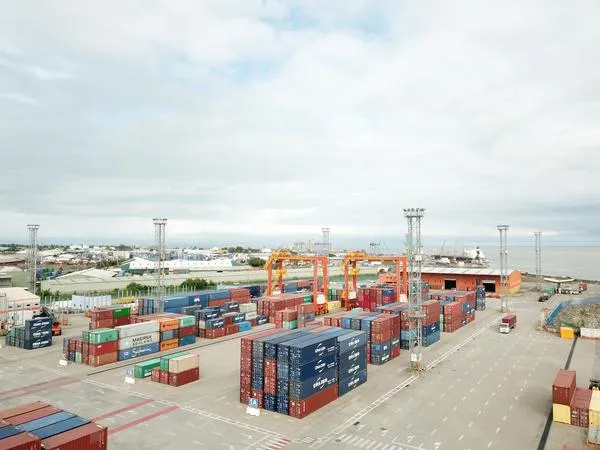
Photo credit: Papua New Guinea Customs Service
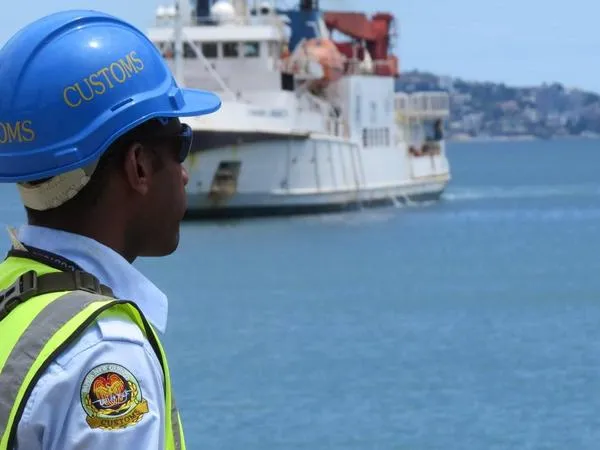
The PNG Customs Service and Investment Promotion Authority (IPA) have renewed their partnership to work together in relation to trade, border protection and facilitation, promoting investment including intellectual property enforcement.
In order to advance their continuous collaboration, customs chief commissioner David Towe and IPA managing director Clarence Hoot signed a memorandum of understanding (MoU) in Port Moresby.
The last Memorandum of Understanding was initially signed in 2013 and expired in 2016.
Hoot claimed that the MoU was a result of the need to uphold the national government's duties and obligations under the World Trade Organization (WTO), particularly with regard to the Trade Related Aspects of Intellectual Property Rights and their responsibilities as the relevant government agencies to carry out enforcement duties and obligations fundamental to the WTO.
The MoU also acknowledges IPA's and Customs PNG's obligations under the Financial Action Task Force and its regional affiliate, the Asia Pacific Group on Money Laundering, as well as their duties as pertinent government organisations to carry out enforcement and obligations essential to countering money laundering and financing for terrorism.
According to him, the MoU will be carried out through the use of approved channels for communication, partnerships and collaboration, information sharing, joint initiatives, and consultations.
The parties will also follow their obligations under the Memorandum of Understanding and within their respective legal systems.
Reference: The National (22 July 2022). “Customs and IPA sign MoU, renew partnership”.
The Independent Advisory Group overseeing the review of the Central Banking Act 2000 and Financial Sector Regulation has been given the clearance to go ahead with Phase II of the review.
Chairman Robert Igara in a public notice said: “With the successful completion of IAG’s phase I work and decision of the National Executive Council in November 2021, the Minister for Treasury approved on April 07th 2022 the Terms of Reference for Phase II of the IAG’s mandate.”
Phase II, according to Mr. Igara, will concentrate on the financial sector in order to examine its regulatory and supervisory structures, expand access for our citizens and enterprises, especially SMEs, across the nation, and develop PNG's government bond markets to lower borrowing costs.
The Central Banking (Amendment) Act 2021, which includes the restatement of the Central Bank's objectives, a strengthened role for the board of the Central Bank, particularly with regard to monetary policy and financial sector regulation, changed governance arrangements, measures to improve transparency and communication with the government, and the introduction of a new financial sector regulator, was successfully passed as a result of the 32 recommendations in the phase I report, according to him.
“We need to encourage competition, investment, accessibility and growth in our financial sector and use modern technology to increase productivity and efficiency, look at our laws governing our banks and institutions as well as the insurance and superannuation industries, and ask whether they are robust enough to support these reforms,” he said.
“We need to relook at our Anti-Money Laundering and Counter Terrorism Act 2014 and whether it poses a threat to the accessibility of our banking system to farmers and small businesses.
“We need to relook at whether our Central Bank has the appropriate legislation to fulfil its functions in light of changing technologies and global banking dynamics.”
According to him, the Phase II terms of reference address a number of unresolved Phase I problems pertaining to BPNG's financial sector governance and commitment to openness. Dissemination, engagement, advice, and accountability.
Reference: Post-Courier (20 July 2022). “Clearance Given For Phase II Of Review, Says Igara”.
“Foreign Exchange (FX) market inflows gained momentum in June Quarter. FX inflows are expected to seasonally taper in September Quarter, and outstanding FX orders build-up again,” says BSP Group General Manager – Treasury, Rohan George.
“As FX flows can be lumpy, we expect there to be periods where outstanding FX orders build up,” said George.
According to the BSP Pacific and Economic Insight Quarter 2 report, Mr. George emphasised that, the FX market turnover in the June Quarter, rose by 16% from the March Quarter of 2022. Subsequently, FX market turnover was 20% higher than 12 months ago, supported by strong commodity prices in particular Oil, Copper, Palm Oil, and Coffee. These firmer commodity prices have offset the lost FX market inflows from the closure of the Porgera Gold Mine.
Meanwhile, the outstanding FX orders with BSP have fallen by 55% in the past three months, assisted by record June FX inflows, but remain similar to levels seen 12 months ago,” added George.
He said: “BPNG FX intervention in June rose to 260% from May and up 33% from the March Quarter, as global inflation increased FX foreign currency requirements of the Oil, Transportation, Food and other sectors.”
“BPNG increased the Kina Facility Rate (KFR) by 0.25%, and raised Cash Reserve Requirement (CRR) of commercial banks by 1%, tightening monetary policy to combat imported inflation. A move over time to pre Covid-19 monetary policy settings will see reduced liquidity, higher interest rates and reduced demand,” stressed George.
“Recessionary fears amid a tightening of monetary policy in Australia weakened the Australian dollar and saw Kina rise 10% to 0.3985 from March. The Kina remained stable against the U.S. dollar at 0.2840,” said George.
He added that, “Consequently, to manage volatility in foreign currency flows, businesses should place FX orders with correct documentation, as soon as possible, ensure orders are cash backed whilst awaiting execution, ensuring tax clearance certificates are current and reflect the expected FX order execution time,” he said.
Article courtesy of BSP
The price of goods and services have continued to increase since the second quarter of 2021, with Consumer Price Index (CPI) rating closing the first quarter of this year at 6.9 percent – the highest level rating since 2010.
To counter this high domestic inflation, the Bank of PNG has tightened the Monetary Policy by increasing the Kina Facility Rate (KFR) by 0.25 percent to 3.25 percent this month (July 2022).
According to the BSP Pacific Economic and Market Insight Q2 2022 Report, BSP Group General Manager for Corporate Banking, Peter Beswick said the uplift in the Kina Facility Rate (KFR) by BPNG in signalling and tightening the Monetary Policy would result in the finance sector reviewing loan and deposit interest rates.
The KFR intends to serve as the interest rate at which funds can be lent or borrowed. It is a monthly rate and any changes to it should translate to market interest rates.
“The Bank of PNG has flagged the tightening Monetary Policy, with an increase in the KFR by 0.25 percent to 3.25 percent in July 2022. This move is to counter high domestic inflation. Domestic prices have continued to increase since the Q2-21, with headline CPI for the Q1-22 at 6.9 percent. The highest level since 2010,” Mr. Beswick said.
“BPNG has noted the key drivers of inflation as being import inflation (through fuel and food), caused by the pandemic and Russia-Ukraine conflict. Inflation and living costs are expected to remain high for the remainder of 2022, as global recession fears affecting fuel, energy and logistic costs globally,” he added.
Mr. Beswick further said that under this scenario, PNG should benefit from increased prices on commodity exports. However, this lift could be partiality offset by reduced export volumes in the agricultural sector, as small holders and regional communities are involved in the general election.
“In terms of business drivers, we have seen some uplift in select business sectors of the PNG economy. Hotels & Accommodation providers have seen increases in occupancy levels, due to additional consultants and short term contractors arriving to assist government with the general election. Australia has an increased presence, with additional defence force personal assisting with law and order nationally. While aid agencies have committed additional resources on the ground to assist with the election operations, logistic and oversight.
“Major extractive projects on the horizon for 2023, should see improved sentiment as the PNG economy transitions into its next significant growth phase,” Mr Beswick concluded.
Prime Minister Hon. James Marape, MP says the completion of Telstra’s acquisition of Digicel Pacific this month is demonstration of international confidence in the Papua New Guinea economy.
“The government has worked to liberalise the telecommunication market, and to also even out the playing field so that we attract important investments, and build important competition pressure in the marketplace, which translates into low-cost communications charges, and high penetration in a country that remains largely disconnected.”
Prime Minister Marape said that Telstra is rated the number one telecommunication company in Australia and through its successful acquisition of Digicel Pacific, this is a strong vote of confidence in our economy, its current state and more importantly, the future outlook.
“Investments are made with a long-term view, and most certainly a large transaction such as this one is only made when there is confidence and certainty in what the long term prospects in the economy are like.”
“Now that the acquisition is completed, this will only enable our link to the outside world much faster and deeper.
“I want Telstra to maintain links all over our country especially in the unconnected pockets of our out-of-reach communities, and to grow those links.
"The completion of this acquisition also presents an opportunity for the PNG stakeholders to work on possible participation in the telecommunication business, in keeping with the government’s mantra of maximizing participation by its stakeholders.
“We also want Telstra to interface with Telikom and as initially foreshadowed, under the Telstra PNG subsidiary; PNG stakeholders could be offered up to 50 per cent of equity,” he said.
Prime Minister Marape said while Telstra announced its successful acquisition this month, I’d like to reiterate that telecommunication services are critical to PNG’s social and economic development. It has the potential to address education and health concerns and will build a strong resilient population who are aware of what is going on.
“There is an expectation that wherever possible infrastructure sharing will be encouraged, reducing the need to erect several towers at the same location. Telikom will welcome the opportunity to collocate on Digicel infrastructure.
“I want to also thank Telstra and the Australian Government for their confidence in our economy and investing in our country.
“My Government looks forward to working closely with Telstra in developing its ongoing infrastructure network plans for PNG,” the Prime Minister said.
Digicel Pacific is the leading provider of communication services across PNG, Fiji, Nauru, Samoa, Tonga and Vanuatu. This acquisition also includes the businesses in these other countries.
Article courtesy of The Department of Prime Minister & National Executive Council
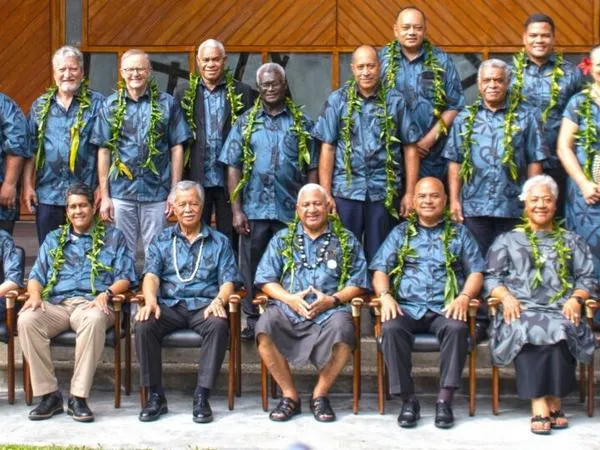
Photo: Photo of PIF Leaders
Pacific Islands Forum Chair and Host, Fijian Prime Minister Hon. Josaia Voreqe Bainimarama, and other members of this esteemed group.
I am honored to be here today representing my people of Papua New Guinea at this august forum in its 51st year of existence.
On this momentous occassion, let us pause to remember pioneer leaders of the PIF such as the late Sir Kamisese Mara, Grand Chief Sir Michael Somare, Solomon Mamaloni, Walter Lini and many others scattered over our wide Pacific Ocean.
The PIF is very much relevant in this day and age and all our current 16 members stand equal.
It must be representative of our unity as a family of nations.
This togetherness gives us the muscle to overcome the many challenges we face in the contemporary Pacific such as climate change, economic issues, and theft of our resources such as those in the sea, to name a few.
Our oceans hold 60 per cent of the world’s tuna resources, and if we stand together, we can ensure that we get the best deal for our countries.
The PIF must be the instrument to unite all of our countries with one voice. That unity must prevail under all circumstances.
Our organisation must be representative of all our diversity. No voice is too small, no voice is too big, all of us are equal.
Leadership within the PIF must be rotated among all regions of the Pacific and recognise the fact that we are all equal.
I want to also speak of the bigger forces at play within our region through geo-politics.
Papua New Guinea’s foreign policy remains that we are friends to all and enemies to none. With no good reasons, someone else’s enemy is not my enemy. And our intrinsic peaceful Pacific ways must pacify all forces and interests in our region.
In this day and age, foreign relationships is not just historical or philosophical, but more to do with trade and commerce for our national economies.
There is a need for greater trade and commerce not just among ourselves within PIF, but outside our region too, hence, the need to sustain our economies is very much a reality.
Look at the example of Nauru, for instance. It was once very rich from phosphate with one of the highest GDP per capita in the world, however, this is so different today.
That should not be the case in a Pacific region of abundance in maritime and land resources. We in the Pacific must use this unity of nations to push for our collective economic well being to develop and sustain our countries.
For instance, in my own PNG, we do not want to compromise relationships with our fellow APEC member countries because those trade relationships keep our economy functional.
The Pacific is and must be a friendly region to all, especially those that sincerely respect our national and Pacific interests.
And I point to one of our greater interests being our national economic security needs.
An economically strong nation in the Pacific contributes to a safe and secure region. And to get there for us in the Pacific, I propose the following:
We in PIF are now outlaying a 2050 strategy, and chief outcome of this strategy must be the economic well being of our people and our nations. In the life of this 2050 strategy, we must become strong and robust economies.
Our traditional and genuine partners need to look within themselves if they can come in better, and instead of giving us free handouts, they must help us to be self-sustaining.
On this note, I thank new Australian Prime Minister, Hon. Anthony Albanese, for his intention to bring in more Pacific islanders to work in Australia and also offer more training.
I also commend Australia for bringing back the Climate Change Mitigation Fund to the Pacific. I appeal to other industrialised nations to follow suit and help small island countries affected by climate change.
My proposal to PIF is to rally for international funds, especially from big industrialised nations, who are contributing to climate change through carbon emissions.
Bring these funds into small island nations like Tuvalu, Kiribati, Marshall Islands, Niue, Tokelau and others. I further propose strongly that instead of talking about victims of climate changes resettling elsewhere, we should use technology and money to assist in land reclamation, ensuring our small island states and communities live in their island of birth.
My further recommendation to Australia, the biggest nation in the Pacific, is to open up credit facilities for smaller island nations to finance our development needs as well as to buy more of our produce.
On this note, let me conclude by appreciating Fiji and the leadership of our host and chairman of our PIF Prime Minister Hon.Bainiramara. I also thank all of you sister and brother leaders for coming together in such tough times.
Unity is important. The strength of our combined membership allows us to overcome our local challenges much better, because here in the Pacific, we are and we must be our sisters and brothers keeper. I want to reach out to our Micronesian family that we are better, stronger and secure together. To the rest of us, let us always exercise our Christian principle of doing unto others what we want them to us.
God bless PIF, God bless our people and May God bless you all.
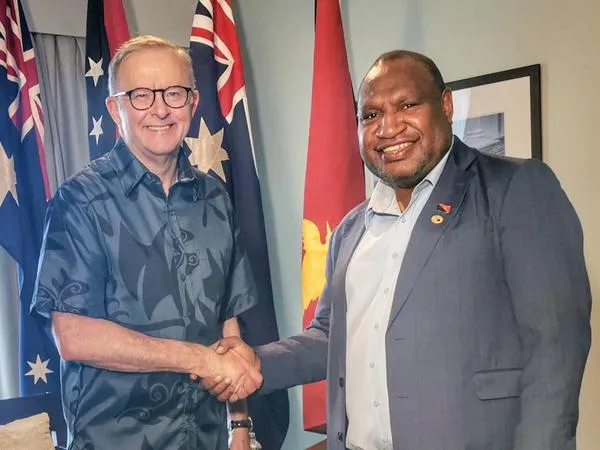
Photo: Prime Ministers Albanese and Marape in Suva.
Prime Minister Hon. James Marape met Australian Prime Minister Anthony Albanese on Thursday (July 14 2022) at the Grand Pacific Hotel in Suva, prior to the convening of the 51st PIF Leaders Retreat at the PIF Secretariat Headquarters.
Being the first meeting since PM Albanese was elected, their initial exchanges were practical and reassuring.
PM Marape, at the outset, acknowledged the strong and excellent bilateral relations between PNG and Australia and took the occasion to congratulate PM Albanese on his recent election as Prime Minister of Australia.
Relations between the two countries have matured and strengthened since PNG’s Independence in 1975.
Most recently, the Australian Government provided much-needed budgetary support to PNG at the height of COVID-19.
“Australia stepped in at a very critical period by providing this budgetary support that enabled us to reconfigure and tidy our public accounts,” PM Marape said.
“Prior to this, I concluded the Comprehensive Strategic Economic Partnership (CSEP) with the immediate past Australian Prime Minister at the Inaugural Virtual Annual PNG Australia Leaders Dialogue.
“This new economic development partnership expands across various sectors including transport, infrastructure, health, education and cultural exchanges and has been factored into a Plan of Action to implement the CSEP which we also endorsed.
“My Government worked closely with former Australian Prime Minister, Scott Morrison, in elevating Australia-PNG economic relationship through the CSEP.
” I look forward to progressing the agenda of increasing economic and trade relationships between our two countries.
“During our discussions, I thanked Prime Minister Albanese for Australia’s continued economic infrastructure support for ports, bridges, roads and airstrips through the Australian Infrastructure Financing Facility for the Pacific (AIFFP).
“In ensuring the region benefitted from the AIFFP, I requested for Prime Minister Albanese to be accommodative, flexible and favourably consider requests from other Pacific Island countries to access the AIFFP to improve their economic infrastructures and other development needs.
“These arrangements signal an economic partnership with Australia on equal terms that are not subservient to Australia.
“In response, Prime Minister Albanese acknowledged our historical ties, reaffirmed that this was a partnership of equals, and that his Labor Government was prepared to listen and assist PNG in its development requirements where necessary.”
Other issues between the two leaders included the socio-economic development agenda for the 51st PIF and more particularly the Micronesian issue that threatened regional stability.
“We both agreed that all members of the Pacific Islands Forum were equal and should be respected, despite their lower populations and sparsity,” PM Marape said.
“I also discussed issues relating to Santos’ decision to offload equity to Kumul Petroleum and will shortly be dispatching a letter to Prime Minister Albanese for his consideration and advice.
“We also spoke about PNG’s bid to join the NRL in 2025 and I sought Prime Minister Albanese’s intervention on the same, which he agreed to.
“To conclude our meeting, I re-extended my invitation for Prime Minister Albanese to visit PNG in September to coincide with the Annual PNG/Australia Ministerial Forum in Wewak as a mark of respect to the Late Grand Chief Somare who had longstanding ties with the Australian Government.”
Article courtesy of PM JAMES MARAPE News Page
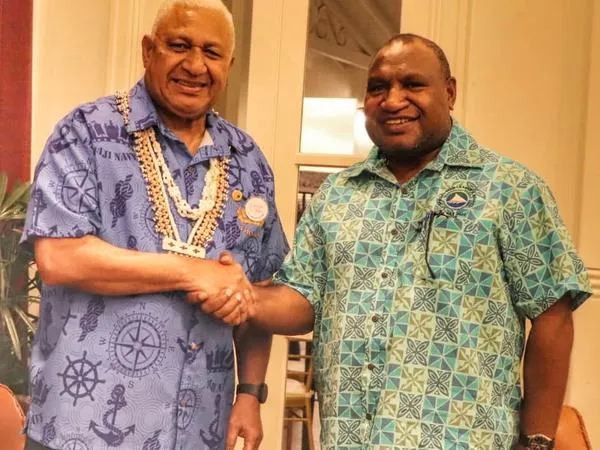
Prime Minister Hon. James Marape had a bilateral meeting with the Prime Minister of the Republic of Fiji. Hon. Voreqe Josaia Bainimarama on the margins of the 51st Pacific Islands Forum in Suva, Fiji.
PM Bainimarama thanked PM Minister Marape for making time to attend the PIF saying it showed his commitment and cause to the wider regional family.
PM Bainimarama also congratulated PM Marape on his re-election as the Member for Tari-Pori in this year’s PNG National General Elections.
PM Bainimarama congratulated PM Marape for successfully handing over the Melanesian Spearhead Group (MSG) Chair to Vanuatu. He reiterated what he mentioned in the Special MSG Leaders’ Summit that sub-regional arrangements like the MSG Free Trade Agreement could assist in strengthening economic recovery efforts.
PM Marape conveyed his appreciation to PM Bainimarama for hosting him and his delegation for this 51st PIF.
He reassured PM Bainimarama of his full support in the face of several challenges to the region, including climate change.
PM Marape maintained that the bilateral relations between PNG and Fiji extended from a long and rich history and commented that there was a noted growing amount of PNG investments in Fiji and looked forward to seeing this part of the bilateral relationship grow.
In reference to the Suva Agreement, PM Marape raised his concern at the withdrawal of Kiribati from the PIF and enquired as to the number of members that have signed on to the agreement.
PM Bainimarama informed that most Forum Leaders had signed onto the Suva Agreement except for PNG, Kiribati and Nauru. Nauru had requested to sign the document last, given the spread of COVID-19 pandemic on the island and the lock- in place.
He said the Suva Agreement would address the political impasse currently between the Forum Leaders and the Micronesian member states.
In this regard, PM Marape re-affirmed to regional solidarity, assured PM Bainimarama of PNG’s support and signed the Suva Agreement in the meeting.
Photo credit:
A Pacific Trade Invest survey for Pacific Island exporters has revealed that despite over half of all responding businesses reporting a decline in export orders over the past 12 months, respondents are confident the future holds promise with two out of three businesses expecting an increase in export orders over the next 12 months.
The Pacific Islands Export Survey 2022 comes at a critical time, providing a unique lens to understand the acute and far-reaching impact the COVID-19 pandemic has had on the region over the last two years.
Dr Tess Newton Cain, Pacific Analyst and Project Lead at Griffith Asia Institute’s Pacific Hub, said the survey provides a wealth of information and insights into the economic temperature of our region.
“The PTI Pacific Islands Export Survey comes at a pivotal moment as many countries of the Pacific shift from keeping COVID-19 out, to managing the impacts of living with it in their midst.
“It adds to a valuable longitudinal dataset that can inform nuanced and sophisticated analysis and policy formulation.”
The report finds that the cost of export and challenging export logistics have increasingly become barriers to Pacific exporters selling their products or services to overseas customers, with 52 per cent stating that cost of export was their main barrier and 48 per cent stating the same for export logistics.
This increased from 46 percent and 38 percent in 2020, respectively.
Mr Newton Cain says that while these challenges are expected to ease in the future, they will still be of immense significance in the short term, with exporters increasingly calling for support in the form of financial grants as they navigate this turbulent period.
“When it comes to barriers to exporting, it is not surprising to see that the major challenges are around transport costs and logistical challenges.
“While we can expect these pressures to ease over the medium term, they will continue to be of major significance in the next little while until international freight systems begin to normalise.”
PTI Australia’s Trade and Investment Commissioner, Caleb Jarvis, said that despite the many challenges, the survey also revealed the strong optimism Pacific Exporters hold for the future.
“Promisingly, we can see that business confidence among Pacific Exporters has increased over the last two years despite the many challenging environmental and economic conditions at play.
“Despite over half of all businesses reporting a decline in export orders over the past 12 months, Pacific exporters are confident that export decline has peaked.
“The future holds much promise, with 66 per cent of mature exporters and 69 per cent of new exporters anticipating an increase in revenue and export orders over the next year,” Mr Jarvis said.
Article courtesy of the Post Courier
PAPUA New Guinea’s economy has weathered the Coronavirus (Covid-19) pandemic well despite many challenges, according to Treasurer Ian Ling-Stuckey.
Ling-Stuckey said according to the International Monetary Fund (IMF), “PNG economy is expected to grow from K79.4 billion in 2018 to K109.3 billion in 2022”.
“The increase over the last two years of K23.9 billion is the largest in PNG’s history,” he said.
“The report from the IMF is more positive about the PNG economy than even the 2022 budget documents.
“This is part of the benefits of honest and transparent engagement with the international community.”
Ling-Stuckey said there was also a major upside to the predictions on the growth of the economy.
“In line with international best practice, the growth forecasts do not include new resource projects until the final investment decision is made,” he said.
“This means that the forecasts do not include the additional growth benefits from the Papua LNG, P’nyang, and Wafi-Golpu projects despite the likelihood of these projects going ahead, especially in light of higher oil and mineral prices.
“The IMF also sees the real rate of growth in the non-resource sector exceeding 4 per cent over the next five years.
“This is higher than the official population growth rate of 3.1 per cent.
“Most of our people earn their livelihoods from agriculture, fishing, selling goods, construction and transport.
“As these vital parts of the economy are expected to grow faster than population growth, this means improving the living standards for our people.”
Article courtesy of the National
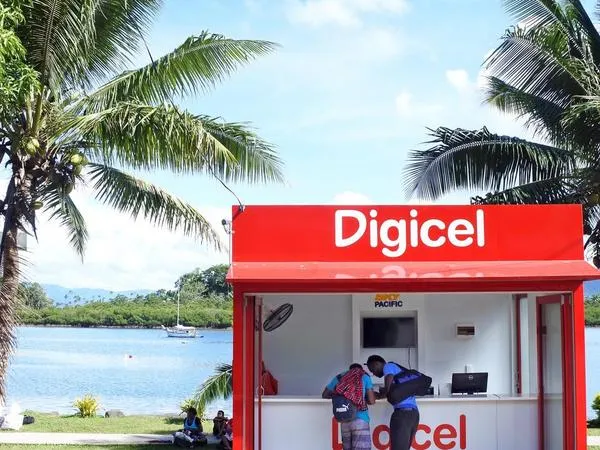
Telstra, Australia’s leading telecommunications and technology company, today announced it has officially acquired Digicel Pacific in partnership with the Australian Government. Telstra will continue to invest in and operate the business across its six South Pacific markets – Papua New Guinea, Fiji, Nauru, Samoa, Tonga and Vanuatu. Oliver Camplin-Warner, Telstra International CEO, said the deal was an exciting milestone for the Digicel Pacific business and its customers in Papua New Guinea. “We’re very pleased to welcome Digicel Pacific into the Telstra family. The Digicel Pacific team in PNG have amazing local expertise and are leaders in digital experiences for their customers. Together, we’ll work to ensure Digicel Pacific remains the top provider in PNG,” he said. Mr Camplin-Warner confirmed there would not be any local job losses in the Pacific as part of the acquisition and the current Digicel Pacific team would continue the day-to-day running of the business. “Digicel Pacific will still have the same people and products that their PNG customers know and love today,” he said. “Telstra will add to these strengths with our more than one hundred years’ experience building and operating the largest mobile network in Australia, and our operations in more than 20 countries world-wide.” “As part of our commitment to building a strong and sustainable PNG, Digicel Pacific will invest in an additional 115 towers which will be built across PNG over the next two years,” Mr Camplin-Warner added. “This investment will mean continued improvements to 4G coverage, particularly in rural areas, which will bring with it opportunities to improve health, education, agricultural, commerce and cultural outcomes through the use of technology.” Colin Stone, CEO, Digicel Papua New Guinea, said Telstra’s expertise in rolling out world-class networks and connecting remote communities would greatly enhance the work to date of Digicel and benefit the people and businesses of PNG. “Telstra has experience connecting regional and remote customers in challenging geographies across mountains, deserts, rainforests and coastlines,” Mr Stone said. “We’re looking forward to Telstra applying its network experience as well as its innovation and technology solutions to PNG to continue increasing connectivity in the region as Digicel has been doing for the past 14 years.” Mr Camplin-Warner said the values of both Telstra and Digicel Pacific were a natural fit, with the companies committed to working together to build a connected future for everyone. “We strongly believe we are “better together”, and this includes how we both work to support some of the most vulnerable in our communities,” he said. “Telstra strongly supports Digicel Pacific’s grass roots community investments through the Digicel Foundation, and we are committed to seeing this work continue.”
Photo credit: Loop PNG - Clarence Hoot
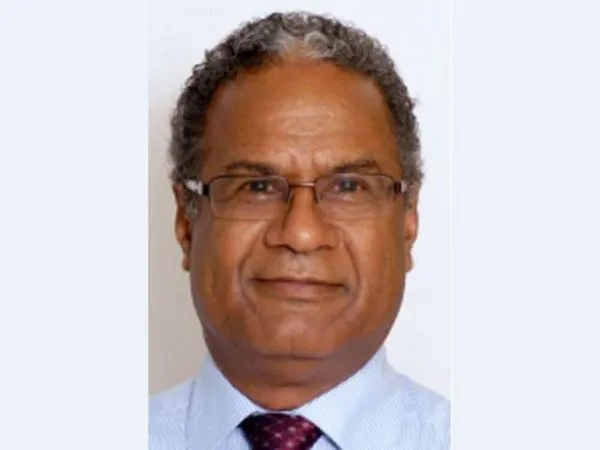
The Investment Promotion Authority will be reviewing its Strategic Plan 2021-2023 as the plan is halfway into its implementation timeframe.
Investment Promotion Authority managing director Clarence Hoot in IPA’s fifth edition of Opportunity newsletter, said IPA is reviewing the plan to assess how much of it has been accomplished and how they are progressing in achieving the goal set in the plan.
He said that they are also preparing to go on an outreach program to educate the public on the Reserved Activities list and other business-related legislations recently passed by Parliament.
“We will keep you posted on the schedule and the places we will be visiting to conduct the awareness outreach program.
“IPA will also be upgrading our Online Registry System to make it friendlier to our clientele.
Apart from this we are developing an investment opportunity profile (IOP) database in Partnership with the United Nations Industrial Development Organisation (UNIDO) to identify, package and promote investment ready projects in the country,” Mr Hoot said.
He said IPA is also updating their website and uploading fresh content to reflect the current economic situation in the country.
“It is apparent that IPA as an organisation is going through a transition period at the moment with efforts currently placed on institutional strengthening and capacity upgrading.
“We hope the incoming government will pass the Bill on the Investment Promotion Act amendments early so we can work on a full rebranding of the IPA with clearer guidelines on the functions and roles and responsibilities of IPA.”
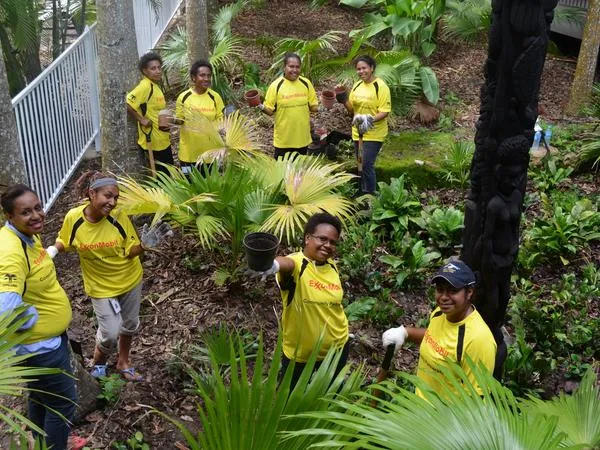
Photo: EMPNG volunteer program
CSR: It once meant a big company handing over large sums of cash in the hope (or more usually, on the condition) of getting something in return, but today it means a whole lot more. Today it is about the social licence to operate and also a necessity if we are to meet net zero by 2050. Today’s global society is identifying that doing good for others is actually doing good for you. In this way Corporate Social Responsibility, although still evolving, is also proving to be good for business. A company that ‘cares’ for its staff and others, creates a happy workforce, a happy workforce leads to less staff turnover, greater productivity and overall, makes for a good bottom line. In fact, progressive companies proactively use their CSR programs as marking tools.
Furthermore, it doesn’t focus just on big corporations. Every entity, private, government and not-for-profit, big or small, has a role to play in improving our communities. It is as simple as the choices we make in whatever our line of work. Ensuring supply chains are equally socially responsible is a sure way to drive change, and really takes little, to no extra effort. By adding a few questions to your procurement processes you’re making a difference. Better yet, those that can, should proactively assist/encourage business in the right direction: if you supply in this way, we will commit to your product/service.
Being socially responsible is worth more than just the material worth that may be provided. It provides the concept of planning for tomorrow, because today is taken care of. It provides long term assurance that support is ongoing, so there is no need for an immediate cash grab. Advanced programs also provide for growth within arrangements and often involve more than one partner. An initial relationship can create leverage and multiply the ROI when further relationships come onboard. This is often the case when industry partners with the not-for-profit sector; partnerships reach out to wider community groups to facilitate work required ‘on the ground’.
More and more we now see collaboration between partners that was previously unheard of. Consider the recent arrangement between one of Australia’s largest pastoral companies, The North Australian Pastoral Company and Australian Wildlife Conservancy, one of the largest conservation NGO’s. This will manage 6 million hectares with key objective to demonstrate that conservation focused land management can benefit both pastoral productivity and biodiversity. It’s an innovative investment in the ongoing sustainability of both party’s core business. You need an open mind but if you start by finding similarities instead of targeting historic conflict, you’ll go a lot further.
Good CSR arrangements aim to become more than year to year grant submissions. To be successful and truly fit the definition of corporate social responsibility, CSR arrangements need to be just like any other facet of business. Budgeted for, measured, and reviewed accordingly to provide an effective feedback mechanism, thus ensuring the biggest bang for your buck!
Agreed milestones also provide greater flexibility into how the project may evolve, even mid allocation, provided it meets criteria and each completed stage provides engagement opportunities between partners as well as to the wider community. These celebrations are equally as important to schedule and commit too as the program itself and what’s more, they are wonderful brand promotional activities.
Regularly sharing progress to the wider community, rather than just listing in an annual report offers your program momentum, credibility and adds to your reputational profile. After all, if nobody hears about it, is it really social responsibility or just a business deal between two companies? Additionally, consider delivering your success to wider audiences. Make them a part of everyday business, promote them at industry expos and during networking events or conferences. Offer to present them to other industry networking events as well. You’ll be surprised at the response. Most of all, share your stories.
Port Moresby Nature Park simply wouldn’t exist without our corporate partners, big and small. Annually they make up 30-40% of our budget. Many of our partners have been with us from the very beginning: ExxonMobil PNG, Ela Motors, Digicel, being key players in our foundation wildlife and education programs. Partners such as Newcrest Mining maybe newer on the scene but equally important as we expand our reach and capacity to assist rescued wildlife, enhancing the awareness of key environmental issues along the way. In our future there are plans for major upgrades to infrastructure to provide a platform for an international conservation research hub. A place where international players can base their fieldwork on PNG biodiversity. With a focus on collaboration and coordinated research, we aim to be the most sought-after platform in the country, and to also utilise this to provide stability to finances. There are a few steps to go in reaching this goal but we are perfectly positioned in a biodiversity hotspot central to current global conversations regarding climate change. We remain steadfast in our Vision- to inspire the guardianship of PNG flora, fauna and culture; we hope you will join us. Remember, it’s not just good for the planet, it’s good for business!
Ony 12 per cent of Papua New Guinea’s population has access to internet, making it one of the lowest rates in the world, an expert says.
Deloitte PNG director of consulting, Alberto Cimas said this was according to the latest available data on internet users in the country which showed that they did do not have full or continuous internet access.
“In other words, they simply use internet just to check Facebook once in a while, but they count as ‘internet users’ when they shouldn’t,” he said.
“Additionally, according to the latest data, only eight per cent of PNG’s population use social networks.
“We can assume that only a very small percentage use social media continuously or on a daily basis.
“In other words, usage of social media in PNG can be considered irrelevant.
“Also, note that the concept of ‘social media’ is very diverse and covers applications like Facebook, Twitter, Instagram, TikTok, Snapchat and others.”
Cimas noted that when looking at the data it was understood that cyber-security or fake news in social media did not pose a real threat to the election process in PNG.
“There are other threats like physical threats, fraud and corruption, manipulation of voting or counting and low implementation of the National Identification,” he said.
“Cyber-security and social media can be a threat in countries where most of the population have access to internet, simply because these cyber threats and fake news will reach most of the population.
“We already saw the case of Cambridge Analytica or the manipulation of social media messages in FB and Twitter during the US elections in 2018.” Here are some common cyber threats during elections overseas were:
In some cases, attackers are looking to see which phone numbers respond, meaning that they are active and working numbers. They may later use knowledge of your working phone number to exploit a more sophisticated attack;
Follow on LinkedIn:
PNG Business News
Be the "First" to get our exclusive Digital Magazine & Weekly Newsletter.