Category:
NAC Sign CADIP Phase Two MoU With The Asian Development Bank
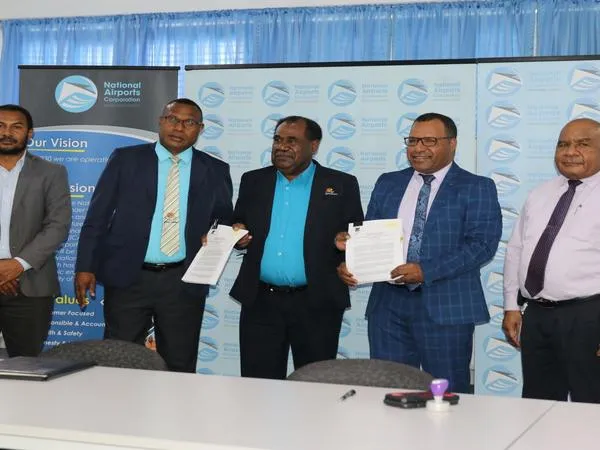
Photo credit: National Airports Corporation Papua New Guinea Facebook Page
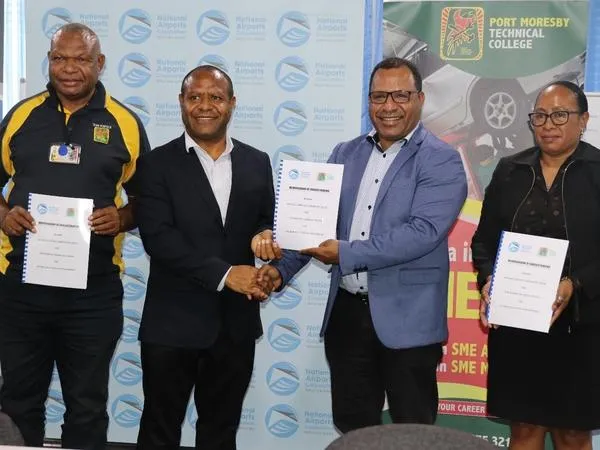
The key partners in the Civil Aviation Development Investment Program (CADIP) in Papua New Guinea have signed a Memorandum of Understanding (MoU) for the Phase-2 of CADIP.
The National Airports Corporation, Asian Development Bank ADB in the Pacific, Department of National Planning & Monitoring, Department of Transport together with Civil Aviation Agencies, signed the MoU in Port Moresby yesterday (Monday July 4, 2022).
The signing of the MoU is a significant step taken by the development partners prior to and in the lead up to the implementation of high impact aviation projects under phase 2 of the program.
The MoU is a result of a series of discussions between the Asian Development Mission (the Mission) and the Government agencies (Department of Treasury, Department of National Planning and Monitoring; Department of Transport), aviation entities (National Airports Corporation, NiuSky Pacific Limited, Civil Aviation Safety Authority, PNG Accident Investigation Commission) and other key stakeholders.
It (MoU) contains information on the ABD Mission’s findings and agreements reached with GoPNG on the following;
- Project scope of works;
- Cost estimates and financings plans;
- Implementation arrangements;
- Project due diligence
- Proposed loan assurances and conditions
- Draft project administration manual; and
- Loan processing schedule.
The proposed CADIP Phase 2, is expected to be financed at an estimated cost of USD$ 171.5 million (ADB loan of USD$ 162.9 and the Government’s counterpart funding of USD$8.6 million).
This means the ADB’s ordinary capital resources loan will be 95% of the total cost whilst the Government’s component will be 5% of the overall cost.
The loan will finance identified projects by National Airports Corporation (NAC), Niusky Pacific Limited (NSPL), Civil Aviation Safety Authority (CASA), PNG Accident Investigation Commission (AIC), National Weather Service (NWS) and Rural Airstrip Agency (RAA) under the following scope; civil works, goods and equipment, consulting services and capacity building.
The implementation period of the second phase will be five (5) years with the loan envisaged to take effect in December 2022. However, prior to that the proposed loan will go through ADB’s approval process which include; interdepartmental review then an internal loan negotiation will be conducted, then the ADB Board’s approval and finally the loan will become effective afterwards.
All projects are expected to be completed by the 30th of June 2028 with the loan closing on the 31st of December 2028.
CADIP Phase 2 will be governed by the Project Steering Committee (PSC) comprising; ADB, the Department of Finance, the Department of National Planning and Monitoring, the Department of Treasury, the Department of Transport (DOT), NAC, CASA, New Sky Pacific Limited (NSPL), PNG Accident Investigation Committee, Air Niugini and Link PNG.
The executing agencies of CADIP Phase 2 will be NAC and NSPL and the implementing agencies will be CASA, DOT, National Weather Services (NWS) and PNGAIC.
CADIP-2 aligns with the Medium-Term Transport Plan, 2019 to 2022 to rehabilitate the national airports in PNG and to ensure they are in compliance with the PNG Civil Aviation Rules Part 139 and the International Civil Aviation Organization (ICAO) Standards and Recommended Practices.
In addition, CADIP Phase 2 aims to improve a selection of Rural Regional Airports. This is to encourage and create business opportunities such as tourism, agriculture and connectivity to boost economic growth and sustainability for our people in the rural and urban areas of PNG.
The proposed CADIP Phase 2 will commence after the successful closure of CADIP 1 which ended after the ADB’s Multi- Tranche Financial Facility (MFF) loan expired on the 24th of November 2021. Under CADIP 1 several high impact aviation infrastructure were successfully implemented through a series of tranches (Tranches 1, 2 & 3). Few projects that were not covered under CADIP 1 will be implemented in the second phase.
Article courtesy of National Airports Corporation - Papua New Guinea




World Bank Commits US$200 Million to Support PNG Roads, Nutrition and Employment
Photo: Stefano Mocci, Country Manager for the World Bank in Papua New Guinea
The World Bank’s Board of Executive Directors has approved three new projects with a combined commitment of over US$200 million (PGK722 million). The projects will support Papua New Guinean communities through major upgrades to key roads, tackling malnutrition and stunting, and improving employment opportunities in the region. Additional support from the Government of Australia will also contribute to these efforts.
“Collectively, these new projects will help address three of PNG’s most significant challenges: improving transport links between key regional hubs to boost access to jobs and markets; supporting children’s development during their vital first 1000 days of life so they can reach their full potential; and helping Papua New Guineans benefit from job opportunities in Australia and New Zealand,” said Stefano Mocci, Country Manager for the World Bank in Papua New Guinea. “We also look forward to working alongside the Government of Australia that has contributed to these projects and is a key partner.”
The first project is the US$93 million (PGK327 million) Resilient Transport Project, which, will support the PNG Department of Works and Highway’s efforts to improve the national priority road network. The project, which also benefits from a Government of Australia grant of US$15 million, will fund the rehabilitation of approximately 63 kilometers of the Ramu and Hiritano highways, together with multi-year maintenance of nearly 200 kilometers of these highways, as well as helping to build the capacity of PNG’s road sector.
The second project, the US$80 million (PGK281 million) Child Nutrition and Social Protection Project will implement PNG’s ‘Fast Track Initiative to Reduce Stunting’ by scaling up a community-based approach to deliver nutrition services and improve families’ nutrition knowledge and practices. The project, which is complemented by an additional US$10 million of Australian Government grant funding, will also pilot a social safety net providing protection to the most vulnerable households with pregnant women and mothers with young children. The project will improve the delivery of nutrition services and support village health volunteers and church health organisations to deliver community-level education on topics including breastfeeding, diet and hygiene.
Lastly, the US$32 million (PGK113 million) Enhancing Labor Mobility from Papua New Guinea project will help PNG benefit from rapidly-expanding employment opportunities in Australia and New Zealand; where workers can earn and build new skills to bring back to their communities. While other Pacific Island countries have successfully tapped into these labour programs PNG has faced challenges in scaling up participation. This new project will support the PNG Government to boost equitable access and worker readiness for these programs and help workers reintegrate when they return.
“With nearly half of children under age five being stunted, malnutrition affects the lives of far too many Papua New Guinean families and has an enormous impact on PNG’s economic potential,” said the World Bank’s Stefano Mocci. “Alongside new work to upgrade and maintain critical roads like the Ramu range section along the Ramu highway that play a vital role for economic activity and supporting hard-working Papua New Guineans in accessing regional employment, we are proud to be supporting the PNG Government to meet these important needs.”
Article courtesy of the World Bank