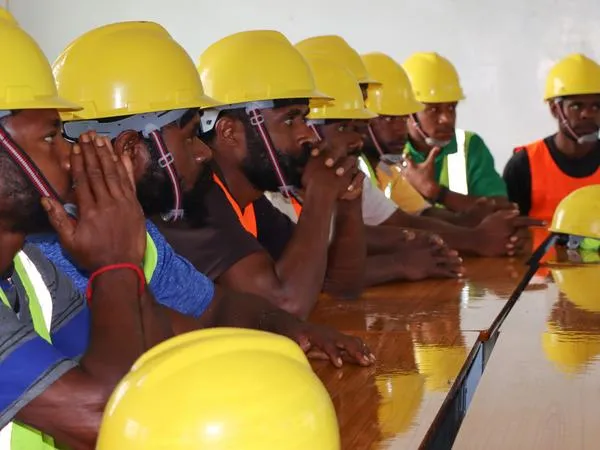
To build the capacity of the local workforce to support rural road transport infrastructure development projects in Papua New Guinea, the EU-STREIT PNG Programme trained and upskilled a new batch of interested young men and women in the Sepik region.
The EU Funded UN Joint STREIT Programme continues to train more young people from rural Sepik with the skills required for decent employment opportunities in road transport infrastructure development in Papua New Guinea. In its latest step, the Programme organised a 4-day training on ‘Occupational Safety and Health Hazards.’ Delivered in collaboration with the Yawasoro Technical and Vocational Training (TVET) Centre in Wewak, this course was the second part of 5-module training courses developed and implemented by the International Labour Organization (ILO) under the EU-STREIT PNG Programme.
The training, conducted on 5-8 August, was attended by 22 youths comprising 7 young girls and 15 young men. The trainees were mostly Grade 8 and 10 leavers that were selected with the help of ward members from rural communities in the Sepik Region like Marienbeg, Angoram, South Wosera, North Wosera, Dagua, Banak, Wewak Rural and Aitape Rural Local Level Governments (LLGs).
Introducing the training and its purpose on the first day, the ILO-STREIT’s Chief Technical Advisor, Mr Shailendra Jha Kumar, said, “This training will help the youth to learn the hazards and safety requirements at construction site for safe construction environment. The participants will also be able to linked for employment as safety supervisor in construction sector.”
Some topics covered in the training were safety and health responsibilities, causes of common types of hazards, accidents at construction sites, prevention of accidents, risk assessment and control, identification of hazards and common types of hazards in construction sites, attending to emergencies and preparation of emergency safety plan, accident and incident reporting, safety signs and symbols, traffic management, recommended noise limit, ventilation and lighting, labour camp standard and its construction. The trainees were also imparted first-aid skills by experts from the Provincial Health Division in Wewak.
The training has provided a new window of opportunity for the 22 young attendees to seek employment opportunities in road construction and other sites to improve their lives. “I struggle to find school fees for my children, and with these skills, I can now find short-term employment in road construction sites to earn an income to support my children and family,” says a female participant, Eslyn Talis. A male participant, Victor Yahaipim added, “With these skills, I’m looking forward to doing something good with my life and want to say thank you.”
They can also seek employment with contractors engaged under the EU-STREIT PNG Programme to rehabilitate 15 access roads in various parts of the Sepik Region.
The 5-module training courses rolled out by the Programme aim to upskill a total of 150 young people on road infrastructure works, thereby developing local communities’ capacity to support, take part and benefit from infrastructure development projects in the region.
The EU-STREIT PNG is being implemented as a UN Joint Programme (FAO as the leading agency, and ILO, ITU, UNCDF and UNDP as implementing partners), is the largest grant-funded Programme of the European Union in the Country and the Pacific region. It focuses on increasing sustainable and inclusive economic development of rural areas through increasing the economic returns and opportunities from cocoa, vanilla and fishery value chains and strengthening and improving the efficiency of value chain enablers, including the business environment, and supporting sustainable, climate-proof transport and energy infrastructure development.
Photo credit: Post Courtier - Benny Popoitai
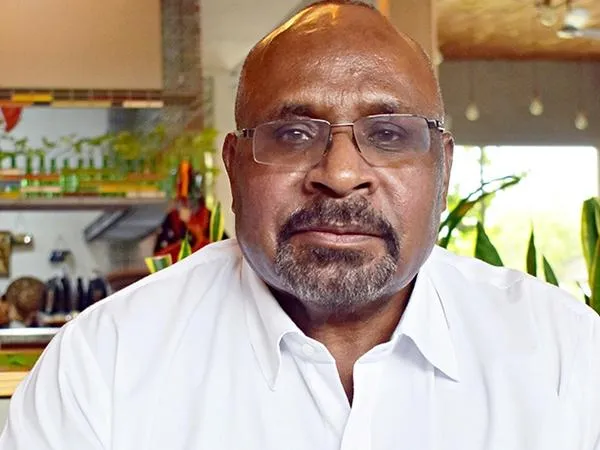
Bank of Papua New Guinea (BPNG) claims that the government has to concentrate more on an export-driven strategy.
This statement on the country's current amount of foreign exchange was given by acting governor Benny Popoitai.
He said that the amount of foreign exchange reserves was $3.08 billion as of March 31, 2022. (about K10.66 billion).
“As of June 30, 2022, the gross foreign exchange reserves fell to US$3.052 billion (about K10.563 billion), mainly reflecting Government loan repayments and Central Bank interventions in the foreign exchange market,” he said in the bank’s quarterly economic bulletin for the December quarter 2021.
Popoitai asked the government to increase spending and boost export sector output, particularly in the agricultural, forestry, fisheries, and industrial industries. “Additional Government assistance to promote value-added exports, meet international export requirements and secure markets overseas would greatly assist growth in these sectors,” he said.
“The Government should focus on an export-driven strategy to boost production and exports in the non-mineral sector to increase PNG’s export earnings to support the domestic foreign exchange market and improve income for the rural people.
“If these sectors are developed, any depreciation of the Kina will have a positive impact on export revenue and growth, while minimising the impact of inflation.
“On the other hand, if the current export capacity in the non-mineral sector is not improved to respond adequately to the depreciation of the Kina, its impact will be more inflationary with a very small corresponding effect on growth and export revenue.
“Going forward, to address the on-going foreign exchange imbalance, any depreciation of the kina must be supported by relevant Government policies to address structural issues, especially to promote the export sector and minimise the impact on domestic inflation.”
Reference: The National (15 August 2022). “Focus on export strategy: Bank”.
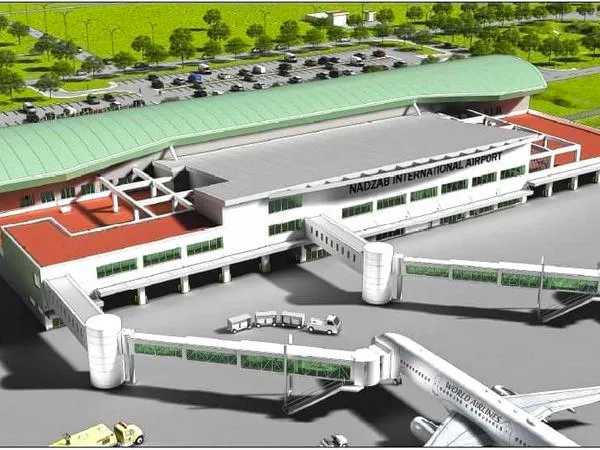
Prime Minister Hon. James Marape says the K794 million Nadzab Airport Redevelopment Project (NARP) will be “a gamechanger for Lae, Morobe and Papua New Guinea” when completed.
He said this today (August 18 2022) after publication of the latest update of the project by National Airports Corporation (NAC).
“The NARP is a high-impact Government project which is funded by the National Government through a soft loan from the Government of Japan through Japanese International Cooperation Agency,” PM Marape said
“The Japanese ODA Step Loan, PN-P11, was signed on October 15, 2015, for 26.942 billion Japanese Yen (K680 million) and counter-funded by GoPNG with K114 million.
“The NARP could have been completed earlier, but for several reasons, including lack of counterpart funding by the O’Neill government and the onset of COVID-19.
“According to the NAC, the NARP is 70 per cent completed, will be 90 per cent completed by the end of this year, and will be fully completed by April 2023.
“I thank the Japanese Government, the Japanese contractors who have built the airport to highest international standards and our very-own NAC for this world-class project which will enable international flights in and out of Lae.”
PM Marape said Nadzab in the Markham Valley, Lae, Morobe and PNG would boom with the NARP, sealing of Yalu Bridge-Nadzab Section of the Highlands Highway at a cost of K400 million, and building of Nadzab Satellite City.
“For more than 10 years, the people of Lae, Morobe and PNG have been complaining about the bad roads between Lae and Nadzab,” he said.
“I am well aware of your cries as I, on my many visits to Lae over the years, have driven through the mud and potholes.
“I can assure you that you will have one of the best roads in the country when the Yalu Bridge-Nadzab section is completed.
“People will be able to travel in comfort from Lae to Nadzab, and then get on an international flight, once the new international airport is completed.”
PM Marape said the new satellite city, an initiative of the National Government and Morobe Provincial Government, would transform Lae and Morobe.
He commended Deputy Prime Minister and Lae MP Hon. John Rosso for being in the forefront of this exciting project for Lae, Morobe and PNG.
“It is a timely intervention with the giant Wafi-Golpu Mine soon to come on stream,” PM Marape said.
“I welcome this satellite city development, where the private sector and super funds, will be major drivers in partnership with the State.
“Once completed, it will complement Nadzab International Airport, and will be timely with Wafi-Golpu and the major agri-business developments in the Markham Valley of Morobe and Ramu Valley of Madang.
“It will also provide home ownership for hundreds of Papua New Guineans.”
Article courtesy of PM James Marape News Page
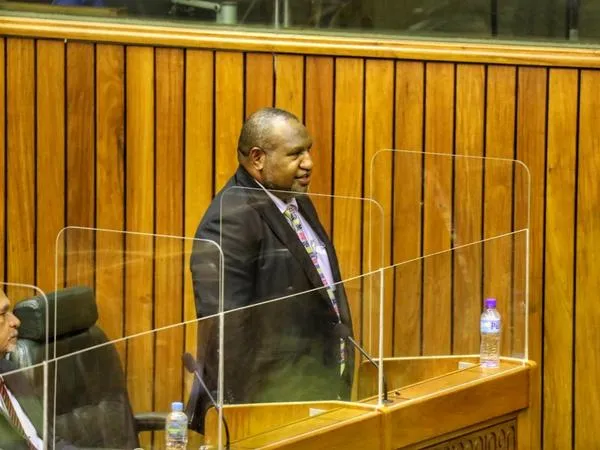
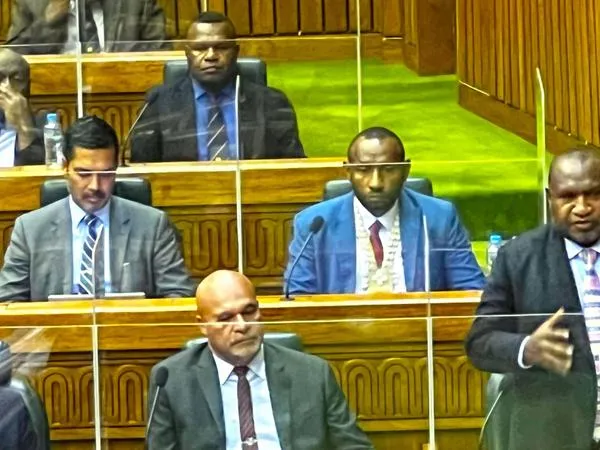
Photo: PM Marape in Parliament on August 9, 2022.
Prime Minister Hon. James Marape is making a call on Australian businesses to consider importing more from Papua New Guinea to balance the disproportionate import-vs-export scale that the two countries have existing between them.
He also wants to see more Australian investors partner with PNG to move his Government’s goals on downstream processing and industrialisation closer to realisation.
The Prime Minister said this today (170822) as he apologised to Business Advantage PNG for his non-attendance at its recently-concluded conference because of urgent work commitments, but thanked it at the same time for continually hosting these forums that keep in the public and investor consciousness trade and investment between the two countries.
The Prime Minister said: “I thank the council for its continued conferences, seminars and forums but what else will they hear from me?
“I have been speaking my mind since 30 May 2019. They know me. I am pro-Papua New Guinea business while I encourage strongly foreign businesses who let Papua New Guinean partnership and engagement.
“We want to Take Back More from our natural and national wealth with a balanced view that our genuine foreign investors make a return on their investments.
“We want to move now into industrialisation by tapping into downstream processing of our natural resources.
“I want to ask Australia companies to seriously partner PNG companies in the area of PNG building a stronger diversified economy and it is about time Australia buy more of PNG’s products.”
While appreciating the sturdy relationship already existing between the two countries, the Prime Minister pointed out that new heights could be reached if Australia could push its trade and investment boundaries further by exploring these named options.
“Australia and PNG businesses have had a relationship for along time and that is good but we need to reach new heights. With Australia as a place of export for our products, we have a huge trade imbalance where we import more and export less to Australia.
“We want to send our food, our energy, our finished forest products, and our human resources at all levels to Australia.
“I was at Singapore organising our diplomatic mission to be at the front of our trade, commerce and business engagements with South-East, North and West-Asia where we have over two billion people in these markets.
“I am serious about downstream processing of our resources to make an economic leap for PNG. This includes our creating a law-abiding and orderly country, finding cheap energy and using PNG’s bilateral relationships to secure markets for our products.
“It is about time PNG and Australia as close nations politically become even more closer in by having Australian business buying PNG products and hiring PNG workforce.
“Areas like replacing food imports is something I am looking at very seriously so we stop capital flights elsewhere but grow PNG.
“If PNG is stronger economically then Australia and the region benefits with a secure solid nation of millions of people.”
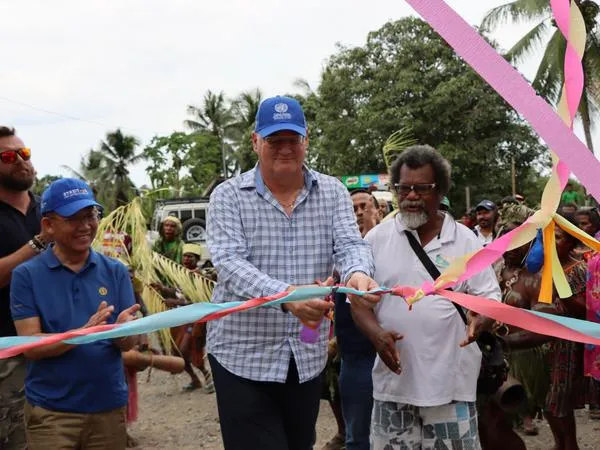
The EU Ambassador to PNG launched a new transport infrastructure project in East Sepik which improves access to market, business opportunities, health aids and schools for more than 2000 villagers in a ground-breaking ceremony.
His Excellency, Ambassador Jernej Videtič, the Head of the European Union Delegation to PNG was in East Sepik recently to inaugurate the rehabilitation of a 6.5 km Munji-Haripmo farm-to-market access road being implemented by the EU-STREIT PNG Programme.
Led by ILO, this project will support 2,200 users as well as open up economic opportunities for the rural communities.
Officiating the ground-breaking ceremony, Ambassador Jernej Videtič said: “the European Union is financing this project to support better marketing of cocoa products and create income generating opportunities to improve schools and health services for the people.”
On behalf of the Provincial Administration, the Acting Deputy Provincial Administrator, Mr James Baloiloi said: “Because of limited financial resources the EU came to help us, especially the people in the Sepik Plains at the backend of this road so we must say thank you to the European Union.”
The EU-STREIT PNG Programme Coordinator, Dr Xuebing Sun also underscored: “Road infrastructure is vital for better welfare and livelihoods of you. This road will provide you with improved access to information, markets, finance, and social services. Maintaining good conditions of the road is key for long term sustainability of your welfare and livelihoods. Thanking to European Union for its generous funding support, we are happy that we are able to reach you and we are here to support you.”
A mother of eight children, Mrs Rita Maru, shared on struggles women in the area face: “For 40 years we carry our market produce and walk 6.5 km to the junction. As a mother, I’m very happy today because we’re looking forward to getting on a Public Motor Vehicles at the doorstep of our house.”
Contractor for this 12-month road project is Kaystar Construction Ltd which will do embankment filling; scarifying, reshaping, and compaction with construction of retaining structures (Stone masonry and gabion wall), 2 reinforced concrete cement (RCC) causeway, reinforced cement concrete vented causeway, 6.5km gravel surface, 28 traffic signs and signages, plastering and painting works and construction as well as maintenance of 7 pipe culverts.
This project is the fourth road out of fifteen farm-to-market access roads that are planned to be rehabilitated by the ILO under the EU-STREIT Programme in the Sepik region, as part of the Programme's stream of works to provide sustainable, climate-proof transport infrastructure aimed at improving agri-food value chains and agri-business enabling environment.
Ambassador Videtič also had the opportunity to overview first-hand rehabilitation work which has started last month on a 7.8 km Banak-Wautogik road in Wewak District by local firm Hiawani Ltd. This road will serve more than 2000 farmers/villagers of Boikin and Dagua LLG of Wewak District, ESP. This is another 12-month farm-to-market access road project implemented by ILO under the EU-STREIT PNG Programme and will generate lots of work for the rural communities.
The EU-STREIT PNG is being implemented as a UN Joint Programme (FAO as leading agency, and ILO, ITU, UNCDF and UNDP as implementing partners), is the largest grant-funded Programme of the European Union in the Country and the Pacific region. It focuses on increasing sustainable and inclusive economic development of rural areas through increasing the economic returns and opportunities from cocoa, vanilla and fishery value chains and strengthening and improving the efficiency of value chain enablers, including the business environment and supporting sustainable, climate-proof transport and energy infrastructure development.
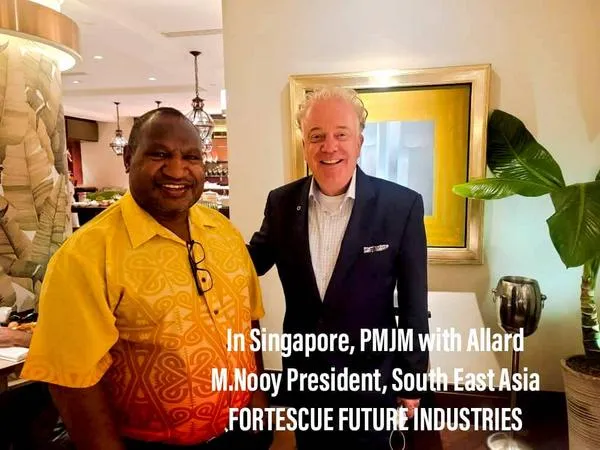
Prime Minister Hon. James Marape hits the ground running in the frontier-breaking clean green energy projects he has been championing over the last two years when he met with leaders of Fortescue Future Industries (FFI) in Singapore recently to progress the talks further.
He said from Singapore FFI has voiced its intention to partner Papua New Guinea in a big way to harvest clean green energy from both hydro and geothermal sources as well as move later down the line into solar and wind energy production.
Currently, FFI has identified and set up project sites in Gulf Province for hydro and West New Britain Province for geothermal work and has been working in these areas since the signing of two important agreements since 2021.
Prime Minister said from Singapore today: “With global consciousness of fossil fuel-induced global warming, clean green energy is the way to move into the future and this meeting follows on the Head Agreement PNG has signed with FFI to progress investment in this energy sector.”
The Prime Minister flew into Singapore to continue these important trade & investment conversations including those on Papua LNG, Pasca LNG, Pn’yang LNG and also to get Porgera and Wafi-Golpu sanctioned.
The Prime Minister also visited the PNG High Commission in Singapore with a view to strengthen it further as a trade and investment office while getting the PNG government to increase trade and investment with the ASEAN and APEC countries.
He said: “The Singapore office will be given more support in that context in partnership with Investment Promotion Authority, the Kumul companies, National Fisheries and Forestry authorities, and our Agriculture & Livestock departments so that it coordinates export and trade into the lucrative Asian market of over 2 billion people who need food and energy, and products PNG can mass produce into the future as we are planning under my government.”
This month, James Marape is re-elected as the Prime Minister of Papua New Guinea. Despite a general election that was scourged with moments of violence, death, destruction of infrastructure, and claims of election fraud, Marape is back in the office as the country's leader.
In the current election, Marape's Pangu Party earned at least 36 of 118 seats and is on the way to lead a coalition government that is composed of at least 17 different parties.
Another milestone for this election is that for the first time in several years, women candidates have been elected in Papua New Guinea's parliament government. [1]
One of them is Rufina Peter who is an economist and member of the main opposition party called People's National Congress. Peter will serve as governor for winning the Central Province electorate. She is one of the two women elected.
The election in some areas were almost declared as failed elections by the PNG police and electoral authorities due to some violent instances where a school and buildings were set on fire at the Enga Province. There were also attempts to remove ballot boxes in Hela Province. [1]
In a recent encounter with foreign media, the Australian Broadcasting Corporation, PM Marape disagreed with their comment that PNG's lack of female representation in Parliament is a slow progress despite having Peter elected as Central Province Governor. [2]
The Prime Minister replied that Australia's first female in the Australian Parliament only happened after 40 years. Australia's federation started in 1901, but it was only in 1943 when there were females elected to Parliament. At that time, Dame Enid Lyons was elected to the House of Representatives, while Dorothy Tangney was elected to the Senate.
On the other hand, in Papua New Guinea, it only took three years for women to be a part of the Parliament.
Aside from Rufina Peter, Kessy Sawang for the Rai Coast open seat in Madang has been elected to Parliament in the 2022 National elections.
From 2012 until 2017, Papua New Guinea also had three women who represented in Parliament. They were Julie Soso of the Eastern Highlands, Delilah Gore for Sohe Open and Loujaya Tony representing Lae Open.
-----
Prime Minister James Marape was born on 24 April 1971 and has been serving as the Prime Minister of Papua New Guinea since May 2019. Since July 2007, he has been a member of the National Parliament of Papua New Guinea where he represented the electorate of Tari-Pori Open in Hela Province in the highlands. In the past, he held cabinet positions as Minister of Education from 2008 until 2011 and as Minister of Finance from 2012 until 2019.
Marape was born in Tari, Hela Province. He studied in Minj Primary School and Kabiufa Adventist Secondary School in the PNG highlands. Marape earned his degree in Bachelor of Arts from the University of Papua New Guinea in 1993 and a postgraduate Honours Degree in Environmental Science in 2000.
Outside of his political career, he was Officer in Charge at the PNG Institute of Medical Research, Tari Branch from 1994 until 1995. For two years (1996 - 1998), Marape was the Operations Manager of GDC at the Hides Gas project. After earning his honours degree, he became the Acting Assistant Secretary of Policy with the Department of Personnel Management from 2001 until 2006. (by Marcelle P. Villegas – PNG Business News)
Reference:
[1] (10 Aug. 2022). "James Marape returns as Papua New Guinea prime minister". RNZ News website.
Retrieved from - https://www.rnz.co.nz/international/pacific-news/472591/james-marape-returns-as-papua-new-guinea-prime-minister
[2] (14 Aug. 2022). "PNG PM Marape slams Foreign Media". Papua New Guinea Today.
Retrieved from - https://news.pngfacts.com/2022/08/png-pm-marape-slams-foreign-media.html
Photo credits: https://news.pngfacts.com/2022/08/png-pm-marape-slams-foreign-media.html
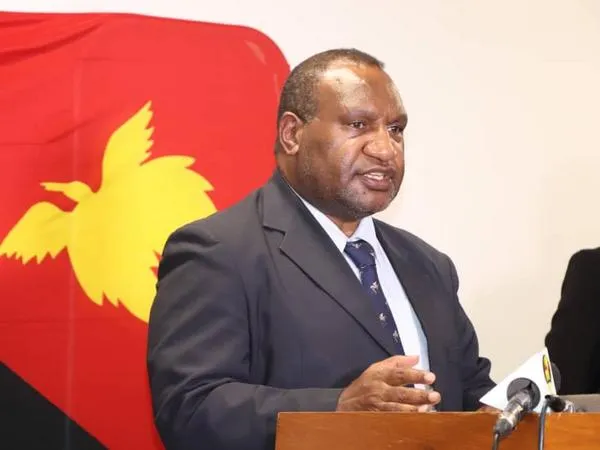
Photo: PM Marape addressing Parliament on Tuesday, August 9, 2022
Prime Minister Hon. James Marape says his Government will do its “utmost best” for the people of Papua New Guinea.
He said this recently (Sunday, August 14, 2022) as he goes through the process of selecting ministers and laying the groundwork for the next five years.
“On August 30, 2022, when Parliament resumes, the Governor-General will be addressing MPs,” PM Marape said.
“Our full Cabinet will be in place by then and I will make a response to the Governor-General and the country as to what exactly we will be doing and some Key Performance Indicators (KPIs) that will hold the Government accountable.”
PM Marape said his Inaugural Statement to Parliament on Tuesday, August 9, was a general one that covered the thoughts and intentions of Government.
“When I make a response to the Governor-General’s statement on August 30, 2022, it will be more detailed and will indicate what we will do in different sectors like Health, Education, Law-and-Order, Infrastructure and Economy,” he said.
“These were the bases on which Pangu Pati received overwhelming support nationwide, since we reclaimed Government in 2019.
“We will not let our people down since they shared these aspirations when they voted for Pangu.
“We have committed to a better Papua New Guinea through strategic interventions in these key sectors, which are vital for our country to grow.
“We want to better our Law-and-Order environment, Infrastructure, Economy, Health and Education.
“We will expand on these five focus areas into an exact plan on what we will do.”
PM Marape urged all Papua New Guineans to be positive about the future of the country.
“We are a continuing Government and know exactly what to do for our country over the next five years,” he said.
“The next five years are fundamentally important as we work towards our 50 years of nationhood in 2025.
“We want to steer our country in a better direction guided by our core principles and values like ‘Take Back PNG’, ‘Richest Black Christian Nation’, and ‘Leaving No Place and No-one Behind’.
“These are very much congruent to the Vision 2050 intentions and clarity on what these mean, and our national outcomes will be augmented in the next sitting of Parliament.
“The country can rest assured that we know exactly what we are doing, and that we want our country to be a better place.
“By the time we hop out of this decade, into the 2030s, we must be well on our way to the better destination that we have created in the 2020s.”
Article courtesy of PM Marape News Page
EU Funded UN Joint STREIT Programme in Papua New Guinea establishes a renewable energy-powered facility to support local government authorities in East Sepik Province, in delivering effective services to rural farmers and entrepreneurs.
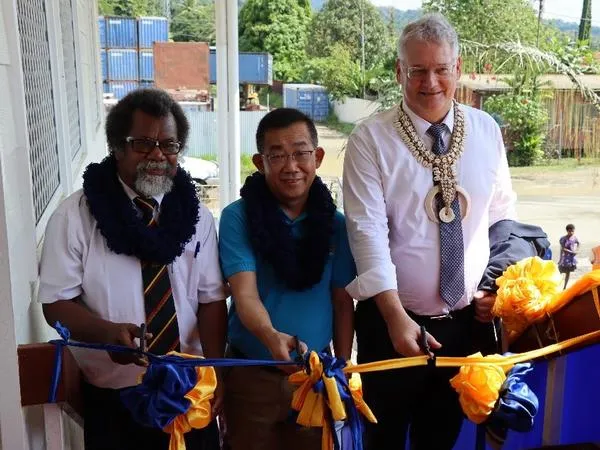
With generous support of the European Union, the FAO-led EU STREIT Programme officially opened a new 3 cluster office building on 10 August 2022, to host the Programme along with the East Sepik provincial divisions of Agriculture and Livestock, Cocoa Board and the National Agriculture Quarantine & Inspection Authority.
The new-look office building is powered by 189 solar panels, which significantly reduce greenhouse gas emissions and reduces the collective dependence on fossil fuel. The solar panels supply the building with 90 KW of energy, relieving the resident agencies and authorities from relying on fossil-generated electricity for their needs, including lighting, ICT, water pumping, and temperature control.
This zero-carbon-emission facility has the capacity to accommodate around 90 experts, technicians and extension service officers. Equipped with 120 batteries, the building can support staff’s operation for 36 hours in case of experiencing high cloud cover.
The building, currently co-resided by the Programme and provincial agricultural bodies, will be transferred over to the East Sepik Provincial Administration at the end of the Programme and will continue to provide a sustainable base for sustainable support to agriculture-related services in the Province.
Officiating the opening ceremony, His Excellency Ambassador Jernej Videtič, Head of the European Union Delegation to PNG, in his address, said: “I am happy to be here and to see that things are moving in the right direction to bring sustainable benefits to the people of East Sepik” Ambassador Videtič further highlighted that “with resources from the citizens of Europe to fund the EU-STREIT Programme in providing training, tools and support, the quantity and quality of cocoa, vanilla and fisheries products will increase. The objective is also to protect these quality products in international markets under the EU-STREIT introduced initiative of Geographical Indication.”
The East Sepik Acting Deputy Provincial Administrator, Mr James Baloiloi, in his speech expressed his appreciation to the EU for funding the EU-STREIT Programme and the interventions that the Programme is doing in East Sepik and Sandaun provinces. “The STREIT Programme has gone ahead to introduce a culture of agribusiness that now enables the people of this Province and the people of Sandaun Province to have cash income that can sustain their livelihoods.” Mr Baloiloi added, “this infrastructure and building supports us and facilitates the service delivery to our people in this Province as well as Sandaun Province.”
Thanking the EU for its generous funding support, Dr Xuebing Sun, the EU-STREIT Programme Coordinator, said: “the Programme has generated substantial impacts at beneficiary, local institutions and enabling business environment levels. This would not be possible with good partnership, increased ownerships and leaderships of the governments and implementing partners.”
“This co-residing and close co-operation among UN agencies and their national partners in this integrated space reflect the partnership approach taken by the Programme to sustainably develop agri-enterprise activities in the region,” added Dr Xuebing Sun, adding “the new climate-friendly facility, which is fully powered by solar energy, also provides a space to welcome, advise and serve the farmers, including interested women and youth, who play very important roles along agri-food value chains”.
“This kind of ‘green investment’ enables a shift to a more green economy for local institutions and infrastructure to meet cocoa, vanilla and fishery value chains stakeholders” advised Anthony Bennett, the FAO Lead Technical Officer of the EU-STREIT PNG Programme.
United Nations’ implementing partners supporting the FAO-led EU-STREIT PNG present in the office include the International Labour Organization (ILO), International Telecommunication Union (ITU), United Nations Capital Development Fund (UNCDF) and United Nations Development Programme (UNDP).
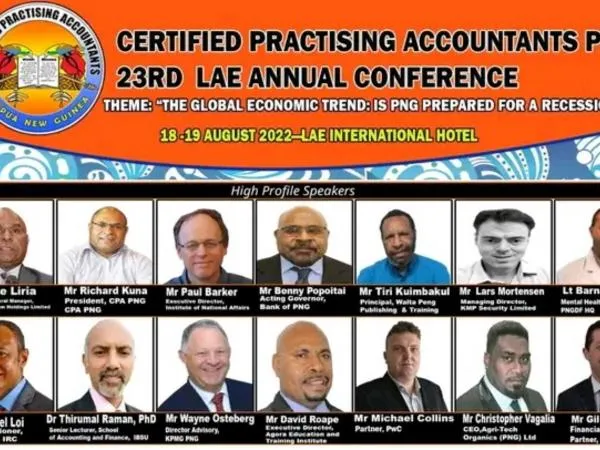
Certified Practicing Accountants of Papua New Guinea will be hosting their 23rd annual conference with about 400 participants nationwide expected to attend the two day conference organized by CPA PNG in Lae Morobe Province from August 18 to19, 2022
CPAPNG was established in 1974 and has come a long way with a lot of achievements along the way. Over the years its membership grew from mere numbers to just below 2000 which includes 40% locals and 60% non-citizens. .
The CPA PNG conference is one of CPAs three significant annual events on their calendar with this year's conference theme; Is PNG prepared for the recession?"
The conference will see certain key leaders in executive management roles from both the public and private sector delivering presentations in line with the conference theme.
CPA PNG's Executive Director Mr. Yuwak Tau said the theme of the conference was selected because there was a decline in the global economy and the general so when that eventuates small economies tend to be affected.
He added that they have basically selected the theme that was current and appropriate so that members would find relevance during the course of the conference.
“The meeting is to create intellectual and interactive discussions with seasoned business leaders to present and share their ideas and experiences to find probable outcomes within their business environment and industries in times of economic uncertainty”.
Some of the topics to be presented by consultants are current significant issues such as crypto currency, transport pricing, bit coin block chain technology and stress management. This were some topics that people have heard about but have not really ventured into.
Mr. Tau added that it would be quite hard to measure the benefits immediately but the participants will be able to look at insights shared during the conference that would be appropriate in the areas of employment, accounting, finance, auditing and others. The conference will create an environment where participants can also share information so That they can take points to apply in their work place and industries.
In relation the Kumul petroleum Holdings had also presented a cheque of K50, 000 to support the coming event at their head office. The cheque was presented by KPHL's executive General Manager Corporate Affairs, Luke Liria and was received by CPA PNG Chairman Richard Kuna.
Mr. Liria said KPHL has appreciated the effort put in by CPA PNG to ensure that its members in State owned enterprises and the private sector were given appropriate level of training and as part of KPHL's corporate social responsibility and commitment they hope that their support will continue to help the organization facilitate and make sure the accounting practices is of international standards.
CPA PNG's Chairman, Richard Kuna acknowledged KPHL for their support and stated that he was looking forward to seeing KPHL being a big part of the upcoming conference.
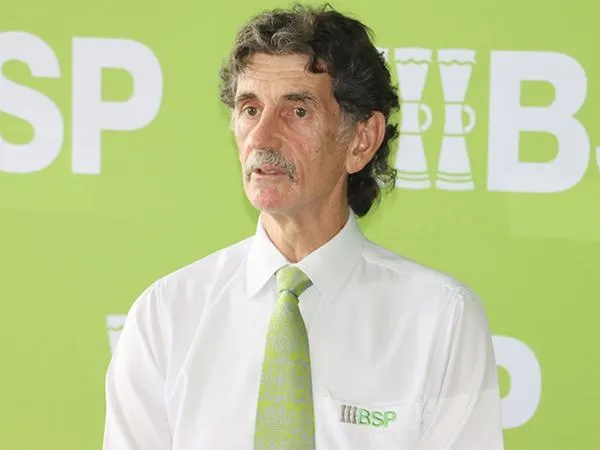
Bank South Pacific's Financial Group Ltd Chief executive officer Mr. Robin Fleming has recently announced that the bank has granted more than K200 million as loans to small to medium enterprises under its credit scheme facility that the then Marape government had released to the bank to support Small to Medium Enterprise (SME) and local businesses during the peak of the COVID-19 pandemic.
Mr. Fleming said about 1523 customer loans have been approved, that is about 60% of loan approval rates since 2019.
Prior to this announcement BSP and the Department of Commerce and Industry (DCI) had agreed to increase the maximum loan under the small-to-medium enterprise (SME) credit enhancement facility to K5 million. The previous limit was K3 million when the Government first released K100 million as security to the bank under its K200 million SME allocation for BSP to rollout the loan facility last year.
Fleming stated that even though they have exhausted and rolled out the bulk of the governments relief funds for SME's they will still be running the SME loan program under its credit facility scheme
“At this stage, BSP has not received the funding planned for this year but that is not preventing BSP from giving loans under the facility”.
“There remains significant capacity for BSP to continue to assess, approve and funds loans under the facility”.
“The agreement with the Government did provide for momentum in the SME facility to be maintained while allowing for the Government budget and funding process to be adhered to”.
As part of the government SME relief funding, Commercial Banks were allocated K200 million with BSP Financial Group receiving K100 million, NDB K80 million and another K20 million was allocated to the department of Commerce and Industry
BSP could not comment on how the National Development Bank (NDB) is dealing with the K80 million it received, but the intent, when discussions were initiated, was that BSP would be lending to more mature SMEs and NDB to startup ventures.
In addition to enabling SMEs to access lower cost of funds through the facility with BSP, the bank has also made it a responsibility to ensure that Government funding is preserved by not approving loans that have a higher risk of default.
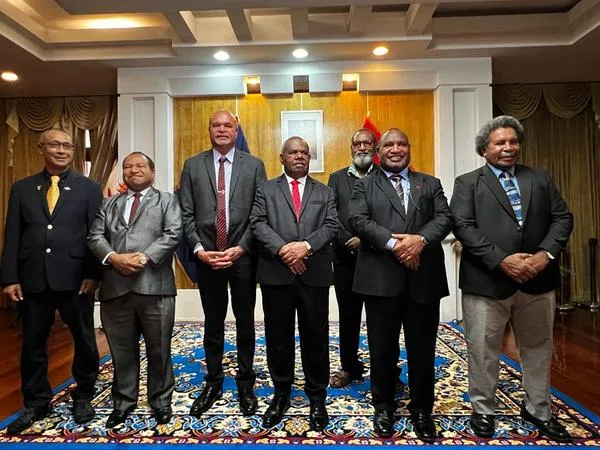
Photo: The Caretaker Cabinet with Governor-General Sir Bob Dadae in Government House
Prime Minister Hon. James Marape says he will take no more complacency from heads of Government departments and agencies to move Papua New Guinea forward.
He said this in no uncertain terms during a meeting with them on Loloata Island recently (Thursday August 11 2022).
PM Marape said heads of departments and agencies who failed to perform would be removed immediately.
The Caretaker Cabinet of PM Marape, Deputy Prime Minister Hon. John Rosso, Hon. William Duma, Hon. Ian Ling-Stuckey and Hon. Soroi Eoe are now into checking on Government departments and agencies.
The Prime Minister said fundamental guides such as Vision 2050 and the Eight-Point Plan were already in place to guide heads of departments and agencies and there should be no more excuse for complacency.
“Every department and agency should now have handover-takeover notes for the transition of Government,” PM Marape said.
“We must be equipped with up-to-date statistics and correct information.
“I’m assuming that you have all this ready, and by next Tuesday (August 16 2022), all these reports should be handed in.
“I intend to appoint a full Cabinet by next Thursday (August 18 2022) and heads of departments and agencies should have all these ready for the new ministers.
“I bluntly tell heads of departments and agencies that continution in your job hinges on what you have achieved over the last three years, and your plans for the future, consistent with views of Government.
“There is no gurantee of you continuing your job if you fail to comply with these by next Tuesday
“The days of free rides and complacency are over.
“I have had three years of experience as Prime Minister, from 2019 to 2022, to know who’s who in our political and administration systems.
“I have 15 years of experience as a political leader now, and am well-versed in Vision 2050, and our hopes and aspirations for PNG.
“Before the full Cabinet is appointed, I want to check the work of all department and agency heads, to see whether or not you have been performing.”
PM Marape said the onus was on this current generation of leaders to fix up the country.
“I want to grow the economy to a K200 billion economy at the very earliest,” he said.
“Pangu Pati went into the elections campaigning on economic independence.
“Albert Einstein once said, ‘doing the same thing over and over, and expecting different results, is insanity’.
“I’ve been talking, and talking, for the last three years and I now want to see tangible outcomes.
“I want results to be placed on the table for all to see.
“We want to better our country as we journey into 50 years of Independence at 2025 and beyond.”
The National Fisheries Authority named Justin Ilakini as its new Managing Director in an official statement on July 28.
Ilakini has extensive knowledge of the fishing industries in both Papua New Guinea and the region. He was born and raised in Gavuone Village, Central Province, and served with the NFA for eight years before accepting advising positions with the Pacific Islands Forum Fisheries Agency in Honiara, Solomon Islands (FFA). He worked with the governments of Pacific FFA members and key figures in the tuna business throughout his more than nine years of service to the FFA, promoting regional economic integration and facilitating investment.
He rejoined the NFA in 2019, and he has since been given the job of Managing Director. Mr. Ilakini brings to NFA a strong desire to advance a transformation agenda.
Two key elements of this transition will be the organisational and fisheries sector reforms.
The major goal of these changes is to make sure that the NFA, as an organisation, is in the best possible position to preserve the development pillars that are mentioned in the Fisheries Strategic Plan 2021–2030. They are as follows:
Ilakini states, “At the NFA our key mandated function is to protect and sustainably manage our resource and to ensure it is secured for our children for generations to come, but at the same time we also have the challenge to generate and raise revenue.”
“Those functions at times can have conflicting policy objectives with each other, so through the wisdom of the National Fisheries Board, and under my leadership, we will endeavour to ensure government policy directives are effectively implemented through appropriate structural changes.”
The primary agenda items backed and strongly supported by the Government are outlined in Ilakini's inaugural 90-day plan as key emphasis areas that aim to jump-start key parts of organisational strengthening along with increasing the NFA's reach into the commercial sphere.
Ilakini states “We have established a commercial entity that is 100% owned by the NFA.
“This commercial entity, namely Fisheries Capital Limited will be the engine room for maximizing revenue, enabling key infrastructure to help expand our fisheries industry, grow downstream processing, increase local participation and be solely responsible for capitalizing the sector with PNG interests at its heart. This can also be seen as our strategy to capitalize on our major source of revenue, the vessel days scheme (VDS), wherein we will look at creating more value from our tuna resources, instead of just rent-seeking.”
"Transform Papua New Guinea into a significant commercial fisheries hub in the Asia Pacific" is the overriding goal of these programmes. This includes embracing efforts for digital transformation to enhance service delivery and better position the NFA to be digitally nimble in the rapidly changing world of e-commerce and digital business.
Reference: Loop (1 August 2022). “Dawn of a new era for NFA”.
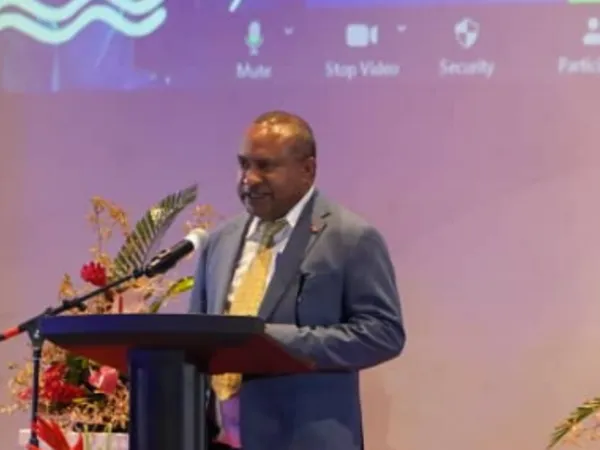
Treasurer Ian Ling-Stuckey cites the International Monetary Fund's (IMF) 6.8% inflation forecast for Papua New Guinea.
“PNG’s economy can be greatly affected by shifts in the global economy,” he said.
“The latest IMF World Economic Outlook released last week increased inflation predictions for developing countries to an extraordinary 9.5 per cent average in 2022.
“In contrast, the latest IMF prediction for PNG is 6.8 per cent.
“In these challenging times, PNG needs good economic management to protect PNG from the buffering seas of the international economy,” he said.
The expense of living burden brought on by the conflict between Russia and Ukraine, he claimed, has been managed by the government.
“The K611 million household assistance package announced back in April has already removed all taxes from retail fuel products,” he said.
“Wage earners are receiving up to K42.30 per fortnight due to the reduction in taxes because the tax-free threshold has been moved from K12,500 to K17,500.
“The Department of Education is working with the Treasury to fund all legal school project fee costs in 2022.
“And the IRC is working to reduce prices of key commodities such as rice and tinned fish.”
Reference: The National (1 August 2022). “IMF predicts 6.8pc inflation”.
Photo credit: Islands Business
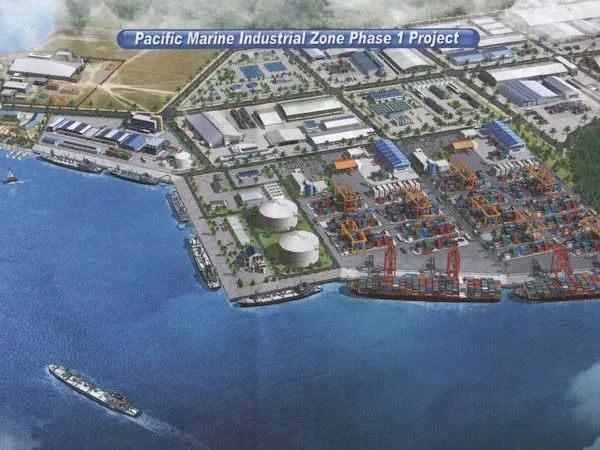
The Madang business community wishes to contribute more to the growth of the Pacific Marine Industrial Zone (PMIZ) in the region.
The development of the project, according to Kevin Murray, president of the Madang Chamber of Commerce and Industry, would have a favourable effect on the city's economy.
A committee has been formed for the initiative, but according to Murray, corporations have not yet shown an interest in it.
“As far as I know, the business community hasn’t been involved in any discussions,” he said.
“We know there are some plans to develop it, but there has been no communication with the business community.
“We would like the people who are developing and promoting the project to talk to us so we can know what plans they have.”
The PMIZ and the Manus tuna facility are key projects for the fisheries industry, according to Fisheries Minister Dr. Lino Tom.
According to Lino, the government has budgeted K100 million for the PMIZ, which has been delayed by ten years.
The Manus tuna facility will be developed using K30 million of the funds.
“The PMIZ is like a flagship project that will drive our 10-year strategic plan, so it’s actually on foot,” he said.
“We’ve also engaged KPMG to do the financial feasibility.
“We hope to start work this year based on the feasibility and the reports.”
Businesses in Madang want to see the provincial government come together and cooperate for the province's economic advancement.
According to Murray, the lack of leaders who collaborated to promote the province had to change if Madang was to realise its potential.
“In the last term of parliament, we didn’t have this, members were doing their own thing and not cooperating together,” he said.
“This has to change after the elections.”
Murray characterised the economic situation in Madang as typical.
“Everyone is a bit weary but business is fairly close to normal,” he said.
“We would like to see the PMIZ developed, that might happen after the new Government is in place.
“There are some large Chinese businesses coming and stimulating the local economy.
“Basically for all these things to happen we need to have politicians who are going to act in the best interest of people, province and the betterment of the economy.”
Murray also emphasised the importance of finishing the Modilon road, which was still under construction.
He claimed that because of the poor condition of the road, businesses suffered from automobile damage.
“But things are looking up now because there are a lot more activities and we are looking forward to the road being completed.”
The business community hoped that the General Election of 2022 would be conducted peacefully, Murray continued.
Reference: The National (2 August 2022). “Madang businesses want input in PMIZ development: President”.
Photo credit: Centre for Excellence in Financial Inclusion
Financial information is vital to making informed decisions and NASFUND Contributors Savings and Loan Society (ncsl), as a financial institution, endeavors to provide necessary training and awareness to empower people to make good financial decisions.
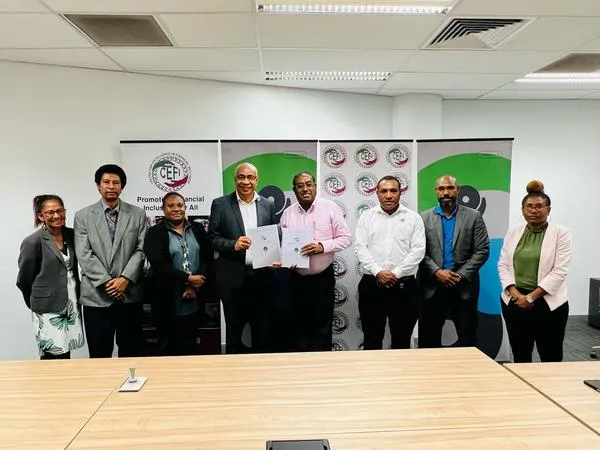
On Monday 01 August, ncsl and Centre for Excellence in Financial Inclusion (CEFI) signed a Memorandum of Understanding for Financial Literacy Training.
Under the MoU, CEFI will provide a ‘Train the Trainers’ program to ncsl staff to empower them to go out and conduct educational awareness on financial literacy to the Society’s growing membership.
CEFI’s Financial Literacy Program will train ncsl officers on how to facilitate and deliver financial literacy information to its members so they are empowered to make appropriate financial decisions, including accessing the right types of financial products and services that address their business and household needs at reasonable costs.
ncsl Chief Executive Officer Vari Lahui said ncsl is pleased to partner with a recognized institution in the country that specializes in financial literacy training and is also mandated to drive programs on financial inclusion.
“Through our Lending, we have noticed that our members entering into numerous borrowing arrangements with other financial institutions at exorbitant costs and we believe the partnership with CEFI allows us to gain the knowledge and experience to reach out to our members in such situations and assist them with advice,” he stated.
CEFI Advisor Saliya Ranasinghe said CEFI is privileged and happy to partner with the most innovative and progressive society in the country.
“We are very pleased to work with the largest savings and loan society by membership size to train staff and clients to make a difference in the community through this program.
“Financial literacy is something everybody in this country needs. PNG has a lot of money but the problem is how to manage it. This partnership between the two organizations now enables progress towards better managing the issue of better financial management,” Ranasinghe said.
The MoU will initially run for a period of 12 months and ncsl aims to reach out to as many members as possible and will provide progressive monthly updates to CEFI as part of the agreement with the aim of enhancing the Program where necessary.
Article courtesy of the Centre for Excellence in Financial Inclusion
Follow on LinkedIn:
PNG Business News
Be the "First" to get our exclusive Digital Magazine & Weekly Newsletter.