TISA Bank Limited, a homegrown 100% Papua New Guinean financial institution, has emerged as a modern, values-driven alternative in the commercial banking sector after receiving its banking licence in 2024 — the year of the country’s 50th anniversary of independence.
In an exclusive interview with PNG Business News, TISA Group Chief Executive Officer Mr Michael Koisen OBE ML reflected on the institution’s rapid evolution, outlining how the bank is combining digital innovation, financial inclusion and ethical banking to reshape access to finance across the country.
He said 2025 represented a period of “transition and trust” as the group consolidated its operations following the approval of its banking licence in 2024.
“In 2025, TISA Bank did not just operate — we evolved,” Mr Koisen said, describing the year as a turning point following the bank’s successful launch as a licensed commercial institution.
Group CEO Mr Koisen remains confident that TISA Bank’s value-driven approach provides a strong foundation for long-term growth.
“Our vision is to be the heartbeat of PNG’s economy — a bank that listens, innovates and grows alongside every citizen,” he said. “We don’t just see customers; we see the architects of our nation’s next 50 years.”
“Since Papua New Guinea gained independence, TISA Bank has emerged as a homegrown financial institution proving that a bank deeply rooted in its people can still compete successfully with mainstream banks.”
TISA in PNG is the largest savings and loan society and credit union in the Pacific. Born from a teachers’ savings movement that began more than five decades ago in 1972, the financial institution has evolved with ambitious plans to expand financial access, modernise banking services and retain national wealth within the country.
“What began as a small savings group for teachers has evolved into a modern financial institution that seeks to balance commercial performance with national development goals,” Mr Koisen said.
Mr Koisen clarified that while he serves as Group CEO of TISA Group, the organisation’s structure includes several subsidiaries beyond the bank.
“TISA Group owns TISA Bank. We also own an insurance company that has recently been renamed TISA Insurance Group, with operations across Fiji, Tonga, Vanuatu, Solomon Islands and PNG. In addition, we have property investments, an equity portfolio and a security business.”
He added: “We have consistently paid our members a 7% bonus for more than 15 years. We have never dropped below that percentage.”
According to Mr Koisen, the bank’s philosophy is built around what it calls “values-based banking”, an approach reinforced by its membership in the Global Alliance for Banking on Values (GABV), a global network promoting financial institutions that prioritise community well-being and sustainable economic development.
This model reflects the bank’s commitment to ensuring profits remain within PNG, supporting national development rather than being exported overseas.
Strong Financial Performance in a Transitional Year
TISA recorded strong financial performance in 2025. Total group assets reached K1.39 billion, representing a 22% increase and signalling growing public confidence in the institution.
Even during this expansion phase, the bank maintained its commitment to members by distributing approximately K24.5 million in bonus interest, representing a 7% return to more than 80,000 members.
For Mr Koisen, the distribution reflects the bank’s continued commitment to its cooperative heritage.
“We are not just a financial institution; we are a partner in progress. We believe that empowering our people means unlocking prosperity for our nation,” he said.
Digital Transformation as a Growth Engine
A central pillar of TISA Bank’s growth strategy is its investment in modern digital infrastructure.
Rather than adapting outdated legacy systems, the bank adopted a digital-first architecture built around the Oracle FLEXCUBE 14.7 core banking platform. This system allows real-time transaction processing, automated back-office operations and enhanced data security.
The platform’s API-first architecture also enables integration with external systems, including government digital platforms and payroll systems such as ALESCO, which was successfully integrated in March 2025. The integration allows thousands of public servants to receive their salaries directly into TISA accounts, simplifying financial management for the workforce.
The new digital platform has driven a triple-digit increase in “new-to-bank” accounts, largely due to the convenience of mobile and internet banking services.
Pacific-First Innovation in Banking Technology
Building on its digital transformation strategy, TISA Bank has introduced several innovations designed to increase accessibility for customers across the Pacific region.
Among the most notable is voice-activated banking integrated with Siri technology, enabling customers to perform basic banking functions using voice commands.
The initiative represents a regional first and is particularly significant in a country where literacy levels and digital familiarity vary widely.
“We are the only bank in the South Pacific that allows you to talk to your bank using voice technology through your iPhone. You can tell the app to transfer money and it will complete the transaction for you,” Mr Koisen said.
The bank has also introduced the Yumi Pei digital wallet, designed to support QR payments and instant transfers while reducing PNG’s heavy reliance on physical cash.
In January 2026, the bank further expanded its digital offering with the launch of a vertical Visa debit card featuring modern security design and 3D Secure technology for safer online and international transactions.
While technological innovation remains central to TISA’s strategy, financial inclusion continues to be the institution’s primary mission.
Approximately 75% of PNG’s population remains outside the formal banking system, presenting both a national challenge and a major opportunity for financial institutions.
To address this gap, TISA has introduced an agency banking model that shifts away from expensive brick-and-mortar infrastructure.
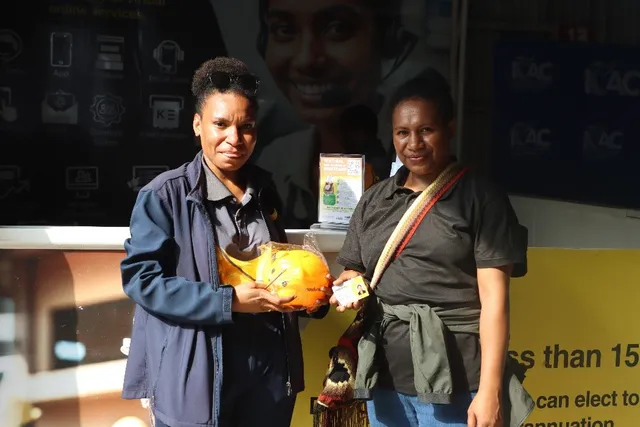
Through partnerships with local trade stores and small businesses, the bank is establishing community-based agents capable of providing basic banking services such as deposits and withdrawals within rural villages.
This model allows customers to access financial services without travelling long distances to urban centres.
Complementing the agency network is biometric onboarding technology, which allows customers to open accounts using fingerprint or facial recognition verification. The system enables individuals with limited identification documents to register using community references from village magistrates or pastors.
Supporting Small Businesses and the Real Economy
Beyond retail banking, TISA Bank has also positioned itself as a key partner for Papua New Guinea’s small and medium enterprise sector.
Recognising SMEs as the “heartbeat of the economy,” the bank became the naming rights sponsor of the PNG SME Business Breakfast, committing K300,000 to initiatives supporting entrepreneurship and local business growth.
Through this initiative, the bank has supported credit guarantee programs that allow local businesses to secure financing when traditional lending options may be unavailable.
TISA also maintains deep ties with public servants and educators — communities closely connected to the organisation’s origins.
Expanding a Nationwide Banking Network
Alongside digital innovation, TISA Bank is rapidly expanding its physical presence across PNG.
As of early 2026, the bank operates five full commercial branches located in Port Moresby (Waigani), home to the flagship TISA Ruma headquarters; Lae in Morobe Province; Kokopo in East New Britain; Wewak in East Sepik; and Alotau in Milne Bay Province.
The Alotau branch, opened on January 8, 2026, represents the newest addition and supports Milne Bay’s push toward city status.
The bank continues to operate between 17 and 18 provincial service centres originally established under the Teachers Savings and Loan Society. These centres are progressively being upgraded into full commercial banking facilities.
By 2027, the bank aims to expand to 20 full-service commercial branches across 18 provinces, with Mt Hagen, Wabag, Kavieng and Madang among the next targeted locations.
To complement branch expansion, the bank has already deployed more than 50 agency banking partners, with plans to scale the network into the hundreds nationwide.
Strengthening Risk Management and Cybersecurity
Operating as a licensed commercial bank requires strict compliance with regulatory standards set by the country’s central bank, the Bank of Papua New Guinea.
TISA has adopted a “secure-by-design” philosophy, integrating cybersecurity and compliance systems directly into its digital infrastructure.
These include automated anti-money laundering and counter-terrorism financing monitoring systems that analyse transaction patterns and flag suspicious activity in real time.
The bank’s cloud-based infrastructure, hosted through Oracle Cloud, provides enterprise-level security, including encrypted data storage, continuous threat monitoring and disaster recovery systems designed to maintain services even during infrastructure disruptions.
Embedding ESG and Ethical Banking Principles
Ethical banking is another defining feature of TISA’s corporate identity.
As the first financial institution in the South Pacific to join the Global Alliance for Banking on Values, TISA integrates environmental, social and governance considerations into its decision-making processes.
“For TISA, ESG is not a compliance checklist — it is our DNA,” Mr Koisen said.
“We believe that banking can be a powerful force for good in overcoming social inequality and the climate emergency.”
The bank prioritises lending to sectors that directly contribute to the real economy, including agriculture and small-scale manufacturing.
Loans tailored for vanilla, cocoa and coffee farmers help support rural livelihoods while promoting sustainable land-use practices.
The bank also avoids financing projects that disregard community land rights or create significant environmental harm.
Investing in Local Talent
As a fully PNG-owned institution, TISA places strong emphasis on developing local leadership.
Mr Koisen said the bank is investing in staff training to build both technical expertise and a strong service culture.
“We want bankers who not only understand transactions but who genuinely care about improving the lives of Papua New Guineans,” he added.
The appointment of Luke Kaul as Acting Chief Executive Officer in February 2026, following his tenure as Group Chief Operating Officer since 2018, reflects the bank’s commitment to leadership continuity during its expansion phase.
TISA is also investing heavily in workforce development, training staff at its Waigani headquarters to manage complex digital banking systems and developing specialised roles such as market risk managers and digital compliance officers.
Partnerships with organisations such as CPA PNG support professional development among accounting and finance staff.
Looking Ahead
TISA Bank is now entering what leadership describes as a “scale and sophistication” phase.
The bank aims to balance its portfolio by shifting toward a 70% corporate and SME lending mix and 30% retail banking, while expanding into trade finance and foreign exchange services.
This strategy aligns with major economic developments expected in PNG, including large-scale resource projects such as Papua LNG and Pasca A, which could generate opportunities for local contractors and landowners.
However, the bank must also navigate emerging challenges, including regulatory scrutiny linked to PNG’s placement on the Financial Action Task Force grey list in February 2026, as well as infrastructure and skills gaps in rural areas.
Mr Koisen offered a word of advice.
“Banking is not a 100-metre sprint. The journey for us is a marathon because we want to do things properly and do them well. There is a saying: ‘speed kills’. While speed may be important for some, it can also be dangerous. Assess properly, make decisions and build robust systems that will stand the test of time.”
He told PNG Business News that the establishment of new banks in PNG would ultimately improve services across the country.
“For many years we only had four banks and customer service was often below par. With new banks entering the market, competition will drive improvements,” he said.
“One of my tasks is to give people services that are better than what they have been receiving for many years.”
According to Mr Koisen and the bank’s media management division, TISA Bank’s social media platforms have also played an important role in customer engagement and feedback over the years, helping strengthen the bank’s services and ensure accessibility for all customers — including farmers in rural communities.
He added that TISA Bank aims to position itself as an agile and customer-focused alternative.
“We are different. We are values-based, we are Papua New Guinean-owned, and our purpose is to empower our people financially.”
For TISA Bank, the mission is clear: to combine modern banking technology with community-focused values and ensure financial opportunity reaches every corner of Papua New Guinea.