

Bank of Papua New Guinea (BPNG) Governor Elizabeth Genia has assured the business community that Papua New Guinea’s recent placement on the Financial Action Task Force (FATF) grey list does not mean the country is unsafe for investment or business operations.
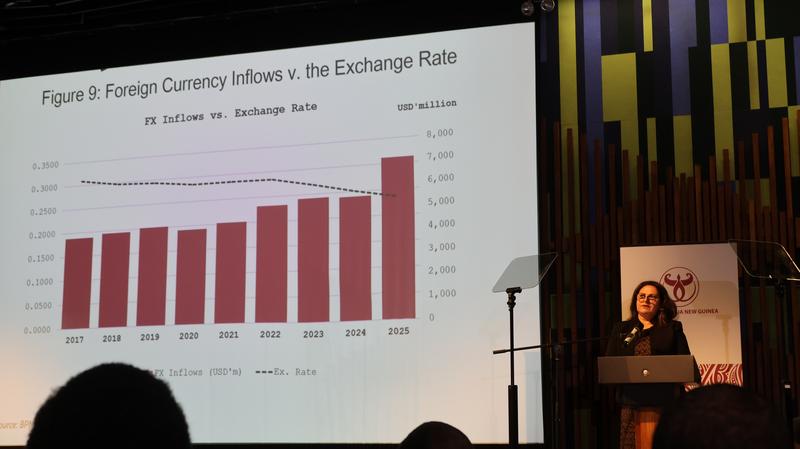
Governor Genia made the remarks during a BPNG business breakfast meeting held on Monday, March 9, where she presented the Bank’s March 2026 Outlook on the Economy, Inflation and Monetary Policy.
The Governor outlined recent economic developments, the outlook for inflation and the latest decisions of the Monetary Policy Committee (MPC), noting that Papua New Guinea’s economy continues to show resilience despite increasing global uncertainty.
Addressing concerns about Papua New Guinea’s placement on the FATF grey list, Governor Genia said reforms are already underway to strengthen the country’s anti-money laundering and counter-terrorism financing framework.
“Grey listing does not mean Papua New Guinea is sanctioned or unsafe to do business,” she said.
Governor Genia said the country continues to record steady economic growth with moderate inflation, although global developments are contributing to a more uncertain international environment.
Domestic economic growth for 2025 has been revised upward to 5.3 percent, largely reflecting stronger production in the liquefied natural gas (LNG) and mineral sectors.
“For 2026, growth is projected to moderate to around 3.0 percent, representing a return to a more sustainable pace of expansion following the strong rebound in 2025,” she said.
Global uncertainty and energy prices
The Governor also highlighted emerging geopolitical risks that could influence global and domestic economic conditions.
Governor Genia said the recent escalation of conflict in the Middle East has introduced significant uncertainty into the global economic outlook. Disruptions to maritime transport through the Strait of Hormuz have contributed to higher global energy prices.
“Higher energy prices would feed directly into global inflation at a time when central banks in many advanced economies have only recently brought inflation back towards target,” Governor Genia said.
According to BPNG data, annual headline inflation stood at 4.1 percent in the December quarter.
Core inflation measures remained lower, with the trimmed mean at 1.8 percent and exclusion-based inflation at 0.7 percent.
The Bank projects headline inflation of around 4 percent in 2026, while core inflation is expected to remain within the 2.5 to 3 percent range over the medium term.
Monetary policy position
The Monetary Policy Committee assessed current economic conditions and determined that existing policy settings remain appropriate.
“Overall, the Committee judged that the current monetary policy settings are consistent with a broadly neutral stance and remain appropriate given contained underlying inflation and steady economic activity,” Governor Genia said.
Despite global uncertainties and the FATF grey listing, Governor Genia said Papua New Guinea enters this period of heightened global uncertainty from a position of relative resilience.
“Inflation remains contained, our reserves are adequate, and the financial system is stable. The Bank will continue to monitor developments closely and adjust policy settings if required to maintain price stability,” she added.
BPNG also reaffirmed its commitment to independence, transparency and continued engagement with the private sector and development partners.


