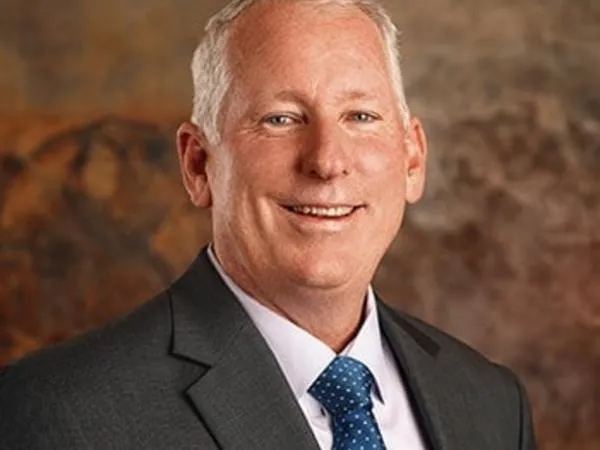
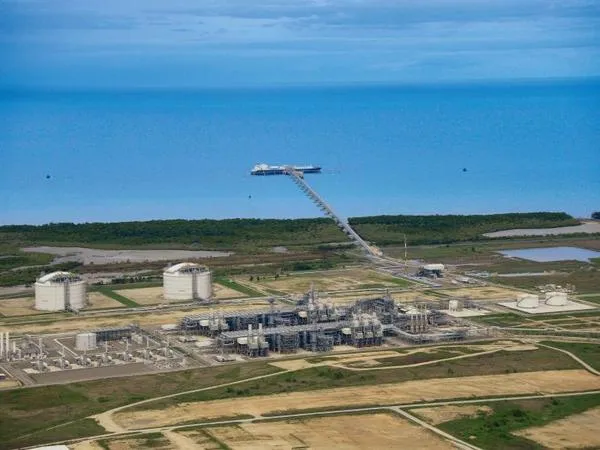
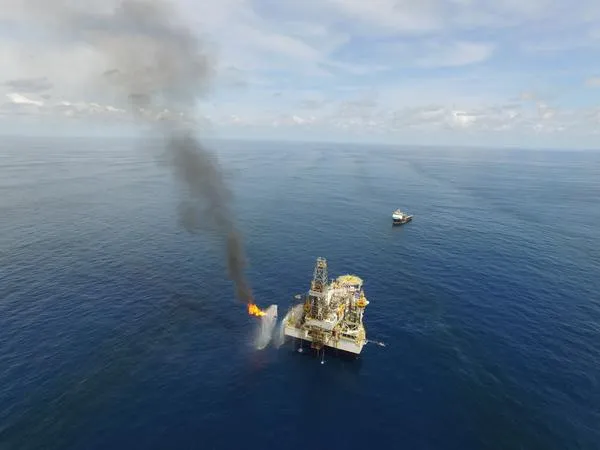
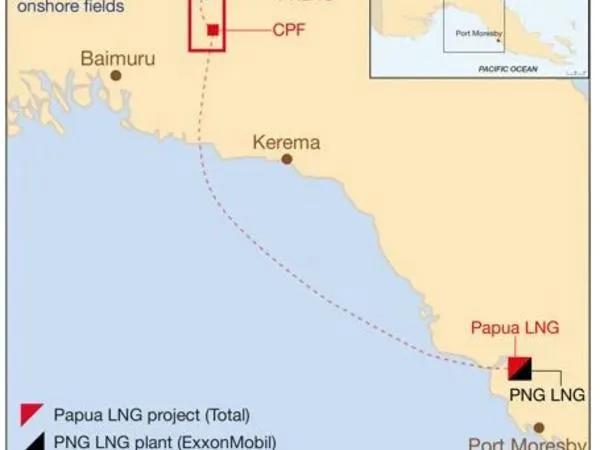
Photo credit: Santos - Brett Darley
PNG will continue to be a major focus of strategy as Santos works to decarbonize operations, according to the upstream chief of Santos.
Santos president of Upstream Oil and Gas, Brett Darley, stated that Santos is still eager to keep that region as its primary investment priority.
“More broadly as a company, Santos is developing our three-hub carbon capture and storage (CCS) strategy.
As we seek to decarbonise our economy, carbon capture and storage will be critical in achieving that goal,” Mr Darley said.
“Australia needs to get behind CCS, because we know net zero cannot be achieved without it. If Australia and the world is serious about net zero, then we must be serious about decarbonising existing energy sources as the market evolves over time for new clean fuels, such as hydrogen,” Mr Darley said.
He said that there are countless chances in PNG, both professionally and socially.
“People might be surprised to know that around 80 per cent of global primary energy today still comes from hydrocarbons – the same as 45 years ago.
However, with less than 15 per cent of the population in Papua New Guinea having access to electricity, and those with access facing the challenges of temperamental supply, we must bring on new supply and continue to develop our product safely and sustainably, for years to come,” Mr Darley said.
“We know global supply will be tight for years to come due to OECD supply constraints, government policy, and activism.
Gas must become the baseload, alongside renewables in developed countries, otherwise the transition will be very messy.
For this reason, the next 30 years calls for a structural shift in the way that the world generates energy. As an industry, we need to maintain supply while we innovate to transition to net zero emissions.”
According to him, Santos's new plan is to backfill existing infrastructure and then maintain production across all of its assets until the mid-2040s and beyond. It also focuses on decarbonization and clean fuels.
“While we backfill and sustain our core assets to deliver the critical fuels the world needs, we will also decarbonise these critical fuels and produce clean fuels as customer demand evolves,” Mr Darley said.
“Santos is in a very strong position to be a leader in all three of these areas over the course of this decade and beyond.
As a core region for Santos, our Papua New Guinean assets will be key in this strategy, and we are keen to maintain our investment focus there.”
Reference: Post-Courier (7 December 2022). “Santos Looks At Decarbonisation”.
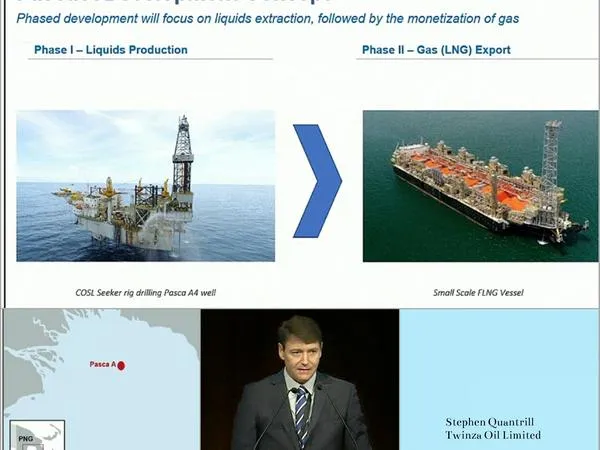
Before we end the year, let us have a recap of Twinza Oil Limited’s presentation during the 2021 PNG Mining and Petroleum Conference and Exhibition. Although the report was presented a year ago, (2 December 2021), Twinza’s Executive Chairman, Stephen Quantrill, provided a remarkable forecast and insights on how their Pasca A Development Project will boost the economy of Papua New Guinea.
Twinza Oil Limited is an upstream Oil and Gas company with assets in Papua New Guinea. Their principal asset is the Pasca A liquid-rich gas field offshore Papua New Guinea. According to their company website, “the Pasca A field development plan has been completed, the petroleum resources certified and the programme necessary to obtain the licenses for full field development is complete.” [1]
“Once the necessary government approvals are received, the Pasca A development is poised to become the first offshore gas field development in Papua New Guinea.” The company foresees that the development of the gas field will encourage and lead more exploration of other fields in the Gulf of Papua.
With its main headquarters in Perth, Australia, Twinza is expanding their presence in Papua New Guinea to support the Pasca A Development. The company also has offices in Sydney, Brisbane, Port Moresby and in Singapore.
“Twinza’s executive management team has a proven track record in the early identification, development and operation of highly prospective oil and gas projects.”
During his presentation, Mr Quantrill described the Pasca A Development as a “Low Hanging Fruit”. To explain this, he enumerated the following highlights of the project, namely: investor pedigree, experienced team, GCA Resources Estimate of >120mmboe (or million barrels of oil equivalent per day), simple development, short time to production, and strong economics.
He reported that Pasca A Development will boost the PNG economy. Moreover, the project delivers long-term investment, provides increase in government revenue, and supports economic growth. Here are more key points and numbers about Pasca A Development:
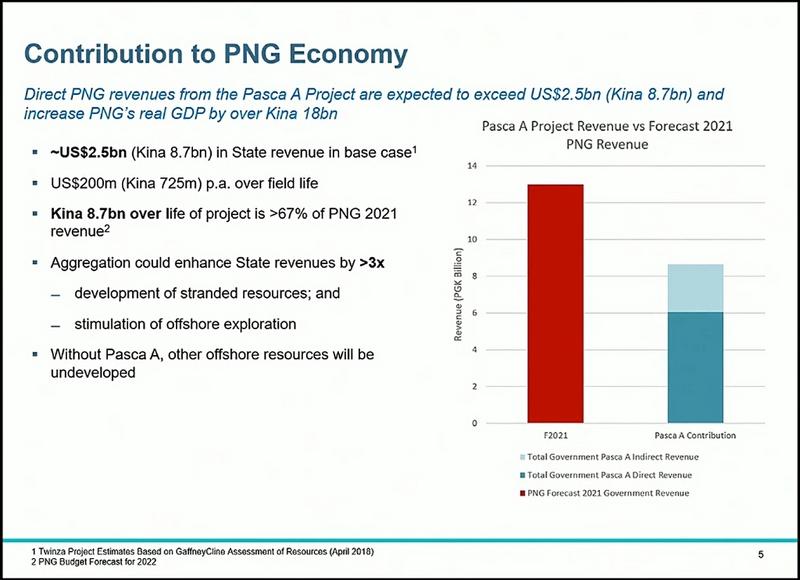
Regarding Pasca A Project’s contribution to PNG’s Economy, Mr Quantrill reported, “Direct PNG revenues from the Pasca A Project are expected to exceed US$2.5bn (Kina 8.7bn) and increase PNG's real GDP by over Kina 18bn.”
He also discussed the Economic Multiplier Effect of the Pasca A Project. "Pasca A Project will have a positive benefit on PNG's overall economic performance as a result of the flow-on to other industry sectors.” He gave the following key points, such as the "Multiplier effects" of the project is 2x to 3x the direct benefits. The project also entails investment in physical assets (marine facilities) and social assets (education and health). Additionally, the project will generate employment benefits such as hiring more than 100 full-time workers during development, and/or total PNG operating workforce of 400 to 500.
For the macro-economic benefits in Papua New Guinea, it forecasts an increase in real GDP by K18.1 billion and an increase in real income of K4.6 billion. Aggregations could further enhance State revenues by more than 3x. [2]
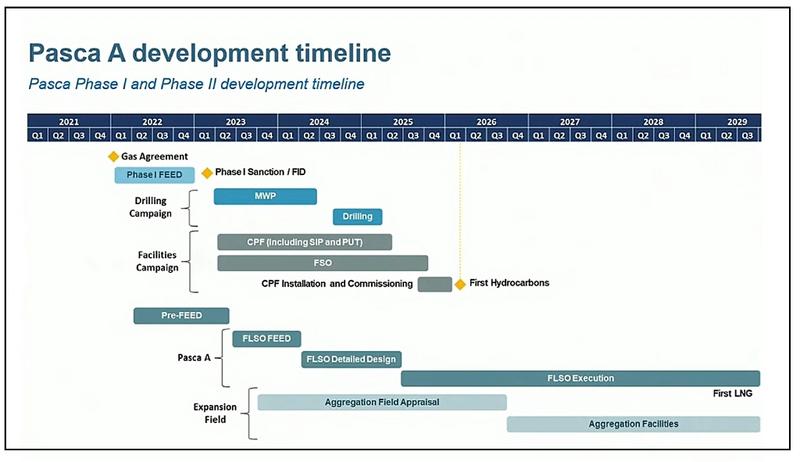
Below is Pasca A Project development timeline.
The Pasca A project also supports PNG's energy transition initiatives. The company sees this as an excellent opportunity to provide a bridge to electrification to 70% of PNG population by 2030, or a 12 to 15 year bridge to renewable power.
The Pasca A gas condensate field is a carbonate pinnacle reef that was discovered around 50 years ago. However, for almost 30 years, this was dormant with no further technical follow-on work. Then, in 2011, Twinza Oil Limited acquired the field. By 2018 they drilled a new exploration well. “Improvements in drilling efficiency, production technology, and development engineering have transformed the technical and commercial viability of the Pasca A gas condensate discovery.”[1]
Hopefully, once government approvals are complete, the first offshore gas field development in Papua New Guinea will move forward and eventually fulfill their goal of helping the country’s economy.
This year, the 16th Papua New Guinea Mining and Petroleum Investment Conference and Exhibition will be held on the 5-7th December at Hilton Hotel Sydney. PNG Business News is media partner of this event.
Reference:
[1] Twinza Oil Limited company website - https://www.twinzaoil.com/
[2] Quantrill, Stephen (2 December 2021). “Twinza Oil Limited - Pasca A Project - Gulf of Papua”. A presentation during the PNG Mining and Petroleum Conference, Port Moresby and Brisbane
Photos and charts: Credit to Mr Stephen Quantrill, Twinza Oil Limited
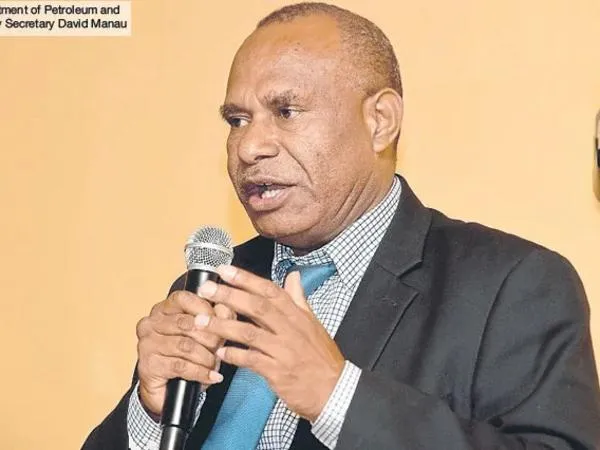
The Petroleum Sector National Content Policy is anticipated to be finished by the end of this month and presented to the National Executive Council the following month, according to Department of Petroleum and Energy Secretary David Manau.
Manau stated that this strategy will also establish an office to look at the practical elements of assisting the sector in profiting from national content during the Chamber of Mines and Petroleum workshop in Port Moresby.
“If successful, a national content policy intervention may increase national job creation, boost the domestic private sector businesses, facilitate technology transfer and build a
competitive national workforce,” he said.
“Main challenge worldwide is that national content goals are often unfulfilled and the opportunities are not captured and not tangibly measured.
“National content in the petroleum sector should firstly aim at the landowners who give access for the investor's licenses to gain access into their regions to operate.
“And the circle spreads to the local level, district, provincial, and the national level,
“Each of the stages also looks at the different magnitude and impact of the project, for example in the early exploration stages in the petroleum sector, you will only focus on the bull's eye, so your social licensing is you deal with the landowners on the ground, you have access to them, and then you give them some services, some businesses.
“At the next level, now if Papua LNG and P’nyang come on in the next 5 years, the national content plan in the petroleum sector should also look at the national level down to the host communities.
“So you look at the national level, you are talking Steamships, Curtain Brothers, however, if they can participate with local level company through a JV arrangement participation, that is even better, the local content policy works for all.”
Manau said that the national content requirement will affect upcoming projects in the pipeline, such as:
Reference: Esila, Peter. The National (17 October 2022). “All eyes on petroleum policy”.
Photo credit: PNGEITI
An undertaking by state owned Kumul Petroleum Holdings Limited (KPHL) to increase its PNGLNG equity through a conditional arrangement between PNGLNG partner Santos has raised concerns over the lack of transparency surrounding the whole arrangement and the partial financial transaction that already took place between the parties involved, according to the PNG Extractive Industries Transparency Initiative. (PNGEITI).
KPHL has offered to acquire five percent (5 %) of Santos equity in the PNGLNG Project with asset valued at US$ 1.4 billion. This includes a proportionate share of project finance debt of approximately US$ 0.3 billion which is the condition upon which this commercial arrangement that has been made.
PNGEITI Head of National Secretariat Mr. Lucas Alkan said following publication of this arrangement in the media this week .
“While it is understood that the compromise between two major players in the PNGLNG project as purely commercial, the PNGEITI is concerned at the opaque nature of the environment in which such arrangements are being made, particularly when substantial amount of money belonging to the people of PNG entrusted under the stewardship of KPHL is involved.
This deal can easily be likened to the controversial UBS transaction which recently ended up being investigated by a Royal Commission of Inquiry that cost the State millions of Kina in tax payers' money.
We understand KPHL had already made partial payment of US$55 million and subsequent payments to finalise the transaction are expected to be made before the end of December this year.
KPHL has a moral and corporate reasonability to be transparent and accountable to Parliament and the people of this country when conducting its business in this sector” Mr Alkan said.
“The PNGEITI, a global best practice standard for the good governance of the extractive sector that PNG is a member of takes the position that KPHL must inform the public on where financing is being sourced to secure the purchase of the 5% additional equity for the State.
The details of this transaction, whether it is being funded from KPHL’s budget, any external borrowing by KPHL on behalf of the State (if so, what asset is being used as collateral) or through the National Government Budget (this is not in the 2022 supplementary budget). Further, it is not clear as to whether NEC had approved for KPHL to execute this transaction to acquire additional equity from Santos. The public has the right to know these details and understand as to how KPHL’s balance sheet would be affected given that a US$ 0.3 billion debt would be inherited from Santos.
The PNGEITI is not against KPHL’s proposal to acquire an additional 5% equity from Santos as it is consistent with the Government’s policy objective of having a greater equity interest in resources developments however, Santos’ intention to deal exclusively with KPHL regarding the sale raises a lot of questions.
We strongly urge KPHL and Santos who are both active members of the PNGEITI Multi Stakeholder Group (MSG) to demonstrate good corporate citizenship and uphold the principles of the EITI Global Standard by disclosing the commercial and economic nature of this transaction for the sake of transparency and accountability in this planned sale of Santo’s 5 percent share in the PNGLNG to KPHL,” Mr. Alkan said.
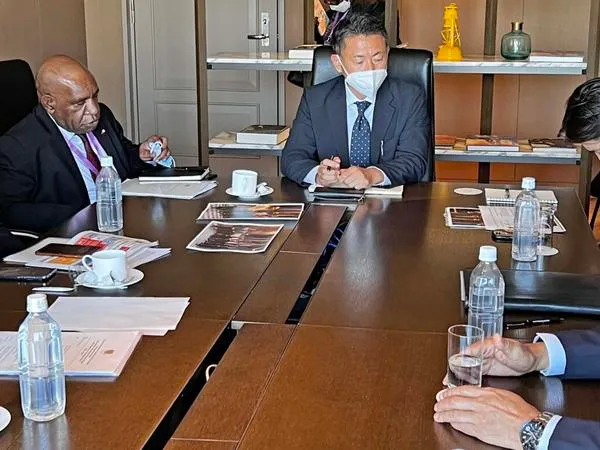
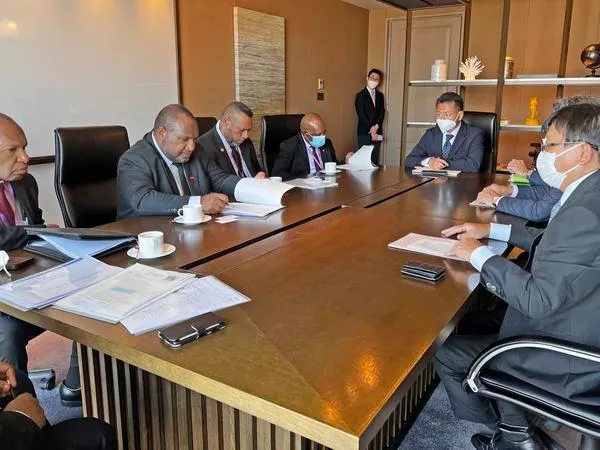
Photo: PM Marape in discussion with LNG Japan Corporation President and CEO, Kyo Onojima, in Tokyo.
Prime Minister Hon. James Marape has told the LNG Japan Corporation that Papua New Guinea has about 20-trillion cubic feet (TCF) in stranded gas fields, apart from the major LNG projects, waiting to be developed.
He said this in Tokyo on Tuesday (September 27, 2022) when inviting LNG Japan Corporation to invest more and diversify in PNG LNG.
He made the invitation to LNG Japan Corporation during a meeting with President and CEO, Kyo Onojima, and his delegation in Tokyo during his one-day visit to attend the state funeral of former prime minister Shinzo Abe and bilateral meeting with current Prime Minister Hon. Fumio Kishida.
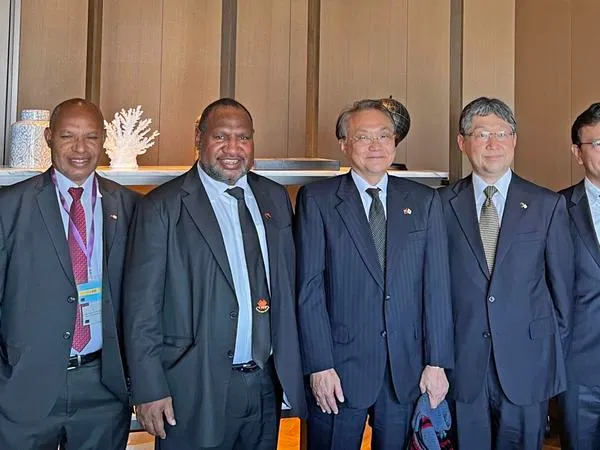
PM Marape – who was accompanied by International Trade and Investment Minister Hon. Richard Maru, East Sepik Governor Hon. Allan Bird and PNG Ambassador to Japan H.E. Samuel Abal – said there were so many opportunities for LNG production in PNG as he invited LNG Japan Corporation.
LNG Japan Corporation was formed on October 1, 2001 on the foundation of LNG business long established by Sojitz Corporation (formerly known as Nissho Iwai Corporation) and business network established through solid trust from customers by Sumitomo Corporation.
“We have a lot of opportunities in upstream and downstream of LNG, as well as in stranded fields hanging around,” PM Marape told Onojima and his delegation.
“We have up to 20 TCF of stranded gas fields, and are looking for investors who can partner Kumul Petroleum Holdings Ltd (KPHL) and Mineral Resources Development Company (MRDC), with both companies having a combined value of K10 billion.
“MRDC represents the landowners, who are important stakeholders, and we also want to give them more opportunity to participate with investors.
“I appreciate the fact that LNG Japan Corporation already has an agreement with KPHL in the upstream business, as well as possibly venture into midstream, given that the stranded gas fields need to be mobilised.”
PM Marape said LNG Japan Corporation already had enough exposure to PNG’s LNG industry to know of business opportunities available in the country.
He previously had a meeting with LNG Japan Corporation in December 2019 in Port Moresby with then President and CEO, Hiroshi Kawahara, who is now Chairman of the company.
LNG Japan is studying feasibility of potential LNG-to-power projects in PNG, leveraging its long experiences in the LNG industry, including a small-scale domestic LNG sea transportation project in Indonesia.
It is also looking at producing methanol as a raw material for plywood manufacture, hence, contributing to downstream processing of logs.
LNG Japan, from the days of its predecessor, has over 40 years of experience in upstream development, financing, marketing, trading and shipping in the global LNG Industry.
LNG Japan and Kumul Petroleum entered into a joint venture agreement on June 7, 2017 (amended on August 2, 2018) to set up as unincorporated joint venture for marketing of spot and short-term cargoes from PNG LNG.
The company, together with JX Nippon Oil & Gas Exploration Corporation and Marubeni Corporation (Japanese consortium) and Kumul Petroleum entered into a memorandum-of-understanding on August 30, 2018, to jointly pursue any opportunities to participate in the Papua LNG Project, as equity participants and financiers
Article courtesy of PM James Marape News Page
Photo: The PNG and JX Nippon Oil & Gas Exploration delegations after their meeting in Tokyo.
Prime Minister Hon. James Marape has encouraged major Japanese company JX Nippon Oil & Gas Exploration, which already has a 4.7 per cent stake in the PNG LNG Project, to also participate in upstream and downstream of Papua LNG (Gulf), P’nyang LNG (Western) and the exciting new Muruk LNG (Hela).
JX Nippon Oil & Gas Exploration has been involved in the oil exploration and development projects at Kutubu and Moran as well as other oil fields in PNG since the early 1990s, and has a 4.7 percent interest in the PNG LNG Project.
PM Marape made the invitation to JX Nippon Oil & Gas Exploration during a meeting with President and CEO, Nakahara Toshiya, and his delegation in Tokyo on Tuesday (September 27, 2022) during his one-day visit to attend the state funeral of former prime minister Shinzo Abe and bilateral meeting with current Prime Minister Hon. Fumio Kishida.
The Prime Minister – who was accompanied by International Trade and Investment Minister Hon. Richard Maru, East Sepik Governor Hon. Allan Bird and PNG Ambassador to Japan H.E. Samuel Abal – said PNG’s economy would be powered by LNG for at least the next 30-40 years and JX Nippon Oil & Gas Exploration was welcome to increase its investment portfolio.
JX Nippon Oil & Gas Exploration has been involved in the PNG LNG Project, which ranks as its third LNG project following those in Malaysia and Indonesia, from the business feasibility study stage. The project links Highlands’ production facilities with a liquefaction plant and exporting facilities outside Port Moresby through an onshore and subsea pipeline that extends for more than 700km. It began production in 2014 and supplies LNG to Japan and other Asian nations.
“JX Nippon has been an active partner in our oil and gas sector space,” PM Marape told Toshiya and his delegation.
“You are involved in the PNG LNG Project and we sincerely appreciate your presence there.
“We have moved Papua and P’nyang, and we now want to ensure that Muruk is secured.
“Our Government is moving to secure at least five per cent for domestic market use, and I invite JX Nippon and your other subsidiaries in the petro-chemical space, to venture into this as I want a robust petro-chemical business in PNG for domestic consumption as well as export.
“I also ask JX Nippon to advocate for PNG LNG in Japan so that the gas we produce can be sold more on the Japanese market.
“We’re looking at PNG being an LNG producer for the next 30-40 years.
“JX Nippon has been part of the growth of PNG’s oil and gas industry and we invite you to go more into downstream processing, as well as upstream in partnership with Kumul Petroleum Holdings Ltd (KPHL) or as a stand-alone.
“You know our culture and environment, having been here since 1990 in the petroleum business and are most welcome.”
Photo: PM Marape and the PNG delegation (left) meeting with Sojitz Corporation President and CEO Masayoshi Fujimoto and his team in Tokyo.
Prime Minister Hon. James Marape has invited leading Japanese company Sojitz Corporation into the upstream and downstream processing of liquefied natural gas (LNG) in Papua New Guinea.
He made the invitation to Sojtiz during a meeting with President and CEO, Masayoshi Fijumoto, and his delegation in Tokyo on Tuesday (September 27, 2022) during his one-day visit to attend the state funeral of former prime minister Shinzo Abe and bilateral meeting with current Prime Minister Hon. Fumio Kishida.
PM Marape – who was accompanied by International Trade and Investment Minister Hon. Richard Maru, East Sepik Governor Hon. Allan Bird and PNG Ambassador to Japan H.E. Samuel Abal – said the Government would make land available for Sojitz to come into PNG in a big way.
PM Marape said Sojitz had been wanting to venture into downstream processing of LNG in PNG, as well as go into the upstream sector, and apologised for delays in making this become a reality.
Sojitz Group, which has been in PNG since 1963 when it started exporting lumber to Japan, is engaged in a wide range of businesses globally, including manufacturing, selling, importing, and exporting a variety of products, in addition to providing services and investing in diversified businesses, both in Japan and overseas.
It is particularly wanting to break into the petro-chemical industry in PNG – for which it already has an agreement with Kumul Petroleum Holdings Ltd (KPHL) – to produce ammonia.
“You have been waiting patiently for the last six to seven years,” PM Marape told the Sojitz delegation.
“Now that I am prime minister, we have no excuses not to progress these business intentions of Sojitz, an established company in Japan which is also involved in business in PNG since 1963.
“I thank Sojitz for its continued presence in PNG since 1963 and we have a special place in our heart for you.”
PM Marape said Minister Maru has been tasked with bringing in investors such as Sojitz into PNG and he would be a “one-stop shop” for all foreign investors.
He asked Sojitz for a fresh expression-of-interest which would be fast-tracked by his Government as a matter of urgency.
“This is consistent with the global trend into the cleaner energy space,” PM Marape said.
“Going forward, the Government in keen on KPHL getting more gas for the domestic market, at an affordable process.
“Sojitz is welcome to partner in downstream processing of gas.
“If you can give me cheaper petrol and cheaper diesel, and even the ammonia that you want to process, you’re my friend for life.
“Papua New Guinea needs to find solutions to the expensive petrol and diesel we are currently importing.
“It is ironic that we produce oil and gas, however, continue to import expensive petroleum products
PM Marape said there were also opportunities in the upstream for Sojitz to go into.
“KPHL will now have first right to some of the smaller gas projects, and Sojitz is most welcome to join,” he said.
“If you want to go into upstream by yourself, you don’t have to partner with KPHL, you can go in on your own as well as in the midstream and downstream.”
Photo: Oil Search
Santos advises it has received a binding conditional offer from Kumul Petroleum Holdings Limited (Kumul) to acquire a 5 per cent project interest in PNG LNG for asset value of US$1.4 billion, including a proportionate share of project finance debt of approximately US$0.3 billion (the Offer).
Kumul is Papua New Guinea’s national oil and gas company and existing partner in the PNG LNG project.
To secure the Offer, Kumul has paid an amount of US$55 million to Santos which will be held in escrow to be released to Santos as a deposit for part payment of the Offer price if it accepts the Offer.
The Offer is conditional on Kumul obtaining the waivers of certain pre-emptive rights by each other PNG LNG project participant under the project operating agreement to allow the transaction to proceed
The Offer is expressed to be irrevocable, except in limited circumstances, and will remain open for acceptance until 31 December 2022. Santos has agreed to deal exclusively with Kumul during this period regarding the sale of equity in PNG LNG.
The proposed transaction will have an effective date of 31 December 2022 with Santos to retain all 2022 cash flows. Completion will be subject to customary conditions including necessary regulatory approvals and Kumul securing financing.
The potential sale would increase the equity interest of the State to approximately 22 per cent supporting the PNG government objectives for the people of PNG to have a greater equity interest in the development of their natural resources.
Santos Managing Director and Chief Executive Officer Kevin Gallagher said the potential sale of a 5 per cent interest in PNG LNG to Kumul represents an opportunity to build strategic alignment for the future development of PNG’s natural gas resources, including via PNG LNG infrastructure.
“PNG LNG is a low-cost and low emissions intensity asset that contributes strong cash flows to the project participants and economic and social benefits to the nation,” Mr Gallagher said.
“Following the transaction, Santos would maintain a 37.5 per cent interest in this world-class project.
“Santos has been a committed partner in PNG for over 40 years, involved in more than 30 different licenses and has significant community partnerships and projects across the nation.”
As part of the proposed transaction, Santos and Kumul will negotiate a Heads of Agreement to further collaborate on the development of Kumul’s regional capacity and capability, including carbon emission reduction opportunities to achieve net-zero operations.
JB North & Co is acting as financial adviser and Allens is acting as legal adviser to Santos.
Article courtesy of Santos
The Pasca A offshore gas project in the Gulf of Papua will focus to help transform the PNG energy sector and to boost sustainable growth in the country.
Twinza Oil (PNG) Limited chairman, Stephen Quantrill said when in full production, the Pasca A Liquefied Petroleum Gas (LPG) project’s landed prices will be lower than the current LPG imports.
He said that as a benefit to PNG once the project starts, Pasca A has pledged a 10% domestic market obligation (DMO).
According to Mr. Quantrill, the promise is in line with PNG's goals for sustainable development, which include achieving complete carbon neutrality by 2050 and a 70% electrification objective by 2030.
He asserted that accessible LPG might revolutionise the PNG energy industry and support long-term development.
“The advantage of the LPG includes a low carbon substitute for burning fuel, oil and diesel, and it is profitable and affordable by land and marine transport system,” Mr Quantrill said.
“It requires a low infrastructure investment to reach in diesel and is very accessible.”
According to Mr. Quantrill, the Pasca A LPG component is a crucial commodity for providing energy to PNG.
According to him, the project's schedule will allow PNG to reach its goal of providing 2% of the world's LNG supply.
The PNG government consented to the parameters of the Pasca A project in 2021, and more investment and project funding are still required for the gas agreement and petroleum development licence (PDL).
Once it is up and running, the Pasca A project will bring in K8.6 billion in income for PNG over the course of its existence, with K500 million per year.
Additionally, the project will generate K18 billion in GDP throughout its lifetime, K400 million in local spending, 300 construction employment, and 500 permanent jobs in PNG as the yearly operating cost in the country.
Reference: Wohi, Lorraine. Post-Courier (26 September 2022). “Pasca A Project To Assist Transform Energy Sector”.
Photo credit: PNG Energy Summit - Wayne Kasou
Santos has paid more than K1.21 billion in corporate tax since the merger, despite the current focus of considerable discussion on multinational corporations in the extractive industry to pay their taxes.
A further K43.2million was also paid as direct taxes as an operator in the country.
At the recent PNG Energy Summit 2022, Santos Senior Vice President for Stakeholder Management, Wayne Kasou, stated that the Group has also contributed more than K20.6 million in royalties, K10 million in development levies, K1.6 million in community development and social investment, K1.1 million in education support for landowner scholarships, K300,000 in community development programmes, and K1.3 million for sustainability projects.
In his presentation of the company's update, Mr. Kasou claims that the merger was advantageous for Santos and its shareholders, particularly at a time when oil and LNG prices were much higher owing to the improvement in the world's energy demand.
The 1000th export shipment of the Kutubu Oil Blend from the Kumul Marine Terminal in April, he added, was a significant achievement for the firm in 2022 and was made possible by a proud and committed team that consistently ensured there were no production interruptions.
With the effective shutdown of major regular maintenance in Kutubu without any casualties, another significant milestone was also reached.
The highest safety records in the company's history helped achieve this despite the backdrop of COVID-19 limitations, and in August, the PNG operations produced the most at a rate of 119-kilo barrels of oil equivalent per day.
In commending the employees and contractors Mr. Kasou said, “Our employees and contractors who remained focused throughout the merger and integration activities.
“Their resilience, courage, and ability to respond to change have resulted in the phenomenal results seen so far in terms of profit, safety, and production.
“This was achieved against a backdrop of uncertainty, two years of COVID-19 lockdowns and restrictions, a year earlier – the 7.5 magnitude earthquake that severely impacted our local communities and operations, the changes in previous management, and recently, a merger.”
The value that the PNG company has provided to the entire Santos organisation as well as the nation, according to Mr. Kasou, is deserving of celebration.
“At Santos’ half-yearly announcement, PNG contributed 50 per cent of the value to the wider group. Our people are our greatest success story, and I am proud to recognise the team,” he said.
Reference: Yafoi, Melisha. Post-Courier (23 September 2022). “Santos Invests In PNG”.
By 2032, it is anticipated that the Papua Liquefied Natural Gas project (Papua LNG) would produce an additional 2–3 million tonnes of liquefied natural gas annually.
Given that Total Energies announced FEED (front-end engineering and design) for the Papua LNG Project in July of this year, Minister for Petroleum and Energy Kerenga Kua believes that PNG will export LNG in the ensuing decades.
The project, according to Mr. Kua, will virtually double PNG's LNG exports from the current 8.5 million tonnes per year to 14–15 million tonnes per year, he said during the 2022 National Petroleum and Energy Summit in Port Moresby.
“Papua LNG is likely to reach its final investment decision (FID) in late 2023 and with a four-year construction phase, we expect the first phase of LNG around the end of 2027 and late 2028,” Minister Kua said.
“This will be followed by FID and construction on P’nyang gas project with further plans to deliver 2-3 million tonnes per annum of LNG by 2032.”
According to Mr. Kua, as nations improve their renewable energy resources, LNG serves as a bridge fuel worldwide, and PNG is on the route to achieving that goal.
In the future, when they could be customers for PNG's export of green energy, he said that PNG's role as an LNG exporter will help.
According to Peter Larden, managing director of ExxonMobil PNG, PNG is in a good position to increase its LNG capacity as a result of the PNG LNG project's strong foundation.
According to Mr. Larden, the country has the chance to watch as new innovations take place, which might boost the economy of the country for many years to come.
“PNG exports somewhere between 8 and 9 million tonnes of LNG per year and even if the Papua Project comes online, it will still represent about 2 per cent of global demand or global supply through the 2030 period,” Mr Larden said.
The good news, he added, is that PNG has a variety of advantages because it can export LNG to fulfil demand across the world, particularly in the Asia Pacific area.
Jean-Marc Noiray, managing director of TotalEnergies PNG Ltd, stated that once the Papua LNG project is approved, Total would concentrate on the initial activities.
He said that Papua LNG is now developing its national content principles and practises to further drive these results into and through the massive project activity.
“The national content plan will provide the guiding framework and also the collection of reporting from across the project for our reporting to government,” Mr. Noiray said.
Reference: Wohi, Lorraine. Post-Courier (21 September 2022). “Papua LNG To Delicer By 2032”.
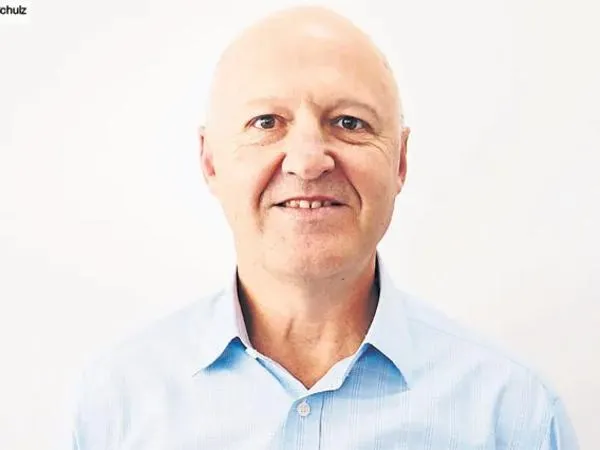
Craig Schulz has been appointed as Kumul Petroleum Holdings Limited's new chief operating officer, filling a long-standing vacancy.
According to managing director Wapu Sonk, it is essential that they have senior technical management personnel who are sufficient and properly qualified given their current level of operations in the petroleum sector, in non-petroleum related national development activities, and with upcoming major projects like Papua LNG and P'nyang LNG.
With his decades of expertise in engineering and petroleum development projects in Australia, PNG, and other countries, he said he is convinced Mr. Schulz would be a tremendous asset for Kumul Petroleum.
“As an organisation we have to be technically and managerially ready to participate in a meaningful manner in Papua LNG, P’nyang LNG and other petroleum development projects that are in the pipeline,” he said.
Having worked with Kellogg, Brown & Root, BHP, and Santos, Mr. Schulz has more than 25 years of leadership and significant project management expertise in the energy and resources sectors in Australia and other countries.
“This experience includes three years in PNG from 2010-2012 as country manager for Santos, a major partner in the PNG LNG Project and operator of the country’s oil fields,” Mr. Sonk said.
Mr. Sonk said Mr. Schulz is not new to Papua New Guinea or the PNG petroleum business and has good links to other national and international stakeholders.
“He will hit the ground running and will be actively supporting Kumul Petroleum’s existing cadre of national professionals,” Mr. Sonk said.
“Development of PNG’s natural gas resources will underpin future national development so it is important that the economic and social benefits from petroleum projects can be maximised.
“Kumul Petroleum has to have the right team members to ensure that this is achieved.”
Reference: Post-Courier (9 September 2022). “Kumul Petroleum Appoints New COO”.
Photo credit: PNG Chamber of Mines and Petroleum - Stephen Quantrill
The Pasca A gas project's developer, Twinza, is prepared to collaborate with regional members of parliament to identify and reap the community advantages of the Pasca Development project.
Stephen Quantrill, the executive chairman of Twinza, stated as much at a briefing for the PNG Chamber of Mines and Petroleum during the Members of Parliament Induction.
According to Mr. Quantrill, Twinza anticipates that the project would create 300 direct and indirect employment in PNG during construction and that this figure will rise to 500 once the facility is up and running.
He said that the business will aim to have PNG citizens fill 90% of these positions.
“Twinza will introduce training programs to give the maximum number of Papua New Guineans the opportunity to work on the project and its supporting industries,” he said.
Mr. Quantrill gave an update on the Pasca development, which, according to the business, could be operational and begin paying the government the planned K500 million in direct revenue annually by the conclusion of the current legislative session provided the required permissions are granted this year.
The project will open up the economic development of neighbouring found and potential resources, and it is anticipated to contribute more than K18 billion to Papua New Guinea's GDP throughout its lifetime.
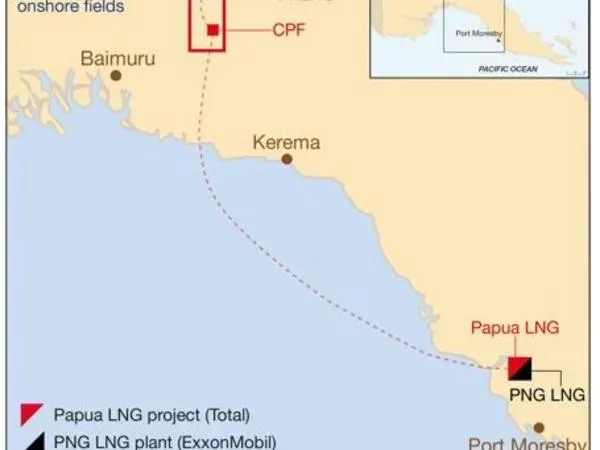
The project sits 95 kilometres off the coast of Kerema in the Gulf of Papua, 93 metres below the surface of the ocean.
Mr. Quantrill stated that the project is prepared to go into FEED as soon as the gas deal is finalised, signed, and approved, which the business stated is set to happen this year.
Reference: Post-Courier (2 September 2022). “Pasca Project Targets 90 Per Cent Of Jobs For Nationals.”
According to Peter Laden, managing director of ExxonMobil PNG Ltd, there are major sources of LNG (liquefied natural gas) supplies outside of Papua New Guinea (PNG).
According to Laden, PNG presently accounts for 2% of the market for LNG, which produces eight to nine million tonnes annually.
“In the future, even after Papua LNG, we will still represent about two percent of the global LNG market as a number of new projects come online in the coming years,” he said.
“We are challenged and fighting for a limited amount of global capital to advance the next trench of projects here in PNG.
“That’s why we are all here with the common objective, we want PNG on the map and we want to advance the resources here in a responsible way.”
Laden acknowledged the benefits of the nation's competitiveness.
“Specifically, proximity to Asia where the majority of our customers are is a true advantage.
“This is a true advantage with shorter shipping routes to South East Asia at this point in time and it is also one of the global greenhouse competitive LNG projects already.
“So when future investors and lenders look for future opportunities, they will start from there.”
Commenting on exploration, Laden said this year that ExxonMobil was conducting its own seismic campaign and building on over US$2 billion (K6.9 billion) in exploration investments since 2010.
“We are very active in the exploration space but we are going to need to work together to advance the exploration potential in this country.”
Reference: Pacific Mining Watch (29 August 2022). “PNG gas competing on global supply market, says exec”.
Photo credit: TotalEnergies
According to an official, Papua New Guinea would gain K86 billion from the Papua LNG project throughout its lifetime.
Jean-Marc Noiray, managing director of Total Energies PNG Ltd, made the comments at the induction ceremony for new lawmakers in Port Moresby. He said this when acknowledging the country’s laws and regulations that governed resource projects as some of the best in the world.
Local laws, according to Noiray, recognised landowners and gave the State and its citizens a powerful role.
“From a regulatory point of view, we have done all that was needed, we have the gas agreement which secures the fiscal and regulatory terms,” he told MPs.
“They are stabilised in a fiscal stability agreement with all the amendments that were required. So we are ready to go.”
According to Noiray, during the course of the project's existence, the State would collect between 50 and 55 percent of its worth.
“The higher the price of the gas, the more the shareholders are going to get,” he added.
“The direct value going to the State we reckon will be in the order and value of US$25 billion (K86 billion) over the life of the project.
“Just half of that is direct from what the developer will pay in terms of income tax than we have other direct taxes that will be paid, the workforce for example which we reckon is in US$3 billion (K10 billion) and indirect benefit in the order of US$8 billon (K27 billion) going to the country.
“All those numbers, we will round them up and will be in the file that we will give to the authorities to try to get our different licenses.
“We are keen to start contributing big to the country and to help the country and its citizens and local communities.”
Reference: Pacific Mining Watch (29 August 2022). “Papua New Guinea getting K86 billion from gas”.
The Pasca A offshore gas project in Gulf will go ahead once the gas agreement is signed and the petroleum development licence (PDL) is approved, says developer Twinza.
Robert Gard, the chief executive officer of Twinza, made the statement while attending the recent induction ceremony for the 11th National Parliament in Port Moresby.
“We are awaiting finalisation and signing of the gas agreement and approval of the petroleum development licence.
“We are ready to proceed with front-end engineering and design (Feed) and project financing arrangements,” he said.
The 95 km offshore Pasca A offshore gas project is located in 93 m of water.
It was found in 1968, and Twinza bought it in 2011.
After conducting a rigorous subsurface evaluation programme, Twinza submitted for a PDL in 2015.
Pasca A possesses more than 70 mmbbl (million barrels) of liquefied petroleum gas and condensate in addition to 0.33 trillion cubic feet of recoverable dry gas. The project's advantages include:
According to Gard, around 70 local businesses have already been named as service providers for the continuing project.
“Direct jobs include offshore, supply base and office workers such as operating, maintenance, onshore support, marine support, catering staff, management and office support,” he said.
“Indirect jobs include security, airline operations, hotel and transport, meals and catering supplies, spares and materials supply, helicopter logistics, training and professional services.”
The Pasca A liquids-rich gas field in the Gulf of Papua is being developed by Twinza, an Australian upstream energy firm. The business has been operating in PNG since 2011 and has committed more than K350 million to thoroughly assess the market.
Its creative development strategy and design are now prepared for implementation.
Twinza is supported by financially sound and helpful investors and has offices in Port Moresby, Perth, and Singapore as well as a skilled staff of experts.
Reference: The National (25 August 2022). “Twinza: Projects await signing”.
Follow on LinkedIn:
PNG Business News
Be the "First" to get our exclusive Digital Magazine & Weekly Newsletter.