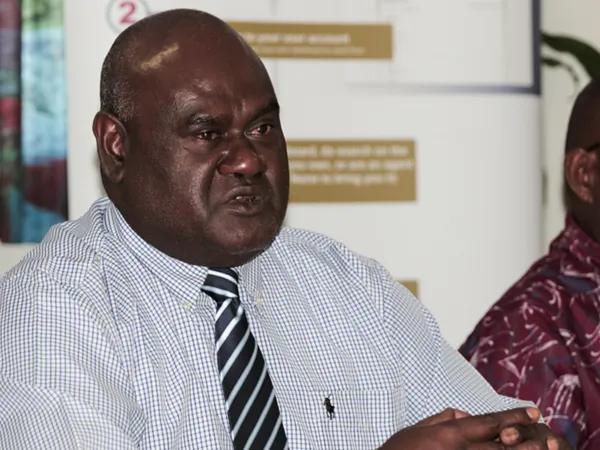
Photo: Clarence Hoot
The Investment Promotion Authority (IPA) delivered a stakeholder awareness and training workshop for the New Guinea Islands Region in Kokopo from 27th – 28th October 2022. The awareness was geared towards training and building the capacity of New Guinea Islands Provincial Commerce Officers and Business Development Officers from the districts by providing awareness on the IPA functions and the key legislative and systems changes and processes. The awareness focused on different Acts administered by the IPA, functional duties of the key Divisions and Units within the Investment Promotion Authority, and current regulatory and legislative reforms that IPA is undertaking. Furthermore, it focussed mostly on the rollout of the Online Registry Service. The overall program was based on the theme: Connecting everyone and making our system work’
Provincial commerce officers and BDOs from the Autonomous Region of Bougainville, West New Britain, East New Britain, New Ireland and Manus provinces participated in the two-days training sessions.
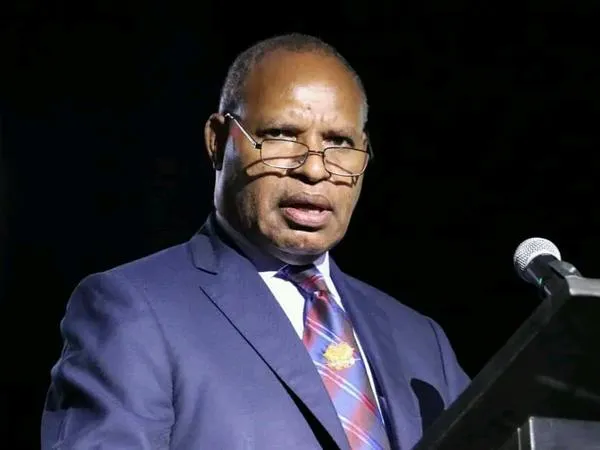
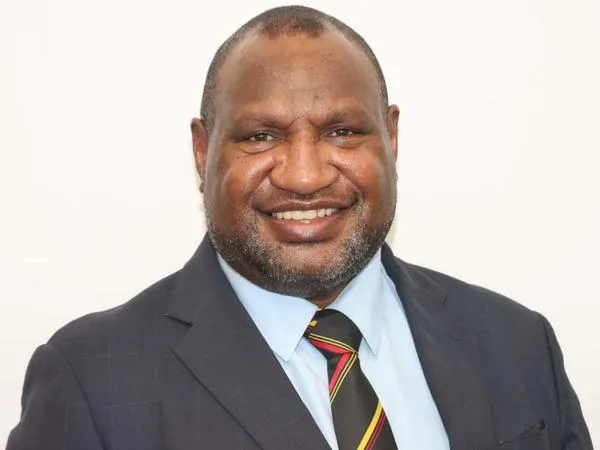
The training was officiated by the Managing Director of the Investment Promotion Authority, Mr. Clarence Hoot. Mr. Hoot outlined the main aim of the training program and challenged the participants to learn as much as they could and be able to deliver the services in their respective provinces for our simple people. Senior Managers and officers from IPA conducted the two days training program. The participants expressed their sincere appreciation and gratitude to IPA for facilitating such a useful training which now empowers them to better serve the people in rural areas. After the training, the commerce officers were awarded with certificates of participation.
There was also notable interest from the general public in East New Britain Province who attended the awareness program. Many expressed their interest indicating IPA should continue to roll out such awareness and training programs annually and empower Papua New Guineans to venture into SME businesses. Some of the general comments received from the participants include awareness on how to assist SMEs to bring their products to the market and opportunities for joint venture (JV) partnerships with foreign investors.
Complementing IPA’s awareness program, there were also sessions delivered by other private and government agencies, especially the National Development Bank (NDB) and the Internal Revenue Commission (IRC). The NDB made its presentation on its small business loan (SME) products whilst IRC presented on Small Business Tax Regime.
The IPA team accompanied by some provincial commerce officers also made awareness presentations to the students of the University of Natural Resources and Environment which was well received. The students and lecturers registered their interest for future such events to be delivered as well.
Mr. Hoot has made a call that provincial commerce offices and business development officers within the Region should work more closely with IPA Regional Offices around the country to assist with their roles in ensuring service delivery right down to the people that matter - our rural population. Officers from the Provincial Commerce Divisions should move away from their traditional way of operations and become more supportive to businesses and general clients by providing support services. The IPA online registry platform by now is almost accessible to all which allows people to formalize and operate their businesses.
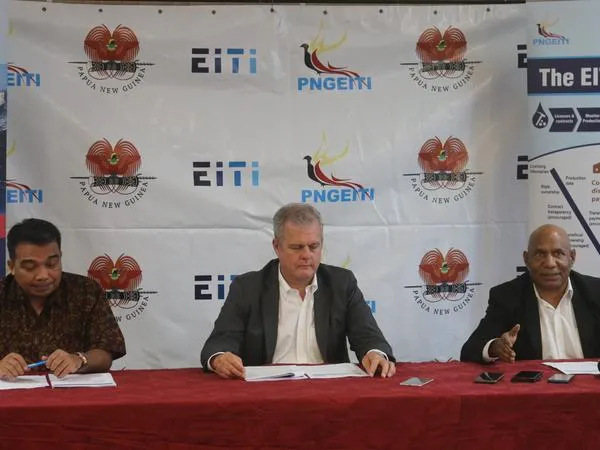
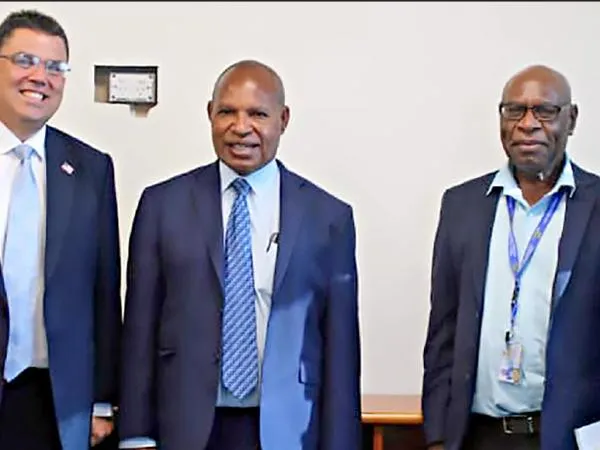
Photo caption: L-R: Emanuel Bria, Country Officer – Asia, Mark Robinson EITI Executive Director and Lucas Alkan Head of PNGEITI National Secretariat during a press conference held on the last day of the mission, Friday November 11, 2022.
An EITI International mission led by its Executive Director Mark Robinson to Papua New Guinea concluded today on a good note.
The EITI International team comprised of the EITI Executive Director, the Director for Asia and the Pacific and the Country Lead for Papua New Guinea arrived this week for a 3 days consultation with the Stakeholders that included the PNGEITI Multi-Stakeholder Group including the development partners.
The mission’s main objective was to meet and discuss the outcome and findings of Papua New Guinea’s second EITI Validation (country assessment report) with various players in the extractive consisting representatives from extractive companies, government departments, extractive SOEs and civil society bodies which provided leadership and guidance in guiding the implementation of the EITI Global Best Practice Standard in PNG’s mining and petroleum sector.
Head of the PNGEITI National Secretariat Mr. Lucas Alkan said “The visit by the international team to Papua New Guinea just under a month after they have issued their verdict on Papua New Guinea’s progress in implementing the EITI Standard last month recognizes the important role the EITI plays in promoting transparency and addressing governance issues in the extractive industry ” PNGEITI head of National Secretariat Mr. Lucas Alkan said.
“The world is in a transitional phase, moving away from carbon dependent fuels to address climate change. In this transition, minerals will play an important role in putting companies and government alike under pressure to mine more as the demand for minerals increase to build carbon neutral machines like electric vehicles.
This means Papua New Guinea will be under pressure to undertake mining and petroleum development activities where there is potential for illegal practices and corruption to creep in given such circumstance. EITI will play in important role in this transition period to hold authorities and companies accountable for their conduct in managing the sector and to abide by the rules and regulations governing the extractive sector in our jurisdiction.
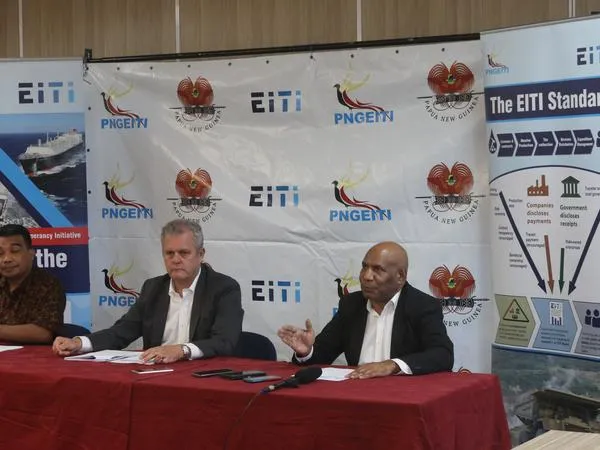
From left to right EITI International Executive Director Mark Robinson, EITI International Director for Asia and the Pacific and the Country Lead for Papua New Guinea Mr. Emmanuel Bria and PNG EITI Head of National Secretariat Mr. Lucas Alkan at the press conference.
EITI International team comprised of the EITI Executive Director Mark Robinson, EITI Director for Asia and the Pacific Mr. Emmanuel Bria and the Country Lead for Papua New Guinea has successfully completed its findings of Papua New Guinea's second EITI Validation ( Country Assessment Report) with its formal announcement on Friday 11th of November ,2022 at Treasury office Port Moresby.
The Validation result comes after a month of consulting with various players consisting of the representatives from the extractive companies, government departments, extractive state-owned entities and civil society bodies to provide leadership and guidance in guiding the implementation of the EITI Best Practice Standard in PNG's mining and Petroleum sector.
PNGEITI Head of National Secretariat Mr. Lucas Alkan welcomed the EITI Board's candid assessment and decision on PNG's efforts to implement the EITI, describing it as fair assessment, taking into account the efforts put in by multi stakeholder Groups over the years since 2013 when the government signed up to implement the EITI.
"We consider the second country assessment as consolidating the correct actions that have been taken and the work current in progress. PNG has made significant progress in implementing the EITI relative to other economies around the world that are implementing the same EITI standards".
Giving his assessment so far regarding EITI's role in Papua New Guinea the Executive Director of EITI International, Mr. Mark Robinson stated that PNG needs more transparency in revenue collection for public information, the room for contract transparency and lastly for the beneficiaries in the extractive sector to benefit well in their resources. Other key success area noted is the well structured electronic data currently available by the Mineral Resource Authority that provides good management of the mineral resources.
"EITI has to be meaningful to the local people and how it will benefit them socially and economically in a proper way".
EITI Director for Asia Pacific Mr. Emmanuel Bria explained further that EITI is an independent National Secretariate that works in line to make sure the government's local content is met along with the extractive sector (oil, gas and mineral) in a more transparent way to benefit its citizens according to the set international standards and its jurisdiction.
PNG operationalized EITI implementation in 2015 and published its first report in 2016. Since then, it has so far published seven country reports covering successive financial years. The 2021 and 2020 reports are now being worked on and are expected to be published by December this year.
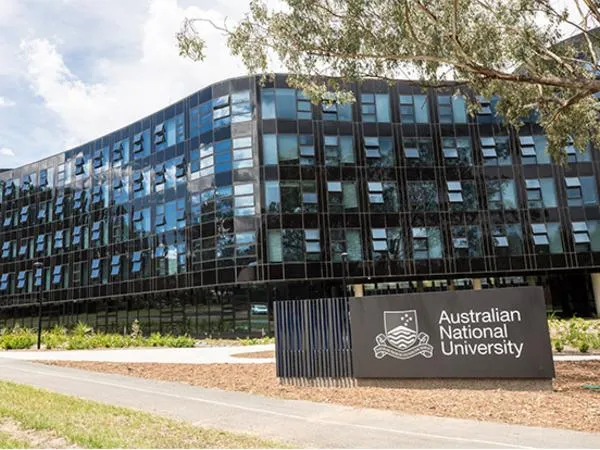
Photo credit: ANU
Despite major setbacks faced by many economies of Island Nations throughout the Pacific due to the global Covid-19 pandemic and the Ukraine-Russian war from 2019 to 2021, a recent study and report released by the Australian National University (ANU) shows that PNG's Gross Domestic Product (GDP) has been progressing well compared to other Pacific Island Nations.
The University's research report reveals that PNG's non-resources GDP growth rate was progressing at level by 7 per cent per annum while other pacific island countries performed relatively low. And this is expected to increase by 13.2 per cent next year.
In comparison, the analysis made by the Australian National University shows that the Solomon Islands GDP growth rate was recorded at a negative 6 per cent, Samoa negative 11 per cent, Fiji at a negative 1 percent while Vanuatu at 0 per cent.
Treasurer Ian Ling-Stuckey was moved by the ANU report and expressed his gratitude to the Government for sustaining the economy under trying times.
"This is very good news for the Government in sustaining the economy during the global Covid-19 pandemic and the Ukraine-Russian war". Even when we look at total GDP, including the resource sector PNG was only behind Tuvalu in which they have a population of about 1000th to that of PNG". Treasurer Ling-Stuckey said.
PNG has weathered and is expected to weather the global economic storms from Covid-19 and the Ukraine-Russian war much better than our neighbours, "the Treasurer said.
Ling-Stuckey stated that some of these had to do with different economic structures, but much is due to good, responsible and responsive economic management. While PNG has performed very well in terms of the Pacific, Treasurer Ling-Stuckey stressed that the performance is just above developing countries as a whole.
"These is why we need to continue on our path of budget repair, strengthening of institutions, and increasing our non-resource GDP growth, these are vital steps towards reaching economic independence". The country's Treasurer said.
Prime Minister Hon. James Marape recently stated that Papua New Guinea spends a massive K2 billion-plus on importing food every year, some of which can be easily grown and produced in the country. He said this when announcing that the two major focuses of his government were internal security and growing the economy.
“More control of the prevailing law-and-order situation will lead to increased business, especially in agriculture, to bring down the country’s huge food import bill,” PM Marape said.
He said it would also lead to more benefits from the mining and petroleum sectors.
“I’m very strong in my push for development of our sustainable natural resources like agriculture, forestry and fisheries. We want to ramp up production in these sectors and get more of our people, 80 per cent of whom are involved with land and sea, to migrate from subsistent into the cash economy". PM Marape said.
“My government already has in place price support and freight subsidy mechanisms for agriculture, and partnerships with major banks and lending agencies for support to our SMEs, to ensure that our citizens are active participants in the economy.
“Therein lies the greatest potential and my government is putting money where our mouth is.
“Agriculture will be our major export earner going forward and will also replace food imports. At the moment, we are spending more than K2 billion on food imports alone, which is not good enough for a country with massive land which can be used for agriculture.” he said.
PM Marape also looks forward to more benefits to the country from the extractive industries,
“We will be working to ensure that Porgera Mine reopens at the earliest. Papua and P’nyang LNG projects are both progressing well and should soon move into Final Investment Decision (FID), with construction to run from 2023 to 2032. We also will be working to ensure that Wafi-Golpu, Pasca, Pandora, Frieda River and various other projects progress.” The PM said.
Minister for International Trade and Investment Hon. Richard Maru said Australia must refocus and align their priorities to Papua New Guinea’s preferences.
He was referring to the Papua New Guinea - Australia Comprehensive Strategic and Economic Partnership, specifically the Pillar 3- Economic Partnership for Prosperity. Minister Maru said this in his meeting with the Australian Minister for International Development and the Pacific, Hon. Pat Conroy last week.
During the meeting, Minister Maru said that Papua New Guinea (PNG) was now focusing on growing its economy through the non-resource sectors and that was where Australia could step in and assist.
“Over the last 47 years, PNG has been over reliant on the resource sector and look at where that had left us- highest level of unemployment since independence, highest level of national debt and highest level of crime. It is a serious policy flaw that this Government is determined to fix during our term; our focus is now on reducing crime and growing the economy,” said Minister Maru.
“We will focus on the agriculture, fisheries, forestry, and the services sector. We need to replace all imports like rice, dairy products, coffee, and all other products that we can produce ourselves. We need to downstream process all our raw materials and we need to build our manufacturing sector. We accept the fact that we have a lot of challenges like constant power blackouts and high cost of energy. These are areas that Australia can easily help us,” he said.
Minister Maru said that Australian investors could also assist PNG in the development of its Special Economic Zones.
“This (development of SEZs) is key to our plan to unlock the potential of our economy, so we want them (Australia) to support us in this area,” said Minister Maru.
“We also want Australia to support us develop new industries like cotton and feed. These are areas that Australia is very good at and has very mature industries and they can assist us".
"So, under this partnership (the Papua New Guinea- Australia Comprehensive Strategic and Economic Partnership), when Australia is looking at aid flows to PNG, they should focus on these sectors which will give us greatest impacts in terms of employment and wealth creation; they must not focus on the areas that they define but on our key focus areas that we define,” said Minister Maru.
Meanwhile, Minister Maru also advised Minister Conroy that he had approved for PNG National Trade Office to work with the Australian Government to engage an independent consultant to undertake a Feasibility Study into a possible Trade Agreement between PNG and Australia.
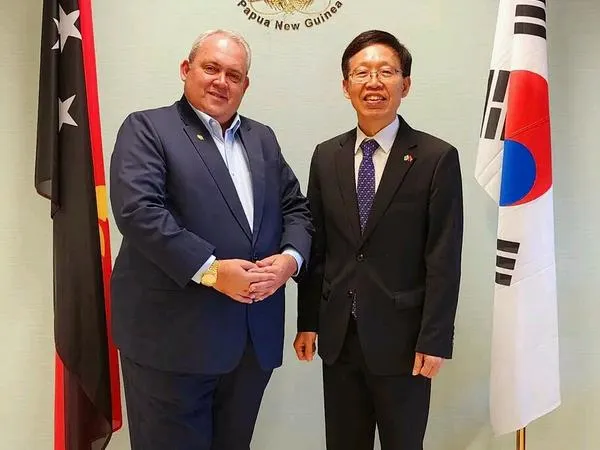
Photo: Hon Justin Tkatchenko & Korean ambassador to PNG, KANG Ho-jeung
Foreign Affairs Minister, Justin Tkatchenko has announced the proposed plans for South Korean investments which will include the re-establishment of the Korean International Corporation Agency (KOICA) and establishment of the Ocean and Fisheries Corporation Centre (OFCC) in Port Moresby starting next year.
Minister Tkatchenko made the announcement after his recent trip to the Korea-Pacific Islands Foreign Ministers meeting in Busan Metropolitan, South Korea.
Tkatchenko stated that South Korea's aid agency has spent millions throughout the world and Pacific on various multiple projects and had closed their office in the country 10 years ago.
"My negotiations with the South Korean Foreign Minister and the President of the Korean International Corporation Agency (KOICA) have concluded that we will re-establish the KOICA office once more in Port Moresby". Tkatchenko said.
Having KOICA established in Port Moresby next year is a huge bonus for the benefit of aid, trade and economy.
Minister Tkatchenko also stressed on the proposed establishment of the Ocean and Fisheries Corporation Centre (OFCC) which is also said to be set up in Port Moresby in the coming year. He said the OFCC would coordinate relationships between South Korea and the Pacific Island Nations in key areas of buying, selling and trading fish and marine resources.
"South Koreans are big seafood eaters, they love fresh fish and seafood. It is part of their natural diet, and they want to do more when it comes to buying and trading our marine products" he said.
"They wanted to set up the Fisheries corporation centre in Fiji, but I insisted for them to have it established in PNG because 15 per cent of the world's Tuna comes from PNG. I negotiated for them to come to PNG so they have taken off their previous decision to go to Fiji and the centre will now be established in Port Moresby" Tkatchenko said.
"South Koreans are very humble, professional and hardworking people and they really want to make these investments are reality, this shows the confidence that Korea has in our Government and also in PNG".
We must look forward to working together with the South Korean's by early next year to re-establish the new KOICA office as well as the establishment of the OFCC". Minister Tkatchenko said.
Photo credit: PM James Marape News Page
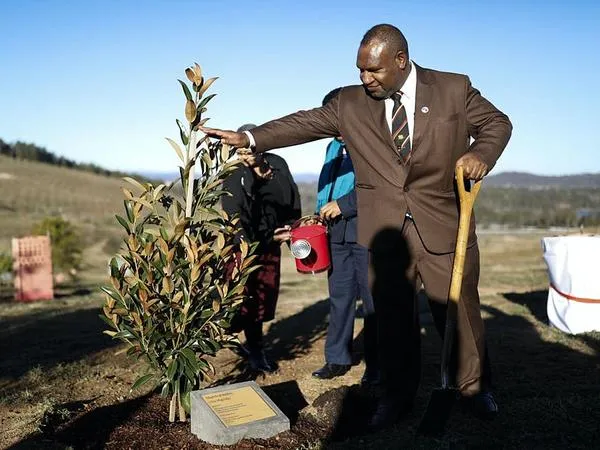
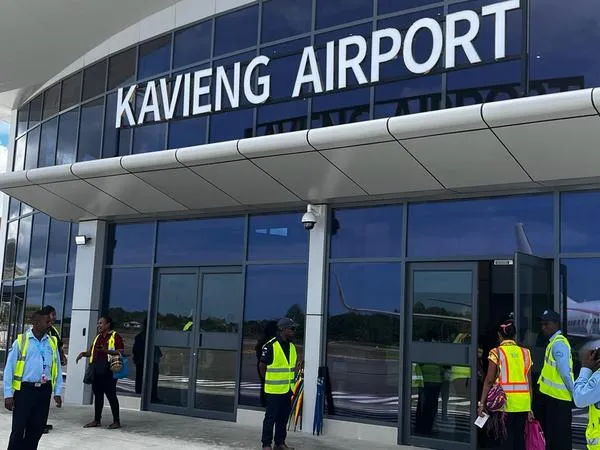
Prime Minister Hon. James Marape says the Government is investing in key infrastructure development such as the K125.7 million Kavieng Airport Development.
He said this on Thursday, November 3, 2022, when opening the project which he launched in June 2020, built through the Asian Development Bank (ADB)-funded Civil Aviation Development Investment Programme (CADIP) and Government counterpart funding, in front of a massive crowd in the New Ireland capital.
The project covered pavement strengthening and 500m runway extension to achieve a total length of 2200m; construction of the new terminal building; construction of the new airport market facility; construction of the powerhouse and installation of standby power supply; installation of an airfield lighting system; installation of water supply; and a new carpark.
PM Marape thanked ADB for its support of CADIP since 2009 which will continue through CADIP II.
He also announced: • K10 million for expansion of Kavieng Town and urged local landowners to free up land for this purpose; and • That a new port would be built in Kavieng through Australia-PNG partnership.
The Prime Minister and a large delegation from Port Moresby arrived in an Air Niugini Boeing 737 aircraft to demonstrate that Kavieng Airport can now handle international flights.
He was accompanied by Civil Aviation Minister and Namatanai MP Hon. Walter Schnaubelt, Treasurer and Kavieng MP Hon. Ian Ling-Stuckey, Finance Minister Hon. Rainbo Paita, ADB Country Director David Hill, management of major airlines Air Niugini and PNG Air, department heads, provincial administration representatives, local leaders and the New Ireland people.
Meantime, across the Bismark Sea in Manus, Deputy Prime Minister Hon. John Rosso opened the East-West Coast Highway Redevelopment.
“This indicates that the Government of today is willing to invest in key economic infrastructure to carry the economy of the country forward,” PM Marape said.
“This sort of infrastructure has a return on investment.
“This airport in Kavieng has a return of 16 per cent-plus.
“This is economic-enabling infrastructure to anchor New Ireland and this part of the country so that you are not just a contributor from Lihir (mine), but can now go the next mile in as far as the economy is concerned.”
PM Marape challenged the people of New Ireland to break away from the status quo and work with Government in developing the economy.
“The Government is investing and focusing on going back to agriculture, fisheries, tourism and sustainable forestry and wants to work with provincial government in this space,” he said.
PM Marape cited the case of the small Pacific island nation of Vanuatu which had a population of only 300,000 people but attracted 88,000 tourists in 2020.
“If 50,000 tourists come to Kavieng, and each of them spends K1000, that is K50 million for the New Ireland economy,” he said.
“This is more money than from the Lihir mine.
“In a place like New Ireland, where law-and-order is not a major issue, we are willing to invest more.
“I want to talk about opening up Kavieng Town; opening up tourism, agriculture, fisheries in New Ireland.
“I want to talk about power-generation for reliable power in this province.
“I want New Ireland, over the next 10 years, to become a strong economic contributor through not only agriculture, but especially tourism a
Photo credit: Post Courier
The American Embassy in Port Moresby has called on the Ministry of International Trade and Investment expressing their strong interest to work with the Ministry to bring in more foreign direct investments from the United States to Papua New Guinea.
American Embassy in Port Moresby Charge d'Affaires Joseph Zadrozny stated that the US has increased its presence in Papua New Guinea by building a new embassy with more employees and is undoubtedly eager to see further investments from the US.
The improvement of internal security to make the country more appealing to investors and trade and investment were the Marape-Rosso Government's two top goals, Minister for International Trade and Investment Richard Maru informed Mr. Zadrozny.
“We are setting up Special Economic Zones (SEZs) to particularly attract foreign investors, similar to all Asian Tiger economies and their successes using SEZs to achieve inclusive economic growth,” he said.
“The particular sectors that we are concentrating on are agriculture – we want to process all our raw materials and replace all food imports, fisheries – we want to build Pacific Maritime International Zone and process all our fish on-shore, and forestry – downstream processing of all our logs.”
The construction of fish canneries in Madang and Manus is also being considered, according to Mr. Maru, who also welcomed investors in the manufacturing sector, privately operated power plants, private educational institutions, and other fresh and exciting investment prospects in all sectors.
He gave Mr. Zadrozny the assurance that the Ministry would do all in its power to help sincere US businessmen who were interested in making investments in some of the important PNG areas.
Reference: Post-Courier (31 October 2022). “US Embassy Keen To Work With Ministry Of International Trade And Investment”.
Papua New Guinea faces competition for technical workforce as the government pushes ahead with projects in the mining, petroleum and gas resource sector in 2023 onwards.
Projects like Wafi-Golpu, Papua LNG, Porgera, and P'nyang are some of the ones that are likely to get off the ground, according to Richard Kassman, Senior Vice President of the PNG Chamber of Mines and Petroleum. However, the concern for the National Government and the industry is to look at having enough Papua New Guinean skilled workforce to cater to the expanding projects.
He mentioned this when the Petroleum National Content Policy White Paper was presented and discussed with the PNG Chamber of Mines and Petroleum members.
The design of the Petroleum National Content policy was made possible by the National Executive Council's approval of the overachieving national content strategy in September 2021.
The National Content Policy for the Petroleum Sector aims to maximise the employment of PNG's people, labour force, local resources, and services in all initiatives related to the petroleum industry.
The Department of Petroleum and Energy will be Mr. Kassman's initial point of contact with the government, according to him, given the competition for resources is restricted.
“If two mining projects take off next year and I hope they do, it will be fantastic for the country.
Then I want the government to understand that we are going to be competing and therefore each of us will have less PNG working for us,” he said.
“The bad news is, we have to bring in experts to work for us, this is the conversation we want to have with the government.”
He stated that from the standpoint of Papua, the first conversation they want to have is to plan and put in place a reporting structure procedure to guarantee that high-quality, private data information is sent to pertinent authorities like the IRC and the bank of PNG when necessary.
Before the NEC approves the Petroleum National Content Policy, the PNG Chamber of Mines and Petroleum is anticipated to offer a thorough response to its feedback.
Reference: Wohi, Lorraine. Post-Courier (31 October 2022). “Resource Skills Lacking”.
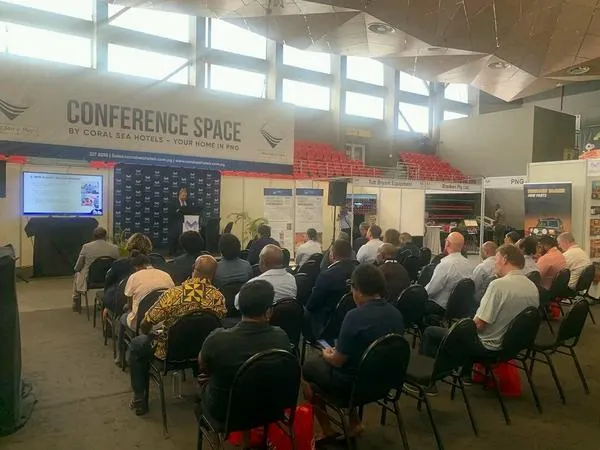
The recent PNG Industrial and Mining Resource Exhibition and Conference that was held in Port Moresby recently for two consecutive days had a positive turnout by exhibitors as well as representatives and attendees from different companies and businesses in the industrial & mining sector when they showcased their various products and services to potential buyers and clients.
More than 55 exhibition booths were set up by Exhibitioners and participants at the Sir John Guise indoor complex mostly by businesses from the industrial and mining sector to network and showcase their services and product capabilities.
During the course of the two-day event there were various speakers from different companies within the industrial and mining sector as well as stakeholder organizations that presented on their companies’ products, services, developments and what they can provide and offer. Some notable presentations where from the gold sponsor of the event, Motor Vehicle Insurance Limited (MVIL), Civil Aviation Safety Authority of PNG (CASA PNG), Cyber Security PNG Ltd and Orica Mining Services.
The expo drew interest and extensive support from key stakeholders in government, and representatives from all business sectors as well as tertiary institutions who were pursuing courses in fields aligned with some of the exhibitors’ specialties.
The exhibition and conference were highlighted as a premier meeting place for industry trade and a forum for establishing high-quality customer contacts. There was also a special 'Buyers Lounge' for suppliers and purchasing officers to meet and purchase products and equipment.
Managing Director and Chief Technical Officer of Benchmark Industrial, Micheal Babul expressed his sentiments and held the exhibition and conference in high regard and was appreciative of the event and all its sponsors.
"It has really helped attract customers and clients to recognise the value and potential of our company's products and the services that we provide, in fact we have sold a number of our equipment and products worth more than K100,000 and gained a lot more clients during this expo and we are really appreciative and happy that we attended as exhibitors". Mr Babul said.
The purpose of the conference was to promote, harness and bring together companies in the industrial and mining sector to expose and network their products and services. It was held to bring Financiers, suppliers, logistic and procurement service providers and other interested parties to attend from both the public and private sector.
The Office of PNG Cooperatives Society were recently presented a cheque of K100,000 by Minister for Commerce and Industry and MP for Sohe in Oro Province Hon. Henry Jons Amuli on behalf of his Sohe District Development Authority to be presented to Oro Kaiva Coffee Growers Cooperatives (OKCGC).
During the presentation Hon. Henry Jons Amuli said Building a strong economy based on investments and growth in the primary industries such as coffee, cocoa, oil palm, vanilla and others remain a key priority of the current Government.
The minister said coffee production in Oro has been on a huge decline over the years due to lack of support for farmers to gain better returns from their labour. “Most of our coffee growers have abandoned their coffee blocks because they were not able to get a better pricing. They feel they were not being rewarded well on their labour,” Minister Amuli said.
He said the Government under the leadership of Prime Minister James Marape has identified the issues and provided much needed interventions such as the price support program and funding support for small to medium size businesses since coming into office.
“The Government also made available funding to support the growth of primary industries and this vision and commitment will unleash the rural economic potential,” he said.
He also committed K1 million from the Ministry of Commerce and Industry to support coffee rehabilitation and production in the Oro Province through the Oro Kaiva Coffee Growers Cooperatives.
“Under my Ministry, we are looking at supporting cooperatives and small to medium size businesses in the primary industry sector at community levels. “I want our rural communities to feel the Government’s economic intervention programs.
They must be economically empowered to improve their social living standards. That is our focus, and we will continue to provide support and interventions throughout the country,” Amuli said.
He urged the two conflicting factions of the OKCGC to resolve their conflict and work in unity to serve the interest of coffee growers.
“I want to place you the executives on notice to solve your in-house issues and work together as one team to receive the funding and revive coffee in Oro.”
Registrar of PNG Cooperative Society Brian Waffi thanked Minister Amuli and said this was the first time in Oro where a district has provided funding support to the PNG Cooperative Society office to assist farmers.
“You are the Minister responsible for cooperatives and you have set the right example to allocate funding from your district to support cooperatives.
“This is the way forward to drive the Government’s economic agenda. Government agencies at national, sub-national and local levels must all work together,” Mr Waffi said.
Photo credit: United Nations
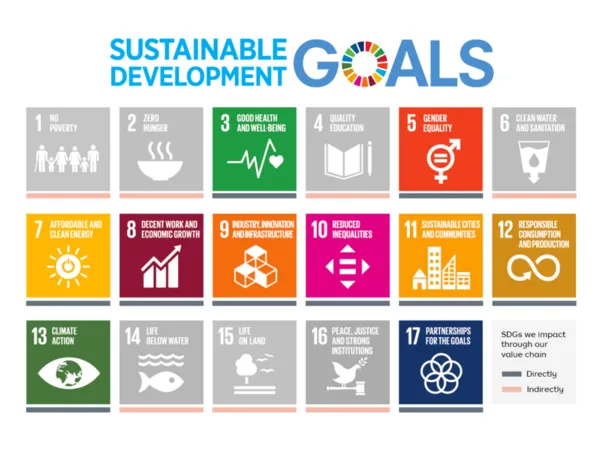
The likelihood that Papua New Guinea won't achieve its 2030 Sustainable Development Goals Agenda is increased by figures indicating a drop in world food production.
Bir Mandal, the country representative and head of the office for the Food Agriculture Organization (FAO), noted that in only two years, the number of people experiencing acute food insecurity worldwide increased from 135 million in 2019 to 193 million in 2021.
He claimed that harsher conditions are anticipated by 2022.
The Asia-Pacific Symposium for Agri-food Systems Transformation was held at the FAO Regional Office in Bangkok at the beginning of this month, and the Minister of Agriculture attended.
Our agrifood systems have structural flaws and poor levels of resilience as a result of the shocks of the COVID-19 pandemic, the food, feed, fuel, fertiliser, and financial crises, popularly known as the 5F problem, as well as climate change and conflict.
Famine and starvation, according to Mr. Mandal, are killing people and endangering children's futures, which will seriously impede efforts to meet the 2030 Sustainable Development Goals Agenda.
According to the FAO and its partners' most recent State of Food Security and Nutrition in the World (SOFI) Report, up to 828 million people would be chronically malnourished in 2021, which is 46 million more than in 2020 and 150 million more than in 2019, before COVID-19.
Papua New Guinea is not an exception to these 5F problems, according to Dr. Nelson Simbiken, acting secretary for agriculture and livestock.
The increase in food prices, feed costs for our livestock industry, including poultry, petrol expenses, fertiliser costs, and the opportunity costs of funding development programmes and investments may be restricted, according to Dr. Simbiken, and will have an immediate impact on PNG.
According to him, the Department of Agriculture would help the government on questions of policy and top priorities in order to protect the economy from potential threats and shocks.
“We are promoting the production of small livestock in the country like sheep and goats to be produced in the regional area or in the provinces,” Dr. Simbiken said.
“We also ensure that our meat production like village chicken and poultry is supported and at the same time we ensure that there are cassava, sago and all our traditional root crops must be grown.”
According to Dr. Simbiken, the department is coordinating with the provinces as part of the food security programme to guarantee that farmers have access to suitable seed programmes in all of the provinces and areas.
According to Mr. Mandal, FAO will keep working to increase farmers' access to early maturing, drought- and frost-tolerant seeds, which would boost output.
Qu Dongyu, director-general of the FAO, asked the government, business, academia, civil society, and all other relevant parties to collaborate and do their part in altering how food is produced, distributed, and consumed in order to empower the most vulnerable.
Reference: Wohi, Lorraine. Post-Courier (24 October 2022). “PNG At Risk Of Falling 2030 SDG Agendas”.
Photo: James Marape
Papua New Guinea will have the financial room it needs to support the country's growth with a K200 billion economy.
Prime Minister James Marape said that since his election as Prime Minister in 2019, he had held firm on his view that PNG had the potential to transform the nation into a K200 billion economy.
“This requires that we evolve from a mindset of dependency on Government, wantoks, and foreign aid to one of economic independence, where we harness economic opportunities available in our country and invest in growth,” he said.
“Our Government’s election victory was a vote of confidence in the direction that we have taken our nation over the course of the past three years.
“We have sought to stabilise an economy shaken by global uncertainty and to bring about the budget repair. But the fact is that more needs to be done.”
In the meanwhile, Marape said that the government had been expansionist during the previous three years by adopting budget strategies to make sure that the economy was stimulated and expanded as well as sustained in its ability to provide public services and reduce debt.
“Commenting on the 2022 Budget, the National Research Institute recognised that the massive 2022 budget will contribute to stimulating the economy via spending and the subsequent effect on increasing consumer demand, consistent with the Keynesian school of thought,” he added.
“It recognises that consumer demand is vital for businesses to perform well, and to create more income and employment in the economy.”
Reference:Kuku, Rebecca. The National (24 October 2022). “K200 billion economy possible: PM”.
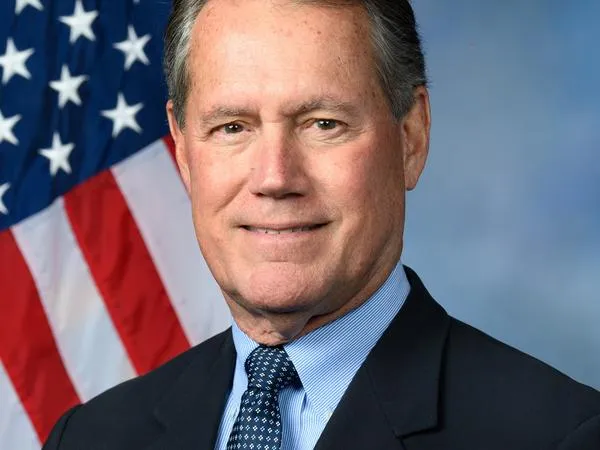
Photo: US Congressman of Hawaii, Ed Case
The American Chamber of Commerce (AmCham) Coral Sea hosted a roundtable discussion with US Congressman Ed Case of Hawaii on Wednesday 19th of October 2022 at its Port Moresby based Office. The AmCham was launched earlier this year to promote sustainable economic growth, foreign investment and greater opportunities for US and the Pacific companies including the Coral Sea region that is PNG, Solomon Islands and Vanuatu.
The discussion comes after a meeting with the Biden Administration last month ago At the US- Pacific Island country summit in ways to enhance Partnership and trade.
Key issues highlighted were how to work in collaboration with AmCham Coral Sea Countries and the US especially Hawaii, providing ways to enhance business growth and explore congress role in enhancing AmCham's efforts.
In his welcoming remarks, AmCham Coral Sea Vice President Peter Burnie (PWC Papua New Guinea) shared AmCham's partnership has having multiple facets that provide innovation, diversity, trust and integrity with Commercial relationship as its centre.
"We recognize the incredible importance of the US government's involvement in the region and our connection is the differentiator in other business organizations and is our key to success".
"I deeply appreciated the discussion with AmCham Coral Sea, how we can all seize the moment following Biden's and congress landmark meeting with the Pacific Island Leaders in Washington DC last month said US Congressman Ed Case (Hawaii). Our Joint Declaration on US Pacific Partnership and our whole range of related initiatives throughout our Pacific demonstration our commitment for working with our partners to increase economic potential and opportunities all towards mutual strengthening of our countries and it's share values .I am really excited at the enhanced role my Hawaii can and wants to play in facilitating this next chapter in the Pacific Century.
Photo credit: Department of Prime Minister & National Executive Council
Prime Minister Hon. James Marape has given the green lights to Japanese think tank Japan Development Institute (JDI) to start work on developing a new Special Economic Zone (SEZ) Master Plan for Papua New Guinea.
He gave the blessing following a meeting with JDI CEO and Chairman, Dr. Shoichi Kobayashi, in Port Moresby recently (October 27, 2022).
PM Marape said the establishment of SEZs would be factored into the 2023 Budget to get the ball rolling.
The meeting was also attended by International Trade and Investment Minister Hon. Richard Maru, PNG Ambassador to Japan H.E. Sam Abal and SEZ Authority Chairman Varigini Badira.
Dr Kobayashi’s visit follows an invitation by PM Marape during a meeting with him in Tokyo last month.
Dr Kobayashi and Ambassador Abal are in PNG this week to further discussions with the Government on progressing the SEZ concept.
They met with the SEZ Authority and Minister Maru on Tuesday (October 25) and visited the Rigo Rice Project in Central.
On Wednesday (October 26), they travelled to Madang to visit the PMIZ and overnighted there.
Today, the team met with PM Marape in Port Moresby, and will return to Japan at the weekend.
PM Marape told Dr Kobayashi to work closely with Minister Maru on progressing the SEZ concept in PNG.
“I want to thank you on behalf of the country,” he told Dr Kobayashi.
“It is in our interest to progress the SEZ concept.”
The JDI is an independent think tank/consulting firm, specialised in international development. It was first established in 1982 as the World Consultant Service (WCS) and later changed its name as JDI after merging with the think tank of the Institution of Engineering Consulting Firms Association, Japan (ECFA) in 1997. With its distinguished experts from numerous disciplines and the network with its associate institutions and experts in the world, JDI provides a broad range of consulting services in the field of development, carries out practical studies, and proposes concrete projects and strategies.
Starting with industrial development in southern Thailand in 1978, JDI has dealt with 40 SEZ projects in 20 countries, to date.
Follow on LinkedIn:
PNG Business News
Be the "First" to get our exclusive Digital Magazine & Weekly Newsletter.