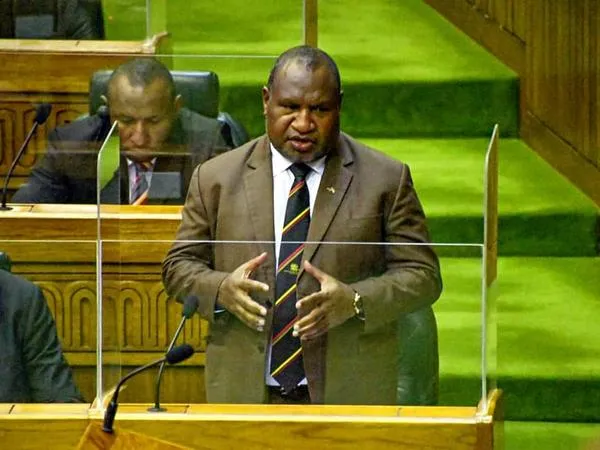
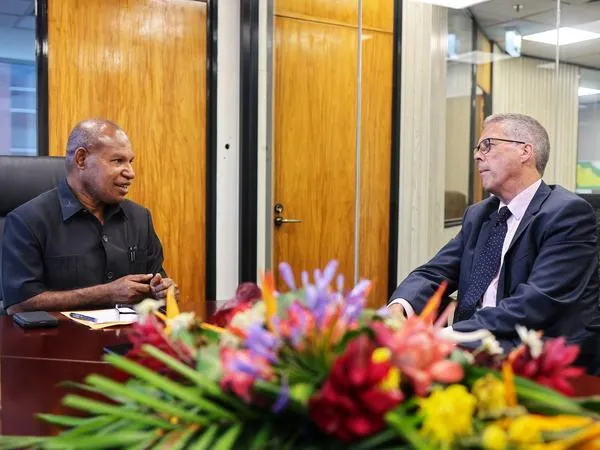
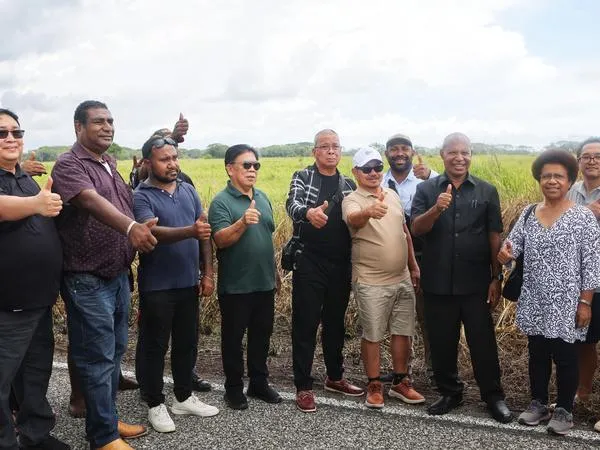
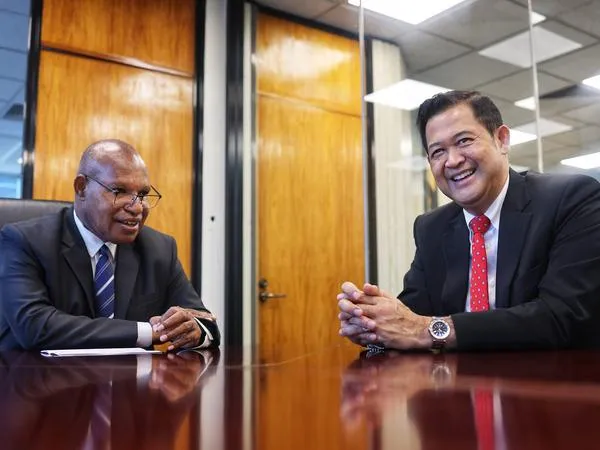
Photo credit: International Trade and Investment Ministry of Papua New Guinea Facebook Page
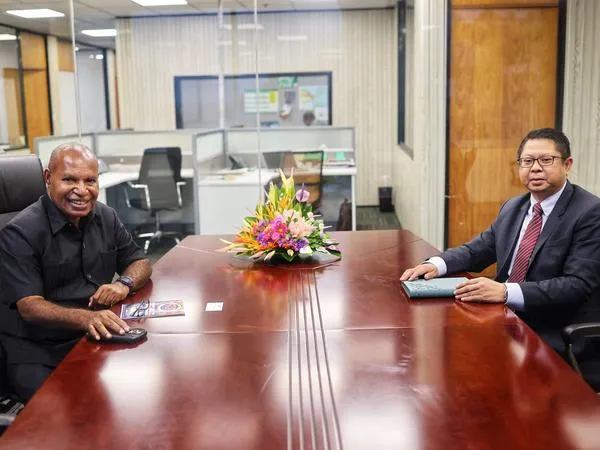
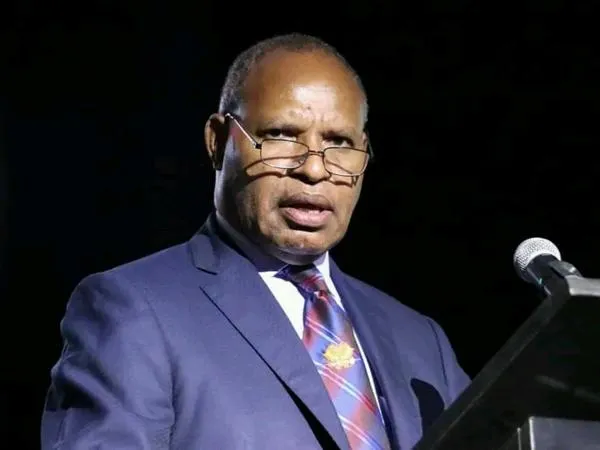
Outgoing Malaysian High Commissioner to Papua New Guinea, His Excellency Melvin Cheah Chee Aun will be leaving the country tomorrow with one regret and that is COVID-19 prevented him from working to assist many more interested Malaysian investors who were keen to invest in Papua New Guinea. In his parting message to the Minister for International Trade and Investment, Hon. Richard Maru yesterday, His Excellency Aun requested Minister Maru to travel to Malaysia to meet over five major Malaysian investors who would very much like to explore investment opportunities and invest in Papua New Guinea.
His Excellency Aun stressed that these five Malaysian investors were keen on investing in the agriculture and manufacturing industries. He said they were especially keen on downstream processing of Papua New Guinea’s raw materials and were also interested in shipping services.
“Papua New Guinea has one of the highest freight rates in the world for domestic transshipment of goods and we need more competition to reduce the cost of shipping,” said Minister Maru.
Minister Maru assured His Excellency Aun that he will be in Malaysia in two weeks’ time to meet with the Malaysian investors who are requesting to meet with him to explore the vast investment opportunities in Papua New Guinea.
“PNG is not new to Malaysian investors. Malaysia is already the second biggest investor in Papua New Guinea behind Australia. We are excited about more investors from Malaysia showing interest to invest in Papua New Guinea,” said Minister Maru.
Photo: MV Rabaul Chief sailing on Papua New Guinea waters. The vessel will be deployed on the new PWX service.
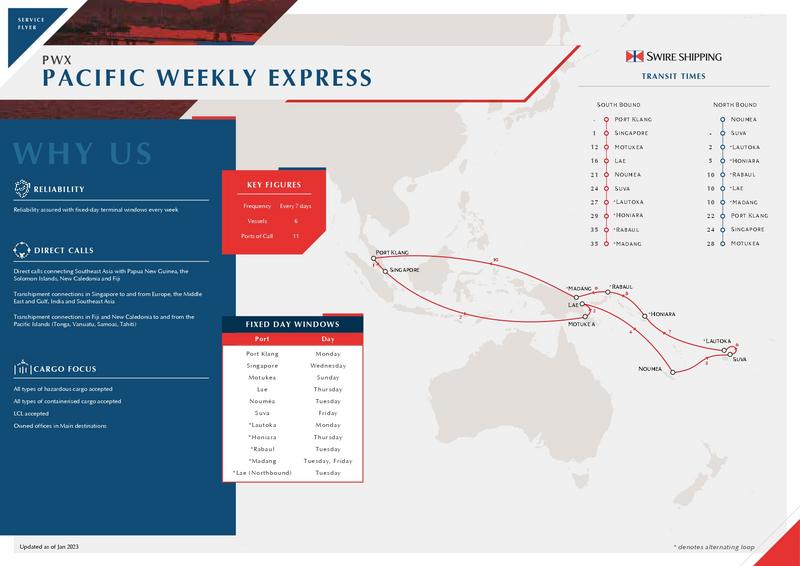
Swire Shipping, a leading operator of liner shipping services in the Asia Pacific, has introduced the Pacific Weekly Express (PWX) service, a new fixed-day weekly service that connects South-East Asia, Europe, India, and the Middle East with Papua New Guinea and the Pacific Islands.
The new service operates on a seven-day frequency to Papua New Guinea, Solomon Islands, New Caledonia, and Fiji, with connections in Fiji and Nouméa to the Pacific Islands of Tonga, Vanuatu, Samoa, American Samoa, and Tahiti.
PWX combines and expands two existing services – superseding the existing Southeast Asia (SEA) and East Southeast Asia (ESEA) services – offering greater frequency, predictability, and speed. The new service underlines Swire Shipping’s commitment to connecting the communities of the Pacific, doubling frequency to the ports of Lae, Motukea, Nouméa, Suva, and Honiara.
Ben Pike, Chief Operating Officer for Swire Shipping, said: “As a partner of choice to many, we believe it is our duty to support our customers’ supply chains with best-in-class liner services. With this in mind, we are pleased to introduce a significant upgrade to our network by including more fixed-day weekly and fixed-day fortnightly products in our key markets. The PWX service will bring significant value to our customers immediately and help to support communities and trade in the region.”
PWX service enhances supply chain planning while reducing risks
With a weekly frequency, customers in the Pacific will now be able to optimise their supply chains and reduce risk. The predictability and reliability of the weekly service will enable them to reduce inventories, lower holding costs, and improve stock management, whilst reducing supply chain risk and the possibility of stock outs. Customers will be able to standardise and repeat processes at both origin and destination locations, making it easier to plan their supply chains. They will also benefit from shorter waiting times and fewer vessel clashes in ports with better on time performance.
An improved network of services in the Pacific
The introduction of the PWX service enables Swire Shipping to upgrade its Papua New Guinea (PNG) Service (serving Australia to Papua New Guinea and Solomon Islands) to a fixed-day fortnightly service. This complements existing fixed-day fortnightly products on the Australia-Pacific Islands (PIS) Service and North Asia Express (NAX) Service (serving North Asia to Papua New Guinea and Townsville, Australia).
Swire Shipping’s integrated logistics division will support the network of services in the Pacific by providing first-mile and last-mile logistics services, facilitating a seamless process.
Acting Bougainville Chief Tax Collector Aloyis Daton has appealed to the Bougainville Executive Council (BEC) to review the taxation laws in Bougainville as some regulations were harsh and did not contribute to the economic development.
Mr Daton said that he had presented the submission on the suggested taxation policies to the Minister for Finance in Bougainville and that they are waiting for a formal meeting with the Bougainville Executive Council (BEC) to discuss further on how to reduce the taxation laws next month.
This would result in the introduction of the new taxation policies, he said.
Mr Daton said that Bougainville needed its own taxation laws that were suitable and applicable to the business environment in Bougainville.
Business ventures of Bougainville were unique and differ significantly from business ventures in Papua New Guinea, he said.
He said that the current taxation laws that were adopted from Papua New Guinea into the taxation system of Bougainville were not successfully working however, those laws needed to be reviewed to suit the needs of the business ventures.
Mr Daton said that the suggested five taxation policies that would work in the region were:
He said that these were the five policies papers that the Minister for Finance will present to the BEC next month.
Mr Daton said that the objectives of the five taxation policies were to;
Mr Daton said that the initial purpose of the review was to welcome a healthy cash flow of the tax payment by the business ventures.
At the moment, there is no involvement by the Autonomous Bougainville Government (ABG) in any business ventures but if the laws are reviewed, then this can make changes and allow the government to be involved by means of becoming shareholders and also paying tax that business ventures also pay, he said.
The taxation policies would see significant change in the behavior of the tax contributors in the business sector and government and that is healthy to the growth of the economy of Bougainville, he said.
Minister for International Trade and Investment, Hon. Richard Maru has highly commended Prime Minister James Marape and the NEC for the very bold and visionary decision to set up a Mission in Thailand amongst the four new missions to be established by the Marape-Rosso Government. The other three are Israel, UAE and Switzerland.
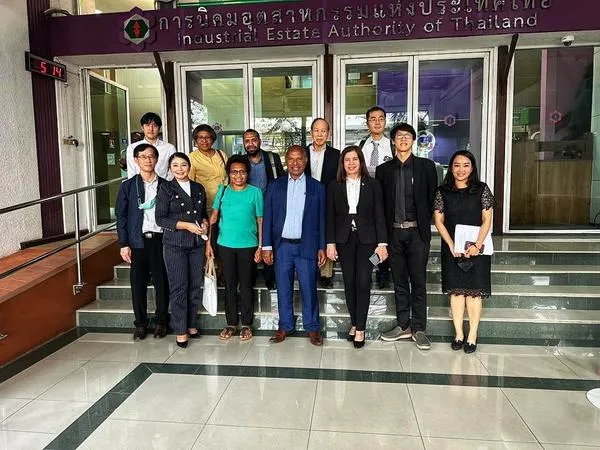
“In my view after visiting Thailand last week on a Trade and Investment Mission, the decision by the Marape-Rosso Government to set up a Mission in Thailand this year as part of our walk across Asia strategy will in time prove to be one of the best decisions taken by any Government since Independence. My delegation marveled at the sheer size and achievements of Thai industries to become world leaders and pacesetters in industries like the fish processing industry, chicken processing industry, starch from cassava, rice and sugar. They used to be third world nation producing agriculture raw materials like PNG is still doing 47 years after Independence while Thailand has transformed to become world leaders in food processing and exports,” said Minister Maru.
Thailand has 40 fish processing plants and is tuna capital of the world with no local fishing industry. They are able to buy and become the leading world supplier of finished fishing products from fish supplied to them from fishing grounds all over the world including Papua New Guinea (PNG).
“We visited and found out that they are major suppliers of fresh and cooked chicken products to Japan, US and the European Union after meeting Japan, US and European Union quality processing standards and accreditation. Thailand is now the world’s leading cassava starch supplier and also sugar. It’s unbelievable they also supply finished products only and do not export raw materials or semi processed agriculture products like PNG does,” said Minister Maru.
“During our visit, leading Thai companies have expressed interest to invest in Papua New Guinea if we are able to provide land, electricity, good roads, wharves and all the enabling infrastructure and incentives to come and set up world class industries to mainly assist them to meet growing world demand for their quality products for countries in the ASEAN region like Indonesia, Australia and our own domestic market demand and Indo Pacific Region. By building a strong trade and investment relationship with the Government of Thailand, the private sector of Thailand, targeting potential investors and the people to people ties with Thailand, the Thai investors can help us develop our vast agriculture, fisheries and manufacturing industries into world class industries in our country,” said Minister Maru.
“We were amazed when they told us that Japan has 30, 000 companies operating in Thailand and they employ over 1 million people from Myanmar to assist with low-cost labor in their manufacturing industry, to ensure they continue to be a low-cost producer of goods and services for the world. They have developed their tourism industry and today enjoy an influx of 40 million tourists a year. Thailand has moved to industrialization starting with manufacturing first all their agriculture products and now they have moved to automobile and other hi-tech industries,” said Minister Maru.
“I was inspired by the trip because I envision if we follow the same path as Thailand and the same trajectory, our PNG economy can be transformed over the next 20 years if we develop a long and enduring partnership with Thailand and benefit from their business models, capital and technology, and their leading global brands and reputation and access their well-established global markets,” Minister Maru added.
Minister Maru said PNG can also benefit from a strong trade and investment partnership with Thailand in areas like tourism development and developing Special Economic Zones (SEZs).
“We found out from our visit to the Industrial Estates Authority of Thailand that is equivalent to our new Special Economic Authority that over the last 30 years they have built 4922 factories, built 4 international ports, accumulated over US$200 billion in Special Economic Zones and created directly 932,258 new jobs,” said Minister Maru.
“The Marape-Rosso Government’s vision to anchor our future by building Special Economic Zones to drive economic growth, large scale mass employment opportunities for our people and create vast wealth creation opportunities for our people and our country is the right way to go based on global experience from countries like Thailand so opening our new Embassy this year in Thailand has to be given our highest priority,” said Minister Maru.
“I am very inspired, and I have no doubt that cementing a trade and investment relationship with Thailand on a Prime Minister to Prime Minister level with a State visit this year by our Prime Minister and the opening of our new Embassy in Thailand will be one of the greatest contribution the Marape led Government will do to secure an even brighter and better future for our beautiful country,” said Minister Maru.
Meanwhile, the first large scale investor that the Delegation met and have invited to come to explore investment opportunities in PNG are scheduled to arrive in Port Moresby early next month.
“My Ministry and the Department will work to invite more Thai investors to come and invest in Papua New Guinea as a major focus of Marape-Rosso Government’s economic growth initiative,” said Minister Maru.
Papua New Guinea will observe its Golden Jubilee as an independent nation 5 years from now in the next term of parliament, and since the country gained its independence the election of the Prime Minister was mandated to the members of parliament, who at national elections were elected by their constituencies.
That system is likely to change as there will be a major constitutional review on the form and system of the government, particularly the election of the Prime Minister which is to be decided by the people.
The constitutional office mandated by law to review legislation that is already passed by parliament will now undertake a major review.
The Constitution and Law Reform Commission (CLRC) will launch the work into reviewing the form and system of government this month.
In the year 2025, the country will be commemorating 50 years as an independent nation and a nationwide public consultation looking at changing the constitutional law to give Papua New Guineans the right to elect the Prime Minister will now be considered.
The nationwide consultation is to run from March to April this year.
According to public notice, a final report with recommendations will be submitted to the office of the Prime Minister in December 2023.
CLRC states that the review is in line with a decision by the National Executive Council (NEC).
In turn, the NEC has directed the head of state to issue a directive to CLRC to review the constitution on the organic law at the provincial and local level government systems as well as other related laws that concern the formation of the government with the focus on the process of electing a Prime Minister.
The government believes that the time is right to initiate this major review of the current form and system of government. The type of government that Papua New Guinea has today is a result of recommendations on the system of government by the constitutional planning committee.
The recommendations were fitting for a new country then, but after nearly 50 years, it is time for a review to reflect the current circumstances of PNG.
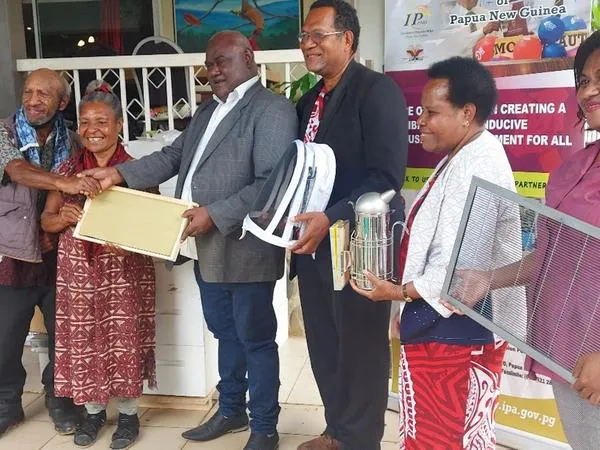
The Investment Promotion Authority (IPA) has assisted a small bee farming business in Simbu Province with bee keeping equipment to help boost its production capacity.
Bussy Honey & Integrated Farming is a family business owned by Mr. Mek Degene and his wife Mrs. Matri Degene and located in Ainanimin Village in the Tabare LLG, Simbu Province. The couple were appreciative of the IPA’s gesture and sincerely thanked the Organisation for their assistance.
The IPA support is a one-off sponsorship assistance given in the form of 40 beehive trays, industrial sugar feed for the beehives and honey extractor frame. The items were purchased from the PNG Beekeeping Supplies, a well-known SME in the Eastern Highlands province who also provides skillset training to local honey bee farmers.
In handing over the equipment to Bussy Honey & Integrated Farming, IPA Managing Director Mr. Clarence Hoot said the IPA was happy to support such impactful community-based projects in such small ways to contribute to their growth into a fully developed SME in the beekeeping and honey production industry.
“IPA does not provide funding to SMEs and this is a good-will gesture to Bussy Honey as one of the local SMEs we have worked with through our Hagen Office” Mr. Hoot said. “It is a success story of some of the promotional programs our Hagen based Highlands Regional Office has been doing in the Highlands region, “Mr. Hoot said.
Bussy Honey & Integrated Farming started off with only two beehives in 2021 and started selling their honey after registering their business in May 2022. Their honey product is now being supplied to a major retail outlet in Kundiawa. It comes in 500g jars and its brand name is BUSSY HONEY, Simbu’s own 100% pure organic Honey. With the IPA sponsored 40 beehives, they are now looking to supply throughout Simbu province.
PNG Beekeeping Supplies manager, Mr. Loie Tella thanked IPA for supporting Bussy Honey & Integrated Farming business stating that there was a huge need for capacity to develop the honey production industry in the country.
“PNG consumes 200 tonnes of honey annually while the local production capacity is at 120 tonnes only,” Mr Tella said. “Hence, the market is ready both domestically and internationally for us to develop this industry.”
Mr. Hoot reiterated that the IPA is here to promote such business opportunities and identify investment ready projects for both domestic and international markets and partnerships. He further called upon leaders and other government departments and agencies to support SMEs in the agriculture sector as such interventions could see agriculture SME propel to fully pledged businesses in future thus contributing to our economic development.
The presentation was witnessed by bee-farmers, DAL, Commerce and SME Officers from the Chimbu and Eastern Highlands provinces as well as representatives of the IPA senior management.
Photo credit: Investment Promotion Authority
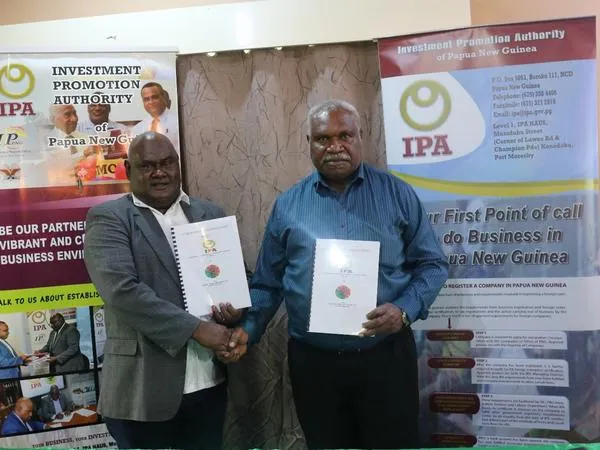
The Investment Promotion Authority (IPA) has signed a Memorandum of Understanding (MOU) with the Eastern Highlands Provincial Administration (EHPA).
The MOU paves way for the Eastern Highlands Provincial Administration to deliver IPA services through the Help Desk to be established within the Commerce Division in the province.
The MOU was signed by the IPA Managing Director Mr. Clarence Hoot and Eastern Highlands Acting Provincial Administrator Mr. Ipa’e Maniha and provides the avenue for IPA to collaborate with the provincial administration, business community and the general public of Eastern Highlands to ensure that IPA services are accessible.
It also provides training opportunities for provincial commerce advisors and business development officers through work attachments with the IPA Head Office or its Regional Office in Mt Hagen. After officers have been trained they will work with IPA to carry out awareness in Goroka and within the districts of EHP.
The MOU with EHP is the first for the highlands region with similar arrangements to be extended to other Highlands Provinces in the immediate future. “One of the key things that we would like to consult on through this MOU is the review of the Reserved Activities List as further work from the last approved RAL by government, “Mr. Hoot said.
An immediate task under the MOU is the training of EHP Commerce by IPA on how to use the new Online Registry Services to register and re-register their business entities. As support to ensure the EHP Commerce Division performs efficiently and diligently, the IPA also donated a computer set hereafter including a three-in-one, printer/scanner/copier and a wifi modem to assist the Commerce Officers’ use in providing these services.
Mr. Hoot said he was happy to see that the MOU was finally signed after a while and reinforced the IPA’s commitment in making available its services right down to the district level with the use of information technology. “The IPA has been around for the last thirty years and over the years has been committed in ensuring that its services trickle down to ordinary citizens,” Mr. Hoot said. “That is why we have been investing resources in strengthening partnerships and enhancing collaboration with Provincial Administrations and other stakeholder agencies as well as private sector stakeholders,” he added.
Whilst acknowledging the internet connectivity issues currently being experienced in some parts of the country, Mr. Hoot said this must not limit the government from continuing to strive to deliver services using technology.
Mr. Maniha was pleased with the IPA for choosing the EHP stating that the province was big with a population of almost 800, 000 and the Government needed to empower the people by creating business opportunities for them to participate in.
“We have to start creating employment for our people and people must be trained to create their own business, “he said. “With such services we can help our people to do that.”
Mr. Maniha also said that there were many businesses operating in the province but his office was unsure whether these businesses have been registered or not. He said with the set up of the IPA help desk the team can conduct spot checks to identify what activities these businesses were conducting and whether they were legally registered and paying taxes.
He said as the Acting PA of the province he would ensure that the help desk was effectively implemented so that IPA can eventually set up a full IPA branch in EHP.
The MOU with EHPA now brings the number of MOUs and IPA help desks established with Provincial Administrations to nine provinces. The IPA will work with other provinces soon starting with Enga, Jiwaka, Chimbu and to Southern Highlands and Hela provinces.
IPA has existing MOUs with its colleague regulatory agencies such as the Internal Revenue Commission, Immigration and Citizenship Services Authority, Customs PNG, Financial Analysis and Supervision Unit (Bank of Papua New Guinea), National Information and Communication Technology Authority, PNG Fraud Directorate, Department of Implementation and Rural Development and National Cultural Commission.
Mr. Hoot is calling on other Provincial Administrations and Government Agencies to partner with the IPA so that all government services can be streamlined and delivered to the people in rural communities and provinces so they can equally participate in nation building going forward.
Photo credit: PNG Chamber of Mines and Petroleum - Dr Albert Mellam, PhD
PNG Chamber of Mines and Petroleum today announced the departure of Dr Albert Mellam, PhD, as the Executive Director of the Chamber, having served in this role for the past 5 years.
Dr Mellam is the first Papua New Guinean and second Director to head this peak industry body in its 34 years of existence. The first Director was Mr Greg Anderson, who served as its Founding Director and led the Chamber for 29 years.
The President of the Chamber, Mr Anthony Smaré, expressed the gratitude of the Chamber membership for Dr Mellam’s service “We thank Dr Mellam for his service and his invaluable contributions especially in guiding the Chamber through a challenging period of its history. During his tenure as Executive Director, Dr Mellam undertook important organisational reforms to strengthen the Chamber’s operations. Dr Mellam made significant progress with expanding the Chamber’s relationship with stakeholders, and in forging a stronger relationships with government and other stakeholders with an interest in the resources sector in Papua New Guinea.”
In thanking the Chamber, Dr Mellam said: “I served the Chamber at a challenging time in its history. Much of my efforts were centred around the ongoing dialogue with government on key policies and proposed legislative reforms in the Hydrocarbon and Mineral industry, and in managing the impacts of the COVID-19 pandemic. Many operating companies that are critically important to the economic wellbeing of our country were impacted, and every effort was made to ensure these companies remained operational during the pandemic.
“There was no global experience to draw from in managing industry affairs during this pandemic”, said Dr Mellam. He noted that besides remaining operational many companies had assisted the government and the public through the provision of health and safety materials and equipment.
Asked to reflect on his time as the Executive Director, Dr Mellam said:
“The national economy is going through an ‘evolutionary phase’ that will impact the Mining, Petroleum, and Energy sectors. This is a natural process and requires the collective efforts of all stakeholders to ensure positive outcomes that benefit the nation and people of Papua New Guinea and keeping the investment climate attractive. It is healthy for the industry and for development of the country’s resources that these conversations are taking place.”
Among the challenges that continue to be faced is a significant hiatus in exploration activity that has impacted prospects for petroleum and mining discoveries that could propel more dynamic economic development in the country, Dr Mellam said.
He would also like to see the dialogue on the reopening of the Porgera Mine concluded soon and the mine re-open. "Many thousands of jobs and families were impacted by the closure of the Porgera mine and it is my hope that operations can recommence soon, as this will help boost the national economy and contribute to affairs and development aspirations of the local region."
Dr Mellam said he is confident he has left the Chamber in a good position to progress its contribution as a Peak industry body. He expressed gratitude to industry members, the government, landowner groups, development partners, the business community, institutions of higher learning and research organisations, and private citizens for the partnership he has enjoyed during his time with the Chamber.
Dr Mellam’s departure took effect on 20th January 2023. The Chamber is now under the stewardship of Pansy Taueni-Sialis, the incumbent Chief Operating Officer, until a new Executive Director is appointed.
Photo credit: PNG Office of the Prime Minister Facebook Page
Prime Minister Hon. James Marape announced recently (Wednesday, January 25, 2023) that Papua New Guinea will host the World Indigenous Business Forum (WIBF) in October this year, 2023.
The WIBF is a forum where indigenous people from all over the world like the New Zealand Maoris, American Indians and Australian Aborigines converge for face-to-face conversations, envisioning, shared learning, mutual opportunity, investment possibilities and a social and economic purpose. It is a forum that specifically promotes indigenous businesses from all around the world. WIBF provides a platform for exchange of ideas, creation of partnerships and bringing investment to communities, entrepreneurs, and organisations.
“I am happy to announce that the National Executive Council has approved for Papua New Guinea to host and co-fund WIBF this year. This will be the biggest event that we will host as a country after APEC 2018,” PM Marape said,
“We have been supporting our local SMEs as a core policy of this Government and hosting of this event will not only highlight our support for the world indigenous business, but it will also provide an opportunity for our local business to build international networks, create partnerships and also look for markets among all the countries that will attend the forum. Our local entrepreneurs and SMEs will have the opportunity to showcase their products, share experiences, best practices and inspiration from successful businesses across the globe.
“We want to use the opportunity to promote Papua New Guinea as an investment destination, a tourist destination, as a safe place to do business, open up opportunities for us to build networks to find export markets for our products to the world, and also help us to encourage indigenous businesses from all around the world to come and invest in PNG.”
Over 600 indigenous businesses from all over the world and at least 400 indigenous Papua New Guinean businesses are expected to be part of WIBF 2023.
“My Government plans to have a big indigenous business expo to run concurrently with the WIBF so that our indigenous businesses in Papua New Guinea can use the opportunity to promote their indigenous goods and services to the world. Our delegates to this forum will only be indigenous Papua New Guineans as that is the nature of WIBF. We expect this forum to also bring in up to K10 million into the country,” PM Marape said.
The Ministry for International Trade & Investment will be the lead partner and a National Steering Committee that will be chaired by Vice-Minister for International Trade and Investment, Hon. Kessy Sawang, will be set up. The committee will comprise of relevant Government agencies and private sector including Tourism Promotion Authority, Department of Agriculture, Department of Foreign Affairs, Cocoa Board, Coffee Industry Corporation, SME Corporation and MSME Council.
“I call on all our indigenous SMEs and large companies to prepare well and take full advantage of this one-off opportunity to market your products and services and our country to the delegations from around the world who will be coming to attend this forum. You must also canvas new business opportunities and forge partnerships to grow your businesses with new indigenous partners from around the world,” PM Marape said.
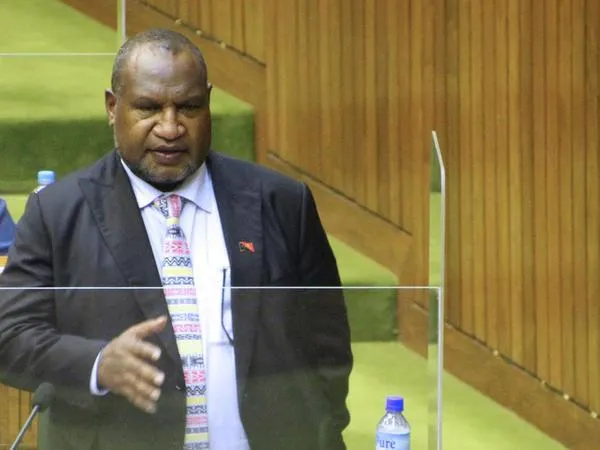
Prime Minister Hon. James Marape has welcomed passage of the landmark National Trade Bill 2023 by Parliament. The landmark bill, unanimously passed by Parliament last Thursday (January 19, 2023) after much debate, was introduced by Minister for International Trade and Investment Hon. Richard Maru. It adds to the growing number of important laws passed by the Marape Government since 2019. “I welcome passage of this very-important bill by Parliament after being introduced by Minister Maru,” PM Marape said. “It will facilitate the promotion and expansion of trade and investment in the country and do away with the bottlenecks of the past which have hindered, rather than progressed, exports of our raw materials to other countries. “One of the most-obvious bottlenecks has been continuous transfer of the trade functions between departments of Foreign Affairs and Trade and Industry – resulting in chaos and confusion. “Lack of properly-coordinated trade has seen smaller countries from the Pacific being able to export their taro, ginger and handicrafts to Australia and New Zealand while Papua New Guinea – which has over 80 per cent of the population and landmass – cannot get our agriculture and fisheries products into Australia and New Zealand markets “A competent and dedicated National Trade Office will be set up – under Department of International Trade and Investment - with a clear legal mandate to identify, negotiate and secure new and better market access for our goods and services.” The National Trade Office will:
A full feasibility study on the bilateral trade between Papua New Guinea (PNG) and Australia will commence at the beginning of next month. This was announced by the Minister for International Trade and Investment, Honourable Richard Maru ahead of a PNG Australia Ministerial Meeting that is scheduled to be held next month. Minister Maru said, a full term of reference has been agreed to between the two countries and the Centre for International Economics (CIE) will deliver the study beginning February this year.
“The study assesses the feasibility of a comprehensive bilateral FTA covering goods and services as well as other crosscutting issues such as investment and local content policies, competition policy, movement of people, sanitary and phytosanitary issues, and technical barriers to trade,” said Minister Maru.
The trade relations between PNG and Australia have been under the PNG-Australia Trade and Economic Relations Agreement signed in the 1970s and recently under the South Pacific Regional Trade and Economic Corporation Agreement.
“Despite Market access offered under these arrangements, for PNG, they have not served their purpose to increase PNG’s exports. Only one commodity group seems to enjoy increased market share in Australia which is gold, copper and other precious metals. Current statistics indicate that over 98.9% of PNG’s exports to Australia comes from the mining and petroleum sectors. Other commodities which are very critical for economic development, poverty alleviation and improving the living standards of ordinary Papua New Guineans see a declining market share in Australia although the demand or market in Australia seems to be increasing for these products which PNG can or is able to supply. A similar pattern is revealed for the services sector. Australia continues to enjoy significant services trade surplus in the PNG market whilst PNG experiences great difficulty to supply services connected to the temporary movement of natural persons and other services skill,” said Minister Maru.
“Therefore, this study is very critical to assess how to make trade and investment between PNG and Australia work for the benefit of our people. The study will assess why PNG products especially from the agriculture and manufacturing sector continue to face stringent quarantine and other Non-Tariff barriers to trade making PNG products difficult to enter the Australian Market and make recommendations forward,” Minister Maru added.
The study will cover amongst others;
A team from CIE will be in the country beginning February to do consultations with stakeholders and will deliver the final report by June 2023.
“I look forward to the outcome of the study which will be implemented soon after the report is delivered. We hope to engage with the Australians for a bilateral trade agreement, a trade agreement that addresses issues that hinders PNG exports and one that is beneficial to PNG similar to the Economic Partnership Agreement with the European Union,” said Minister Maru.
The team of rice investors from the Republic of the Philippines who arrived on Monday have chosen Gabadi in the Kairuku District of Central Province as the most ideal location for large-scale rice investment in Papua New Guinea (PNG), under the nucleus estate concept. They want to establish a 800-hectare estate rice model farm and train and support local village out grower farmers under family owned or rice-cooperative farmers from Brown River to Vanapa and to Gabadi all the way to Bereina.
The Filipino investors’ plan for this Rice Nucleus Estate Model Farm is to set up rice demonstration blocks, a rice processing plant and farmer training facilities for out growers.
“We want to train the local farmers to be better rice farmers and we will buy all the rice that they produce. We will bring our science and technology and invest in mechanized large-scale commercial rice farming in PNG,” said former Philippines Department of Agriculture Secretary, Dr. Emmanuel Pinol.
The land they are interested in to set up the 800-hectare model rice farm with all the processing facilities is the recently acquired Manumanu State land which was recently acquired by the Government through KCHL for K34 million.
The local people at Gabadi have vigorously opposed the establishment of the Military Barracks and welcomed the visit of the National Government and the Filipino Rice investors when they visited yesterday. They indicated full support for the rice industry development including the use of the Manumanu land for the rice model farm so they can also benefit from the cultivation of rice as their major cash crop in the Kairuku District.
“We need large-scale jobs and wealth creation opportunities,” said the Ukaukana village Councillor of the Kairuku LLG, Victor Maggio.
Minister Maru said the undeveloped land will not generate any return to the State for the K34 million it spent to buy the land.
“The development of over 100, 000 hectares of rice in Kairuku District will replace over K800 million in rice imports annually with the proposed Gabadi model farm being the catalyst. We will need only one year for the Government to recoup the K34 million it spent to acquire the Manumanu land purely on economic returns,” said Minister Maru.
“We must make use of thousands of hectares of unused State land all over the country to generate revenue and create employment and wealth for our citizens. The Manumanu land is one of such land,” Minister Maru said.
The Filipino delegation led by Dr. Pinol and consisting of scientists, engineers, economists, financiers, as well as an award-winning farmer were convinced that Gabadi is the ideal location for them to farm rice. After conducting some rapid field tests, Dr Pinol said that Gabadi and the surrounding areas have the right mixture of silty loam and clay in their soils, a lot of available water, abundance of flat land and good climate. They collected soil samples from Brown River, Vanapa and Gabadi and were so impressed will be agronomic conditions for rice growing in PNG.
“In the Philippines, on average, rice yield per hectare is only 4 tons whilst in Papua New Guinea, around Central Province you could easily have an average yield of up to 8 hectares of rice per ton making PNG one of the most ideal countries to grow rice anywhere in the world,” said Dr. Pinol.
“PNG can be a major rice exporter to the world in the future if it fully develops its rice potential,” he added.
From initial estimates from the trip yesterday, the Brown River area could mobilize 10,000 hectares for rice, Vanapa up to 40,000 hectares of logged out land flat land and Gabadi and outwards to Bereina and beyond another 100,000 hectares.
“Combined with Rigo District the Central Province could easily grow and feed the entire country with rice, if we use mechanized farming methods, drone irrigation and solar power to provide electricity. Papua New Guinea only needs 100,000 hectares of rice farms to produce the 400,000 tonnes of rice we consume annually,” said Minister Maru.
The Filipino delegation also met with Prime Minister, Hon. James Marape yesterday and briefed him on their trip to the Central Province and their bold decision to build a model rice farm in Gabadi this year.
“If agreement is reached between the National Government, who owns the Manumanu land at Gabadi, the Central Provincial Government, the Kairiku District Development Authority, the Hiri Koiari District Development Authority and the local impact communities, the project can begin this year,” said Minister Maru.
Minister Maru asked the Philippines delegation to formally communicate their interest to the Government so he can formally put to them the process we can jointly follow to bring the project into reality.
“It will certainly start with a full feasibility study with a 10-year rice development plan, fully costed with financial modelling to assess the scientific, technical, environmental and financial viability of the project. This includes ascertaining the capital investments that is required to be made,” Minister Maru said.
Minister Maru said the Marape-Rosso Government is keen to be a shareholder in the project together with the Central Provincial Government and the respective DDAs and LLGs.
“The National Government must also take a decision to free up the Manumanu land for this agriculture project to help our country finally after 47 years to start on such a project of national significance that has the potential to supply our country our entire country and help us replace the K800 million we spend annually on rice import,” said Minister Maru.
“It will only help us create thousands of new jobs for rice farmers and business opportunities for our families. The Philippines has a dual interest in investing in rice in Papua New Guinea. It is an exciting investment opportunity for them while the investment is also needed to their own food security. They will export the surplus rice back to the Philippines. They do not have the land to grow enough rice to feed their own people, whose staple diet is rice,” Minister Maru said.
“The Gabadi Model Farm is such a high priority of the Marape-Rosso Government so I will request the investor to fast track the completion of the feasibility studies so we can put a detailed submission to the NEC to approve this project in the coming months in close consultation with the respective DDA’s, the Department of Agriculture, the Central Provincial Government and the Prime Minister and the National Government. The Central Province commercial rice industry will be developed as a Special Economic Zone project so the Government can provide the project all the support it needs both in fiscal incentives and infrastructure support including extending the power lines down to Gabadi, where the proposed model farm will be established,” said Minister Maru.
“This large-scale rice development opportunity with our Philippines investors presents the best opportunity our country has had since Independence to replace our rice imports of K800 million annually and propel PNG into being a net rice exporter to the world so grab this opportunity with both hands and run with it,” said Minister Maru.
Minister for International Trade and Investment, Hon. Richard Maru has invited Indonesia through its Ambassador to Papua New Guinea, His Excellency Adriana Supandy to host the first ever historical PNG-Indonesia Trade Meeting this year in Jayapura, Indonesia.
“I want the first historic Trade Meeting between our two countries to happen this year in Jayapura in March,” said Minister Maru during his meeting with Ambassador Supandy on Friday last week.
“If Indonesia agrees to have the Trade Meeting, then we can put together an agenda for the meeting and also put together a technical working committee to organize the meeting. Our Trade Team will not only be made up of Government Departments and Agencies but also representatives from East Sepik, West Sepik and Western Province,” said Minister Maru.
Minister Maru said he will meet with the Indonesian Trade Minister in his follow-up trip to Jakarta after the Trade Meeting to have their first bilateral meeting, mainly to discuss Indonesia President Joko Widodo’s visit to Papua New Guinea (PNG) this year and hold initial talks on working together to develop a framework to negotiate a bilateral trade agreement between PNG and Indonesia.
“We don’t want President Widodo to come for just another visit, we want him to come with the private sector of Indonesia to hold first Indonesian Trade Fair in Port Moresby where big companies of Indonesia can come and promote their products, including their banks. President Widodo can open the Trade Fair as part of the program for his visit. That is one agenda that I want to discuss with the Indonesian Trade Minister and the Indonesian Chamber of Commerce and their Private Sector,” said Minister Maru.
“Many Papua New Guineans do not know what products Indonesia produces and one way through which they can know is when they walk through an Indonesian Trade Fair. We want to start marketing Indonesian goods here and of course our goods to Indonesia,” said Minister Maru.
Minister Maru also added that PNG and Indonesia needed to quickly look at opening flights and shipping services between the two countries, and also look at having a sports relationship to build people to people relationship in addition to our students going to study in Indonesian Universities and Colleges.
“When I first took office last year, I made a bold statement that Indonesia will be the highest trade priority of Papua New Guinea in this term of parliament. My Ministry and Department will work to translate my statement to concrete and tangible actions and results,” said Minister Maru.
Photo: Minister for Trade and International Investment, Hon. Richard Maru
Special Economic Zones are a launching pad for economic development in the country, and the current government has taken a decisive stance under the leadership of current Prime Minister James Marape by setting up and legislating 18 SEZs in 2019.
This policy was the brainchild of PM Marape right after taking office in a successful vote of no confidence against the former Peoples National Congress (PNC)-led government.
The remainder of that period leading up to the 2022 general election was spent on identifying the different SEZs around the country.
In this fact-finding mission to identify suitable land available for massive agroeconomic projects, 18 potential agricultural hubs were identified across the country in certain provinces.
These 18 economic zones include Kokopo Tourism Zone, Tokua Airport City SEZ and Gazelle Agro SEZ (East New Britain), Sepik Plains SEZ (East Sepik), Vanimo Free Trade Zone (Sandaun), Central Province Rice Zone, Baiyer Agriculture Zone (Western Highlands), Karamui Agriculture Zone (Simbu);
Middle Ramu Economic Zone and PMIZ (Madang), Western Province SEZ, Labu SEZ, Nadzab Airport City SEZ and Lae- Nadzab SEZ (Morobe), Ihu SEZ (Gulf), and Manus Special Economic Region.
At the same time, a new ministry responsible for this massive initiative to transform the economic landscape of the country was established as the Ministry of International Trade and Investment. It is currently held and led by MP for Yangoru-Saissia Richard Maru.
Minister Maru announced last December that Papua New Guinea’s new journey to achieve economic independence and transformation has begun. Enough talk of SEZs has already been done and it was time for “action and implementation”.
"We want to start bringing investors to start establishing the SEZs by 2023 so we can create jobs for our people and transform our economy. Our over-dependency on the resource sector has left us where we are now – the highest level of unemployment, the highest level of deficit, the highest level of national debt, and the highest level of lawlessness,” he said.
“A draft master plan will be presented in April (2023) when PNG hosts its very first SEZ Summit in Port Moresby, where all SEZ experts from around the world will come together to share their stories and experience on how their countries used SEZs as a vehicle for economic growth.”
“These experts will be allowed to comment and put their input in the draft master plan before it is finalized and presented to the Government for approval and implementation,” said Minister Maru.
As the initial idea to legislate and formulate its framework is all good, much is left to accomplish in the actual implementation phase, he said. “This is a new policy directed under the new government and we cannot compare this to past government policies such as the controversial Pacific Marine Industrial Zone (PMIZ) in Madang and the Konebada Petroleum Park in Central.”
The only difference this current government will make is by using the five-year mandate to develop these 18- SEZs to accommodate agro-economic projects that will directly substitute imports and enable the export of any surpluses to our Pacific neighbors under the Pacific Islands Forum (PIF) and Melanesian Spearhead Group (MSG) trade agreements and treaties, Mr. Maru said.
The onus of developing and realizing the full potential of these SEZs depends on the support of host provincial governments and district development authorities (DDAs) concerned, he added. The counterpart funding put in by Provincial Governments and DDAs to support SEZs in their areas would be reimbursed as announced by PM Marape.
The projects will benefit the host provinces in increased internal revenue, employment, transfer of technical knowledge and skills, and other local SME spin-off benefits. Therefore, if Papua New Guinea is to become fully economically independent by 2050, prioritizing and developing these SEZs is the way forward, Mr. Maru said.
The Ministry of Trade and International Relations should check on the status of the proposed land that is to be developed under the SEZs and facilitate and transfer all titles to the respective SEZs to take custody of each of the selected 18 sites.
They would be independently assessed, valued, and demarcated for these purposes, and to consider as state leases to add onto the meager 3 percent of alienated land under state ownership, Mr. Maru said.
The Prime Minister's announcement of purchasing land to expand towns, cities, and district boundaries is the right direction that can also include the SEZs, he added. “The long-term effect of these developments would enormously benefit Papua New Guineans in various other ways in many years going forward.”
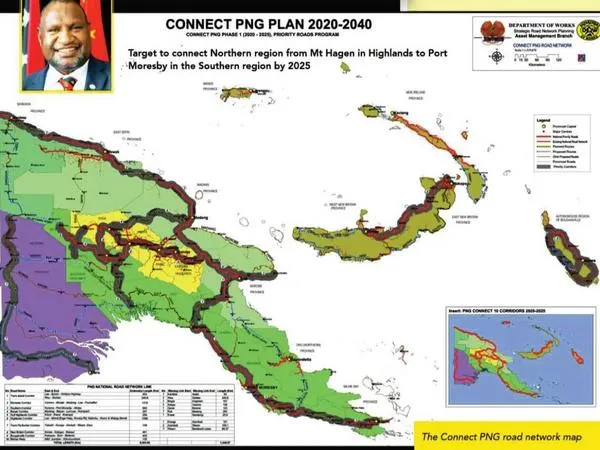
The National Government continues to embark on prioritizing its "Connect PNG Economic Road Transport Infrastructure Development Programme 2020-2040" with its delivery target set for 2040.
This means by 2040, PNG will have access to 100 per cent road connectivity, connecting more than six million people to massive services and economic opportunities. The program provides a strategic pathway for implementing the National corridor development plan which covers 20 years.
Within these 20 years, the Government will improve critical road networks comprised of the strategic national, sub-national and new missing link roads. This ensures and elevates physical access and connectivity for economic growth, productive investments, job creation, and poverty reduction in all regions and provinces.
Minister for Works and Highways Solan Mirisim is adamant to drive the program with strong funding support from the Government, its donor agencies and development partners.
To fully implement and guide the program the Government passed Connect PNG (Funding and Implementation Arrangements) Act 2021, which commenced on February 1, 2022, and is now operational and in progress.
The key provision of the Act empowers the Government to commit a guaranteed long-term total funding of K20 billion commitment towards the program, with an annual national budget allocation forecast of 6.5 per cent (1.4 billion).
The funding will involve combined GoPNG-CSO Partnership Policy financing commitments and pledges from loans, grants, and private financing at the lowest reasonable cost.
The overall implementation program will develop, expand, rebuild, and sustain a road network of 16,200 km of strategic roads on a rolling 20-year program in 3-year phases. Phase one commenced already in 2022 and will be completed in 2027 targeting four high-priority spending areas, which will cover almost 8,000 km with an expected budget funding of K7.44 billion.
The four high-priority spending areas include; Strategic Economic Highways, Construction of Missing Links, Building of Provincial and District Economic Roads, and the National Bridge Development and upgrade Program.
Phase two of the program is expected to commence in 2028 and ends in 2034 with a projected funding commitment of K6.7 billion covering upgrading and expanding works, while phase three commences in 2035 and ends in 2040 with a projected funding commitment of K5.3 billion.
It is understood that the program's future benefits and impacts are not guaranteed due to several critical challenges identified such as underfunding, procurement delays, social issues, inflationary risks, political risks, and natural events, which can potentially affect and have an impact on the implementation of phase one of the program.
However, the Government has undertaken necessary actions to address this going forward so that the Connect PNG Program remains focused to deliver its targets and goals.
Meantime, beginning of this year 2023, the Department of Works and Highways (DOWH) will be consistent with the Connect PNG Act 2022, regarding the carry-over of ongoing contractual commitments that total up to K6 billion.
Photo: Simon Sia and PNG SME Corp Delegates
As the Government has placed more emphasis on Micro, Small & Medium Enterprises (MSMEs) and Small & Medium-Sized Enterprises in the country, Eastern Highlands Province launched its SME policy over the festive period.
Governor for Eastern Highlands Simon Sia and delegates from the PNG SME corporation launched the SME policy in the provincial capital of Goroka.
Small to Medium Enterprise Corporation Managing Director Petrus Ralda clarified and confirmed that Eastern Highlands Province is the first in the country to have its own SME policy.
He stated that this is in line with the National SME policy framework and congratulated the Eastern Highland Province SME coordination team for implementing the Provincial SME policy.
Mr Ralda further said that the SME Corporation is ready to work with the Eastern Highlands Provincial Government and SME coordination team to provide the necessary support.
The official launch of the policy was well attended by more than 400 SME business owners in the province and also SME owners from the neighbouring Chimbu province who were present to witness and also showcase their various products and services.
The EHP SME Policy is focused and developed upon a product of a hectic provincial consultation and discussions covering a wide range of areas including issues that needed urgent attention.
The provincial SME coordination team stated that the SME movement in the province is growing rapidly, and an increasing number of SMEs are initiating business concepts, especially in agriculture and getting themselves registered through IPA Online Registration.
The launch of the provincial SME policy provided an avenue and opportunity for SME owners to meet, greet and most importantly showcase their products and services as well as network with each other.
Speaking at the launch, Governor Simon Sia, who was a prominent and well-known business figure in the Highlands region before entering politics, challenged all SME owners and aspiring entrepreneurs to set goals for their businesses and work harder towards achieving them.
Governor Sia further urged all Eastern Highlanders to venture more into agricultural business activities to sustain themselves.
The provincial SME policy has set out the foundation for SME growth, entrepreneurship and economic development in the province. Business services will be offered to assist and provide nourishment to small business owners, in rural areas so that it helps small people in bigger business environments.
Follow on LinkedIn:
PNG Business News
Be the "First" to get our exclusive Digital Magazine & Weekly Newsletter.