

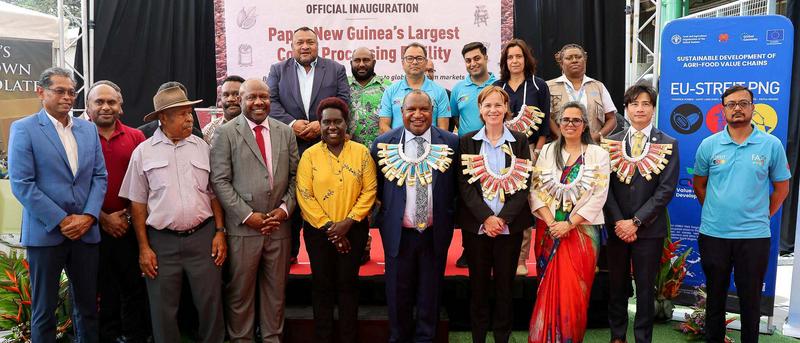
Papua New Guinea has inaugurated upgraded cocoa processing and chocolate-making capacity at Paradise Foods Ltd.’s Queen Emma Chocolate factory in Port Moresby, strengthening the country’s ability to process cocoa locally and supply higher-value products to overseas markets.
The upgraded facility includes 12 types of new machinery worth US$2.8 million, provided through the European Union-funded EU-STREIT PNG Programme and implemented by the Food and Agriculture Organization of the United Nations.
Paradise Foods expects the investment to double production and improve the consistency and quality of cocoa ingredients and finished chocolate for specialty buyers.
The expansion allows more Papua New Guinean cocoa to be processed into semi-finished and finished products before being exported, supporting the government’s push for greater downstream processing.
Prime Minister James Marape said domestic processing could generate significantly greater value than exporting raw cocoa.
“This is our own company, complementing the Government's desire for 100 per cent downstream processing in-country,” Marape said at the inauguration.
“And through this approach, we are making three times more than what we make when we export the raw product.”
The investment also strengthens links between cocoa farmers and domestic processors. Under the EU-STREIT PNG Programme, cocoa farming groups in East and West Sepik have been connected directly with Queen Emma Chocolate, supplying well-fermented and smoke-free beans.
FAO head of country office in Papua New Guinea Kachen Wongsathapornchai said a reliable domestic market that rewards quality could encourage farmers to improve fermentation and drying practices.
“Quality only becomes sustainable when the market pays for it,” Wongsathapornchai said.
Under the programme, 3.4 million pest-tolerant cocoa seedlings have been planted and 4,960 hectares of cocoa blocks rehabilitated, with a reported grafting survival rate of 95%.
About 19,400 cocoa farmers have also been trained in bud grafting, integrated pest and disease management, block management, climate-smart agriculture and post-harvest handling.
The programme has upgraded 500 cocoa dryers, introduced 100 solar combination dryers and is establishing 120 cocoa storage facilities. It has also supported the formalisation and development of 363 cocoa agribusinesses.
Paradise Foods chairman Anthony Smare said the company’s investment reflected its confidence in Papua New Guinea’s future.
“We were not told to invest in our country, we chose it,” Smare said, adding that Paradise Foods was “PNG-owned” and “PNG-made.”
The company has also used support from the EU-STREIT PNG Programme to showcase Papua New Guinean cocoa and chocolate at trade events in Australia, New Zealand and Singapore, building relationships with specialty chocolate makers and niche ingredient buyers.
EU Ambassador to Papua New Guinea Erika Hasznos said the investment formed part of the EU’s Global Gateway strategy to support Papua New Guinea’s cocoa value chain, from production in the Sepik to processing in Port Moresby.
“By raising quality and consistency, EU-PNG cooperation brings more value for Papua New Guinean business and small farmers, and more opportunities to access premium European markets,” Hasznos said.
The investment supports Papua New Guinea’s Medium Term Development Plan IV priorities on downstream processing, commercial agriculture, micro, small and medium enterprises and private-sector partnerships.
The EU-STREIT PNG Programme is the European Union’s largest grant-funded initiative under its Global Gateway strategy in Papua New Guinea. The programme is implemented by the United Nations through a joint programme led by FAO, in partnership with ILO, ITU, UNCDF and UNDP.
As of June 2026, the programme had reached 513,000 individuals, benefited 85,400 families, supported 700 farmer groups and trained 34,000 farmers across 42 local-level government areas in East and West Sepik.
Queen Emma Chocolate is produced by Paradise Foods, described by the programme as Papua New Guinea’s leading domestic cocoa processor and chocolate maker.


