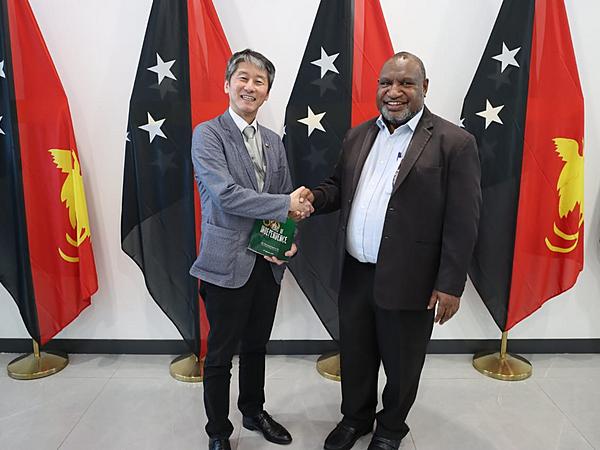
Prime Minister James Marape has reaffirmed Papua New Guinea’s long-standing partnership with Japan, setting out plans to deepen cooperation in education, trade, clean energy and regional security following high-level talks with Japanese officials.
Marape met with Matsuoka Hideaki, Shirouzu Kenichi and Hisanobu Mochizuki, highlighting what he described as a “forward-looking agenda” anchored on human capital development and economic expansion.
Scholarships, skills development prioritized
The prime minister pointed to the growing role of the Japan International Cooperation Agency in supporting Papua New Guinean students and public servants through scholarships and postgraduate training.
He said expanded access to Japanese education — including master’s programs — is strengthening the country’s workforce and creating a pipeline of technically skilled graduates, particularly in language and specialized fields.
Marape also pushed for deeper institutional ties between University of Papua New Guinea and Papua New Guinea University of Technology with Japanese universities, especially in emerging technologies.
Trade, connectivity seen as growth drivers
On the economic front, Marape backed efforts to improve logistics links, including direct shipping and air connectivity, to facilitate trade expansion.
He said Papua New Guinea is seeking to scale up exports of agricultural commodities such as coffee, cocoa and vanilla to Japan, while opening its market further to Japanese goods and investment.
“There is significant potential for growth in trade, investment and value-added manufacturing,” he said, reiterating that the country remains open to foreign business participation.
Clean energy collaboration proposed
Marape also outlined a longer-term vision for energy cooperation, inviting Japanese firms and research institutions to partner with Papua New Guinea in renewable energy and battery storage technologies.
He said the country’s natural endowments — including hydro, geothermal and solar resources — position it to become a future supplier of clean energy, potentially exported through advanced storage systems rather than conventional means.
Call for regional stability
The prime minister underscored the need for sustained peace and cooperation in the Asia-Pacific, urging major powers to adhere to international law and prioritize stability.
“We live in a connected world where what happens in one region affects all of us,” he said, emphasizing coexistence and respect across territorial domains.
Marape also confirmed plans to participate in the Pacific Islands Leaders Meeting, a key forum for Japan’s engagement with Pacific nations, signaling continued high-level dialogue between the two sides.
Long-standing partnership
He concluded by describing Japan as one of Papua New Guinea’s most trusted partners, noting that bilateral ties have been built on mutual respect and development cooperation.
“Together, we can build a future based on innovation, sustainability and shared prosperity,” Marape said.