

Papua New Guinea’s economic outlook remains cautiously optimistic despite rising global uncertainty, with businesses demonstrating resilience as key constraints shift from foreign exchange shortages to challenges such as utilities and infrastructure.
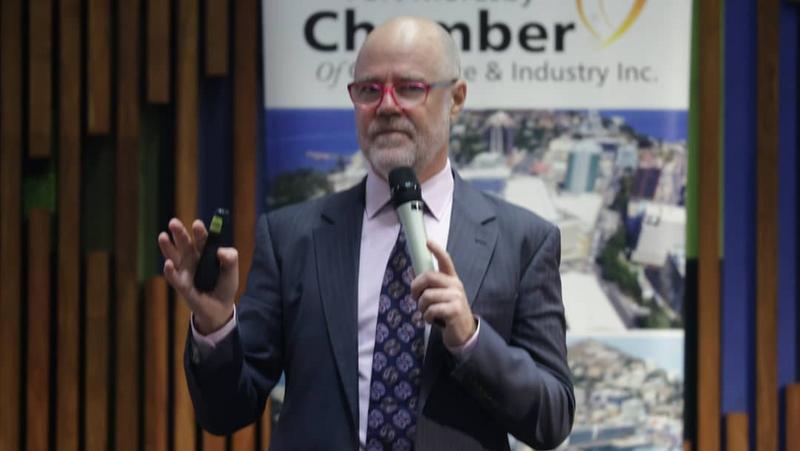
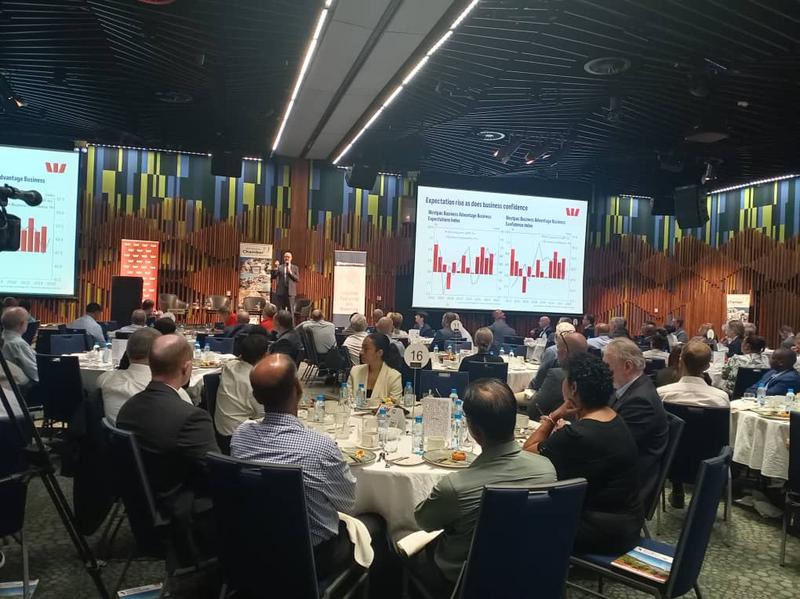
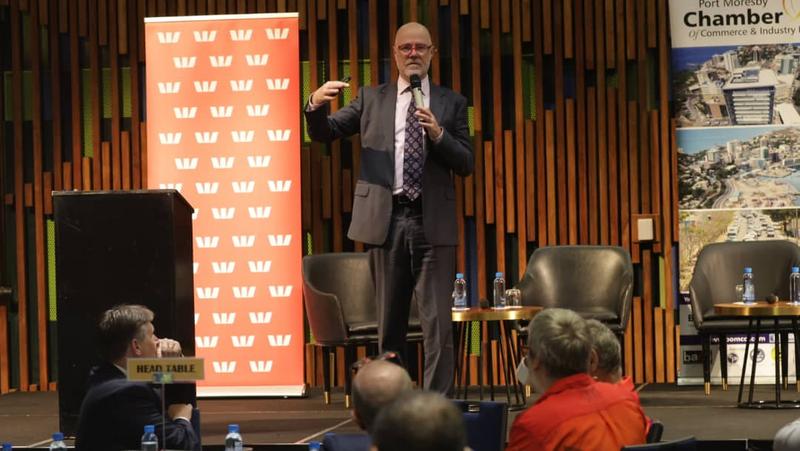
This was the central message from Justin Smirk, who delivered a detailed economic briefing during the Port Moresby Chamber of Commerce and Industry (POMCCI) Breakfast Meeting on March 26 at the Hilton Port Moresby, marking the release of the 2026 Westpac 100 CEO Survey.
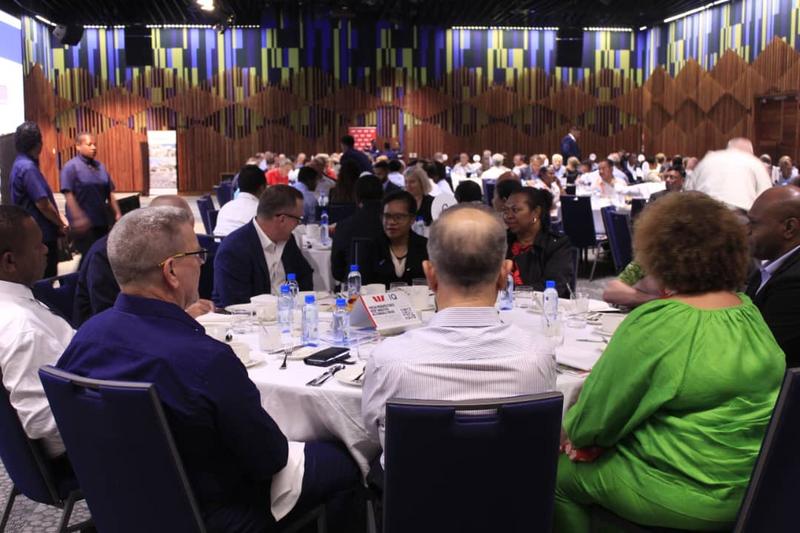
Hosted by POMCCI, the event brought together business leaders to review survey findings and assess global economic developments and their implications for Papua New Guinea.
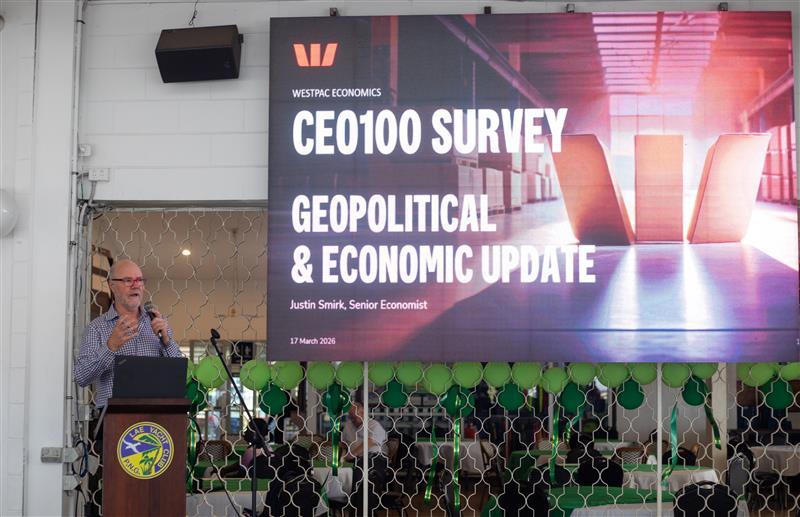
The briefing formed part of a broader visit by Smirk to PNG, during which he engaged with senior business leaders and clients, and delivered presentations at the 100 CEOs Forum and the Lae Chamber of Commerce and Industry. Discussions focused on global economic conditions, inflationary pressures, commodity markets and how businesses can better position themselves amid external volatility.
The 2026 survey points to strengthening business confidence, with 72% of CEOs forecasting increased investment this year. Smirk said this aligns with broader trends observed in the data, including improved profit performance and rising investment expectations.
“We’ve seen outcomes for profits exceed expectations last year, and expectations for this year are stronger than average,” he said.
Shift in business constraints
A key development highlighted in the survey is the declining prominence of foreign exchange (FX) shortages, long considered the primary barrier to business operations in PNG.
For 2026, FX has dropped to 12th place among business constraints. In its place, unreliable utilities have emerged as the most significant impediment, followed by security and law and order, limited government capacity, and a shortage of expertise and skills.
Smirk said easing FX pressures has enabled businesses to operate more freely, but has also exposed deeper structural issues.
“When you remove one key impediment, you find the next constraints. Utilities are now front and centre because they’re directly affecting business activity,” he said.
Global geopolitical risks
A major focus of the presentation was the impact of escalating geopolitical tensions, particularly in the Middle East, on global energy markets.
Smirk noted that tensions, including those involving Iran and the United States, continue to drive volatility in global oil prices. He warned that Papua New Guinea, as a net importer of refined fuel, is particularly exposed to these fluctuations.
Higher fuel costs are already flowing through to transport, logistics, electricity generation and the broader cost of goods across the economy.
He also outlined scenarios involving disruptions to critical oil shipping routes, noting that even the threat of conflict has constrained supply due to insurance restrictions on vessels.
“The straits are effectively closed, not necessarily because they physically are, but because insurers won’t cover ships going through,” he said.
Westpac modelling suggests that while short-term disruptions may have a limited global impact, prolonged disruptions of up to three months could push oil prices to between US$150 and US$200 per barrel (approximately K570 to K760), significantly slowing global growth and increasing inflation.
The conflict has already driven sharp increases in oil, petrol and LNG prices, with regional LNG prices rising from around US$6 to US$19 per unit (approximately K23 to K72). These increases are feeding into supply chains, particularly in Asia, with refined fuel prices such as diesel and kerosene rising sharply.
“These price movements are real, and they won’t disappear quickly,” he said.
Commodity gains offset risks
Despite these pressures, Papua New Guinea is benefiting from a broader upswing in commodity prices and remains well positioned to capture long-term demand for its natural resources.
Gold prices have continued to rally since 2024, with forecasts suggesting they could remain around US$5,000 an ounce (approximately K19,000), while copper prices remain supported by strong global demand.
“It’s a two-sided story,” Smirk said. “Higher energy costs are a challenge, but higher commodity prices are providing a strong offset.”
Currency and inflation outlook
On the currency front, Smirk pointed to a weakening US dollar, driven by rising debt levels and shifting global investment patterns. He warned that this could place downward pressure on the Papua New Guinean kina, particularly if exchange rate policy remains closely aligned with the US dollar.
He added that global trends in inflation and interest rates will continue to shape PNG’s economic trajectory, underscoring the need for businesses to factor these variables into planning and risk management.
At the same time, rising global fuel costs are expected to push inflation higher, with Smirk indicating a potential increase of around one percentage point in the near term.
Domestic resilience
Despite global headwinds, PNG’s domestic economy continues to show resilience, particularly outside the resource sector.
Survey indicators suggest that non-resource sector growth could reach between 4% and 5%, supported by stable business activity and improved operating conditions.
“This tells us we can generate growth without relying entirely on major resource projects,” he said.
Untapped capacity
The survey also found that several constraints typically associated with fast-growing economies — including access to land, capital and warehouse space — are not currently major concerns.
“For me, that’s the opportunity,” Smirk said. “It indicates we have capacity to grow faster. These constraints usually emerge when economies are expanding more strongly.”
Outlook tied to reforms
Smirk emphasised that while the outlook is positive, sustained growth will depend on addressing long-standing structural challenges and maintaining reform momentum.
“We’re not going to fix utilities, law and order, or government capacity overnight,” he said. “But incremental improvements in these areas will make a significant difference.”
He added that understanding global trends — particularly commodity prices, inflation and interest rate movements — will be critical for businesses as they plan, invest and manage risk.
“The framework is not spectacular, but it is quite optimistic. We have the foundations for growth — what we need now is to keep removing the headwinds.”
Westpac engagement
Andrew Cairns said Smirk’s visit underscores Westpac’s commitment to supporting informed decision-making across the economy.
“At Westpac PNG, we are committed to connecting our customers and stakeholders with global expertise that helps them navigate economic change,” Cairns said. “Justin’s insights provide valuable context for businesses as they plan for the year ahead.”
As part of his visit, Smirk also engaged with regional audiences in Lae and participated in media interviews, including a live discussion on FM100, providing perspectives tailored to local business conditions.
Westpac PNG continues to play an active role in promoting economic dialogue and financial literacy, helping businesses and communities build confidence in an evolving economic environment.
.jpg)
.jpg)


