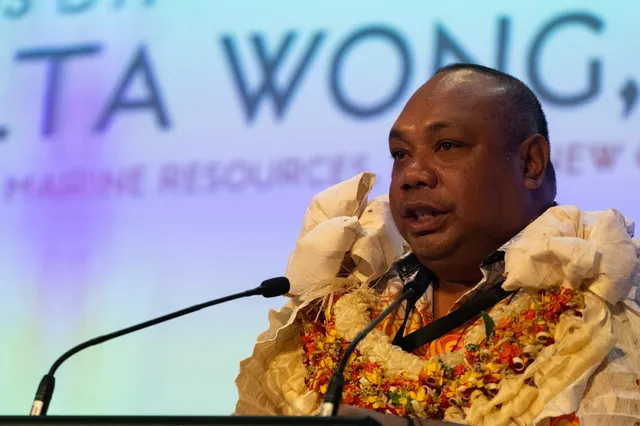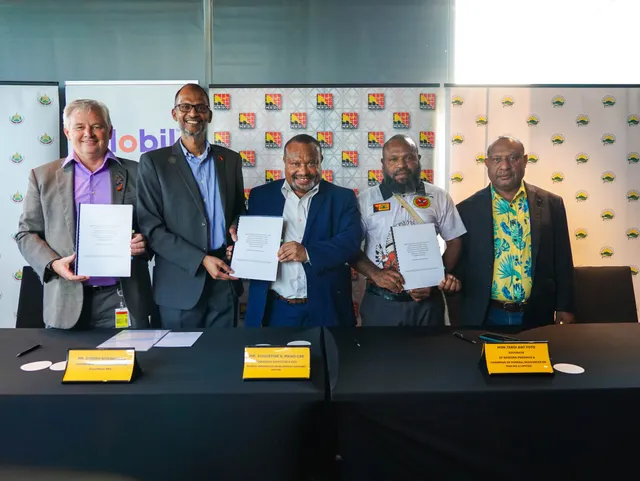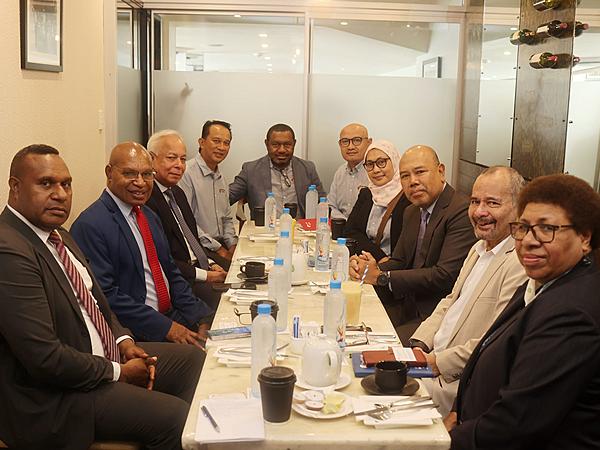
Discussions have been concluded between the Minister for International Trade and Investment, Hon. Richard Maru, and the Chairman of New Britain Palm Oil Limited (NBPOL), Datuk Mohamad Helmy Othman Basha, for the State to take equity in Ramu Agri Industries Ltd (RAI) early next year.
Minister Maru, who is also responsible for State Equity, said that the state will take up equity under the State Equity Funding with other Papua New Guinea (PNG) investors as investment partners in RAI. It will also be relatively easy to raise capital in the stock exchange through an Initial Public Offering to raise large sums of investment funds because RAI is a well-managed and very profitable business in oil palm, cattle and sugar industries and has a very bright future except its limited by land for expansion.
"The proposed joint ownership will specifically focus on expansion of RAI to the Sepik Plains (oil palm and cattle) and in Abau, Central Province (sugar). It is important that the Government take up equity so we can give comfort and confidence to the company to invest outside of its current areas of operation. This is part of our reset agenda to double the size of the palm oil industry and stop sugar and cattle imports," he said.
RAI is owned by NBPOL, a large, integrated producer of sustainable palm oil. NBPOL currently operates across five provinces, including West New Britain, Oro, Milne Bay, Madang, and New Ireland, managing over 92,000 hectares of planted oil palm. It employs more than 20,000 people in PNG and supports thousands of smallholder farmers, suppliers, and service providers connected to its operations.
“The company is already investing in the country and understands the local conditions and is also a leading global player. This makes the proposed partnership a very strategic one. They also have access to Tax Credit through which we can develop townships, police posts, schools and other infrastructure,” said Minister Maru.
The Minister noted that oil palm is PNG’s largest agricultural industry, with export earnings of K2.2 billion (approximately USD $283 million), and significant potential for growth.
Oil Palm in PNG is grown on about 236,000 hectares of land on estates and on smallholder farms. The estates produce 65% of the country’s oil palm, while smallholders produce the remaining 35%. The palm oil industry of PNG remains the country’s biggest earner as far as cash crops are concerned.
Oil palm became a commodity in 1960, and has been contributing to the economy by providing jobs and revenue.
In Indonesia, the palm oil industry accounts for 1.6% of GDP and employs 4.5 million people. As the majority of the harvest is exported, the industry generates more than USD $18 billion a year in foreign exchange — the single biggest contributor in the country. It is the only country that has significantly increased the size of its palm oil, which grew by almost 650% between 2000 and 2022.
"If we are to grow oil palm on all our 6 million hectares of grassland, we are looking at generating over K20 billion (approximately USD $2.57 billion) annually in export earnings and creating one million new jobs in the formal sector and another one million indirect jobs. We need volume to go into downstream processing,” he said.
Regarding sugar, the Minister said that PNG is a net importer of sugar. In 2023, PNG imported over USD $29 million worth of sugar from mainly Thailand and Malaysia.
"We are potentially missing out on tens of thousands of jobs by importing sugar instead of developing and expanding our domestic industry. We have the potential as a country to replace sugar imports, be a net exporter, and we can also use bagasse, the fibrous residue left after crushing sugarcane, to produce electricity," he said.
He further explained that while RAI cannot supply the total market demand, the Government will not offer any tariff protection like the 15-year infant protection previously available.
“We can only protect a new sugar company, which is possible under this new partnership and at a new location like Abau where ENBPOL owns 5,000 hectares of land which can be used for sugar development. The balance of the sugar can be supplied by village farms or through planting of large estates using lease-leaseback scheme,” he said.
Datuk Basha committed to providing a formal Offer Letter for the State to take up equity in RAI. Minister Maru assured him that upon receipt of the letter, he would take a submission to Cabinet to seek approval in principle for this strategic partnership, which he said will transform the oil palm industry over the next 50 years. He also reassured the company of the Government’s highest level of support.
The Minister also acknowledged concerns about limited industry consultation on the Palm Oil Industry Authority Bill 2025 and the Palm Oil Management Bill 2025 and promised to advise the Government of these concerns.