

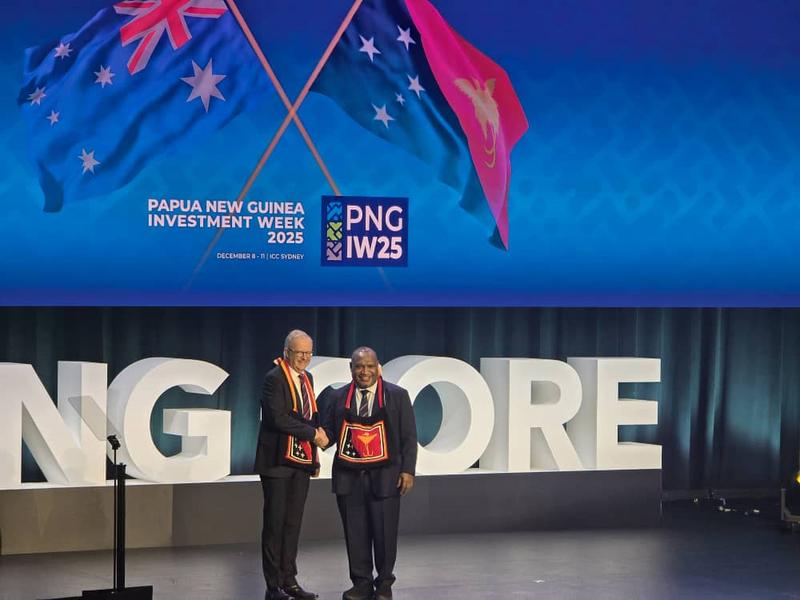
Australia’s Prime Minister, Anthony Albanese, has reaffirmed the strength, trust and long-term vision underpinning the Australia–Papua New Guinea relationship, highlighting deeper economic cooperation, shared prosperity and a historic new security alliance during his address at the PNG Investment Week Leaders’ Summit in Sydney 9 December 2025.
Speaking before leaders from business, government and regional partners, Prime Minister Albanese underscored the unique bond between the two nations, grounded in history, friendship and growing economic ties.
Before his speech, he acknowledged the Traditional Owners of the land on which the summit was held and extended a warm welcome to delegates from PNG, Australia and across the region.
“This forum is about all of us working together to find new pathways for investment and development and maximising the dynamic and growing trade relationships that do so much to benefit the people of both PNG and Australia,” Prime Minister Albanese said.
He reflected on the close personal and national ties linking the two countries. He briefly referenced the many milestones shared with PNG Prime Minister James Marape in recent years—from addressing each other’s parliaments to walking the Kokoda Track together, honouring the Second World War legacy that binds both countries.
He also recalled shared celebrations at PNG’s 50th Independence Anniversary in Port Moresby earlier this year, describing it as a powerful moment to reflect on both nations’ intertwined histories and future ambitions.
“These moments,” Albanese said, “are defined by mutual respect, deep trust, and an appreciation of the history and geography that unite our peoples," he said.
Pukpuk Treaty
A central point of his remarks was the Pukpuk Treaty, the security pact signed between Australia and PNG earlier this year. Albanese described it as Australia’s third-ever alliance, and its first in more than 70 years—an achievement he called “a historic moment”.
The treaty formalises the long-standing defence partnership between the nations.
“We are mates. We are equals,” he said, repeating Prime Minister Marape’s words that the relationship represents “equal partners… working side by side going forward into the future.”
Trade and Investment Drive Shared Prosperity
Albanese highlighted strong two-way trade, which reached $8.1 billion in goods during 2024–2025. He noted growth in PNG’s agricultural exports—particularly vanilla, coffee and cocoa—supported by new biosecurity investments and infrastructure upgrades that are improving market access.
Australia is financing several major infrastructure projects to support PNG’s economic expansion, including:
-
A 47 km upgrade of the Wau Highway, improving connectivity across Morobe Province
-
Sealing of the Kokoda Highway, undertaken jointly with PNG
-
More than $600 million for the upgrading of five key ports, critical for a country of more than 600 islands dependent on maritime trade
He emphasised that all these initiatives aim to strengthen local employment, supply chains and economic resilience within PNG.
“Australia is committed to remaining a proud and reciprocal economic partner of PNG. PNG’s exports to Australia continue to flourish. And while raw materials are an important feature of our trade relationship, they are by no means the whole of it," he said.
New investments to strengthen biosecurity mean PNG’s dynamic agriculture sector can continue to thrive and grow its market access. Exports of vanilla, coffee and cocoa beans to Australia are growing strongly, diversifying our trade relationship and proving that Australian markets are hungry for PNG’s exceptional produce.
“Infrastructure investments are helping local producers take their goods to port and to market by better, safer, more reliable roads,” Prime Minister Albanese added.
Supporting Climate Resilience and Human Development
Recognising climate change as an existential threat to the Pacific, Albanese reaffirmed Australia’s commitment to helping PNG access greater international climate finance. This includes support for infrastructure and agriculture designed to withstand more extreme weather patterns.
He added that Australia is investing both in physical development and in PNG’s greatest asset—its people—through improved health systems, education and skills training, and enhanced energy and communications networks.
“These are the foundations for stronger communities and stronger economies,” he said.
NRL Expansion Creates New Economic Opportunities
A particularly celebrated development is the anticipated entry of the PNG Chiefs into the NRL. Prime Minister Albanese described the move as a cultural milestone that also carries significant economic potential.
The expansion is expected to boost tourism, spur infrastructure development and generate new investment opportunities, including direct flights between Sydney and Port Moresby, which Qantas is set to resume in March 2026.
“It is all part of welcoming a country that has given so much to rugby league into a competition where they so clearly belong,” he said.
Albanese closed by urging leaders to continue building the next chapter of the relationship—one centred on regional stability, strengthened sovereignty, robust trade and sustainable development.
Invoking Prime Minister Marape’s words, he said PNG and Australia are “two houses with one fence”, benefiting from a neighbourhood that is peaceful, stable and prosperous.
“Our shared history guides us, and the opportunities of our shared future lie ahead,” he said.
Prime Minister Anthony Albanese’s speech formed a core highlight of the PNG Investment Week Leaders’ Summit, reaffirming the strategic importance of PNG–Australia cooperation at a time of growing regional and global change.


