

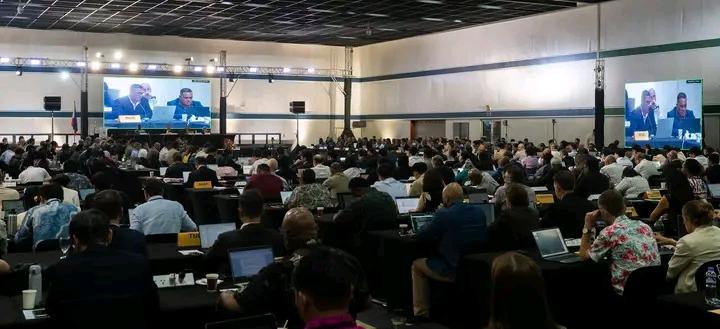
Papua New Guinea has renewed its call for fairness, strengthened scientific management, and climate-resilient policies at the Twenty-Second Annual Regular Session of the Western and Central Pacific Fisheries Commission (WCPFC22), held 1 to 5 December in Manila, Philippines.
Addressing ministers, fisheries heads and delegates from across the region, Minister for Fisheries and Marine Resources, Hon. Jelta Wong, reaffirmed PNG’s commitment to sustainable tuna management and the protection of Pacific Island interests under the WCPF Convention.
Minister Wong emphasised PNG’s alignment with fellow Pacific Island countries, highlighting that the region’s globally recognised healthy tuna stocks are the result of “disciplined governance, regional solidarity, and the sacrifices of our people.”
He noted that Pacific nations are pursuing greater value from their fisheries—but always through science-based and sustainable measures.
“The efforts to agree on measures that are sustainable and supported by scientific information have enabled Pacific Island countries to directly benefit from this significant natural resource.”
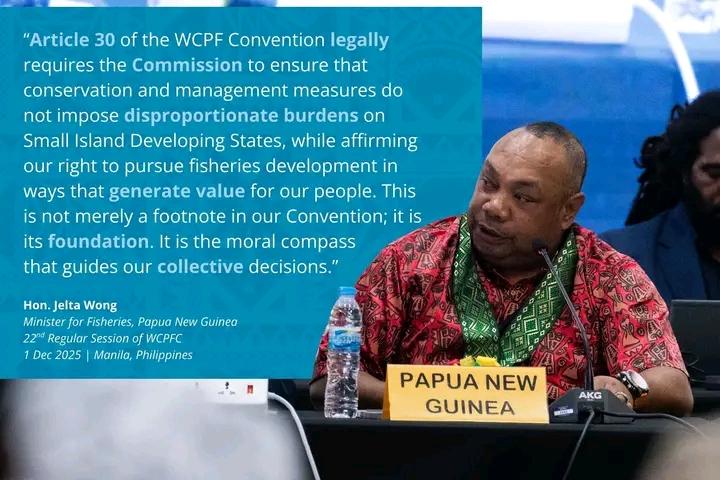
Upholding Article 30, Protecting Small Island Developing States
PNG’s message was a strong reminder that the Convention’s Article 30 is a legal safeguard for Pacific Island states.
“Our Pacific Island countries’ economies, food security, and livelihoods are deeply tied to tuna and other highly migratory fish stocks. This recognition is not symbolic—it is essential,” he stated.
Wong cautioned that increasing technical and compliance demands within the Commission risk marginalising the very nations Article 30 seeks to protect. To address this, he called on developed members to support a new requirement:
“We further call on this Commission to recognise that climate-driven changes in tuna abundance must not result in a redistribution of benefits away from those who have historically conserved these resources. We urge the Commission to integrate climate resilience into all future conservation and management measures, ensuring that Pacific Island countries are financially and technically equipped to adapt and respond to shifting tuna stocks.
“We further rely on the recent advisory opinions of the International Tribunal for the Law of the Sea and the International Court of Justice, which reaffirm the obligation of States to prevent and mitigate climate harms. The Commission must act in accordance with these principles.
“We now call upon the Commission and our members of developed States to ensure that all new measures adopted by this Commission include a SIDS Special Requirements review clause, which will guarantee that equity is not assumed but assured,” he added.
A Growing Threat to Tuna Stocks and Pacific Economies
The Minister warned that climate change is already reshaping tuna distribution and compromising the economic stability of Pacific Island countries.
“The Pacific did not create the climate crisis, yet we bear its brunt,” he said. “Scientific evidence confirms that climate change is already altering the distribution and productivity of key tuna stocks.”
Wong urged the Commission to ensure that climate-induced shifts in tuna abundance do not result in a loss of benefits for the region. He also highlighted the recent advisory opinions of the International Tribunal for the Law of the Sea and the International Court of Justice, saying they “reaffirm the obligation of States to prevent and mitigate climate harms.”
Backing FFA Proposals: Albacore Management and High Seas Transshipment
PNG offered strong support for two key proposals submitted by the Forum Fisheries Agency (FFA):
-
South Pacific Albacore Management
Describing it as the product of “many years of rigorous discussions and negotiations,” Wong said the proposal is “supported by factual scientific data, with the collective endorsement of all 17 FFA member countries.”
He appealed for cooperation from developed member states, stressing the profound dependence of Pacific nations on decisions made at WCPFC22.
-
High Seas Transshipment Reform
The Minister said strengthening high seas transshipment rules is essential for combating illegal, unreported and unregulated (IUU) fishing while boosting port-based economic benefits.
“For PNG and Pacific Island countries, strengthening the high seas transshipment measure is vital. By requiring transshipment in ports, we combat IUU fishing, ensure transparency and accountability, and safeguard our tuna resources,” he said. “At the same time, port-based transshipment drives domestic development—creating jobs, generating revenue, and distributing the economic benefits of our fisheries amongst our communities.”
Wong emphasised that national sovereignty must remain central to regional fisheries governance.
“The sovereign rights of member countries over their waters and resources must not be infringed upon. Regional decisions must further respect and complement national laws and priorities,” he said.
He added that the Pacific is not seeking handouts: “Let us remember: the Pacific is not asking for charity. We are demanding fairness. We are not passive recipients of global decisions—we are active architects of regional solutions.
“May our deliberations be guided by justice, equity, and the spirit of Pacific solidarity.”
WCPFC22 continues in Manila, where member states are negotiating key conservation and management measures that will shape the future of tuna stocks in the world’s largest and most valuable tuna fishery.


