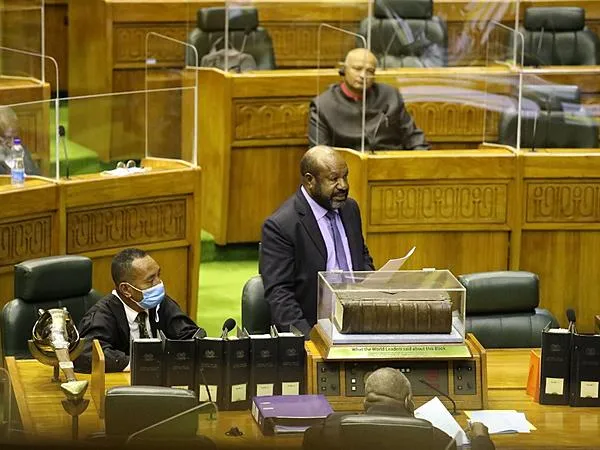
The Autonomous Bougainville Government has approved a budget of nearly K500 million for the fiscal year 2022.
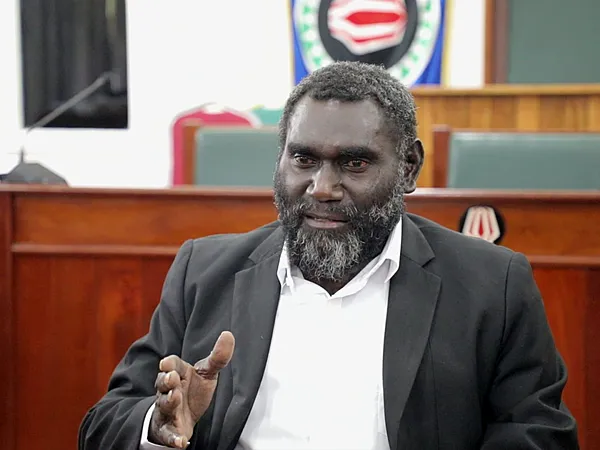
The 'One Post Referendum Budget' was the topic of the 2022 ABG Budget, which was presented in parliament by ABG Minister for Treasury and Finance Hon. Salas, Mathias
“The budget directly addresses all priorities that the ABG has set towards our journey to independence,” Minister Salas said.
“The main focus of the 2022 ABG Budget is the consolidation of the peace and political process through economic and infrastructure development to prepare and mobilize the people of the conduct of consultations and negotiations for Independence in Bougainville,” he said.
Minister Salas noted that the National Government contributes around 91 per cent of the overall budget, which represents a 29 per cent increase over the total appropriation from the National Government to the ABG in 2021.
“Funds that are provided by the national government through the national budget are part of its commitments to the rebuilding and political process in Bougainville aimed at targeted projects or programs,” Minister Salas said.
“In 2022, the total appropriation is estimated at an amount of K549,324,600.00, with total National Government Grants at K424,065,000.00, ABG internal revenue at K45,000,000.00 and re-appropriated funds estimated at K74,683,100.00,” Salas said.
Minister Salas also expressed his concern that the National Government offer clarity on a mismatch in statistics in the National Budget for funding allotted to Bougainville.
“Clarification will be sought from the National Government on the amount of K430,065,000.00 allocated to the ABG (in the Appropriation Bill) when in fact the budget schedules show a figure of K424,065,000.00, a variance of K6,000,000.00,” Salas explained.
Minister Salas had made a formal request to the Prime Minister and the National Minister for Finance for more information on the difference at recent joint government meetings in Port Moresby.
Reference: Autonomous Bougainville Government (15 December 2021). “Parliament passes ABG 2022 Budget”.
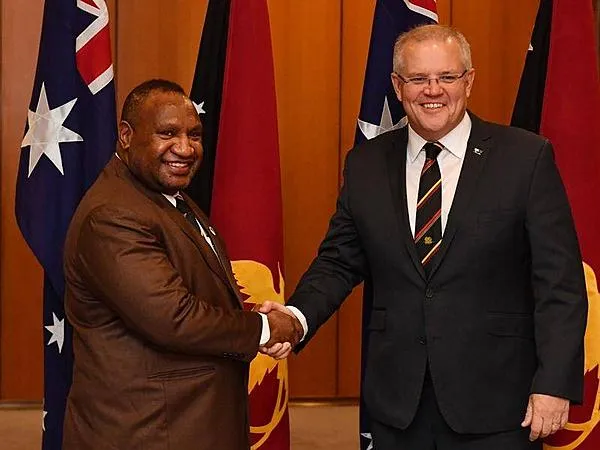
The third Papua New Guinea-Australia Annual Leaders' Dialogue was conducted virtually on December 8, 2021, between Prime Minister Scott Morrison and Prime Minister James Marape.
The two Prime Ministers recognized the fundamental importance of the bilateral relationship between Australia and Papua New Guinea, as well as our shared interests in a safe, stable, peaceful, wealthy, and democratic region. They reaffirmed their commitment to the Comprehensive Strategic and Economic Partnership between Papua New Guinea and Australia (CSEP).
Papua New Guinea and Australia are collaborating to combat COVID-19's health and economic consequences. In addition to the more than $340 million in COVID-19-related assistance that Australia has provided to support Papua New Guinea's response to the pandemic, Prime Minister Morrison announced that Australia will contribute an additional $35 million in sector budget support to the Papua New Guinea Government's tuition fee subsidy for primary schools, ensuring that around 1.1 million primary school students can continue their education. Prime Minister Marape commended Australia for its unwavering commitment to provide PNG with a complete COVID-19 vaccine supply and distribution assistance.
The Prime Ministers also talked about Australia's financial support for Papua New Guinea's economic reforms and budget repair, as well as the suspension of Papua New Guinea's principle and interest obligations on a 2020 loan from Australia, as part of the G20 Debt Service Suspension Initiative. Despite global economic concerns, Prime Minister Marape praised Australian corporations such as Santos, Fortescue Future Industries, and Telstra for their willingness to invest in Papua New Guinea.
The Prime Ministers praised the tight cooperation between Australia and Papua New Guinea in meeting Papua New Guinea's development requirements, which includes the Australian Infrastructure Financing Facility for the Pacific (AIFFP). They addressed the AIFFP's pipeline of high-quality, long-term infrastructure projects, including transportation-related infrastructure and energy projects. They expressed their enthusiasm for working together under the AIFFP to build high-quality, climate-resilient ports infrastructure that would benefit the people of Papua New Guinea economically and socially.
The Prime Ministers recognized the need of conserving Papua New Guinea's forests, including contributing to the global response to climate change, which poses a particular threat to the Pacific. They agreed that Australia will offer greater assistance to the forestry industry in Papua New Guinea, including project funding for nature-based climate solutions. At COP26 in Glasgow, Prime Ministers signed a Memorandum of Understanding on Cooperation on Building Capacity for Participation in Global Carbon Markets, creating a cooperation under the Indo-Pacific Carbon Offsets Scheme.
The Prime Ministers reviewed Australia's long-standing support for PNG's national election procedures, highlighting ongoing collaboration through their respective national election boards as well as logistical and other support for PNG's national election in 2022.
The Prime Ministers discussed the Solomon Islands Government's request for Australia and Papua New Guinea to deploy quickly with Fiji and New Zealand to bolster the Royal Solomon Islands Police Force's response to public disturbance. They emphasized the necessity of peacefully, legally, and via communication settling any conflicts.
The Prime Ministers agreed to keep working together to address the Pacific family's common issues. They talked on the relevance of the Pacific Islands Forum and its crucial role in responding to shared issues, as well as their wishes for the Forum's sustained unity.
Reference: Department of Prime Minister and National Executive Council (9 December 2021). “Joint Statement: Papua New Guinea-Australia Annual Leaders Dialogue
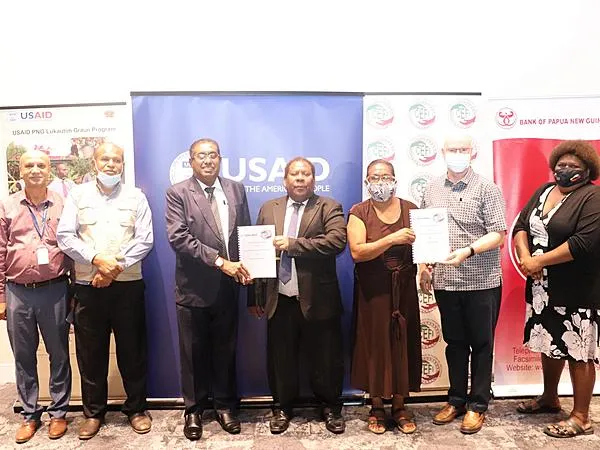
CEFI Executive Director Saliya Ranasinghe (3rd from left), Bank of PNG Assistant Governor Ellison Pidik (4th left) and AOR / Development Assistance Specialist, USAID Julie Hulama and Maurice Knight (Cardno LGP Chief of party) with the signed financial inclusion partnership documents.
The Lukautim Graun Program (LGP) — funded by the United States Agency for International Development (USAID) and implemented by Cardno International Development — and the Centre for Excellence in Financial Inclusion (CEFI) signed a partnership agreement to roll out financial literacy trainings in six provinces in Papua New Guinea. Approximately 86% of PNG’s population lives in rural and remote areas on land owned by traditional landowners. Pressures from such industries as forest extraction as well as population growth threaten the PNG’s natural resources and biodiversity. With limited options local communities are tempted to convert their resources to meet short-term needs. This risks the ability of current and future generations to meet their needs and potentially opportunities for increased conflict larger demands for governments to care for those whose resources have been lost. USAID’s Lukautim Graun Program is a five-year project that works with PNG governments and non-governmental organizations to empower traditional landowners to directly manage and conserve the natural resources on which their livelihoods, wellbeing, and social stability depend. CEFI promotes financial inclusion and literacy, poverty elimination and the promotion of vibrant financial sector across Papua New Guinea, including for those in rural and remote areas. CEFI advances accessible quality financial services, innovative delivery channels and financial education to those who are often completely left out of the formal economy. CEFI also works to ensure financial education is introduced into public and private school curriculums and promote standardization and certification processes for the delivery of financial literacy training in PNG. CEFI’s mission aligns with USAID’s LGP-based efforts to expand entrepreneurship and creative enterprises, increase access to financial services, and develop new micro- and small-scale businesses in PNG, particularly for people who live in rural and remote areas. CEFI and USAID’s LGP program will particularly emphasize women’s economic empowerment. “Unless women and girls are empowered to fully participate in the economy, PNG will not be able to meet its development targets,” Maurice Knight, Chief of Party for USAID’s Lukautim Graun Program, said. “And for women, and men, to be fully enabled in the economy, PNG’s biodiversity and natural resources must be wisely managed so that current generations can meet their needs while not threatening the ability of future generations to meet their needs. The linkages are obvious.”
Mr. Saliya Ranasinghe, Executive Director for CEFI stated that “Financial inclusion is identified as an important priority in the implementation of CEFI’s third financial inclusion strategy which women and youth are important under the digital financial services and financial literacy and financial education.” “This agreement between Cardno and CEFI aligns with USAID’s 2020 Gender Equality and Women’s Empowerment Policy that affirms USAID’s vision of a prosperous and peaceful world in which women, girls, men, and boys enjoy equal economic, social, cultural, civil, and political rights and are equally empowered to secure better lives for themselves, their families, their communities, and their countries,” said Julie Hulama, USAID Development Specialist. “Our cooperation also aligns with CEFI’s financial inclusion strategy that prioritizes access to financial services for informal and small-scale enterprise development, SME Finance, resource sector engagement and digital finance. The signing of this MOU comes at the perfect time as we launch our new 2022-2026 in the first quarter of 2022,” said Mr. Loi Bakani, Chair and member of the Board of CEFI. Through the USAID Lukautim Graun Program, CEFI and Cardno will begin implementing joint training programs in the first quarter of 2022 in Eastern Highlands, Jiwaka, Madang, Milne Bay, Morobe and Simbu provinces.
Article courtesy of the Centre for Excellence in Financial Inclusion
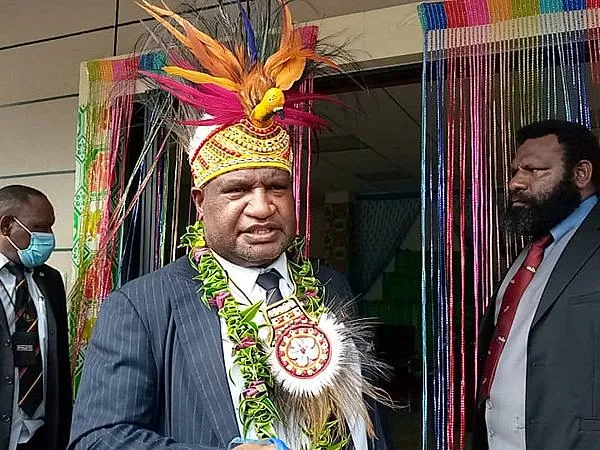
During his official visit to West Sepik, James Marape inaugurated a number of impact initiatives.
PM Marape described his visit as a watershed moment, not only for the official opening of the new West Sepik Provincial Administration Building but also for the announcement of other significant projects.
“I want to acknowledge the leadership of the Governor of West Sepik, Hon. Tony Wowo, who did not wait for the National Government. Instead, he went ahead and used the funding given to the provincial government and the province’s internal revenue to build the new provincial assembly Building,” he said.
“It is not easy to have a vision and to bring it to reality.”
West Sepik, according to PM Marape, is one of the few provinces that owns and operates a modern building.
He stated that the National Government will provide an extra K4 million for the building's other expenses.
“As I am now standing at the new Provincial Assembly Building, I will take the opportunity to make some announcements of projects for West Sepik,” PM Marape said.
“The new Vanimo Wharf that will be built here by a South Korean company will cost about US$200 million. This is the closest port for us to export to Asia.”
He stated that after the Vanimo port was constructed, the provincial government would be entitled to a part of the port's earnings.
Another project, according to the Prime Minister, is the road connecting Vanimo and Wewak. Under the Connect PNG initiative, the first stage of the K200 million construction has been allocated, and a contract is set to be issued.
“This road will connect Vanimo to Wewak so you can go shopping in Wewak, and you can take a short amount of time to travel instead of a long time that it takes now,” he said.
“The road from Telefomin to Tabubil is another K200 million project where a new road will be cut.”
The Prime Minister said that K15 million had been set up in the 2022 Budget for the construction of a new modern hospital in Vanimo.
He also stated that the government will provide the province K5 million to develop a Technical Vocational Education Training (TVET) college for West Sepik's youth.
Reference: PM James Marape News Page (6 December 2021). “PM Marape launches several projects in West Sepik”
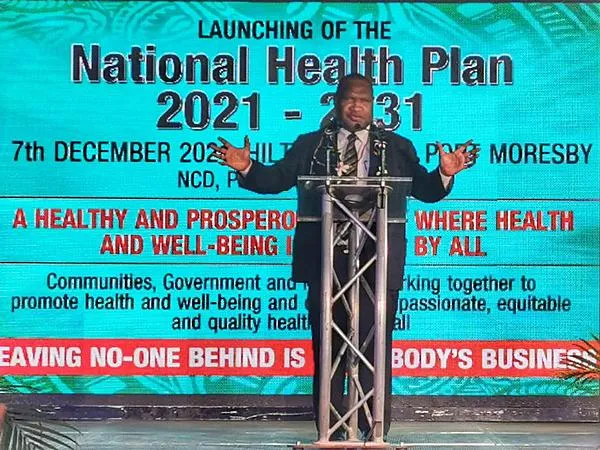
By the year 2030, Papua New Guineans could anticipate decent healthcare services "within an hour's reach" across the country, according to Prime Minister Hon. According to James Marape.
As he summarized the National Health Plan 2021– 2030 before unveiling it in Port Moresby, the Prime Minister gave this command to the Department of Health, namely the Health Secretary and the heads of the Provincial Health Authorities (PHA).
PM Marape did not mince words when he warned the PHA chiefs that this was "not an intellectual plan" and that they needed to "connect the connections," internalize the strategy and start implementing it.
He said: “I summarise the plan into this – a quality health system and facilities must be within reach in an hour by walking, by boat, by vehicle, or by a plane for our people wherever they are in the country.
“Health is our people’s fundamental right; it is our moral responsibility to provide good health care to our people.”
In a similar spirit, the Prime Minister stated that by 2031, he does not want to see any more "medical tourists visiting Singapore, the Philippines, or elsewhere."
He continued: “PHAs heads, I come to you because you stand beneficiary in the devolution of functions that already is being transferred to you. As you sit in on your PHAs, the Health Secretary does not know who is living one hour away or two hours away from the aid post or the health centre. It is you.
“Health is our peoples’ fundamental right. That is why we have given you a greater allocation this year when Covid-19 exposed a total deficiency we have inherited in our health care system.
“A country with only 200 ICU beds is totally shocking for us. A nation of 8 million people having 200 ICU beds right across the country is not something that we can be proud of.”
While the Ministry of Health and National Planning and Monitoring worked on a more realistic, watertight, and comprehensive blueprint for PNG's hospitals, the Prime Minister told the PHAs to "keep away from the K15 million" allocation intended for provincial hospitals. These new programs are being developed with the help of a development partner for the country's 22 modern hospitals.
“So we must make strategic interventions synchronised with my view that all hospitals, health centres and community aid posts must be one hour within walking distance or by a mode of transport for our citizens for necessary reliable health care within their reach for any level of health needs,” the Prime Minister said.
PM Marape added that, even if he didn't return as president next year, the focus on health would continue throughout the years with similar investments in every budget until 2030.
The 7th National Health Plan since independence was launched exactly one week after the passage of the 2022 National Budget, which is expected to put Papua New Guinea on the road to debt recovery by 2027.
With a prediction of a K200 million economy by 2030, the Prime Minister has given the 7th National Health Plan his direct design control in order to contribute value to the overall economic aim because, as he put it, "a healthy population implies a healthy economy."
The National Budget for 2022 allocates K2.8 billion to health, accounting for 11% of total spending — the biggest allocation to PNG health since independence.
The investment of K50 million to the cancer unit at the Port Moresby General Hospital – another first in the health sector budget – is one of the notable areas worth emphasizing.
Aside from that, the Department of Personnel Management is now assisting the development of 5,000 new roles for extra health care employees. Later on, this would be included in the permanent construction.
PM Marape also called attention to sectors within Health that needed immediate attention beginning next year, such as medical research and raising the level of the PNG medical board to "world-class" status.
Reference: PM James Marape News Page (7 November 2021). “PM Marape launches10-year National Health Plan”.
Photo credit: Share GK - Flickr
The Asian Development Bank (ADB) has welcomed the publication of the Kumul Consolidated Holdings Authorisation (Amendment) Act 2021 in Papua New Guinea’s (PNG) National Gazette, a key step in efforts to reform governance, increase transparency, and improve the performance of the country’s state-owned enterprises (SOEs).
The act delivers several key reforms to aid the work of Kumul Consolidated Holdings (KCH), the holding company for PNG’s SOEs. These include providing a clear definition of ministerial, SOE board, and SOE management roles; revising KCH’s role to focus on SOE performance monitoring; improving SOE transparency requirements; and establishing a transparent, skills-based process for SOE director selection.
“SOEs provide critical public services and utilities to the people of Papua New Guinea,” said ADB Pacific Liaison and Coordination Office Regional Director Lotte Schou-Zibell. “That’s why ADB is working with the Government of PNG on these reforms, which will strengthen SOE performance and governance—making them more profitable and transparent, more likely to enable private investment, and better suited to the needs of the community.”
“These reforms will enable KCH to ensure PNG’s SOEs are sustainable, well-governed organizations that deliver reliable, affordable, and efficient services,” said KCH Chairman Moses Maladina. “This legislation will support KCH’s efforts to improve access to power and communication utilities, water, sanitation, banking and financial services, travel, and maritime services for PNG residents.”
The Government of PNG’s broader SOE reform program is supported in part by an ADB policy-based loan. The act was developed with support from the Pacific Private Sector Development Initiative (PSDI)—an ADB technical assistance program in partnership with the governments of Australia and New Zealand.
“The passage of this act demonstrates the Government of PNG’s commitment to transparency and improved governance and performance in its SOEs,” said Australian High Commissioner to PNG Jon Philp. "I congratulate the government for achieving this important step in its ambitious SOE reform agenda and, through our support for PSDI, Australia is proud to support improvements to the delivery of essential services. Much work is required to implement the act, and Australia looks forward to working with PSDI and the Government of PNG on this in the coming months and years.”
Established in 2006, PSDI works with ADB's 14 Pacific developing member countries to improve the enabling environment for business and support inclusive, private sector-led economic growth.
ADB is committed to achieving a prosperous, inclusive, resilient, and sustainable Asia and the Pacific, while sustaining its efforts to eradicate extreme poverty. Established in 1966, it is owned by 68 members—49 from the region.
Article courtesy of the Asian Development Bank
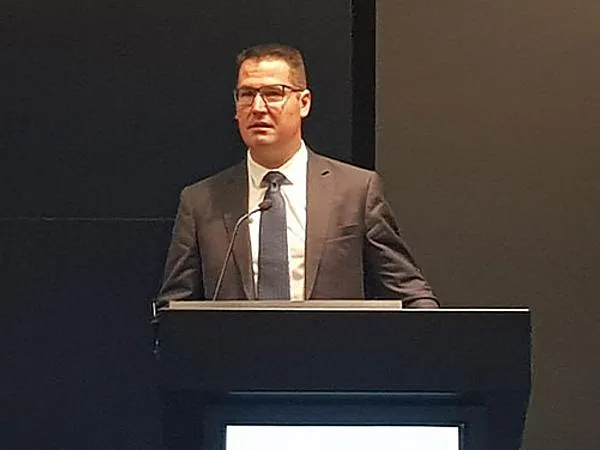
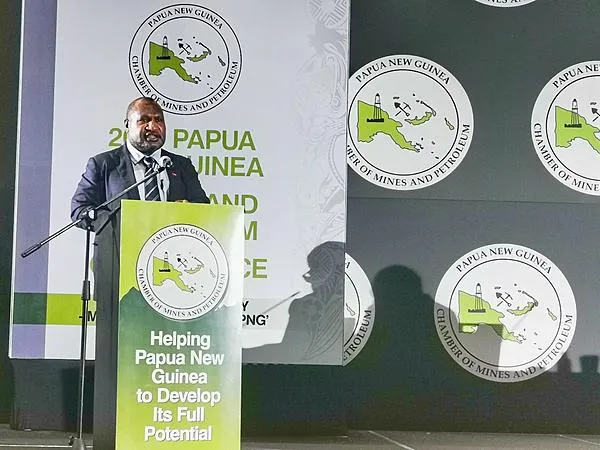
Senator Zed Seselja, Australia's minister for international development and the Pacific, said the Australian government will continue to engage with Papua New Guinea to reopen borders and normalize commerce and trade.
Seselja addressed the 2021 PNG Mining and Petroleum Conference and Exhibition yesterday that the government has received about AU$340 million (about K854 million) in Coronavirus (Covid-19) support.
He said that the Covid-19 had a huge impact on companies, and that Australia had cooperated with Air Niugini, the country's official carrier, to ensure that commercial flights to Australia were not disrupted.
“We also recognise the importance of fly-in-fly-out workers in the mining and petroleum sectors,” he said. “So we have worked closely with businesses and state governments in Australia to support travel exemptions arrangements for these workers.
“Likewise we have assisted the PNG Government in pre-departure flight tests at Jackson international airport in Port Moresby.
“Since Nov 1, Australia has been gradually relaxing its border restrictions under a risk based approach to reopening.” Seselja said Australia’s support had also been buffering the economy through loans and grants to help mitigate the worst economic impacts of the pandemic.
“We have been encouraged by progress on some major resource project negotiations this year. Namely the Papua LNG and Pnyang (gas agreements).
“Getting these negotiations over the line will improve economic certainty and over the construction phase, stimulate urgently needed investment.
“We know that business requires a predictable operating environment, certainty around mining, oil and gas legislations will encourage investment in PNG.”
Seselja emphasized the importance of continued negotiations between industry and government on new tax and regulatory policies.
Reference: Luma, Dale. The National (2 December 2021). “Aust To Ensure Trade Continues”.
The mining and petroleum industries' continued drop in exploratory activity is a source of concern for the industry.
Exploration activity has been declining and falling since 2019, with no obvious signs of recovery, although the sector remains confident that this will soon reverse.
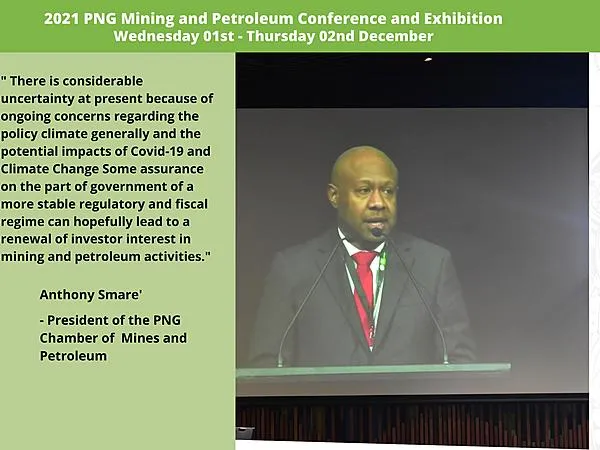
In his opening remarks at the 2021 Mining and Petroleum Conference yesterday in Brisbane, Australia, PNG Chamber of Mines and Petroleum president Anthony Smare highlighted the industry's worry about the downturn in exploration activities.
In the previous two years, he added, existing world-class projects in the country have had to contend with COVID-19-related risks or compete with high society expectations of increased benefit flows to the national government and local and regional communities.
Despite the strong performance of these projects, he expressed concern about the ongoing collapse of the country's exploration activity.
“There is considerable uncertainty at present because of ongoing concerns regarding the policy climate generally and the potential impacts of COVID-19 and climate change.
Some assurance on the part of the government of a more stable regulatory and fiscal regime can hopefully lead to a renewal on investor’s interest in mining and petroleum activities,” he said.
Mr Smare stated that there has been worry about the shifting policy climate in PNG, which has resulted in the closure of the nation's second largest gold producer, Porgera Mine, as well as the stalling of other key resource projects due to different policy concerns.
He claimed the sector's export earnings declined by K6 billion last year after years of steady growth since the PNG LNG Project began exporting in 2014.
“According to reports by Bank of PNG, the petroleum and mining exports last year fell from K32.5 billion in 2019 to K25.8billion as a result of a fall in LNG prices and the shutdown of Porgera Mine in April 2020,” Mr Smare said.
He went on to say that the chamber has been holding webinars for the past year to discuss changing government policies, and that these webinars have complemented the ongoing resource sector activities that focus on areas like community affairs and safety, where PNG projects have been comparable in performance to aid development cooperation.
Reference: Kamus, Maxine. Post-Courier (2 December 2021). “Exploration Activities In Downward Trend”.
Papua New Guinea, according to James Marape, has never been an "uncertain area to invest."
In Port Moresby, he said this while speaking digitally at the 2021 PNG Mining and Petroleum Conference & Exhibition in Brisbane.
“We are an oil, gas and mining nation,” the Prime Minister said.
“This is evident in the fact that quite a substantial part of our GDP has its anchor in the mining and oil and gas space.
“Papua New Guinea is a traditional mining and oil and gas country.”
PM Marape stated that regardless of which administration is in power, "our goal stays set and static" in terms of politics.
“That is something that investors right across Planet Earth must know from the outset,” he said.
“We are a robust democracy, our judiciary is totally independent from the executive government, our Parliament functions in every term.
“We’re going into election in time and on schedule (in 2022) to elect our 11th Parliament next year.
“We have successfully held 10 democratic elections since 1977.”
PM Marape said in spite ongoing law-and-order problems, “our country has never failed to live on, never failed to honor legally-binding commitments”.
“We’re picking up social and local issues around all projects that we sign agreements with,” he said.
“We, as Government, have been important partners to all mining and oil and gas companies, who have lived and operated in our country.”
PM Marape noted PNG has previously hosted big multinational corporations such as Placer Dome, BHP, and Chevron, as well as ExxonMobil, Total, Barrick, Santos, JS Nippon, Newcrest, and Harmony.
“It is undisputed that Papua New Guinea prides itself as a welcome business address for world-class investors,” he said.
“Politics can be played by Papua New Guineans from all strata of society, but Papua New Guinea lives on.
“We play politics in the robustness of our democracy, but the goal posts for investment, are fixed because we play within a robust Constitution.
“Our country believes in the rule of law, and what is legally signed will carry on, so I’d like to encourage everyone that Papua New Guinea is not a place to fear in as far as the investment dollar or kina is concerned.
“We are open for business today, as we have been open for business over the last 46 years, and we will be open for business into the next 46 years and beyond.”
Reference: PM James Marape News Page (1 December 2021). “PM Marape invites mining, oil and gas investors to PNG”.
According to James Marape, the 2022 Budget puts a greater emphasis on the health sector than ever before.
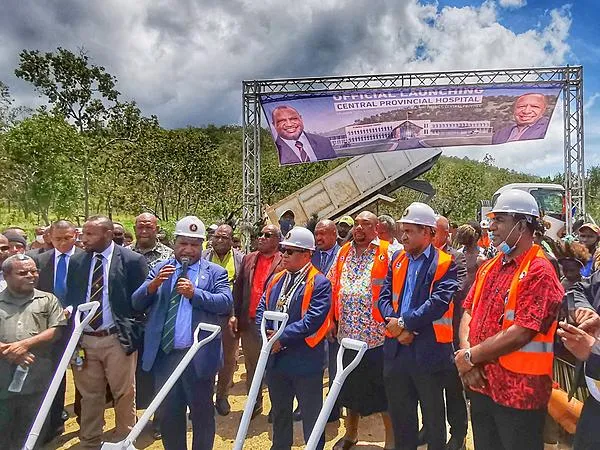
He mentioned this during the opening of the K500 million, 300-bed Central Provincial Hospital for Central and Papua New Guineans in Bautama, Central.
Roads, housing, power, and other infrastructure in the new Central City at Bautama, which is adjacent to the hospital, would cost up to K700 million, according to the Prime Minister.
“This is a very-timely moment, especially on the back of us going into Parliament tomorrow (Tuesday November 30) to pass our 2022 Budget – a Budget that has greater focus on the health sector in our country,” PM Marape said.
“Health is receiving over K2.6 billion of the K22 billion Budget, in fact, 11.2 per cent total allocation.
“This is possibly the first time in the last 46 years we’ve been a nation, for Health Sector to receive the biggest allocation – ahead of Education and many other sectors in our country.
“This is a case in point that we are serious about our people’s health issues.
“Health comes first, we cannot compromise lives and livelihood of our people.”
PM Marape stated that Central was prominently included in the 2022 Budget allocation to the Health Sector, and that this would continue into the following year.
“The story will continue, the journey will continue, until, hopefully in 2025, we will be able to come here again on this ground when a brand-new 300-bed hospital is delivered not just for Central Province but for the country,” he said.
One positive aspect of COVID-19, according to PM Marape, was that it revealed the Health Sector was "completely weak" in responding to the pandemic and other illnesses, with just 200 Intensive Care Unit (ICU) beds.
“COVID-19 has pointed us to the fact that we do not have the health system and capacity to handle severe outbreaks of any disease,” he said.
“In 2021, we made a conscious choice that investment in the health system will be ramped up, something that our generation of leaders can give to our country.
“This is so that by 2025, when our Nation celebrates 50 years of Independence, we have a better reformed health care system in our country.
“This is evident in 11. 2 per cent of the total 2022 Budget going to the Health Sector, and that will be ramped up as we go into 2023, 2024 and 2025.
“Hopefully, we will have 22 world-class hospitals in our country delivered by then, or if not delivered, taking shape.
“I want Central Provincial Hospital to be delivered by 2025.”
Reference: PM James Marape News Page (29 November 2021). “PM Marape: Government is focused on health in 2022 Budget”.
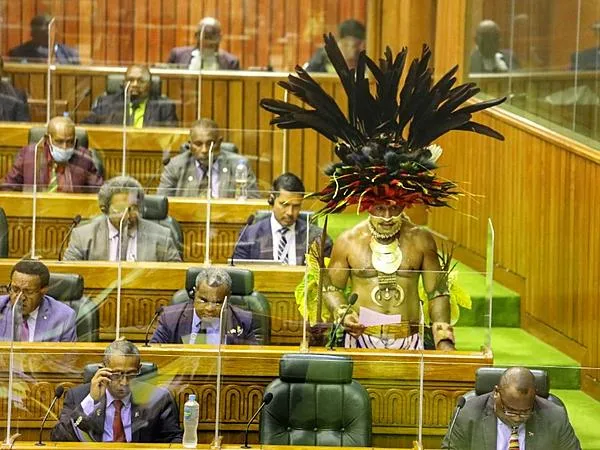
Photo credit: PM James Marape News Page - National Planning and Monitoring Minister Hon. Rainbo Paita in traditional dress during Budget debate.
The K22 billion 2022 Budget, which was passed without opposition by Parliament recently, has been dubbed a "milestone budget" by James Marape.
“This is a milestone budget because it is the first budget-proper for the nation to enter into the K20-billion budget realm,” PM Marape said.
“No past government has entered into this space.
“For the first time, in tough times, we are entering into the threshold of a K100 billion economy as focused by the Treasurer (Ian Ling-Stuckey).”
PM Marape stated in his inaugural address to Parliament as Prime Minister in 2019 that PNG will become the "richest black Christian nation" and that the country's GDP would grow to K200 billion in ten years.
He went on to say that he was delighted to see in Treasurer Ling-presentation Stuckey's that the 2022 Fiscal Year goals will be implemented throughout the year, “we will have a glimpse of surplus budgets starting in 2027, and a Papua New Guinea with no sovereign debt by 2034, if we choose to travel the road we are seeing today – the Pangu Rot (Road)”.
“This is a momentous and key national milestone as we are reaching a K200 billion economy in 2031, by the way we are focused,” PM Marape said.
“Our Budget is focused not on just 2022, but within the 13-year window that the Treasurer has opened for us to glimpse into the future.”
Ian Ling-Stuckey's proposal, he claimed, would transform PNG from a "very costly, debt-ridden economy to a surplus debt-free one."
“The reconstruction started three years ago, despite the once-in-a-hundred years pandemic, depite political instability in our country, despite the weak broken-down systems,” PM Marape said.
“Our economy, despite systematic complacency and corruption over many years, is now seeing signs of better times ahead.”
Reference: PM James Marape News Page (30 November 2021). “PM Marape hails 2022 Budget as ‘milestone budget’
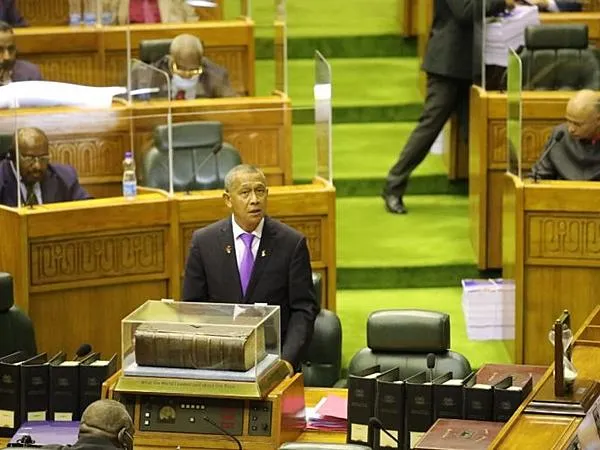
Photo credit: PM James Marape News Page - Treasurer Ling-Stuckey tabling the 2022 Budget
Prime Minister Hon. James Marape has welcomed the tabling of the record K22.175 billion 2022 Budget by Treasurer Ian Ling-Stuckey in Parliament.
He said it would help Papua New Guinea on the path to economic recovery as well as support successful delivery of the 2022 National General Election.
“The total Budget of K22.175 billion is 9.3 per cent higher than the 2021 Supplementary Budget, with a revenue envelope of K16.190 billion which is 18.4 per cent higher than the 2021 Supplementary Budget,” PM Marape said.
“The fiscal deficit for 2022 is K5.895 billion, which is 5.9 per cent of the 2022 Gross Domestic Product (GDP). Compare this deficit to K6. 6 billion or 7 per cent of GDP in 2021.
“In 2022, the PNG economy is projected to grow strongly by 5.4 per cent, from K93 billion in 2021` to K102 billion.
“The 2022 Budget will continue the budget repair and economic recovery path, with strong focus on non-resource sector growth, and at the same time support families and businesses.
“There will be increased development and capital funding to high priority programmes and sufficient funding for key social sectors to stimulate economic growth.
“The delivery of my Government’s third Budget today, despite the many challenges and obstacles, shows clearly the work that we have been doing.
“It points to the fact that our path to economic recovery is correct, and with critical analysis by all multilateral Budget partners like Asian Development Bank, International Monetary Fund and World Bank, our positive trajectories show an increase in GDP for next year and beyond as well as a declining budget deficit trend.
“The handing down of the Budget is the single most-important parliamentary occasion of any government.
“With hangovers and effects of a slowed economy due to COVID-19, your Government has used the last three years of National Budget to ensure our domestic economy was functional and alive, and our crucial services were maintained.
“I want to assure our people and all stakeholders in our economy that we are responsible and prudent to ensure expected outcomes of our Budget are achieved.”
PM Marape said since his Government took office in May 2019, it had used the Budget to support schools, hospitals, COVID-19 programmes, road construction, SME funds, retiring old debts and contractual obligations, paying outstanding industrial awards, and many others.
“Our 2022 Budget embraces our national outcomes including opening up all parts of our country; intervening in sustainable economy; starting up Porgera, Papua LNG and Wafi-Golpu for our economy; paying for our children’s education in 2022 and beyond; building new hospitals; ramping up support to Bougainville; clearing up projects like new Supreme Court Building and ensuring the 2022 General Election is fully funded,” he said.
“All the above we are doing whilst maintaining strict discipline in sticking to our money plan, with our development partners observing our discipline to reforms.
“Key in our reforms is to borrow low-cost US dollar denominated borrowings like the Australian $400-million dollar and the Japanese Government US$280million 0.01 per cent five-year grace period lending, which all came directly into our economy by way of Budget support.
“I just want to assure our people and our economic stake holders that we are going through tough times, but we will use the Budget policies wisely to share the load of burden and also ensure key infrastructure like the 1900 kilometres of road we built the last two years all over rural PNG through our flagship ‘Connect PNG’ programme are continued.”
Article courtesy of PM James Marape News Page
Photo credit: PM Marape News Page - Works Minister Hon. Michael Nali introducing the Bill in Parliament.
PRIME Minister Hon. James Marape has today welcomed the passage of the Connect PNG (Funding and Implementation Arrangements) Bill 2021.
The Bill, passed with a vote of 78-5 by a largely unanimous House, will see to the actioning of the Marape Government’s massive infrastructure development and rehabilitation program that is targeted at connecting remote Papua New Guinea to the outside world and building backwater rural economies.
The massive K20 billion-over-20-years-programme is central to Prime Minister Marape’s vision for economic recovery among ordinary Papua New Guineans and becomes the biggest driver of this developmental change, targeted to impact some six million people through a 100 percent connectivity by the year 2040.
The Programme also takes the focus away from the previous Government’s concentration on road development within the Nation’s Capital and into the areas where roads are needed the most.
Works Minister Michael Nali, in presenting the Bill, called the programme a “game changer” for PNG and greatly applauded the initiative.
He said: “The Marape Government has developed and progressively implemented the Connect PNG Economic Road Transport Infrastructure Development Program 2020 – 2040, commonly known as Connect PNG. It is the largest infrastructure development program ever undertaken by any government.”
Under the Program, these will be developed: 16km of strategic roads comprising 4200km, 1800km of strategic missing links, 9000km of provincial and district roads, and 2000 metres of bridges and cross drainage structures.
Already 2000km of roads have been built by the Marape Government between 2020 and 2021, with more work earmarked under the 2022 budget.
“The (Bill) is to secure a legislative footing for a long-term funding commitment that will ensure that this important plan is fully realised,” added the Works Minister.
Among others things, the Bill will:
Commit the State to allocate minimum annual funding of 5.6 percent of the annual national budget to 2040 to fund the program for its life, amounting to about K1 billion per year;
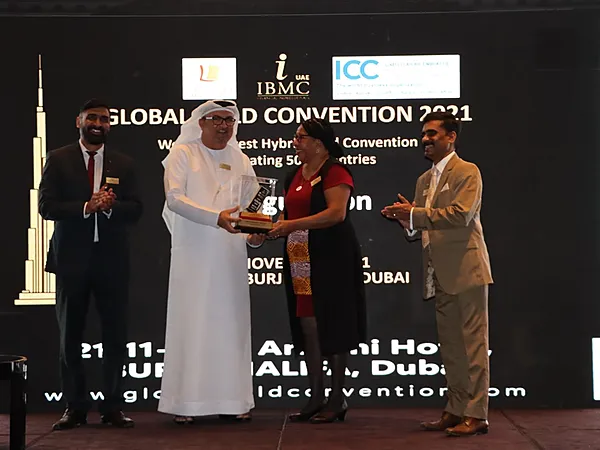
Photo credit: PNG World Expo 2020 - Papua New Guinea Expo Deputy Commissioner General Mrs. Jacinta Warakai Manua receiving the award from Chairman of the International Chamber of Commerce and Secretary General of the Federation of UAE His Excellency Humaid Ben Salem and witnessed by CEO of the IBMC Financial Professional Group Mr. Sajith Kumar on the right with Mr. Anoop from IBMC as well on the left.
Papua New Guinea show-cased its country, people and potential as a gold producing nation at Dubai’s annual premier Global Gold Convention on 21 November 2021.
The Conference was organized by IBMC International, a Dubai based investment and match-making company. More than 50 countries in Africa, Asia, the Middle East, and experts in finance, Government policy, gold bullion trade and innovation, including block chain, shared ideas and views and new technological inventions at the Roundtable. The event is the world’s largest gold convention and the highlight of this event was the awarding of the Global Gold Excellence Award to Papua New Guinea through Ambassador Joshua Kalinoe.
Papua New Guinea was allocated a speaking slot in the panel discussions as well as to play a promotional video on the country, people and culture. Ten Pavilion staff, including the Deputy Commissioner General Mrs Jacinta Warakai-Manua were invited.
Mrs. Manua made opening remarks on behalf of the PNG participants at the Convention and introduced the Commissioner General and Papua New Guinea’s Ambassador to Belgium and the European Union, Mr. Joshua Kalinoe to provide an update on the gold and mineral resources and production statistics, including the future potential of the country as one of the leading gold producing countries in the World.
Ambassador Kalinoe informed the participants that Papua New Guinea has been a gold exporter since the 1930s and is among the large gold producing countries of the world.
He said according to available Government statistics and projections, Papua New Guinea will maintain strong performance at 1.5 million to 2 million ounces of gold annually over the next five years to 2030.
“PNG will continue to be a strong gold producer in the years ahead when several medium and large scale mines a brought into production in the medium and long terms,’ he said
The United Arab Emirates and Dubai in particular, is becoming a leader in gold trade by applying transparent and innovative trading systems.
The Convention also had speakers from Europe, North America, UAE, Australia and India where current and future trends in the trade of gold products, including bullion and jewelry were discussed.
Papua New Guinea was invited to speak at the segment on emerging gold production regions.
Ambassador Kalinoe informed the Convention that Papua New Guinea is a greenfield destination where the potential for gold and other metal production, including copper, remains under-developed.
“Based on available official statistics, there are opportunities to invest in exploration and downstream processing in the PNG mining sector, either in partnership with the existing license holders or in new licenses.
‘Full potential of gold, copper and other minerals, including in the small scale grassroot alluvial gold mining has not been fully realized.
“Papua New Guinea has a transparent commercial and banking regime as well as an investment friendly climate with a stable West-Minister system of democratic Government”, Ambassador Kalinoe said.
He invited investors to talk to the PNG Expo Team at the Gold Convention or visit the PNG pavilion to find out more on investment opportunities, not only in the minerals sector but also in other sectors as well.
The expo team has packaged a total of 23 investment projects worth of more than K37 billion from the different sectors in the country. The projects are currently being promoted at the world expo and opportunities such as the Global Gold Convention and the investment forums are targeted events for promoting these projects.
PNG’s participation in the Global Gold Convention attracted a number of investment interests not only in the Mining sector but also in banking, forestry, agriculture and herbal products.
Photo credit: PM James Marape News Page
Prime Minister Hon. James Marape says the Government has no “sinister motives” in holding back K66 million allocated by the Australian Government for maintenance of the rundown Bulolo Highway in Morobe.
He said this in Parliament recently when asked by Morobe Governor and Deputy Pangu Pati leader, Hon. Ginson Saonu, as to why work was being delayed.
The Prime Minister assured Governor Saonu and the people of Morobe that the K66 million given by the Australian Government was intact.
PM Marape said he had already explained, in reply to critics, that the Bulolo Highway was so badly damaged and would cost more than the K66 million, hence, his Government would add another K50 million to bring the total up to K116 million.
The K50 million is from the K100 million allocated for Wafi-Golpu Infrastructure Development Granst (IDG), K10 million of which had already been given to Morobe Provincial Government and K3 million each to affected districts.
PM Marape said he had already travelled the Bulolo Highway three times, the last being in September when he attended a Wafi-Golpu landowners’ meeting, and had seen for himself the extent of damage.
“It will take more than K66 million to fix the damage,” he said.
“The contract has already been awarded, however, I have written to the Australian High Commissioner and have also talked with the Works Minister about variations to the contract.
“This is so that instead of just doing maintenance work, which will be washed away by the rain, we can do a permanent intervention for the better.
The Prime Minister said K66 million may sound like a lot of money, however, it would only be used for maintenance work.
He said it was his Government that pointed the Australian Government in the direction of Wau-Bulolo for project funding, which critics must know.
“We pointed out areas for them (Australian Government) to invest in, one of which was Wau-Bulolo,” he said.
“When I drove from Mumeng to Lae, I realised the massive extent of damage along this section of the road.
“It’s a very-important economic road so Works Department, Works Ministry and Australian Government have been in discussions over the last few months to see if there can be a variation to the contract.
“It will also assist us (Government) in investing substantially on this road, especially the section from Mumeng to the Markham River.”
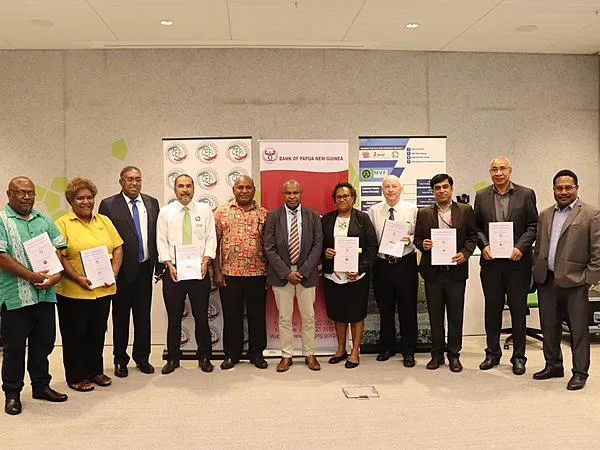
Photo credit: The Centre for Excellence in Financial Inclusion - (left to right) Jack Walom (Chairman,Kada Poroman Micro Finance), Esther Mongea (Senior Operations Manager, People's Micro Bank), Saliya Ranasignhe (Executive Director CEFI), Daniel Faunt (General Manager-Retail, BSP), George Awap (Department-Financial Systems Development Department, Bank of PNG), Stephen Mombi (Acting Secretary, Department of Agriculture and Livestock), Lavinia Taraika (CEO-East New Britain Savings & Loan Society), Tony Westaway (Managing Director, Mi Bank), Gunanidhi Das (CEO-Womens Micro Bank), Vari Lahui (CEO-Nasfund Contributors Savings & Loans) and John Lutulele (Project Manager-Market for Village Farmers Project).
The Centre for Excellence in Financial Inclusion (CEFI) and the Market for Village Farmers (MVF) today (Thursday 18th November) signed a Memorandum of Understanding (MoU) with seven (7) Partner Financial Institutions (PFI).
The MoU will see the PFI’s partner with MVF in implementing the project in six targeted provinces, Western Highlands, Jiwaka, Simbu, Eastern Highlands, Morobe and East New Britain.
CEFI will facilitate the work of the seven PFIs through the establishment of the MoUs and provide technical assistance to the PFIs, with the support from an expert consultant to design and develop innovative financial products and services that meet the commercial and business financial needs of MVF target rural communities.
CEFI and each of the PFI’s will develop a business development plan, including a three-year training plan, to build internal organization capacities and ensure that they provide affordable and diversified financial services to MVF target households and value chain players.
PFI’s that signed the MoU, Bank South Pacific, Mi Bank, Women’s Micro Bank, People’s Micro Bank, Kada Poroman Micro Finance, Nasfund Contributors Savings and Loan Society and East New Britain Savings and Loan Society.
CEFI Executive Director, Saliya Ranasinghe says, “Today is an important milestone for agriculture sector where financial institutions are committing to support and assistance. Farmers should not see the banks as a lending institution but an institution that provide range of financial services that are important. Banks are important partners in progress.”
George Awap, Manager Financial System Development, on behalf of Bank of PNG Governor and CEFI Board Chairman Loi Bakani, says, “CEFI stands ready to work with the MVF project and the financial institutions to promote financial inclusion services with fresh produce farming communities in the six provinces.”
“I want to thank the financial institutions for volunteering to take part in this innovative approach and the stakeholders for bringing the project to the business phase in Papua New Guinea,” said MVF Project Manager Robert Lutulele.
FPDA (Fresh Produce Development Authority) General Manager Mark Worinu added, “This is a milestone achievement for the project and the important reason of the project is partnership because if you want run the supply chain you must have a strong support from the financial institutions.”
Department of Agriculture and Livestock (DAL) Acting Secretary, Stephen Mombi says “I am very happy to see the financial institutions coming onboard to support the project. The project will build partnership and identify key partners that will connect famers with the urban markets. I commend the seven financial institutions for taking the bold step to coming forward to provide financial services to this sector.”
“We got a commitment not just to Papua New Guinea but to the agriculture sector. We will find a way to assist the agriculture sector. BSP is very happy to be part of this project and we are committed to making sure we can deliver it and continue the support to Papua New Guinea,” said BSP General Manager Retail Banking Daniel Faunt.
CEFI is implementing subcomponent 2.2 of the MVF project which is focused on providing livelihood and financial literacy training and provision of innovative financial products and services to improve the lives of farming households in the six selected provinces in the Highlands region, Morobe and East New Britain provinces.
The MVF project is valued at $USD38 million and is executed by the Government of Papua New Guinea through the Department of Agriculture and Livestock and implemented by FPDA, with funding from International Fund for Agriculture Development (IFAD).
Article courtesy of The Centre for Excellence in Financial Inclusion
Follow on LinkedIn:
PNG Business News
Be the "First" to get our exclusive Digital Magazine & Weekly Newsletter.