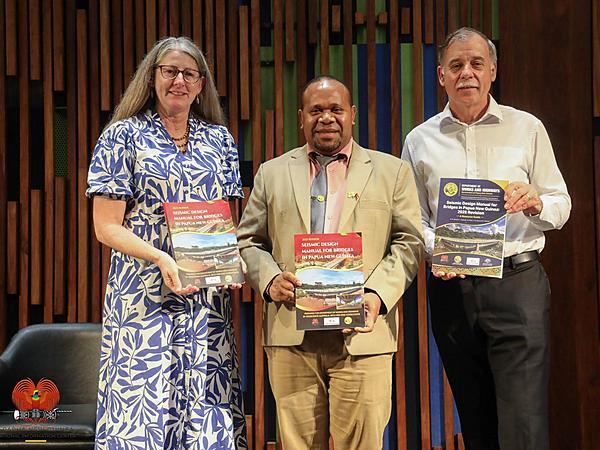
Papua New Guinea has launched a revised manual for the seismic design of bridges, updating earthquake risk information and engineering requirements for the planning, design and construction of bridges across the country.
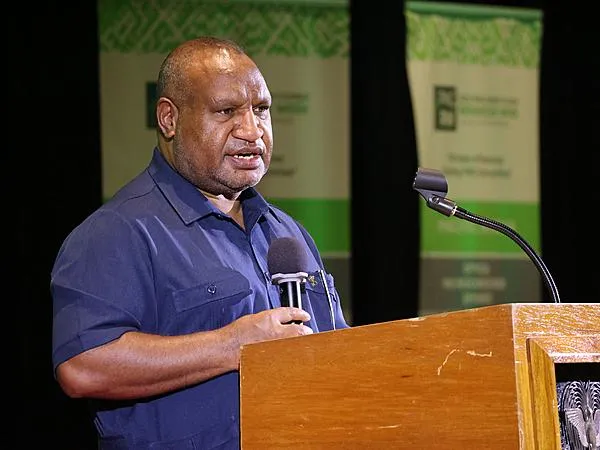
The Seismic Design Manual for Bridges in Papua New Guinea 2025 Revision was launched Aug. 13 in Port Moresby by Department of Works and Highways Secretary Gibson Ali Holemba, who formally launched the manual on behalf of the government.
The revision replaces seismic bridge design guidance that has been used by engineers in PNG for about 40 years.
PNG is exposed to significant earthquake risks because of its location at the convergence of major tectonic plates and microplates. Major earthquakes, including the 1971 Madang earthquake, the 1985 Bialla earthquake and the 2017-18 Southern Highlands earthquake, have damaged roads, bridges, buildings and other infrastructure.
The revised manual incorporates advances in engineering, materials, analytical methods and scientific understanding of seismic hazards.
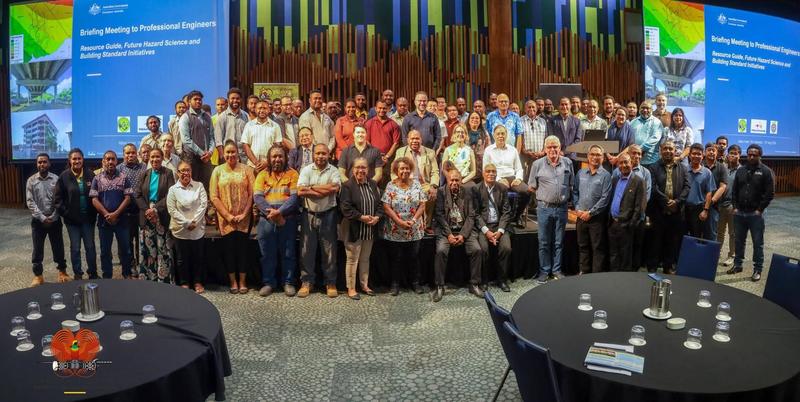
It also incorporates updated information from a probabilistic seismic hazard assessment supported by the Australian government through Geoscience Australia. The assessment provides more detailed seismic risk information at provincial and district levels, giving engineers a stronger basis for determining bridge design requirements at specific locations.
Holemba said the revised manual should be treated as a national requirement rather than simply a technical reference.
“Sound engineering and standards are not optional guidance. They are not optional. They are fundamental requirements and mandatory for protecting lives,” he said.
The Department of Works and Highways will incorporate the revised requirements into project planning, design briefs, terms of reference, tender documents, technical specifications, design reviews, construction and asset acceptance procedures.
All new bridge projects must demonstrate compliance with the revised requirements from the launch date, regardless of whether they are funded by the national government, loans, development partners, tax credit arrangements, provinces or districts.
Bridge acceptance will also require technical evidence including site investigations, geotechnical assessments, seismic calculations, approved drawings, independent technical reviews, material test results, construction records and certification by qualified registered engineers.
The revised approach is intended to ensure bridge designs reflect the specific conditions at each project location.
Previous design parameters did not always account for site-specific seismic conditions. The updated assessment provides engineers with more detailed location-specific information, helping reduce the risk of under-design while avoiding unnecessary design requirements and costs.
The manual also addresses structural ductility, lateral strength, soil instability, slope failures, flooding, debris impact and interactions between seismic and climate-related risks.
For PNG, bridge resilience has implications beyond the structural integrity of individual bridges. Bridge failures can cut communities off from hospitals, schools, markets, ports and airports, making resilient bridge infrastructure important to national connectivity and public safety.
Holemba also warned against allowing construction costs to drive engineering decisions.
“Engineering must dictate the price, not cost dictating the engineering designs,” he said.
He said the lowest initial construction price did not necessarily represent the best value if engineering requirements were compromised and infrastructure could not remain safe and serviceable throughout its intended life.
The department will establish professional training, compliance checklists, independent review procedures and periodic technical audits to support implementation of the revised manual.
Existing bridges on strategic national highway corridors in high-risk areas will also be progressively assessed and prioritized for strengthening, retrofitting, rehabilitation or replacement.
More than 1,000 bridges have been inspected and assessed with support from the Asian Development Bank and World Bank, including load-rating assessments to identify vulnerable structures requiring further work.
The revision was supported by the Australian government through the Department of Foreign Affairs and Trade and Geoscience Australia. Scientific work also involved seismic information from the Port Moresby Geophysical Observatory and Rabaul Observatory, as well as contributions from bridge engineering, geotechnical and technical specialists.
The launch begins the implementation phase of the revised manual. The department is expected to review it as new scientific information, engineering lessons and technologies become available.
Holemba said the effectiveness of the manual would ultimately be measured by the performance of bridges built under its requirements.
“The true value of this manual will not be measured by the number of copies printed,” he said. “It will be measured by the bridges that remain standing.”
The revised manual provides engineers and other professionals involved in bridge development with an updated, locally relevant basis for designing infrastructure capable of withstanding PNG’s seismic risks.