Category:
PNG Tourism Promotion Authority Launches Corporate Plan, 2023-2026
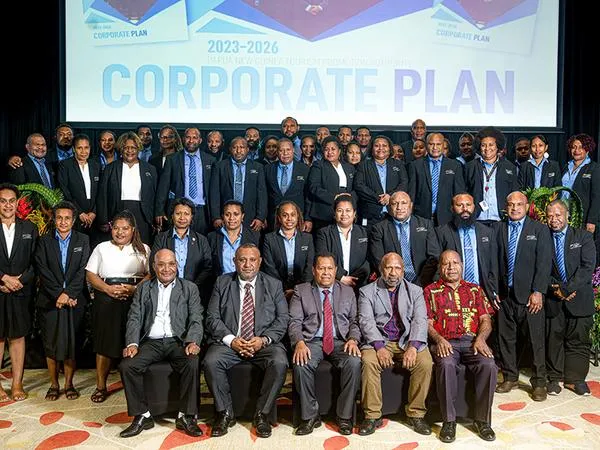
Group photo with the Tourism Minister and agency heads of the NCC and NMAG, including the board, management and staff of the PNG Tourism Promotion Authority. Credit: Roan Paul Photography
The Tourism Promotion Authority proudly launched its four-year Corporate Plan 2023-2026, at The Stanley Hotel in Port Moresby, last week Friday 17th March, 2023.
Minister for Tourism, Arts and Culture, Hon. Isi Henry Leonard, was present at the momentous occasion to officially launch the newly developed Corporate Plan.
“The country’s tourism industry is a thriving sector that has so much potential and is integral to PNG’s development agenda. Being the statutory body established by the Government to manage and promote the country’s tourism interest to the world, PNG TPA needs a clear directive to achieving its mandated tasks; and this policy document has been produced to direct its mission and purpose to achieving just that,” Minister Leonard said.
He added, “The previous Corporate Strategy expired in 2014, which means the agency has been operating over the last eight years without one in place”
“The re-emergence of a new Corporate Strategy demonstrates a renewed and stronger commitment by PNG TPA to make a positive difference in growing the tourism sector”
Hon. Isi Leonard further stated, “The PNGTPA Corporate Plan 2023-2026 sets a clear vision for the agency and articulates well what PNGTPA will do in the next four years, consistent with the Tourism Promotion Authority Act and the Tourism Sector Development Plan 2022-2026.”
Minister Leonard also recalled the devastating impact of the COVID-19 global pandemic on the travel industry worldwide, especially the resulting loss of trillions of US dollars in international tourism receipts.
He also pointed out PNG TPA’s shift in focus of its promotions towards domestic tourism, declaring that the Corporate Plan will be able to assist and guide the organisation in developing this overlooked area of destination marketing.
Chief Executive Officer of the PNG TPA, Mr. Eric Mossman Uvovo, opened the event with an official welcome to the Tourism Minister; including the heads of PNG TPA’s sister agencies under the Ministry of Tourism Arts and Culture: the National Cultural Commission and the National Museum and Art Gallery; as well as other distinguished heads and representatives from PNG’s tourism industry, and its stakeholder partners from the private and public sector.
In his speech, CEO Uvovo emphasised how his organisation’s four-year Corporate Plan was developed to align itself with the Tourism Sector Development Plan 2022-2026, which was launched last year.
“The Corporate Plan is the operation plan of the bigger plan – the Tourism Sector Development Plan 2022-2026. The Corporate Plan 2023-2026 is a small strategic plan that spins the wheels of the bigger plan – the TSDP 2022-2026,” explained Mr. Uvovo.
He stressed that his responsibility as CEO, and that of the senior management of the PNG TPA, was to successfully implement the corporate plan.
Mr Uvovo also mentioned in his speech that the PNG TPA’s priority for the year 2023 is dedicated to reviewing the current National Tourism Policy 1995, and formulating a new National Tourism Policy Framework that will guide PNG’s tourism growth into the future.
The new PNG TPA Corporate Plan has seven strategic priorities, these are:
- Expanding Global, Regional and Domestic Reach
- Accelerating Tourism Investment through SMART Policies and Plans;
- Raising the Levels of Tourism Service Education and Management;
- Maximizing Value from Tourism Research and Monitoring;
- Strengthening Tourism Product Development for Sustainable Tourism;
- Maintaining Excellence in Corporate Governance and Performance; and
- Providing Effective Services through Human Resource, ICT and Financial Management.
These seven priorities are also derived from the Tourism Sector Development Plan 2022-2026.
The Corporate Plan 2023-2026 is available for download online via the PNG TPA’s corporate website: www.papuanewguinea.travel/corporate-site

PNG Tourism Promotion Authority Commences Consultations on New National Tourism Policy, Marketing Strategy
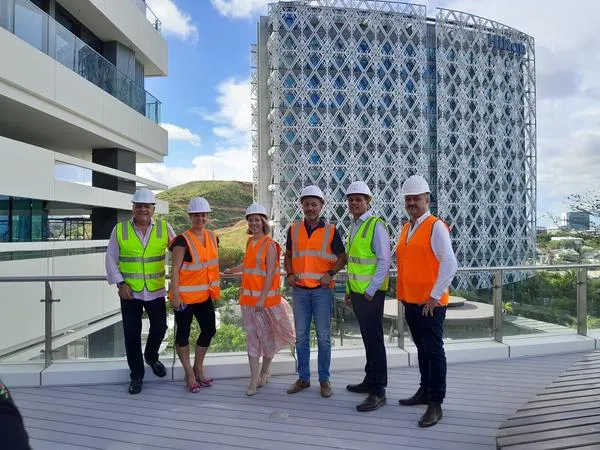
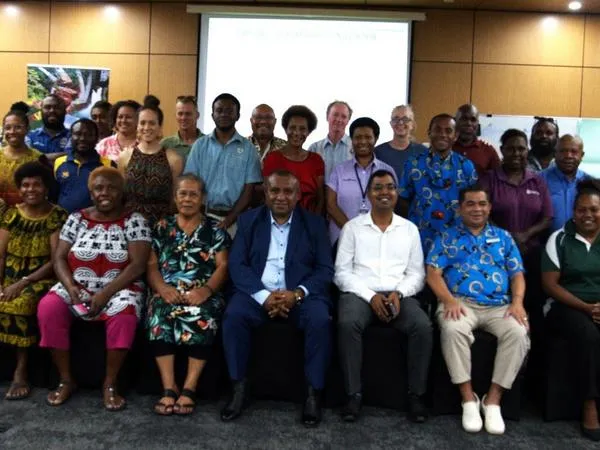
Photo: 2023 Regional Tourism Consultation Workshop participants made up of the New Guinea Islands tourism industry and the PNG Tourism Promotion Authority.
The Papua New Guinea (PNG) Tourism Promotion Authority (TPA) has commenced a series of regional consultations on the development of a new PNG National Tourism Policy and Marketing Strategy.
The TPA, in partnership with the Asian Development Bank’s (ADB) Pacific Private Sector Development Initiative (PSDI), will travel across PNG from 9-28 February 2023 to speak with tourism industry stakeholders as part of its National Tourism Policy 1995 review.
The regional consultations will cover PNG’s four regions—New Guinea Islands (Kokopo), Momase (Madang), Highlands (Mt Hagen) and Southern (Port Moresby).
The first consultations, held on 9-10 February in Kokopo, were attended by the region’s tourism industry stakeholders, operators, guides, event organizers and provincial tourism offices.
Attendees discussed PNG tourism policy reform issues, priorities, and options; the policy development process; future opportunities for New Guinea Islands’ tourism industry; and the role of the TPA in enabling, marketing, and coordinating the tourism sector.
PNG TPA Chief Executive Officer Eric Mossman Uvovo said consultations on the new National Tourism Policy and Marketing Strategy were critical, and would inform subsequent legislative amendments to the PNG Tourism Promotion Authority Act 1993.
“Since the establishment of PNG’s National Tourism Policy 1995 and Destination Marketing Strategy 2018-2022, a lot has changed,” Mr. Mossman Uvovo said.
“The tourism industry is primarily driven by the private sector, so these consultations are important to ensure the new policy helps PNG to develop tourism sustainably, maximise its resources, and position itself as a potential lead Pacific tourism destination.”
Alongside these private sector consultations, PSDI held interviews with multiple PNG government departments and agencies to gauge views on the policy and potential avenues of reform.
PSDI is an ADB technical assistance program undertaken in partnership with the Governments of Australia and New Zealand. PSDI supports ADB's 14 Pacific developing member countries to improve the enabling environment for business and to achieve inclusive, private sector-led economic growth.
It is supporting the TPA to rebuild the PNG tourism sector following COVID-19, and to undertake longer-term tourism sustainability and resilience planning.
The new PNG National Tourism Policy is scheduled for completion by April 2023.
The PNG TPA is a statutory body funded by the Government of PNG. The ultimate goal of the TPA is to market and promote PNG to the world as a desirable travel destination.
Article courtesy of PNG Tourism Promotion Authority


TOURISM UPDATE: PAPUA NEW GUINEA TOURISM SINCE THE BORDERS OFFICIALLY OPENING
Photo credit: Tourism Promotion Authority
Papua New Guinea officially opened its borders to international visitors on the 1st July 2022, and visitor arrivals from January to August 2022 show that the country has received 37,537 visitors – 2,182 of these visitors were here on holiday.
Obtaining a tourist visa remains a challenge for bona fide tourists as the 60-day tourist visa on arrival is no longer available. The PNG Tourism Promotion Authority (PNGTPA) will be working closely with the PNG Immigration and Citizenship Authority to reinstate the tourist visa-on-arrival facility to encourage international travellers to visit Papua New Guinea. Meanwhile, tour operators and agents must continue to comply with PNGICA requirements and apply online for their client’s tourist visas using the Immigration Authority’s website portal.
All COVID-19 travel restrictions have been lifted by the Government since 5th October 2022, the most recent being the vaccine test entry requirement for travelers, and the wearing of masks inside airports.
PNGTPA is aware that COVID-19 has become endemic – meaning the world is learning to live with the disease. Therefore, through the Safe Traveller PNG awareness program, the PNGTPA continues to advocate for the health and safety of the members of PNG’s tourism industry and visitors in the country. Industry members volunteer to participate in the program by undergoing training, and are then certified and promoted through the PNGTPA website as a Safe Traveller PNG business that is equipped to provide a safe and healthy environment for their guests and clients.
Since the lifting of the COVID-19 restrictions across the country, tourism in the country is slowly being revitalized, especially with the return of iconic national events like the Hagen Show, Frangipani Festival, Goroka Show and the recent Morobe Show in Lae. These events have not only brought back international travellers to the country, but refocused a great deal of marketing and promotions towards PNG’s domestic market.
For Morobe Tourism in particular, especially the recent 59th Morobe Show, hundreds and thousands of people attended the two-day event hosted at the Lae Showgrounds. Papua New Guinean show-goers came from the Highlands region, as well as from the Madang and Northern Provinces to attend, what is now becoming the nation’s biggest show with a strong focus on agritourism. Morobe Show is one of the most well-run, self-sustaining events in Papua New Guinea, hosted by the Morobe Agricultural Society – a successful case study for all events and festivals in Papua New Guinea.
Despite the Morobe Show’s success, there are many challenges ahead for tourism in the Morobe Province. Developments of attractions and products in Lae and the wider and remote Morobe Province are key areas the PNGTPA wish to assist the province with. However, the issue of a functioning provincial tourism office is vital in the bridging this assistance at a national level for tourism development in Morobe. The PNGTPA will be revisiting an MOU signed in 2018 by the Morobe Provincial Government and the Ministry of Tourism Arts and Culture.
In March this year, PNGTPA visited the districts of Nawae and Finschaffen to meet tourism product owners and service providers. The team also carried out marketing awareness and delivered guest lectures to the students of the Poly Technical College in Lae.
PNGTPA continues to market and promote Morobe as a travel destination in Papua New Guinea through its website: www.papuanewguinea.travel, particularly events like the Morobe Show, accommodation providers in Lae, as well as local tour operators like LaeAbout Tours and Fuzzy Wuzzy Expeditions.
Morobe Attractions will be a significant part of PNGTPA’s online marketing and promotions next year, working with the Morobe Provincial Government will be a vital and necessary step in showcasing the best of one of PNG’s most vibrant industrial hubs.
Article courtesy of Tourism Promotion Authority

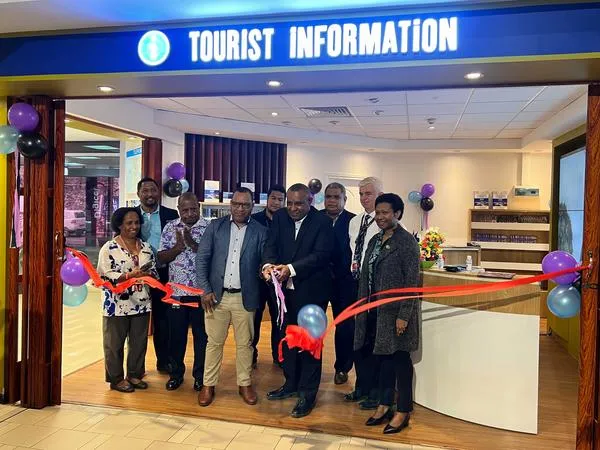
Tourist Information Booth Opens at Jacksons International Airport
Photo: Official ribbon-cutting ceremony at the reopening of the Tourist Information Centre
The Tourism Promotion Authority (PNGTPA), just like all National Tourism Offices around the world, is welcoming travellers back to Papua New Guinea with the reopening of the Tourist Information Centre at the Jackson's International Airport in Port Moresby, Friday 14th October, 2022.
The reopening of the Tourist Information Centre at Jackson's International Airport was officially opened by CEO of the PNGTPA Eric Mossman Uvovo and CEO of the National Airport Corporation Rex Kiponge.
The Centre, will be open from Monday to Friday, 8 am to 4.30 pm, and will serve as an information hub for all tourism enquiries at Jackson's. There will be two friendly PNGTPA information officers who will be working full time at the Centre to assist enquirers.
The Centre is in an ideal location where visitors at the Jacksons International Airport can easily walk over to the Tourist Information Centre to get information regarding travel and tourism, especially accommodation, tours, hire car, events and attractions in Papua New Guinea.
The Tourist Information Centre was operational in 2019, however closed its doors when the COVID -19 Pandemic affected travel globally.
In early 2021, the PNGTPA renovated the Tourist Information Centre, but handed it over to the Health Department and TrackPro to conduct PCR Testing for arriving passengers. The Centre was vacated early this year, allowing the PNGTPA and NAC to carry out further maintenance and renovation.
The PNGTPA is thankful to the National Airports Corporation for the enduring partnership over the last couple of years in helping promote tourism in the country. The PNGTPA and NAC will be signing an MOU to set up similar Tourist Information Centres in other airports across Papua New Guinea.
Article courtesy of PNGTPA

Tourism Boosts Pacific Economic Outlook, but COVID-19, Rising Prices Pose Risks
Photo credit: ADB
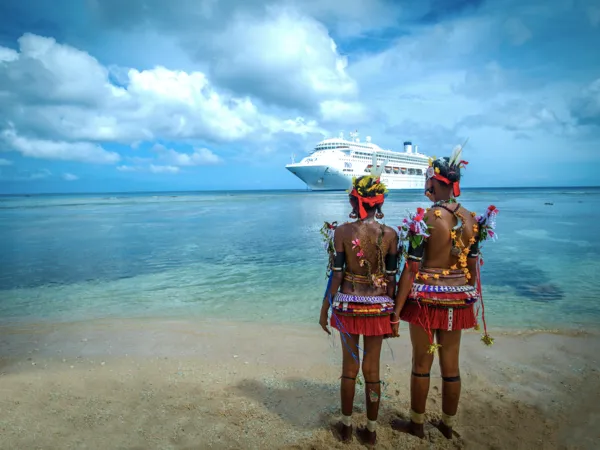
A revival in tourism is expected to boost economic growth in the Pacific in 2022 and 2023, but the COVID-19 pandemic, rising commodity prices, and climate change continue to pose risks, according to the Asian Development Bank.
After an average economic contraction of 0.6% in 2021, ADB’s Pacific Economic Monitor (PEM), released today, says the Pacific is expected to grow by 4.7% this year and 5.4% next year. The turnaround reflects rising visitor arrivals in the tourism-dependent economies of the Cook Islands, Fiji, and Palau, as well as expectations for Papua New Guinea’s minerals sector to benefit from the higher international commodity prices being driven by the Russian invasion of Ukraine.
But the PEM says the Russia–Ukraine war also poses a risk to the subregion through rising import and transport costs, accelerating inflation, and increasing trade and fiscal deficits across the Pacific. Other risks to the Pacific’s recovery include community transmission of COVID-19 and some challenges in vaccine rollouts, as well as the region’s vulnerability to climate change and disasters.
“This outlook for the Pacific is welcome after more than 2 years of negative growth caused by COVID-19, but significant risks to this recovery remain,” said ADB Director General for the Pacific Leah Gutierrez. “It is vital that development partners, stakeholders, and policy makers work closely together to ensure the continued recovery.”
The latest PEM forecast represents an improvement on that seen in the Asian Development Outlook (ADO) 2022 released in April, which projected the Pacific’s economic growth to be 3.9% in 2022.
The PEM identifies Pacific economies as among the most vulnerable in the world to climate change and disasters, and that the impact of these shocks—compounded by the fallout from COVID-19 and commodity price spikes—has been sizable. Ensuring sustainable growth will hinge on investing in climate and disaster resilience, the cost of which can exceed the governments’ own resources. The policy briefs in this issue of the PEM examine how the Pacific is pursuing climate financing from innovative sources, and how ADB is helping to respond to climate change and better manage disaster risk. Continuing efforts to strengthen public financial management will support fiscal sustainability, restore resource buffers, and re-establish a strong foundation for the next potential crisis.
The PEM also examines a wide range of issues affecting Pacific economies, including:
- The role of climate finance in sustaining Fiji’s recovery amid rising inflation
- The North Pacific’s preparedness for sustainable investing
- Climate finance and water security in Kiribati and Tuvalu
- Climate adaptation and budgeting amid volatile revenue in Nauru
- Fiscal challenges of climate financing in Papua New Guinea
- Promoting climate and fiscal resiliency in Solomon Islands
- Counting the costs and preparing for the future of South Pacific economies
- The challenge of financing a climate emergency in Vanuatu
ADB is committed to achieving a prosperous, inclusive, resilient, and sustainable Asia and the Pacific, while sustaining its efforts to eradicate extreme poverty. Established in 1966, it is owned by 68 members—49 from the region.
Article courtesy of the ADB