Category:


Policy Reforms Will Help Enhance Nontax Revenue Collections in PNG — ADB
Policy reforms that strengthen legal frameworks will help Papua New Guinea (PNG) boost nontax revenues, says the latest issue of the Asian Development Bank’s (ADB) Pacific Economic Monitor (PEM)..
“Subdued economic growth of 2% in 2023 is largely due to foreign exchange shortages, 20%–30% lower sales in various sectors, and a weakened contribution to growth from mining, one of the economy’s largest sectors,” said ADB Country Economist for PNG Marcel Schroder. ”PNG has become heavily reliant on revenue from its natural resource sector and is wisely embracing policy reforms to allow the government and statutory bodies to transparently and accountably share nontax revenue.”
The PEM says the Non-Tax Revenue Act of 2022 sets clear guidelines for handling and remitting nontax revenue, including dividends, fees, and charges, to the national budget, promoting transparent and accountable revenue sharing between the government and public and statutory bodies.
The PEM is ADB’s biannual review of economic developments and policy issues in ADB’s 14 developing member countries in the Pacific. In combination with the Asian Development Outlook (ADO) series, ADB provides quarterly reports on economic trends and policy developments in the Pacific.
Domestic Resource Mobilization Instrumental for Economic Recovery and Resilience in the Pacific — ADB
The Pacific economy is projected to continue expanding in 2023–2024, but supporting further growth requires additional government resources, according to the latest issue of the Asian Development Bank’s (ADB) Pacific Economic Monitor (PEM).
Growth for the Pacific is forecast to be 3.5% in 2023 and 2.9% in 2024. Tourism-dependent economies including Fiji, the subregion’s second-largest economy, are seeing recovery in visitor arrivals while resumption of public construction projects is reviving growth in other Pacific economies. Subdued growth of 2.0% in 2023 is seen for Papua New Guinea (PNG), the subregion’s largest economy, due to slower-than-expected expansion in the nonresource sectors. Growth in PNG is expected to pick up to 2.6% in 2024.
However, while tourism and public infrastructure spending are expected to sustain economic expansion in 2024, capacity constraints pose significant downside risks. Vulnerability to disasters and extreme climate events also continue to have potential implications for growth.
“Recovery in tourism and infrastructure spending is driving growth in the Pacific, but continued improvements in the quality of public infrastructure and services remain necessary,” said ADB Director General for the Pacific Leah Gutierrez. “Domestic resource mobilization (DRM) is key to supporting these essential engines for realizing poverty alleviation and economic development.”
DRM is the process through which governments fund their operations. Besides setting tax rates, this involves simplifying related filing, administration, and audit procedures.
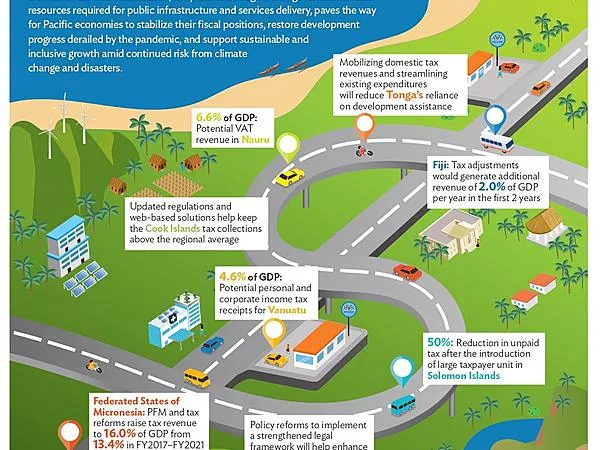
This issue of the PEM examines various dimensions of DRM across the Pacific subregion. Country write-ups look at the Cook Islands’ experiences with tax revenue management; progress and opportunities in tax reform across the subregion, including in Fiji, Nauru, the North Pacific, Solomon Islands, and Vanuatu; prospects for enhancing nontax revenues in PNG; and options for improving DRM in Samoa and Tonga.
The policy briefs in this issue make the case for improving DRM in the Pacific; explore digital transformation in tax administration; and present the key findings of an upcoming ADB report on tourism, which is an important sector in many Pacific economies and thus has a role to play in contributing to DRM.
The PEM is ADB’s biannual review of economic developments and policy issues in ADB’s 14 developing member countries in the Pacific. In combination with the Asian Development Outlook series, ADB provides quarterly reports on economic trends and policy developments in the Pacific.