

Tolu Minerals has more than doubled its reported gold resources in Papua New Guinea to 1.33 million ounces, following a maiden 293,000-ounce resource estimate for its Mt Penck Gold-Copper Project in West New Britain.
The company said its reported resources increased 111% from 631,000 ounces at the start of September, with the portfolio now comprising Tolukuma with 909,000 ounces, Saki with 128,000 ounces and Mt Penck with 293,000 ounces.
The increase follows a resource upgrade at the Tolukuma project announced on Sept. 16 and the maiden Mt Penck estimate announced on Sept. 21. Tolukuma remains Tolu's immediate priority, with a 75,000-metre near-mine drilling campaign under way and a return to gold production planned for early 2027 using existing permitted infrastructure.
Mt Penck resource
The maiden Mt Penck Mineral Resource Estimate comprises 293,000 ounces of gold from 7.3 million tonnes grading 1.2 grams per tonne, reported at a 0.5 g/t gold cut-off and classified entirely as Inferred under the JORC Code 2012.
The estimate was independently prepared by Rose Mining Geology Consultants and is based entirely on historical drilling carried out between 1989 and 2011 by BHP, Indo Pacific Resources and Kanon Resources.
Tolu said it has not undertaken drilling at Mt Penck. The historical database comprises 115 drill holes covering 12,267 metres, while the resource has been classified as Inferred because of drill spacing and limitations in the historical data, including the absence of collated quality assurance and quality control data and density measurements.
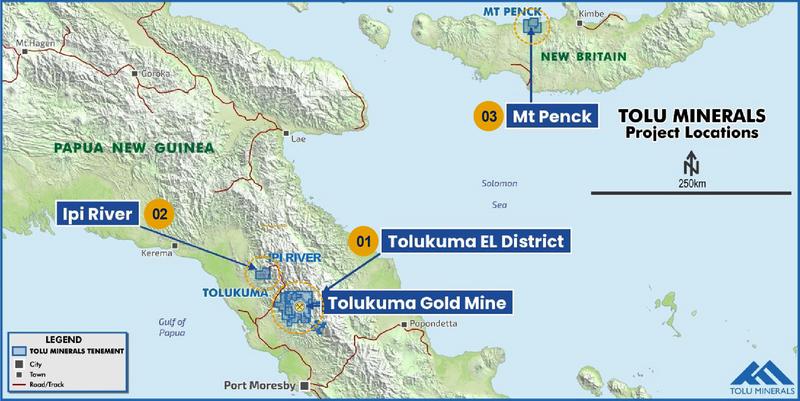
Mt Penck is located on Exploration Licence 2662, about 55 kilometres west of Kimbe in West New Britain. The project has access to the existing wharf at Silavuti, about 4.5 kilometres from the licence, while Kimbe has a deep-water port and Hoskins has a sealed airport with daily jet services to Port Moresby.
Copper-gold potential
The company is also targeting a larger copper-gold porphyry system beneath and adjacent to the shallow gold resource.
Tolu said its interpretation of airborne MobileMT data collected in 2024, together with historical 3D-IP data, has identified the Kavola Porphyry, an interpreted system covering about 1.6 kilometres by 900 metres.
Only two historical holes on its western margin extended beyond 300 metres. One of them intersected disseminated and fracture-controlled pyrite and arsenopyrite over its full 400-metre length, with minor copper sulphides in several intervals.
Three deep drill targets have been identified within the interpreted porphyry system, with Kavola East and Kavola Northeast considered ready for the first phase of drilling. Kavola South is planned for a second phase, subject to the results of initial drilling.
The company's proposed two-year exploration programme includes about 40,000 metres of drilling using three company-operated rigs, alongside mapping, sampling, LiDAR and ground geophysics. The programme has an estimated budget of about A$30 million.
Tolu is assessing options to fund Mt Penck separately from the treasury committed to the Tolukuma restart, potentially through a dedicated vehicle with its own funding and technical team. The company said no decision has been made and any transaction would be subject to board, regulatory and shareholder requirements where applicable.
Tolu managing director and chief executive Chris Muller said Mt Penck would be developed as a separate growth project while the company maintains its focus on restarting Tolukuma.
The company said the Mt Penck resource does not constitute an Ore Reserve and that no Ore Reserves have been estimated for any of its projects. It also noted that no metallurgical testwork, pit optimisation or mining studies have been completed at Mt Penck.
Tolu owns 100% of the Mt Penck project and the fully permitted Tolukuma gold-silver mine, about 100 kilometres north of Port Moresby. Tolukuma produced about one million ounces of gold between 1995 and 2015, according to the company.


