

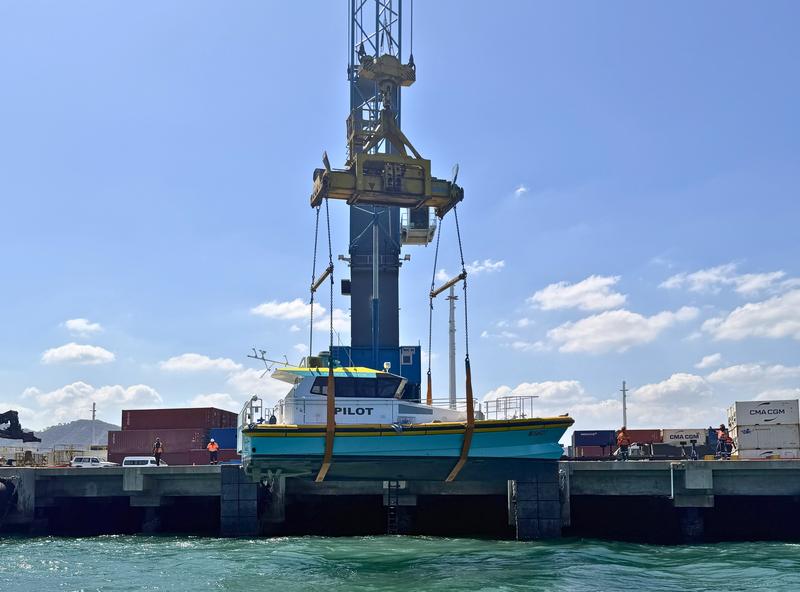
Madang Port is set to receive a new purpose-built pilot boat following the arrival of Musangu II, further strengthening Papua New Guinea’s maritime infrastructure and port operations.
The fourth of five pilot boats delivered through the Australian Infrastructure Financing Facility for the Pacific (AIFFP) is undergoing final safety and registration checks before entering service.
Australia is partnering with PNG Ports through the Ports Infrastructure Investment Programme (PIIP) to deliver coordinated port infrastructure upgrades across Papua New Guinea. The programme aims to enhance the safety, resilience and performance of the country’s ports for communities, businesses and maritime users.
Musangu II replaces an ageing pilot boat and will enhance safety by providing PNG Ports with a modern, reliable means of transferring marine pilots to and from ships calling at Madang Port.
Pilot boats play a critical role in port operations, helping vessels navigate safely through local waters. The arrival of Musangu II will strengthen these services in Madang and support the smooth movement of cargo and trade.
PNG Ports Chief Executive Officer Neil Papenfus said the vessel would help ensure PNG Ports continues to provide reliable services at Madang Port.
“PNG Ports has a responsibility to ensure our ports operate safely and efficiently for all users. The addition of Musangu II strengthens our marine pilotage capability and helps us continue providing safe and reliable services to vessels calling at Madang Port,” Papenfus said.
The new pilot boats deliver significant improvements in reliability, safety and operational performance, helping to minimise disruptions and ensure the continued safe movement of vessels through Papua New Guinea’s ports.
Another benefit of the fleet upgrade is the standardisation of pilot boats, replacing legacy vessels of varying ages, designs and capabilities. This will simplify crew training, maintenance and spare-parts management while improving operational flexibility.
All five vessels were manufactured by Norman R. Wright & Sons in Brisbane and are specifically designed to provide safe, reliable and efficient pilotage services in Papua New Guinea’s rugged operating environment.
Once final safety checks are complete, Musangu II will be transferred to Madang Port and begin service. Taubar II, the fifth and final pilot boat, is in the final stages of testing in Brisbane and is expected to arrive in Port Moresby in late September 2026.
PNG Ports Corporation Limited (PNGPCL) is Papua New Guinea’s national ports authority. It manages 15 of the country’s 23 declared ports and handles 100 per cent of the nation’s seaborne trade.
PNGPCL is a fully corporatised entity owned by the State and is the successor company to the PNG Harbours Board. Kumul Consolidated Holdings is the sole shareholder, holding shares in the corporation on behalf of the State of Papua New Guinea. The corporation’s management and operations are governed by relevant port and shipping regulations, as well as policy directives issued by the National Executive Council through the Ministry of State Enterprises.
PNG Ports Corporation Limited was officially launched on 13 November 2006. The organisation has operated under several names: Papua and New Guinea Harbours Board (1963-69), Papua New Guinea Harbours Board (1970-2002), PNG Harbours Board Limited (2002-06), and PNG Ports Corporation Limited from 2006.
PNGPCL operates and manages 15 of Papua New Guinea’s 23 declared ports: Aitape, Alotau, Buka, Daru, Kavieng, Kieta, Kimbe, Lae, Lorengau, Madang, Oro Bay, Port Moresby, Rabaul, Vanimo and Wewak. These ports handle more than 5.8 million tonnes of cargo annually, representing 100 per cent of Papua New Guinea’s seaborne trade. They also serve as the main gateways to more than 300 scattered islands.
The corporation provides berthage, wharfage, storage, pilotage, harbour management, surveillance and other port-related services. Pilotage services are supported by pilot launches stationed at PNGPCL’s main ports.
Port-related tariffs are regulated by the Independent Consumer and Competition Commission.


