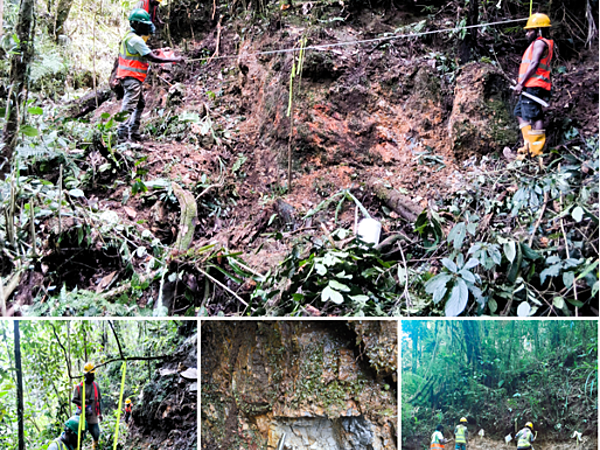
Great Pacific Gold Corp. has expanded the interpreted footprint of two high-grade gold vein systems at its Wild Dog Project in East New Britain following new mapping and channel-sampling results.
The company said its latest work at the Elamaraka and Kargalio vein systems had identified additional mineralized quartz-sulphide veins beyond historically mapped areas, strengthening the potential of the southern Wild Dog structural corridor.
At Elamaraka, continuous channel sampling returned 9 meters grading 4.81 grams per tonne of gold, 41.96 grams per tonne of silver and 0.02% copper.
Individual samples included grades of up to 26.86 grams per tonne of gold and 233.4 grams per tonne of silver. Additional vein exposures along the interpreted corridor returned 4.22 grams per tonne of gold from a grab sample, while channel samples returned 1.20 grams per tonne and 1.05 grams per tonne of gold.
Great Pacific Gold said mapping indicated Elamaraka was broader than a single historical vein, with multiple quartz-sulphide veins showing similar structural orientation and mineralization styles.
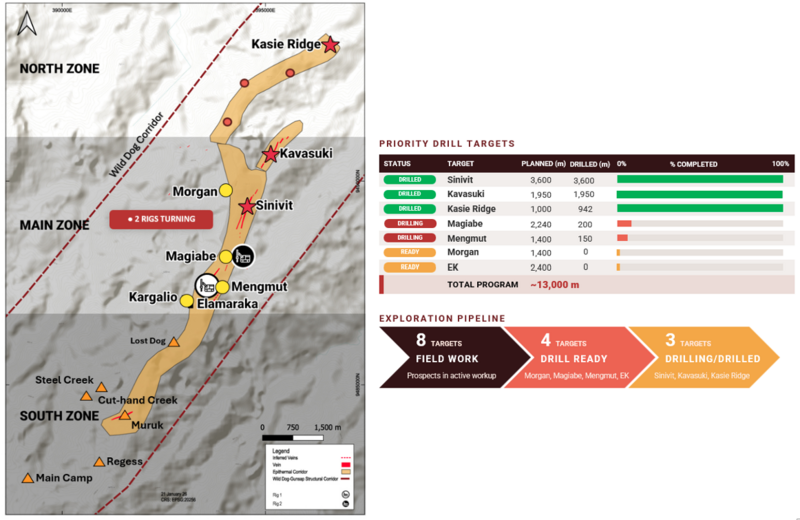
The Elamaraka system is about 2 kilometers southwest of the Sinivit deposit and forms part of the southern continuation of the Sinivit-Kavasuki epithermal corridor.
At Kargalio, a 6-meter channel interval returned an average grade of 7.29 grams per tonne of gold, 12.83 grams per tonne of silver and 0.24% copper, including 2 meters at 16.20 grams per tonne of gold.
A second 6-meter channel interval about 40 meters south returned 2.85 grams per tonne of gold, 8.20 grams per tonne of silver and 0.15% copper.
Another quartz-sulphide-clay breccia zone about 260 meters east of the Kargalio vein returned about 10 meters at 1.77 grams per tonne of gold.
The company said mapping had identified additional mineralized structures at Kargalio, supporting its interpretation that the prospect represents a broader mineralized corridor rather than a single historical vein.
Great Pacific Gold Chief Operating Officer and Vice President Exploration Callum Spink said the results had strengthened the company’s understanding of the southern Wild Dog corridor.
“Historical work reported high-grade gold mineralization at the EK Target Area. Our recent mapping and systematic sampling indicate that these prospects form part of broader mineralized corridors containing multiple quartz-sulphide veins,” Spink said.
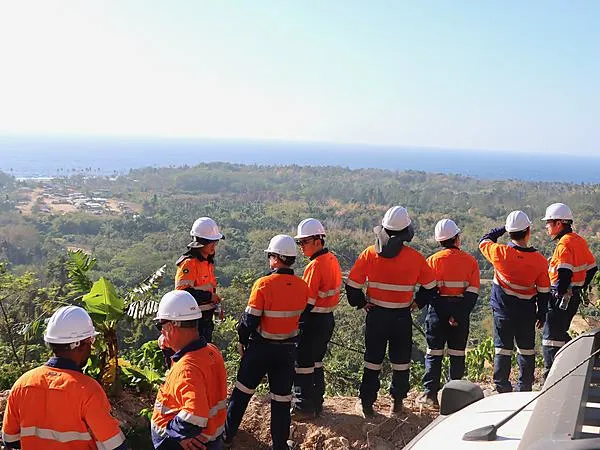
The company has also begun work in the South Zone of the 15-kilometer Wild Dog structural corridor, with earthmoving equipment clearing an access track south of Elamaraka and Kargalio.
An exploration team has been mobilized to conduct initial geological mapping and rock-chip sampling at South Zone prospects including Lost Dog, Steel Creek, Cut-hand Creek, Muruk and Regess.
Great Pacific Gold said the initial South Zone results would be reported after assays are received and reviewed.
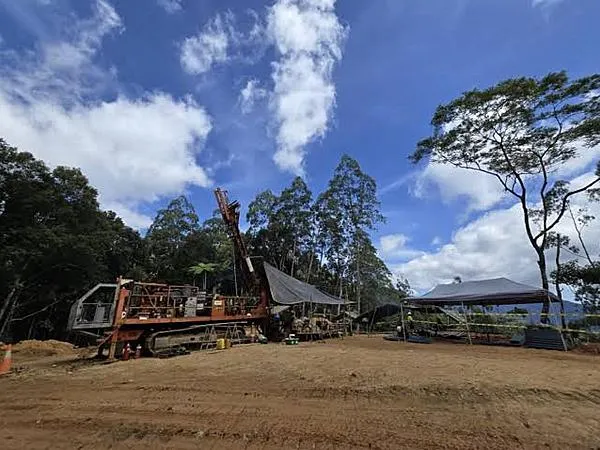
The company currently has two diamond drill rigs operating at Wild Dog and plans to extend systematic drilling into the southern corridor as priority targets are developed.
Great Pacific Gold said its Wild Dog Project includes a 15-kilometer structural corridor in East New Britain, with the company pursuing multiple epithermal and porphyry exploration targets. The company also holds the Kesar, Arau and Tinga Valley projects in Papua New Guinea.