

Bank of Papua New Guinea (BPNG) Governor Elizabeth Genia called for urgent action to translate green finance policies into investment, warning that climate change is already affecting communities across Papua New Guinea.
Speaking at the opening of the 2026 Green Finance Summit in Port Moresby on May 27, Genia said the country must move beyond discussion and focus on implementing solutions that strengthen climate resilience, support sustainable development and mobilise private-sector investment.
The two-day summit, attended by Prime Minister James Marape, government ministers, representatives of Pacific central banks, financial-sector leaders, development partners and business stakeholders, marked the second national gathering dedicated to advancing green finance in Papua New Guinea.
She noted that the inaugural summit in 2025 focused on laying the foundations for green finance through policy development, partnerships and institutional frameworks.
"This year, we move the conversation forward. 2026 is not about introducing ideas; it is about implementation," she said.
"How do we make green finance something real, tangible and workable here in Papua New Guinea?"
Genia stressed that the need for climate resilience is no longer a future concern but an immediate reality affecting communities across the country.
She pointed to the devastation caused by Tropical Cyclone Maila, which struck Milne Bay and Bougainville in April, displacing families, damaging critical infrastructure and claiming 22 lives.
Maila was the 11th tropical cyclone recorded in the region this season, underscoring the growing frequency and severity of climate-related events.
At the same time, PNG is monitoring the emergence of an El Niño weather pattern that could place additional strain on communities, agriculture and natural resources.
"These challenges will continue. We know that Papua New Guinea is uniquely exposed to these environmental realities," Genia said.
She noted that inclusive green finance — the mobilisation of capital towards sustainable and inclusive investments — can play a critical role in helping the country build resilience against climate-related risks.
Green finance facilities near completion
Genia outlined progress made over the past year through the work of the BPNG Green Finance Centre, which has been developing the financial infrastructure needed to support PNG's transition to a more sustainable economy.
A key initiative announced at the first summit was the establishment of Green Finance Facilities aimed at directing funding towards environmentally sustainable projects.
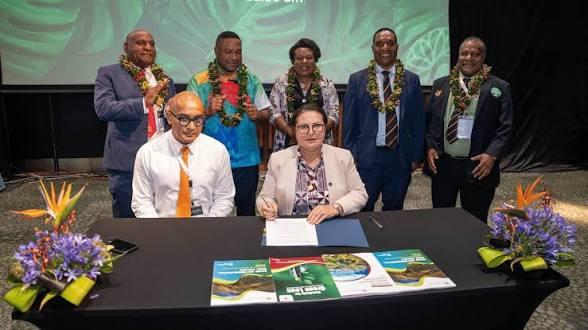
According to Genia, these facilities are now nearing completion and undergoing final testing before being rolled out nationwide.
The central bank has also worked with the National Energy Authority to operationalise a third Renewable Energy Facility, further expanding support for clean-energy investments.
The summit also saw the launch of several initiatives aimed at accelerating green finance implementation.
These include the launch of the Inclusive Green Finance Taxonomy Version 2, which provides clearer guidance for green lending while helping PNG's banking sector align with international financial markets.
The central bank also introduced new Environmental and Social Risk Management Guidelines to help financial institutions integrate sustainability considerations into everyday lending decisions.
In addition, new Green Loan Reporting Standards were launched to improve transparency and enable more effective tracking of green investment outcomes.
Another significant initiative is the establishment of the Green Finance Academy, which will provide technical training and capacity-building support for financial institutions, government agencies and private-sector stakeholders involved in sustainable finance.
Later this year, the central bank plans to launch a National Centralised Climate Investment Database to consolidate information on climate-sensitive projects funded by development partners and private investors.
Genia said the initiatives represent important progress but cautioned that frameworks alone would not generate investment.
"Policies alone do not support a small business adapting to climate pressures," she said.
"Guidelines do not create investment unless institutions are prepared to act."
K55 billion investment needed by 2030
Genia highlighted the critical role of the financial sector in directing investment towards sustainable development priorities.
She said banks and financial institutions are central to the transition because they determine where capital flows, how risks are assessed and who gains access to financing.
Papua New Guinea will require substantial investment in energy, infrastructure, agriculture and sustainable enterprise over the coming years.
Citing estimates from the International Finance Corporation, Genia said PNG will need approximately K55 billion to meet its climate and development commitments by 2030.
She said government and development partners cannot meet the financing requirement alone.
"The private sector must be part of the solution," she said.
For commercial banks, she described green finance as a significant business opportunity but stressed that sustainability considerations must become part of mainstream financial decision-making rather than remain a niche topic among specialists.
She also acknowledged the challenges facing financial institutions as they adapt to new reporting requirements, develop technical expertise and assess the commercial viability of green investments.
"No market gets this perfect from day one," she said.
"What matters is that our progress is practical, proportionate and credible, and our focus is on building systems that genuinely work in the Papua New Guinean context."
Financial inclusion must remain central
Genia said green finance must support inclusive economic growth rather than benefit only large institutions or well-connected projects.
The agenda, she said, must serve ordinary Papua New Guineans, particularly those in rural communities and climate-vulnerable sectors.
She called for greater support for agriculture, small and medium-sized enterprises (SMEs), women-led businesses and enterprises investing in sustainability and efficiency improvements.
"It must support our rural communities. It must support agriculture. It must support SMEs, which are the backbone of employment and income generation," she said.
"It must empower women-led enterprises, which we know are among our most resilient businesses."
She added that many businesses may not explicitly identify themselves as "green" enterprises but are nonetheless making investments that improve resilience, efficiency and sustainability.
International partners support PNG's green transition
Genia credited international development partners with supporting the country's green finance agenda through technical assistance and financing.
She acknowledged contributions from the International Monetary Fund, World Bank, Asian Development Bank and the governments of Australia, New Zealand and the Republic of Korea.
She also thanked the French Development Agency (AFD), the International Finance Corporation and the Global Green Growth Institute for working directly with the Green Finance Centre to strengthen PNG's sustainable finance framework.
Genia encouraged summit participants to engage in open and practical discussions focused on developing workable solutions and partnerships.
She said success would ultimately be measured not by the number of policies produced, but by the quality of investment decisions and the resilience of the country's financial system.
"The Bank of PNG remains fully committed to supporting this journey," she said.
"Financial resilience, sustainable growth and sound risk management are core central banking concerns."
"We cannot achieve our mandate of long-term price stability without building economic and financial resilience."
Genia officially declared the 2026 Green Finance Summit open, calling on stakeholders across government, business and the financial sector to work together to turn green finance ambitions into tangible outcomes for PNG's future.
The summit featured keynote presentations, panel discussions and interactive workshops aimed at unlocking green finance opportunities, accelerating climate-resilient investment and advancing practical action on green growth in Papua New Guinea.


