

Papua New Guinea’s ports are more than gateways for cargo. They are the economic arteries of a nation. With a bold 30-Year Infrastructure Master Plan now being realised, PNG Ports Corporation is modernising its network to connect communities, attract investment and navigate towards the next generation of national growth.
PNG Ports Corporation Limited (PNG Ports) manages 15 of the country’s 23 declared ports, handling 10.8 million tonnes of cargo in 2025 alone and underpinning an estimated K29 billion, or 22 per cent, of Papua New Guinea’s GDP. From rice and fuel to gold, copper and palm oil, almost everything that moves in and out of the country passes through a PNG Ports facility. Yet the infrastructure supporting this vital national role has long been in need of modernisation.
That is now changing. PNG Ports’ 30-Year Infrastructure Master Plan, described as the largest port upgrade program in the corporation’s history, is delivering transformative investment across the entire national network. Backed by the Australian Government’s Australia-PNG Infrastructure Financing Partnership (AIFFP) contributing A$621.4 million (approx. K1.5 billion) and supported by the European Investment Bank (EIB) and Agence Française de Développement (AFD), the program is building resilient connectivity well into the future.
PNG Ports CEO Neil Papenfus says the program's ambition stretches well beyond the waterfront.
“Our infrastructure program is not simply about repairing wharves. We are securing the economic future of every province this network serves, improving the lives of the Papua New Guinean people who depend on it, and positioning PNG as a serious player in Pacific trade and logistics,” Papenfus said.
Kimbe Port: Rehabilitation Underway
The program is already delivering on the ground. Kimbe Port, PNG’s third-largest port and a critical gateway for West New Britain Province, the country’s largest producer and exporter of crude palm oil, is the first port to undergo rehabilitation under the K1.5 billion Port Infrastructure Investment Program (PIIP), financed by the Australian Government through the AIFFP. Since works commenced in August 2025, the project has progressed beyond the halfway mark, generating local jobs and direct economic engagement for communities across the province. Lae Tidal Basin, Kavieng, Oro Bay and Daru are next in line for upgrades under the same program.
Community Service Obligation Ports
Of the 15 ports managed by PNG Ports, only three, Lae, Port Moresby and Kimbe, are commercially self-sustaining. The remaining 12 operate as Community Service Obligation (CSO) ports: facilities that would not be viable on purely commercial terms, but which perform an essential social function for the communities they serve. Ports such as Daru, Aitape, Vanimo and Wewak are lifelines for remote and rural populations where PNG’s terrain makes road connectivity impractical.
Without these ports, the cost of basic goods in these communities would escalate sharply, supply chains would break down and economic opportunities would wither. PNG Ports is working to ensure that the 30-Year Plan addresses both the physical upgrade of CSO ports and the development of sustainable funding pathways, including government support mechanisms, to keep these vital connections open and operational for generations to come.
A Pacific Pioneer: Rabaul’s “Green Port” Model
One of the most significant projects in the infrastructure program is the rehabilitation of Rabaul Port, with financing agreements between PNG Ports and AFD currently underway. The project, valued at approximately €82.6 million and expected to be co-funded by a €16.6 million EU grant, a €24 million AFD loan and a €24 million EIB loan, will be the first initiative in PNG to combine an EU grant with European partner loans under the Global Gateway strategy.
The Rabaul upgrade will rehabilitate key berths, upgrade the overseas berth, and pioneer a “green port” model for the Pacific, incorporating solar energy, advanced wastewater management, and climate-resilient infrastructure built to withstand rising sea levels and tropical storms. Construction is scheduled to commence in 2027, with completion targeted by 2030. The project is expected to create local jobs, reduce vessel waiting times, and strengthen Rabaul’s role as a regional import-export hub and redistribution centre serving some 300,000 residents of the East New Britain Province.
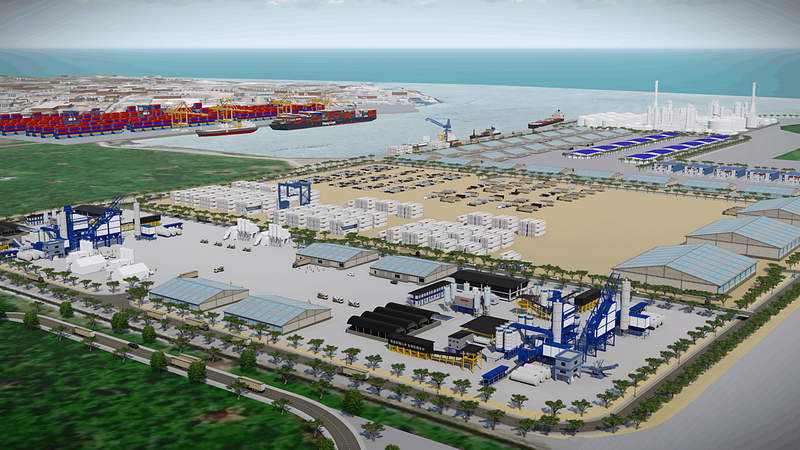
Lae Industrial Park: 350 Hectares of Opportunity
At the commercial frontier of PNG Ports’ growth strategy sits Lae Industrial Park, a 350-hectare world-class industrial and logistics precinct located directly adjacent to Lae Port, PNG’s busiest international terminal. With 45 hectares already developed, including hardstand with container capacity, sealed internal roads, drainage and security infrastructure, the park is open for business while offering significant room to grow.
The National Executive Council (NEC) has granted concept approval for Special Economic Zone (SEZ) status at the Lae Port precinct, a major milestone that will ultimately deliver fiscal incentives including tax and customs concessions to park tenants. Targeted industries include agribusiness and onshore processing, manufacturing, energy and utilities, and logistics and warehousing: precisely the sectors PNG needs to diversify its economy beyond primary commodities.
PNG Ports Chief Commercial Officer, Deborah Onga, describes the park’s appeal to investors as already tangible.
“Lae Industrial Park is a genuine investment-ready proposition. Businesses that locate here gain direct access to PNG’s largest port, proximity to regional shipping routes, and the flexibility to scale operations as their needs grow. With SEZ status on the horizon, the value proposition for investors will only strengthen, and we are ready to work with partners to bring that vision to life,” said Onga.
PNG Ports’ 30-year infrastructure plan represents a coherent and ambitious national vision, one in which Papua New Guinea’s ports are not simply maintained but fundamentally transformed into engines of economic growth, regional connectivity and community resilience. Critically, that transformation is also a matter of readiness. With a new wave of major resources projects on the horizon, PNG needs ports that are capable of handling the scale and complexity of next-generation industry. The infrastructure program is ensuring they will be.


