

Resources and/or Reserves
The words resources and reserves as applied to the presence of oil and gas deposits are often quite casually used without due regard for their actual meaning. This can clearly mislead people either by grossly exaggerating, or under-estimating the importance of an undrilled prospect, the potential oil and gas production of a field, or even the actual petroleum endowment of a nation. The latter can in turn lead to very serious economic policy errors by a government.
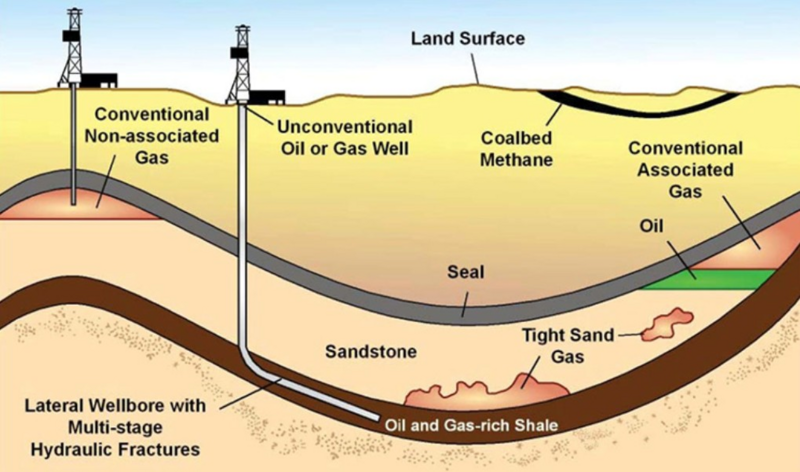
A country may be prospective for petroleum accumulations, but being prospective is only a statement of there being the potential for oil and gas to have accumulated into discrete subterranean pools, or accumulations, which may have the potential to be tapped by wells drilled into them. These accumulations have to be found first by field exploration and the drilling of wells, which are not easy tasks. Discovered accumulations then have to be evaluated for the quality of the petroleum that they bear and their extent, and only if they are large enough, might they be considered for commercial recovery of that discovered petroleum. In this discussion, I only discuss conventional oil and gas accumulated in porous and permeable reservoirs, not oil and gas unlocked from less permeable strata by fracturing or gas released from degasification of coal – coal bed methane.
Discovery
Exactly what constitutes a discovery can be debated for hours by petroleum technocrats. The Society of Petroleum Engineers defines a discovery as being a “petroleum accumulation where one or several exploratory wells through testing, sampling, and/or logging have demonstrated the existence of a significant quantity of potentially recoverable hydrocarbons and thus have established a known accumulation.” In this context, recoverable means that the hydrocarbons have to demonstrate that they are indeed moveable and are not just immovable residues.
A significant quantity implies that there is evidence of a sufficient quantity of petroleum to justify estimating the in-place volume of petroleum as demonstrated by the drilling of wells into the accumulation and for evaluating the potential for future commercial recovery of that petroleum.
One should be cautious in the use of the term discovery. Discovery should not be translated into undue expectations of oil and gas field development and petroleum incomes. Development of any oil and/or gas accumulations only comes as and when there are proven to be adequate recoverable oil and/or gas reserves to warrant the expense and effort of development and production operations. Discovery is the first elemental step towards development, but it is only the initial identification of the accumulation of petroleum, the scope and dimensions of which has to be subsequently ascertained.
Interestingly enough, the Papua New Guinea Oil and Gas Act does not define discovery, though it does require the discovery of petroleum to be notified to the Government immediately and details of the same to be provided within three days. The licensee may then be directed to furnish “written particulars of the chemical composition and physical properties of the petroleum; and the subsoil in which the petroleum occurs; and any other pertinent matters.” Typically, the acid test of a discovery has been the testing of the discovery well to see if the petroleum will flow from the subsurface reservoir to the surface, though modern downhole tools can simulate such tests and provide a reasonable understanding of the petroleum content of the discovered accumulation and the ability of its reservoir to permit the flow of its contained fluids.
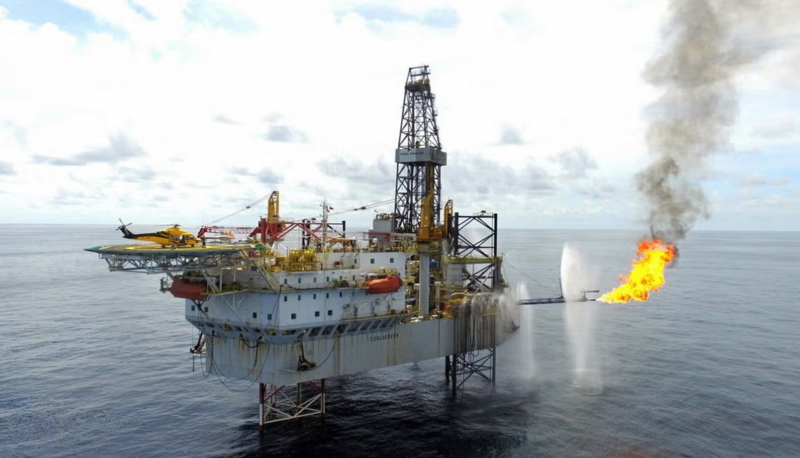
The evaluation of the results of an exploration well needs to be done most carefully. Full attention to the monitoring of the petroleum operations is essential to preserve the interests of the nation, not that the petroleum companies might mislead the government, but errors of interpretation and judgement do occur.
In one famous case in Papua New Guinea, a well-known operating petroleum company thought that it had made an oil and gas discovery. In an effort to keep up with its fiduciary duties to its shareholders and its Australian Stock Exchange listing requirements, it issued a press release announcing that it had made a significant oil and gas discovery of considerable thickness with well logs showing a gas cap overlying a respectable oil column. The company’s development geologist courteously delivered a copy of the press release to the author at the Government’s Petroleum Division at the Department of Petroleum and Energy together with a set of the well logs (which necessarily excited the author). After ten minutes of cursory review of the logs, the author announced to the company’s development geologist that the company had not discovered any oil or gas, but that the well had rather encountered reservoirs full of water. The press release was suitably endorsed and sent back to the company’s managing director, who was stunned in disbelief. The company proceeded to evaluate the well the next morning with a full well test of the various supposed hydrocarbon-bearing reservoirs, but the well tests flowed only water. Such was not only a grave disappointment and embarrassment to the company, but also to the Government which naturally would have preferred a discovery.
A Field
In conventional petroleum reservoirs, a field is typically an area consisting of a single accumulation or multiple accumulations in a reservoir or reservoirs all grouped on, or related to, the same individual geological structural feature and/or stratigraphic condition. There may be two or more reservoirs in a field that are separated vertically by intervening impermeable rock, laterally by local geologic barriers, or both. Aside from accumulation and reservoir, some jurisdictions use the term pool. In Papua New Guinea, a petroleum pool is defined as a “naturally occurring discrete accumulation of petroleum.”
Poor Advice Can be Misleading
In one developing country, its foreign expert oil and gas advisers told the government that it had one billion barrels of crude oil. However, that estimate was only an assessment of the overall potential petroleum endowment of the country, if it might be realised through appropriate exploration and discovery. It was a probabilistic estimate based on an assessment of regional geological parameters that are conducive to the formation of petroleum accumulations. It was obviously dependent on the results of exploration which might, or might not take place. Moreover, the advice failed to define whether that was the amount of oil and gas that might be found in situ within the yet-to-be-discovered accumulations, or whether it would be the amount of oil and gas that might be recoverable, either technically or economically.
Alas oil, as we all know, is viscous and sticky, and does not flow easily. It also requires energy to flow to the surface, so only a proportion of all subterranean oil discovered is ever recovered. That estimate of the country’s oil endowment also only had a 50% probability. Subsequent exploration by oil and gas companies found just several accumulations of crude oil amounting to an aggregate 200 million barrels of oil-in-place. Oil-in-place is the petroleum that exists originally in naturally occurring accumulations, discovered and undiscovered, before production begins. However, the discovered oil was of high viscosity and density, and only 9% was found to be actually recoverable and potentially able to yield 18 million barrels of actual oil production for sale and use.
Politically, the President of the country had staked his national policies on the cited one billion barrels by multiplying that quantity by the then current price of crude oil of US$ 50 per barrel. Thus, he contemplated having a massive US$ 50 billion contribution to the nation’s economy, and maintaining his popularity and position based on such. He told the people that the country would become a member of OPEC and everyone would have cheap gasoline and diesel.
However, the reality was that the discovered recoverable 18 million barrels was quite difficult to win from the ground and the development and operating costs amounted to US$ 30 per barrel, leading to a net value of subsequent oil production being only US$ 20 per barrel for a total value of just US$ 360 million. The President then realised that the Government’s Production Sharing Contract more or less allowed the oil companies to keep 50% of the net value of the produced crude, so his government got just US$ 180 million. And this was spread out over twenty years providing an average income to the Government of just U$ 9 million per year, a far cry from the spectacular windfall of US$ 50 billion. The President was accused of misleading the people and was not re-elected in subsequent national elections.
There is no need for such grave errors. It is the duty of the petroleum technocrat, specialist or expert, be he or she: an adviser, a government official, or a company official to advise non-technical people appropriately, and with great caution. Politicians and others have their expertise, and we petroleum folks have ours; it is our job to communicate our findings to others with professional care and diligence.
In one West African nation, the author once had to tell the President’s Adviser that she was not qualified to talk about the potential oil reserves that some international company had been promoting to her boss, making the President overly exuberant and excited about future oil production. She was alarmed and annoyed when told that the country had no petroleum reserves, but only prospective petroleum resources that had yet to be discovered, may be. Some ten years later, those wells have yet to be drilled, and the country still has no proven oil reserves.
On another occasion in Papua New Guinea, when Chairing the Opening Ceremony of the Second PNG Petroleum Convention in May 1993, the author had to carefully and cautiously advise the then Prime Minister, the Rt. Hon. Paius Wingti, PC (next to whom, the author was sitting) that the enormous Indonesian gas reserve figures being talked about by our guest keynote speaker, Ir. Suyitno Patmosukismo, the then Director General of Indonesia’s Ditjen MIGAS, (an abbreviation for Minyak dan Gas Bumi, or Oil and Gas, and the State regulator of oil and gas) were not actual proven recoverable volumes of gas, but probabilistic estimates of potential undiscovered resources. This put our modest, but conservatively estimated proven recoverable gas resource identified by that time in perspective, and we felt less humbled! The Prime Minister was grateful, and the author had done his duty.

The mainstream media (newspapers, television and radio) often make mistakes in talking and writing about oil and gas resources and reserves, often needing specialist technical correction after promoting public misunderstanding. Sensational news sells better, one supposes. I shall not dwell on the many inaccuracies of social media in these matters.
Within the petroleum industry, we may also sometimes find speculation, especially by smaller oil and gas exploration companies that wish to talk up the petroleum resource potential of their exploration areas. Often this is done to make investment in their company seem more attractive. Whilst the larger integrated international oil and gas companies do not need to play such games, there are times when they might exaggerate the potential of undrilled leads and prospects to the non-technical minds of political leaders in an attempt to persuade them to consider favourable treatment and regulatory actions.
Petroleum Resources Management System
The petroleum industry has rules about such matters. The systematic reporting of petroleum resources has been developed progressively over nearly one hundred years. Today, the Petroleum Resources Management System (PRMS) is highly developed, and subject to regular revision and update. It is published by the Society of Petroleum Engineers, and its Oil and Gas Reserves Committee. It has wide industry input and sponsorship from other industry organisations, such as the World Petroleum Council (WPC), and the American Association of Petroleum Geologists (AAPG), among others.
The PRMS provides a consistent approach to estimating petroleum quantities, evaluating projects, and presenting results within a comprehensive classification framework.
Petroleum
First of all, we need to be sure of what we are talking about. Petroleum is defined as a naturally occurring mixture consisting of hydrocarbons in the gaseous, liquid, and or solid state. Petroleum may also contain non-hydrocarbons, common examples of which are carbon dioxide, nitrogen, hydrogen sulphide, and sulphur, and in rare cases, non-hydrocarbon content can be greater than 50%. Interestingly enough, in Papua New Guinea, although the definition of petroleum is more or less the same, the Oil and Gas Act simultaneously refers to helium alongside petroleum. Helium was found in both the Barikewa 1 and Iehi 1 wells drilled respectively in 1958 and 1960 by Island Exploration Company and the Australasian Petroleum Company. Albeit in relatively low concentration of only about 0.1% in the discovered natural gas stream, it may one day yet have commercial value if the gas from these fields is ever produced for LNG production.
Petroleum Resources
The term petroleum resources is used to encompass all quantities of petroleum both recoverable and unrecoverable naturally occurring in an accumulation on or within the Earth’s crust, discovered and undiscovered, plus those quantities already produced. Further, it includes all types of petroleum whether currently considered conventional or unconventional.
Petroleum Reserves
Petroleum reserves are those quantities of petroleum anticipated to be commercially recoverable by application of development projects to known accumulations from a given date forward under defined conditions. Reserves must satisfy four criteria. They must be discovered, recoverable, commercial, and remaining (as of the evaluation’s effective date) based on the development project(s) applied.
Reserves are recommended as sales quantities as metered at the reference point. Where the entity also recognises quantities consumed in operations as reserves these quantities must be recorded separately. Non-hydrocarbon quantities are recognized as reserves only when sold together with hydrocarbons or volume consumed in operations associated with petroleum production. If the non-hydrocarbon is separated before sales, it is excluded from reserves.
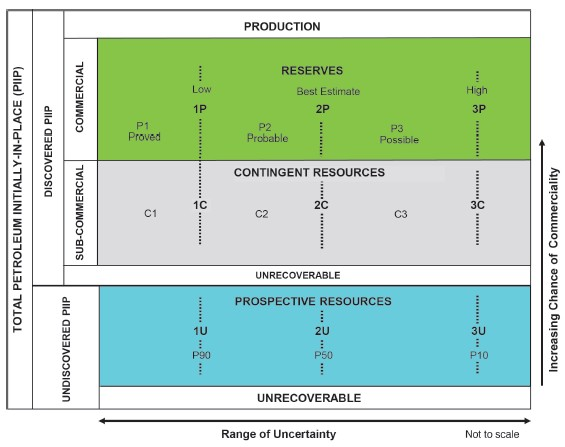
Reserves are further categorized in accordance with the range of uncertainty and should be sub-classified based on project maturity and/or characterised by development and production status. The PRMS summarises this in its Resource Classification Framework. The horizontal axis reflects the range of uncertainty of estimated quantities potentially recoverable from an accumulation by a project, while the vertical axis represents the chance of commerciality, which is the chance that a project will be committed for development and reach commercial producing status.
Proved, Possible and Probable Reserves
In dealing with uncertainty of petroleum reserves, the PRMS classically uses the terms: proved, probable and possible.
Proved reserves are those quantities of petroleum that, by analysis of geoscience and engineering data, can be estimated with reasonable certainty to be commercially recoverable from known reservoirs and under defined technical and commercial conditions. If deterministic methods are used, the term “reasonable certainty” is intended to express a high degree of confidence that the quantities will be recovered. If probabilistic methods are used, there should be at least a 90% probability that the quantities actually recovered will equal or exceed the estimate.
Probable reserves are those additional reserves which analysis of geoscience and engineering data indicate are less likely to be recovered than Proved Reserves, but more certain to be recovered than Possible Reserves. It is equally likely that actual remaining quantities recovered will be greater than or less than the sum of the estimated Proved plus Probable Reserves (2P). In this context, when probabilistic methods are used, there should be at least a 50% probability that the actual quantities recovered will equal or exceed the 2P estimate.
Possible reserves are those additional Reserves that analysis of geoscience and engineering data suggest are less likely to be recoverable than Probable Reserves. The total quantities ultimately recovered from the project have a low probability to exceed the sum of Proved plus Probable plus Possible (3P) Reserves, which is equivalent to the high-estimate scenario. When probabilistic methods are used, there should be at least a 10% probability that the actual quantities recovered will equal or exceed the 3P estimate.
Of course, to be presented as a reserve the petroleum in question has to be discovered, recoverable, commercial, and remaining to be recovered based on a scheme of development to be applied. Where petroleum accumulations fall short of these criteria, they are generally considered to be contingent resources.
Commerciality
Discovered recoverable quantities of petroleum or contingent resources may be considered commercially mature, and thus attain reserves classification, if the entity claiming commerciality has demonstrated a firm intention to proceed with development. This means the entity has satisfied its internal decision criteria. This is typically the rate of return at or above the weighted average cost-of-capital or the hurdle rate. Commerciality is achieved with the entity’s commitment to the project and all of the following criteria:
- Evidence of a technically mature, feasible development plan.
- Evidence of financial appropriations either being in place or having a high likelihood of being secured to implement the project.
- Evidence to support a reasonable time-frame for development.
- A reasonable assessment that the development projects will have positive economics and meet defined investment and operating criteria
- A reasonable expectation that there will be a market for forecast sales quantities of the production required to justify development. There should also be similar confidence that all produced streams (e.g., oil, gas, water, CO2) can be sold, stored, re-injected, or otherwise appropriately disposed.
- Evidence that the necessary production and transportation facilities are available or can be made available.
- Evidence that legal, contractual, environmental, regulatory, and government approvals are in place or will be forthcoming, together with resolving any social and economic concerns.
One might consider the current status of the Elk-Antelope gas field which is to be developed for production gas as feedstock for processing as liquefied natural gas (LNG) by the renowned international oil and gas company, TotalEnergies. In the context of the PRMS, the petroleum of the Elk-Antelope gas field is on the brink of becoming commercial, and thence considered as petroleum reserves. The PRMS nicely demonstrates the transition of contingent resources where development is pending to reserves justified for development and then approved for development.
The fields currently contributing gas to the PNG LNG Project clearly have proved reserves which are either currently being produced or are to be produced. As such fields continue to produce gas their proved reserves are systematically depleted by that production. We term production as the total cumulative quantity of petroleum that has been recovered at a given date. Proved reserves may be replenished as the operating company obtains more and more information about the petroleum accumulation it is producing and their reservoirs. Reserves which previously had less certainty of recovery may migrate from the possible reserve category to the probable reserve category and likewise from the probable category to the proved category. This is not a certainty, but the phenomenon of reserve creep is often realised as production continues, reservoir knowledge and understanding of its behaviour are amassed and field experience expands, but not always. There can be equally disappointing outcomes.

Plays, Leads, and Prospects
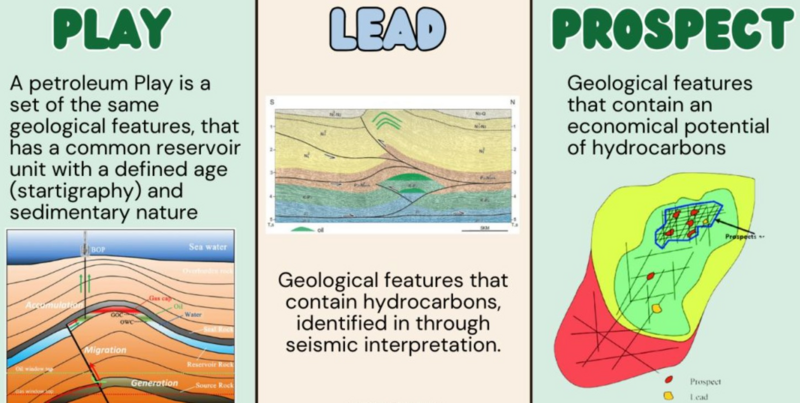
Oil companies will talk of checking out a play. A play is a geological argument used to justify exploration for hydrocarbons. Critical geological ingredients may be present in an area that may encourage the notion that petrolum accumulations might have formed within the subterranean strata. A sedimentary basin may have developed sometime in geological history within the strata of which buried organic material may have matured into oil and gas. The petroleum geologist will have ideas of possible trapping mechanisms which may have caused any generated petroleum to have accumulated in geological traps which would necessarily have to be formed before the petroleum migrated due to its buoyancy.
Geological, geophysical and geochemical are undertaken to identify potential structural trends which may provide potential traps. These are often called leads. When such leads are examined more closely to ascertain that they meet all the criteria for formation of a petroleum accumulation, prospects may emerge which may be worthy of drilling to determine whether there might be a petroleum accumulation worthy of commercial production. Oil companies will drill their best and largest prospects with the hope of finding oil and gas. Alas, all parameters for the formation of an accumulation have to be present and with the correct timing, so often drilling is not successful. Subtleties of geological history and evolution of the geology of the area may preclude the prospect from bearing hydrocarbons. Sometimes perseverance is required as the drilling of several prospects provides more specific geological knowledge of the area, and eventually a discovery is made. There are so many cases where companies have drilled a series of well unsuccessfully, only to have a pleasant surprise eventually with a late discovery.
Appraisal
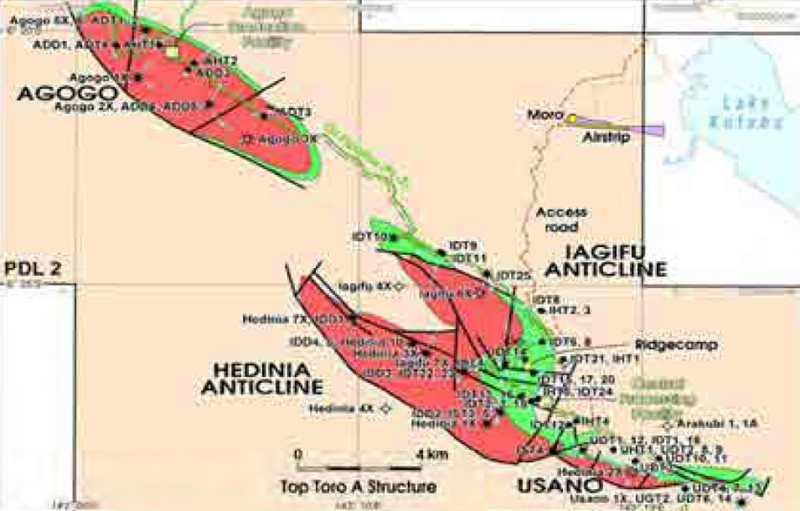
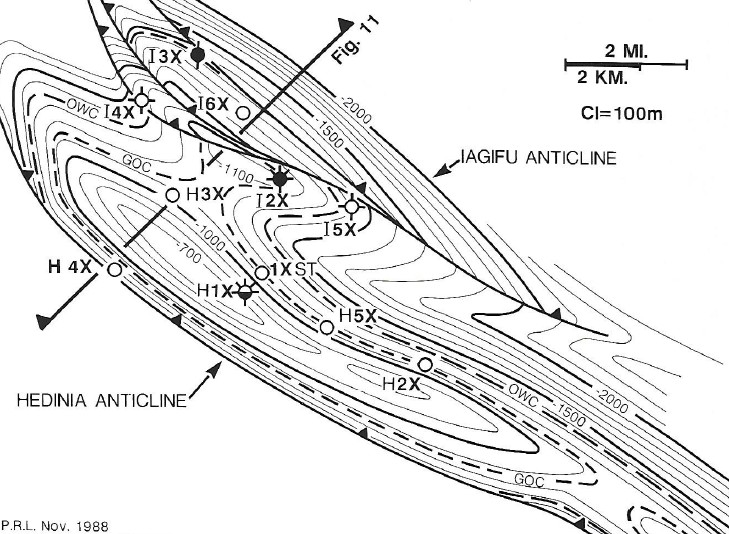
Once a discovery is made, the question everyone asks is, “How big is it?” This is a simple, but daunting question. A typical petroleum prospect in Papua New Guinea might need to be of considerable size to justify and warrant it being drilled in the first place. Take for example, the Iagifu prospect of the Iagifu-Hedinia oil field, in production since 1992 as part of the Kutubu Project. Its pre-drill prospect structure was approximate 6 kms long by 3 kms wide, and ellipsoidal in shape covering an area of about 56.5 square kilometres. Consider that the drill bit that first entered the oil-bearing Toro Sandstone reservoir at 2,430 metres depth in the well was just 12-1/4 inches in diameter, or only 0.076 square metres or 760 square centimetres in area. That bit probed only just over five billionth parts of the prospect, a minute portion of the prospect indeed.
A discovery is nice, but it does not make a field. Sometimes there is not even a defined accumulation, if the discovery cannot be delineated or appraised by further drilling to map out the lateral extent of the accumulation across the geological structure which formed the prospect. There was an extraordinary discovery called Makas 1-X, which was drilled in the 1990s and which allegedly found an oil-bearing sandstone. The well ran into technical difficulties and had to be re-drilled, but when that new well encountered the reservoir sandstone, it was barren of oil. In this instance, appraisal refuted the supposed discovery.
Appraisal seeks to probe the full extent of a newly-discovered petroleum accumulation by the drilling of more wells into the prospect. This is done to gauge whether the accumulation contains enough petroleum to be able to sustain production on a profitable commercial basis. It is an important critical stage of petroleum development. The drilling of further wells on a discovery has to be encouraged and promoted, and if necessary, government regulators need to ensure it takes place.
The operating petroleum company may not wish to spend precious financial resources on appraisal immediately. It may have other competing or urgent investments. The Papua New Guinea legislation does not define the term appraisal of a discovery, but appraisal of a petroleum discovery is included in the rights of petroleum prospecting licensee. However, the government may direct the licensee to do such things as are thought necessary including the completion of wells, the conduct of drill stem or extended production tests for appraisal of a discovered petroleum accumulation.
More specific appraisal requirements are contained either in legislation, licence conditions or production sharing agreements elsewhere. The Papua New Guinea Oil and Gas Act does enable the declaration of what is known as a Location over the specific block within which a discovery is made, and up to eight adjoining blocks (a block is 5 minutes latitude by 5 minutes longitude, or about 81 square kilometres at the latitudes of Papua New Guinea).
The declaration of a Location enables some degree of retention of the licence area by the discoverer, but also importantly triggers the ability of the Government to require various investigations and studies as to assess the feasibility of the construction, establishment and operation of an industry for the recovery of petroleum from the location, particularly technical and economic feasibility studies relating to the recovery and transport of petroleum from the location and processing of the petroleum.
Estimating the Resources
Once a petroleum accumulation has been found and appraised by the drilling of further wells which have shown that the petroleum can flow to the surface, the next big question is the size of the accumulation. Essentially, size of the accumulation it is a matter of size of the reservoir, and that in turn depends on the size of the geological structure that may have formed the trap within which the petroleum got trapped and has been found. Quite simply, the more petroleum bearing rock there is, the more petroleum will be in-place; we call this the bulk rock volume. In simple terms, this is the area of the reservoir times its thickness, though complexities of the geological structure and its shape make this considerably more complicated.
Now, we must remember that in a conventional petroleum reservoir, the petroleum is located in the pores within the rock, a bit like water in a sponge. So, determining the porosity of the reservoir rock is a fundamental factor that has to be measured. A sample of rock can be obtained from the well and physical studies can be made of it to ascertain its porosity as a percentage of the rock, or electronic tools can be lowered into the well to measure physical properties of the rock from which its porosity may be calculated.
Within the subsurface rock strata, water abounds, remnant from the time of deposition. When petroleum accumulates in a porous reservoir rock it, displaces the water, but not perfectly or completely. There is always some water left behind. Accordingly, a portion of the porosity of the rock still contains water depending on local subsurface geological condition. Again, measurements can be made of the reservoir rock in situ by special electronic tools to ascertain what percentage of the pores is filled with water, and what percentage is filled with petroleum. This, we call the water saturation.
When petroleum flows to the surface from a reservoir, it is moving from a location of high pressure and somewhat elevated temperature to standard atmospheric conditions. Oil containing gas will shrink as it rises up the well to ambient conditions as the gas comes out of solution. There is also some shrinkage due to temperature change effects and expansion due to pressure relief. This volume change is called the shrinkage and is expressed as the formation volume factor, the ratio of the volume of petroleum at reservoir conditions to the volume at surface conditions. It typically ranges from 1.0 to 3.0.
In the case of gas, as it flows up the well, it will expand in classic response to the decrease in pressure and temperature from subsurface reservoir conditions to surface conditions. The gas formation volume factor is generally much lower, ranging from 0.001 to 0.01 reservoir volume per surface volume.
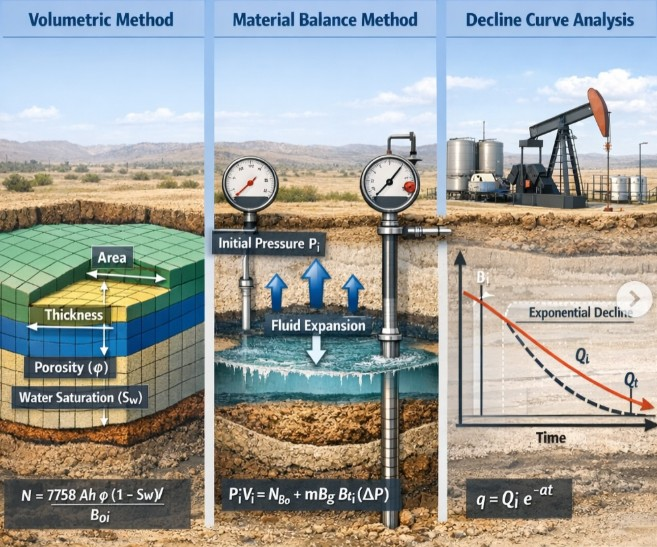
Multiplying these factors together, in broad terms, we get:
Volume of petroleum at surface = bulk rock volume x porosity x (1-water saturation)/formation volume factor
This is what we call a volumetric method, which is adequate in cases where we have some idea of rock and fluid parameters. It is generally used in early stages of appraisal of an accumulation. Other methods are the material balance method in which the tracking of pressure changes is used to estimate remaining reserves, and decline curve analysis, which uses field production data trends to predict future output. Of course, this discussion is quite generalised, and there are many intricacies and additional dependencies.
Petroleum is normally a complex mixture of many different hydrocarbons. Oil most often contains hydrocarbon gases in solution and natural gases contain liquid hydrocarbons in solution.
Also, rarely are reservoirs undisturbed and quite often the very tectonic forces that created the geological structure within which the petroleum has been trapped may cause intricate faulting of that reservoir. This can often spoil the continuity of the reservoir and effectively break it up into many small pieces of reservoir some of which may not have been able to be charged with oil or gas. This often only becomes evident when infill drilling between the discovery and appraisal wells demonstrates such discontinuities. Faults identified in the wells within the reservoir rocks indicate localised tectonic displacement and what is called compartmentalisation. This is the case in the Kutubu oil fields which then required very careful placement of production wells to tap the oil-bearing parts of the reservoir.
Sometimes water enters the petroleum bearing reservoir and flushes the hydrocarbons out of place leaving behind only a residual viscous smear of the original oil charge of the reservoir and the flushing waters. Such was the case in the Toro sandstone reservoir of the large Mananda anticline which showed excellent signs of bearing oil, but the primary charge had been flushed away leaving only a non-recoverable residue.
In some reservoirs, the porosity of the reservoir varies laterally due to changes in the original depositional environment of the sediments, or later mineralogical or chemical changes. The amount of water remaining in the reservoir pores can vary across a field, and hence the degree of fill of that porosity by hydrocarbons.
As one may realise, the assessment of the original oil-in-place or original gas-in-place can become quite tricky. Then, there is one more factor that is absolutely necessary for the oil and /or gas to flow into the well bore; that is permeability.
Permeability is the ability of a porous material (such as rock) to allow fluids (either liquids or gases) or gases to flow through it. Permeability measures how easily fluids flow through the interconnected pores under pressure. High permeability allows easy flow, while low permeability restricts flow. The majority of rocks (more than 93%) have very little permeability and a small amount (2%) have fair to good permeability, the balance are considered to be poorly permeable or tight. From the 2% permeabilities range from 1 to 1000 milliDarcies (mD, the unit of permeability named after Henri Darcy). In the Hides gas field, the reservoir permeabilities of the Toro Sandstone reservoir range from 3 to 2,000 mD with the bulk of readings being between 30 to 150 mD. Such permeability would be said to be good. Both permeability and porosity are related and in the Hides gas field Toro reservoir, permeability broadly scales with porosity which ranges between 2% to 18%.
Recovery Factor
It is good to have an accumulation full of hydrocarbons in a porous and permeable reservoir, but those hydrocarbons still need to be able to get to the surface to be able to be sold. They need to be recovered as oil and gas production. Exactly how much oil and/or gas may be recovered from a reservoir by production is not so easy to estimate. For oil and gas to flow into a wellbore from a reservoir rock and flow to surface requires energy. The flow has to combat gravity and frictional forces to get to the surface. So quite obviously the higher the pressure of the reservoir and the less viscous the petroleum is, the better it will flow. Measurements of reservoir pressure are therefore most important.
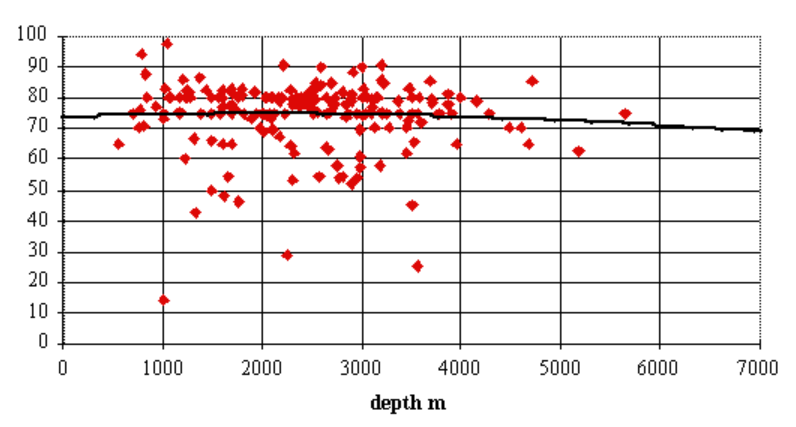
In a gas field, the natural gas will fill its container, the reservoir and pressure within the connected reservoir will equilibrate. As the gas is produced, the reservoir pressure will decrease just like a balloon deflating until such time as there simply is not enough pressure to force the gas out of wellbore. That then is the technical end of production. A crude estimate of the recovery factor of a gas field may be expressed as 1 minus the reservoir pressure at abandonment divided by the initial reservoir pressure. Typical gas fields have high recovery rates of between 50% to 80%.
Of course, gas fills its container and has a very low viscosity; oil is quite different. It is viscous, a liquid and hence moves much more slowly. It does not fill its container as gas does. When a well penetrates an oil-bearing reservoir, the oil has to flow toward the borehole in response to a decrease in pressure caused by the well’s penetration into the reservoir. As the pressure differential between the wellbore and reservoir decreases with time, the oil becomes more and more sluggish. Lighter density oils move easier, but heavier density oils have a hard time. The amount of gas dissolved in the oil very much affects the ability of the oil to flow out of the well because as the pressure is relieved, the gas bubbles out of solution (just like opening a Coca Cola bottle) frothing up the oil and making the oil flow lighter and easier to ascend the well. The amount of gas contained per barrel of oil in solution is known as the gas-oil ratio. In the case of the Kutubu fields, the oil was very gassy from the beginning, and so recovery of the oil was much easier. Indeed, there was so much gas produced with the oil that for many years the gas was reinjected back into the reservoir to help push the oil to surface. In this way, it was also effectively conserved until it too could be produced in the current PNG LNG Project.
Some oil-bearing reservoirs are linked in the subsurface to active aquifers which provide additional energy to help maintain the reservoir pressure for a longer period of time. Petroleum engineers and production geologists quite often devise water injection schemes to aid oil recovery in which massive amounts of water are pumped into the water lying below the oil to help it flow to the production wells. This is called water flooding.
Whilst the extent of gas recovery from a reservoir is more fundamentally connected to the change of reservoir pressure, the extent of oil recovery is not so readily estimated. Elaborate reservoir models may be built describing the reservoir rock, reservoir fluids and their parameters to create simulations of flow through an array of production wells. These simulations can be correlated to actual flow of wells when tested and an overall assessment of likely recovery scenarios made.
Typical oil recovery rates are between 5% to 50% of the original oil-in-place, with an average often cited of around 30% to 35%. Secondary recovery techniques like water flooding and gas injection enhance recovery to between 30 to 40%. Enhanced oil recovery (EOR) techniques may significantly increase recovery by the injection of heat, gases, chemical to reduce viscosity and improve flow, but this comes at a cost.
Ultimate Recovery
As one produces a field, be it an oil field or a gas field, the resources that were estimated to be in place at the beginning of production are steadily depleted. The extent of the recoverable reserves is reduced by every additional amount of production, so the reserves of a field decline. Those reserves that have been recovered and those that may yet be potentially recovered are referred to as the estimated ultimate recoverable reserves of the field. This is the ultimate measure of the total potential commercial output of a field.
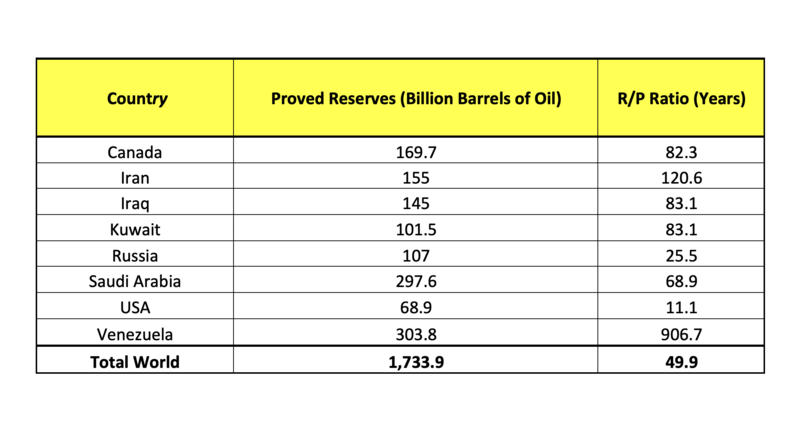
To talk of the reserves of a particular petroleum province and its fields one can only project into the future as those resources that were once reserves and have been produced are no longer such. The estimates of reserves are estimates of the volumes of oil and gas that may be commercially recovered henceforth. A common measure of the utility of such reserves is the reserve-to-production ratio (R/P ratio). This estimates how many years the oil or gas will last at current production rates. It is calculated by dividing remaining proven reserves by the annual production rate. A higher R/P ratio indicates more years of supply remaining.
If one looks at the Statistical Review of Global Energy, the last edition that examines the R/P ratio was in 2020 providing statistics up to the start of Covid. Oddly, after that BP and then the new owners of this great and useful report found it necessary to omit the listings of oil and gas reserves and with that, the comparative R/P ratios, perhaps to mollify the notion that a world in energy transition would still be producing oil and gas for decades to come. Of course, circumstances change as we have seen in the dramatic actions of some nations in the first quarter of 2026. The picture is clear; a select few countries dominate oil production now and in the longer term. Their ability to produce oil into the foreseeable will depend on their access to markets, which if denied may render their reserves to be purely technical.
A similar story can be told for natural gas reserves. It is with respect to natural gas that Papua New Guinea earned a row in the statistics of the Statistical Review of Global Energy, having an assessed 0.2 trillion cubic metres of gas as proven reserves and an R/P ratio of 14.2 years.
Papua New Guinea has been producing oil and gas since 1991 when the Kutubu Project produced its initial oil as feedstock for the Project refinery and the Hides Project produced its initial gas as feedstock for the Porgera mine power plant. In 1992, full scale oil production began at Kutubu and in 2014 large scale gas production at Hides for the PNG LNG Project commenced.
Papua New Guinea’s discovered oil and gas fields are listed below together with their estimated ultimate recoverable resources and reserves, which includes production to date and remaining resources and reserves.
|
Field Name(s) |
Year of Discovery |
Current Licence |
Current Operator |
Estimated Ultimate Recoverable Oil Resources and Reserves |
Estimated Ultimate Recoverable Gas Resources and Reserves |
|
|
|
|
|
Million barrels 2C & 2P (incl. condensates & LPGs) |
Billion cubic feet 2C & 2P |
|
Barikewa |
1958 |
PRL 49 |
Kumul Petroleum |
|
439 |
|
Bwata |
1960 |
PRL 39 |
ExxonMobil |
|
68 |
|
Cobra & Iehi |
1960 |
PRL 14 |
Santos |
|
72 |
|
Uramu |
1968 |
PRL 60 |
Kumul Petroleum |
|
92 |
|
Pasca |
1968 |
PPL 328 |
Twinza |
90 |
464 |
|
Juha |
1983 |
PDL 9 |
ExxonMobil |
29 |
578 |
|
Kutubu |
1986 |
PDL 2 |
Santos |
337 |
1733 |
|
Hides |
1987 |
PDL 1 |
ExxonMobil |
159 |
6938 |
|
Pandora |
1988 |
PRL 38 |
Kumul Petroleum |
|
644 |
|
Agogo |
1989 |
PDL 2 |
Santos |
59 |
541 |
|
Angore |
1990 |
PDL 8 |
ExxonMobil |
13 |
1079 |
|
Elevala & Ketu |
1990 |
PRL 21 |
TWL Energy |
40 |
640 |
|
P'nyang |
1990 |
PRL 3 |
ExxonMobil |
78 |
4600 |
|
SE Gobe |
1991 |
PDL 3 |
Santos |
46 |
156 |
|
Gobe Main |
1993 |
PDL 4 |
Santos |
31 |
159 |
|
Paua |
1995 |
PPL 378 |
Giri Energy |
17 |
|
|
Moran |
1996 |
PDL 2&5 |
Santos |
20 |
344 |
|
Stanley |
1999 |
PDL 10 |
TWL Energy |
12 |
399 |
|
Kimu |
1999 |
PRL 48 |
Kumul Petroleum |
|
525 |
|
Triceratops |
2005 |
PRL 39 |
ExxonMobil |
2 |
30 |
|
Douglas |
2006 |
PRL 40 |
TWL Energy |
30 |
500 |
|
Pukpuk |
2006 |
PRL 40 |
TWL Energy |
0 |
365 |
|
Elk-Antelope |
2006 |
PRL 15 |
TotalEnergies |
64 |
6200 |
|
FlInders & Hagana |
2006 |
PRL 41 |
Santos |
|
1100 |
|
Ubuntu |
2011 |
PRL 28 |
TWL Energy |
4 |
100 |
|
Muruk |
2016 |
PPL 402 |
Santos |
|
845 |
|
|
Summations |
1031 |
28611 |
||
|
The summations are pseudo-summations only, not statistical aggregations and should be used as a guide only |
|||||
Figure 13: A list of oil and gas field discoveries in Papua New Guinea and their estimated ultimate recoverable resources and reserves (2C and 2P respectively) after David Manau, Secretary, Department of Petroleum and Energy (now Managing Director, National Petroleum Authority) modified and amended by the author from public information.
The extent of the future discovery of Papua New Guinea’s petroleum resources will depend entirely on investment in exploration and the necessary drilling of valid prospects. In turn, the extent of reserves will depend on investment in development where production of those reserves may be assessed to be commercial. Without such further investment, we can only produce those resources and reserves that are remaining until they are depleted to the extent that we can, given considerable infrastructure limitations. Only successful exploration including the vital drilling of exploration wells will allow the above table to be augmented with Papua New Guinea’s yet to be found petroleum resources and reserves.


