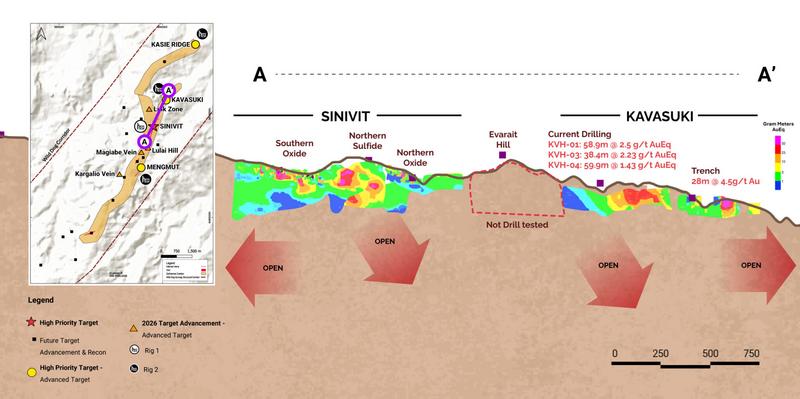
Great Pacific Gold has reported encouraging initial drill results from the Kavasuki target within its flagship Wild Dog project in Papua New Guinea, highlighting the potential scale of mineralisation along the Sinivit–Kavasuki corridor.
The company said its first drill hole at Kavasuki intersected 58.9 metres grading 2.50 grams per tonne gold equivalent (AuEq) from a depth of 38.6 metres. This included a higher-grade interval of 4.6 metres at 8.56 g/t AuEq.
A separate interval of 18.1 metres at 2.14 g/t AuEq was also recorded deeper in the same hole, confirming continuity of mineralisation.
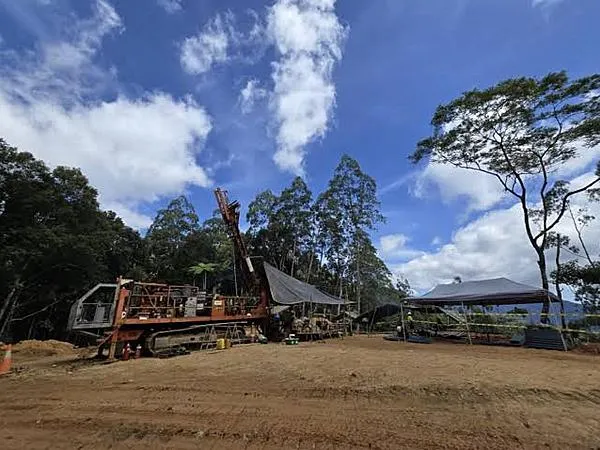
The results come from drill hole KVH-01, part of an ongoing exploration programme targeting epithermal gold-copper mineralisation along a 15-kilometre structural corridor on New Britain island in East New Britain province.
The mineralisation is described as near-surface and hosted within hydrothermal quartz breccia, with sulphide content, indicating a well-developed mineralised system.
Great Pacific Gold said the results improve its understanding of vein geometry and structural controls at Kavasuki, which will guide follow-up drilling aimed at identifying higher-grade zones within a broader chargeability anomaly.
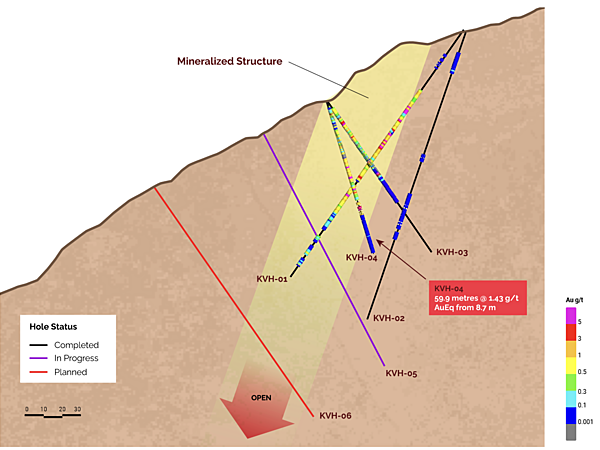
“Results from KVH-04 continue to demonstrate the scale and continuity of the Kavasuki system,” said Callum Spink, Vice President Exploration.
“The intersection of nearly 60 metres from near-surface, with consistent internal higher-grade zones, supports our interpretation of a broad, well-developed epithermal system characterised by multiple phases of veining and mineralization,” Spink added.
More importantly, Spink said that KVH-04 confirms continuity down-dip from KVH-03 and highlights the presence of multiple mineralized zones within a wider envelope. The system is interpreted to be structurally complex, with multiple fault sets influencing the distribution of veining and grade.
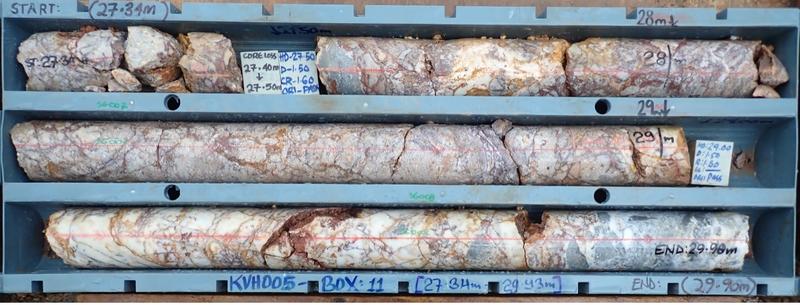
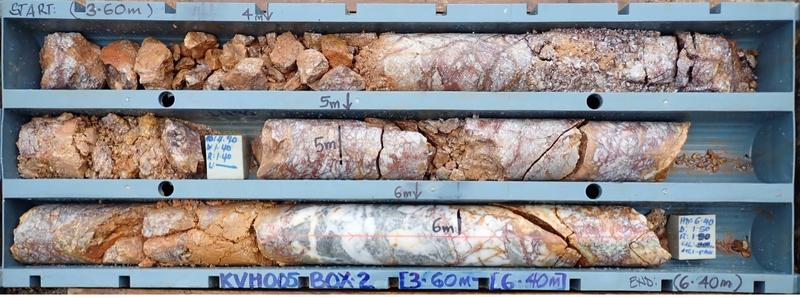
“As is typical of epithermal systems, this results in variability in mineralization within a broader envelope, with higher-grade zones developing in structurally favourable positions. Ongoing drilling, particularly KVH-05 and KVH-06, is critical to refining our understanding of this structural framework and improving targeting of higher-grade shoots at depth and along strike,” he said.
The company has completed a second drill hole (KVH-02) and is advancing a third (KVH-03) as part of its 2026 drilling campaign.
The Kavasuki prospect lies one kilometre north of the Sinivit deposit, another key target within the Wild Dog project, where previous drilling has returned high-grade intercepts.
The broader 2026 programme is designed to test continuity of mineralisation along strike and at depth across the Sinivit–Kavasuki corridor, a priority exploration area for the company.
Great Pacific Gold, listed on the TSX Venture Exchange, is focused on advancing a portfolio of exploration-stage gold and copper assets in Papua New Guinea, including the Wild Dog, Kesar and Arau projects.
The Wild Dog project is considered the company’s flagship asset and hosts both epithermal and porphyry-style mineralisation targets, with ongoing drilling aimed at defining a potentially district-scale resource.
The Wild Dog Project hosts a 15-kilometre-long structurally controlled mineral corridor containing multiple epithermal gold targets and porphyry copper-gold potential identified through recent MobileMT geophysical surveys. The corridor contains the Sinivit-Kavasuki vein system and multiple advanced targets including Kasie Ridge, which are now being systematically drill-tested as part of the Company’s 2026 exploration program