Papua New Guinea is seeking technical assistance from the United Nations Industrial Development Organisation (UNIDO) to modernise its national quality infrastructure, strengthen small businesses and improve the competitiveness of locally produced goods in international markets.
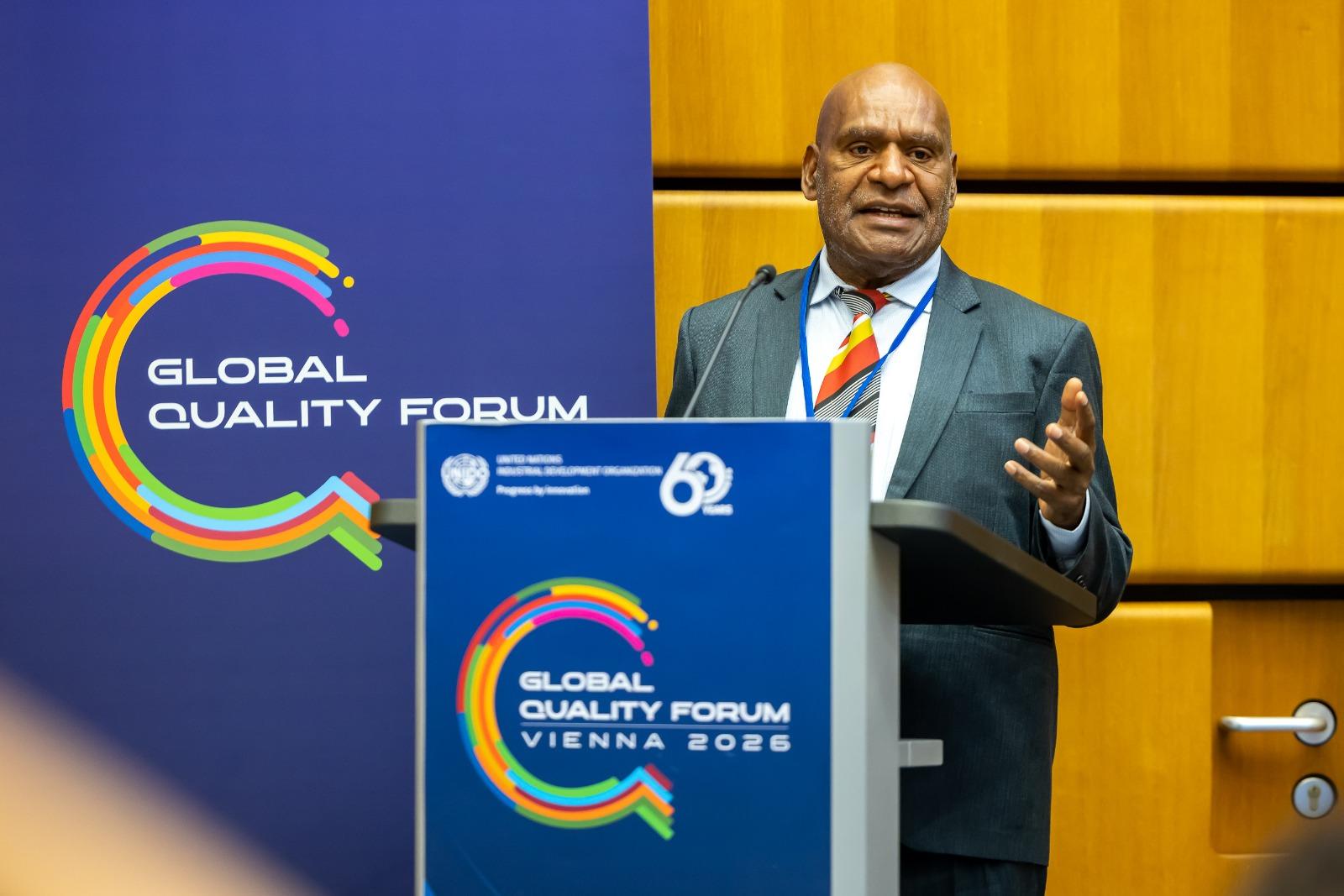
Commerce and Industry Minister Wake Goi led the country's delegation to the UNIDO Global Quality Forum 2026 in Vienna, Austria, from November 4 to 6, where he presented priority areas for technical cooperation, institutional development and long-term economic partnerships.
Accompanied by National Institute of Standards and Industrial Technology (NISIT) Director General and Chief Executive Officer Joe Panga, Goi held discussions with UNIDO leadership on strengthening the country's standards, testing, measurement, accreditation and certification systems.
A key outcome of the engagement was the proposed completion of Papua New Guinea's National Quality Policy, which the government intends to progress towards formal endorsement and launch in the first quarter of 2027.
The policy is expected to establish a coordinated national framework covering standards, metrology, accreditation, conformity assessment and quality assurance institutions.
The delegation also proposed a 10-year National Quality Infrastructure Modernisation Programme, with UNIDO providing technical cooperation to upgrade NISIT's institutional, laboratory, regulatory and human resource capabilities.
The proposed programme aims to develop a sustainable quality system aligned with international requirements, enabling domestic industries to improve production standards and compete more effectively in regional and global markets.
The Ministry of Commerce and Industry said a stronger national quality infrastructure would be essential to supporting the government's economic development objectives, including expanding exports, increasing domestic revenue and accelerating industrialisation.
Under the Medium Term Development Plan IV (2023–2027), the government aims to grow the economy to K200 billion by 2030 and create an additional one million jobs.
The ministry said achieving these targets would require stronger national institutions, internationally recognised standards and reliable testing and certification mechanisms, alongside investment in infrastructure and production.
A functional quality infrastructure would also help reduce technical barriers to trade, strengthen consumer protection, improve productivity and enable locally manufactured products to meet international market requirements.
MSME and blue economy development
Goi also sought expanded cooperation through UNIDO's micro, small and medium enterprise (MSME) development programmes, recognising the role of smaller businesses in entrepreneurship, employment generation and local economic participation.
The proposed assistance would help businesses gain access to technical expertise, quality management systems, product testing, certification and market information.
These capabilities are expected to improve product quality, increase productivity and help local enterprises meet domestic, regional and international market requirements.
The delegation also identified opportunities for UNIDO to support Papua New Guinea's blue economy, particularly its fisheries and related industries.
With its extensive marine resources, the country sees potential to expand fisheries processing, value addition, investment and employment through improved technical capabilities and compliance with international food safety and quality standards.
The proposed cooperation would cover fisheries product testing, processing, certification and compliance with export market requirements.
The government aims to move beyond exporting unprocessed natural resources by strengthening domestic processing and developing industries that generate greater economic value within the country.
Another proposal involved exploring the engagement of a Papua New Guinean technical expert within UNIDO to strengthen coordination between the international organisation, the government and NISIT, while improving access to technical expertise and development programmes.
PNG eyes regional quality infrastructure hub
The delegation also proposed developing NISIT into a Regional Quality Infrastructure Hub for the Pacific, positioning Papua New Guinea as a centre for technical expertise, laboratory services, training and institutional cooperation.
The proposed hub could provide shared technical facilities and specialised services to neighbouring Pacific island countries that may lack the financial resources or market size to establish and maintain comprehensive national quality infrastructure systems.
The initiative would also allow NISIT to expand its technical services and strengthen its international standing.
However, the proposal would require further technical assessment, institutional development and consultations with UNIDO and interested Pacific island countries.
Beyond its discussions with UNIDO, the delegation met with the International Organisation of Legal Metrology (OIML) to explore Papua New Guinea's pathway towards full membership.
Membership would strengthen the country's participation in international cooperation on legal metrology, including the development and application of internationally recognised recommendations governing measurements, measuring instruments and their regulation.
The engagement is particularly relevant to commercial transactions, industrial measurements, consumer protection and the regulation of measuring instruments.
The delegation also met with the president of Global Accreditation Cooperation Incorporated (Global ACI), who expressed support for Papua New Guinea and NISIT in advancing accreditation and strengthening the country's national quality infrastructure.
Accreditation provides assurance that testing, inspection and certification services meet internationally recognised requirements and are technically competent, helping build confidence among investors and trading partners.
Linking quality systems to economic growth
The Ministry of Commerce and Industry said the engagements in Vienna reinforced the importance of quality infrastructure in supporting Papua New Guinea's broader economic transformation agenda.
Stronger standards and certification systems would help local businesses formalise and expand operations, improve product quality and participate in global value chains.
They would also support the government's objective of maximising economic returns from natural resources through downstream processing and domestic value addition.
For consumers, improved quality systems would provide greater confidence in the safety and reliability of goods and services, while investors would have greater assurance that the country was strengthening the institutional and technical foundations of its business environment.
Goi reaffirmed that his ministry would work with NISIT, UNIDO and other international development partners to translate the outcomes of the forum into practical national initiatives.
He said strengthening domestic institutional capabilities and technical systems was necessary for Papua New Guinea to participate successfully in an increasingly competitive global economy.
The immediate priorities include advancing the National Quality Policy, establishing a structured modernisation programme for NISIT and mobilising technical and development partnerships.
The ministry will also pursue further discussions with UNIDO and other international institutions on the proposed regional hub, MSME development and blue economy cooperation.