Prime Minister James Marape has challenged communities in Eastern Highlands to translate the government's multibillion-kina investment in the Highlands Highway into increased coffee production, businesses, jobs and household incomes.
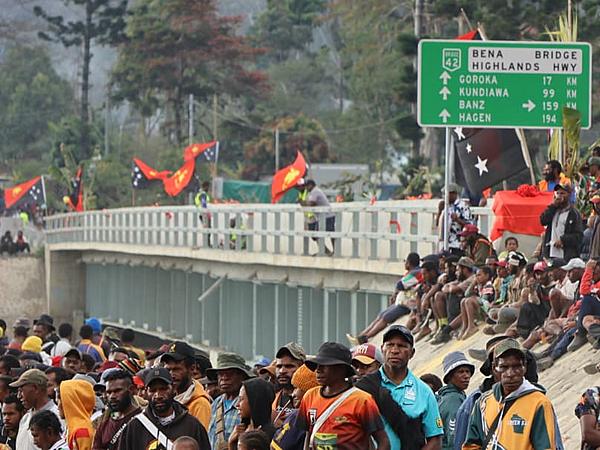
Marape made the call at Bena, where he commissioned the new K20.2 million Bena Bridge and launched the Goroka Four-Lane Road Project toward Korofeigu.
He said improved roads and bridges should generate greater economic activity and help communities take advantage of better access to markets.
“This is the economic lifeline that keeps our economy growing,” Marape said. “The money we are putting into this road is not a misplaced allocation. It is the correct allocation in terms of our strategy to grow the economy.”
Marape urged communities along the highway to increase coffee and agricultural production, saying improved transport infrastructure would make it easier to market their products.
“I want you to deliver coffee bags to repay the money we are investing in building infrastructure,” he said.
He also encouraged unemployed Papua New Guineans to pursue agriculture and small and medium enterprises (SMEs) rather than wait for formal employment or government assistance.
“If you are unemployed, I point you back to SME and agriculture as an SME option,” Marape said.
He called on provincial and district leaders to use government funding to help communities become economically productive.
“Teach a man how to fish; don’t just give him fish,” he said. “Let us lead our people into self-employment activities so that this road can contribute to improving their lives and, collectively, the economy of our country.”
Highlands Highway upgrade
The K20.2 million Bena Bridge is a new 100-meter, two-lane permanent bridge replacing the former single-lane Bailey bridge.
The bridge was constructed by China Wu Yi Company Limited and funded by the Asian Development Bank (ADB) under the Sustainable Highlands Highway Investment Program.
Under Tranche 2 of the program, rehabilitation and modernization work covers 71 bridges along the Highlands Highway corridor — 35 between Nadzab and Henganofi, 19 between Henganofi and Mangiro, and 17 between Mangiro and Kagamuga.
Marape thanked the ADB, Department of Works and Highways, Department of Treasury, Department of National Planning and Monitoring, China Wu Yi, the Eastern Highlands Provincial Government, district authorities, local-level governments, development partners and communities involved in the program.
“Building modern infrastructure is part of building a modern country,” he said.
He also welcomed the construction of roadside market and sanitation facilities, urging communities to use them to capture economic opportunities created by the upgraded highway.
The Goroka Four-Lane Road Project toward Korofeigu is expected to increase road capacity as population, traffic and economic activity grow, while improving the movement of coffee, fresh produce and commercial freight.
With Papua New Guinea approaching its 51st Independence Anniversary, Marape said the country's development would require a stronger culture of work and personal responsibility.
“The drive we took over the last two days is just a symbol of ‘can do’. We can do it,” he said.
Marape also urged communities to protect new infrastructure and ensure public investment translates into increased economic activity.
“When you improve, the country improves. Together, we all grow,” he said.